
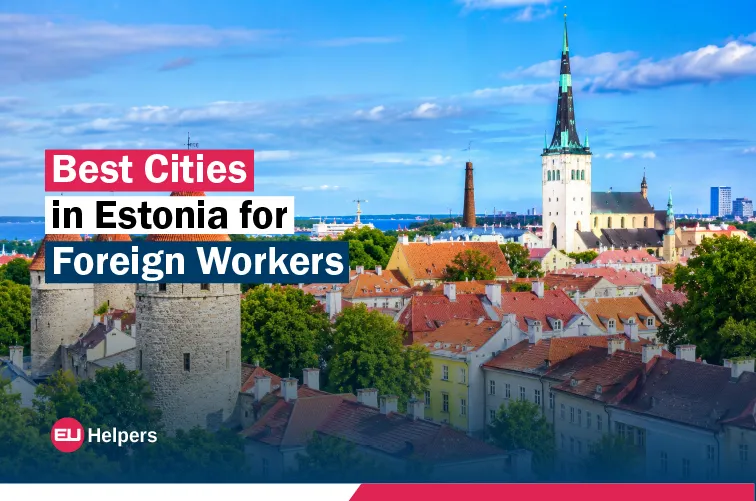

Best Cities in Estonia for Foreign Workers
Estonia (Eesti — Republic of Estonia) has around 1.37 million people, and that small scale shapes every decision about where to work. Be clear from the start: Tallinn dominates. The capital region holds roughly a third of the population and the large majority of international employers, tech companies, English-speaking roles and expat infrastructure. Tartu is a genuine second option for research, healthcare and software; Pärnu and Kuressaare lead seasonal and spa hospitality; Narva, Jõhvi and Kohtla-Järve in Ida-Viru County anchor energy and heavy industry; and smaller towns such as Viljandi and Rakvere carry pockets of manufacturing, food processing and culture. This EU Helpers guide compares the best Estonian cities for foreign workers across sector mix, salary, cost of living and quality of life — international candidates can explore Estonian opportunities through EU Helpers. Estonia joined NATO and the EU in 2004, the Schengen Area in December 2007, and the eurozone on 1 January 2011, so salaries and rents everywhere are in euros.
Essential Context: How Estonian Cities Compare
Estonia's eight most relevant locations for foreign workers break down roughly as follows.
| City | Population (approx.) | Lead sectors | Cost of living |
|---|---|---|---|
| Tallinn | ~455,000 (~600,000 in Harju County) | IT, startups, fintech, logistics, shared services | Highest in Estonia |
| Tartu | ~97,000 | University, research, healthcare, software | Moderate to high |
| Narva | ~53,000 | Energy, rare-earth magnets, manufacturing | Low |
| Pärnu | ~52,000 | Spa and summer hospitality, wood, electronics | Moderate (summer spike) |
| Kohtla-Järve & Jõhvi | ~32,000 and ~11,000 | Oil shale, chemicals, healthcare, public services | Lowest in Estonia |
| Viljandi | ~17,000 | Culture, education, light manufacturing | Low |
| Rakvere | ~15,000 | Meat and food processing, manufacturing, retail | Low |
| Kuressaare | ~13,000 | Boatbuilding, spa and island tourism, dairy | Low to moderate (summer spike) |
National context matters for every city. The statutory minimum wage is €946 gross per month, and the national average gross salary typically sits around €2,000–2,200 per month. Tallinn typically runs 15–25% above that national average, while Ida-Viru County sits clearly below it. Always compare offers on a gross-to-net basis.
Tallinn — The Capital and Digital Hub
Tallinn is where most skilled foreign workers end up, and for most international profiles it is the only city with real depth of choice.
Lead sectors: IT and software (Bolt, Wise, Pipedrive, Veriff, Ericsson Eesti, a dense startup scene around Ülemiste City and Telliskivi), fintech and banking (Swedbank, SEB, LHV), shared service and nearshore centres, e-government technology, cybersecurity, logistics around the Port of Tallinn and Muuga Harbour, construction, and hospitality tied to business and Helsinki-ferry tourism.
Salary context: Tallinn typically pays 15–25% above the national average, placing typical gross salaries around €2,300–2,700 per month. Senior software engineers commonly earn €4,000–6,500+ gross monthly, mid-level developers and data analysts €2,800–4,200, and English-speaking customer support and operations roles €1,500–2,200. Construction and logistics trades typically earn €1,600–2,600.
Cost of living: Highest in Estonia. Central one-bedroom rents typically run €650–1,000 per month, with Kesklinn, Kalamaja and Kadriorg at the upper end and Mustamäe, Lasnamäe and Õismäe cheaper. Groceries for one person typically €250–350 per month.
Who it fits: Software engineers, product and data professionals, fintech and compliance specialists, startup founders and early employees, English-speaking customer support staff, port and logistics specialists, and anyone wanting the largest international community.
Permit route: Temporary residence permit for employment (tähtajaline elamisluba töötamiseks) issued by the Police and Border Guard Board (Politsei- ja Piirivalveamet, PPA), or short-term employment registration with a D-visa for stays under a year. Tallinn is also the natural base for startup visa holders and digital nomad visa holders.
Tartu — University and Research City
Tartu is Estonia's second city and intellectual centre, about two to two-and-a-half hours from Tallinn by train or road.
Lead sectors: Higher education and research (University of Tartu, Estonian University of Life Sciences), healthcare (Tartu University Hospital, one of Estonia's largest employers), software and gaming (Playtech, a Pipedrive office and a steady stream of university spin-offs), biotech and health tech, brewing and food (A. Le Coq), and a growing cultural economy.
Salary context: Typically close to or slightly above the national average. Researchers and postdocs typically earn €2,000–3,200 gross monthly depending on grant and level; experienced software developers €3,000–5,000; doctors and specialist nurses earn on national healthcare collective-agreement scales, with doctors substantially above the average.
Cost of living: Moderate to high for its size because of student demand. Central one-bedroom rents typically €450–700 per month; competition peaks in August and September at the start of the academic year.
Who it fits: Academics, PhD candidates and researchers, doctors and nurses, software engineers who prefer a smaller and calmer city, and families who prefer a calmer city.
Pärnu — Estonia's Summer Capital
Pärnu sits on the southwest coast and is Estonia's best-known resort town, busy from late May to August and much quieter in winter.
Lead sectors: Spa and wellness hospitality (large spa hotels along the beach and a long health-resort tradition), summer restaurants, events and festivals, wood processing and timber products, electronics contract manufacturing (including Scanfil), construction materials, and the Port of Pärnu.
Salary context: Typically somewhat below the national average outside manufacturing. Hospitality staff commonly earn €1,000–1,600 gross monthly, with chefs and spa therapists €1,400–2,200 in season; manufacturing operators typically €1,200–1,800 and skilled technicians €1,700–2,500.
Cost of living: Moderate. Off-season one-bedroom rents typically €400–650 per month, but summer short-term rents rise sharply. Some seasonal employers help with staff housing.
Who it fits: Spa therapists, chefs and hotel staff, event and festival workers, manufacturing operators and technicians, and workers who prefer a coastal town with a slower pace while staying within two hours of Tallinn.
Narva — Border City and Industrial Base
Narva is Estonia's third-largest city, on the Narva River directly facing Russia, and its labour market is overwhelmingly Russian-speaking.
Lead sectors: Energy (Eesti Energia's Narva power plants and the Auvere plant, historically fuelled by oil shale), rare-earth permanent magnet manufacturing (Neo Performance Materials' magnet plant, one of the largest outside Asia), metal and electrical manufacturing, logistics, and higher education through the University of Tartu Narva College.
Salary context: Below the national average for general roles, but industrial specialists can earn well. Process operators and electricians typically earn €1,300–2,000 gross monthly; engineers and technical specialists in energy and magnet production €2,200–3,800.
Cost of living: Low. One-bedroom rents typically €250–400 per month, among the cheapest of any Estonian city of this size.
Who it fits: Materials, chemical and process engineers, electricians and maintenance technicians, Russian speakers, and candidates with energy or heavy-industry backgrounds. Russian is far more useful than English in daily life, and restricted border crossings shape the local economy.
Jõhvi and Kohtla-Järve — Ida-Viru's Oil Shale Heartland
Jõhvi (the Ida-Viru county seat) and neighbouring Kohtla-Järve form a connected urban area in northeast Estonia, about two hours east of Tallinn.
Lead sectors: Oil shale mining and shale oil processing (Viru Keemia Grupp in Kohtla-Järve, Enefit operations nearby), chemicals, healthcare (Ida-Viru Central Hospital), public administration and education (including TalTech Virumaa College in Kohtla-Järve), and new manufacturing projects supported by the EU Just Transition Fund as the region shifts away from oil shale.
Salary context: Ida-Viru County has Estonia's lowest average wages. Production operators typically earn €1,100–1,700 gross monthly; skilled chemical and maintenance technicians €1,600–2,400; engineers and plant specialists €2,200–3,500.
Cost of living: The lowest in Estonia. One-bedroom rents typically €200–350 per month.
Who it fits: Chemical and process engineers, mining and energy technicians, healthcare professionals, Russian speakers, and candidates prioritising very low living costs. The energy transition brings both new projects and job cuts, so check employer stability.
Viljandi — Culture and Small-Town Living
Viljandi is a small town in south-central Estonia, known for its lakeside setting, castle ruins and the Viljandi Folk Music Festival.
Lead sectors: Culture and creative industries (University of Tartu Viljandi Culture Academy), education, healthcare, wood and furniture manufacturing, light engineering, and summer events tourism.
Salary context: Below the national average. Factory and wood-processing operators typically earn €1,100–1,600 gross monthly; skilled trades €1,500–2,200; teachers and healthcare staff on national scales.
Cost of living: Low. One-bedroom rents typically €300–450 per month.
Who it fits: Musicians, artists and cultural workers, teachers, furniture and wood specialists, remote workers on a digital nomad visa, and anyone wanting a quiet, community-focused life in Estonian-speaking surroundings.
Rakvere — Northern Food and Manufacturing Town
Rakvere sits in Lääne-Viru County, about an hour and a quarter east of Tallinn, between the capital and Ida-Viru.
Lead sectors: Meat and food processing (Rakvere Lihakombinaat is one of Estonia's best-known meat processors), agriculture and grain, light manufacturing, construction, retail and regional services, and the Rakvere Hospital.
Salary context: Below the national average for general roles. Food-processing operators typically earn €1,100–1,600 gross monthly; butchers, maintenance technicians and skilled trades €1,400–2,200.
Cost of living: Low. One-bedroom rents typically €300–450 per month.
Who it fits: Food-processing and meat-industry workers, agricultural specialists, maintenance technicians, and candidates who want low costs while staying within reach of Tallinn.
Kuressaare — Saaremaa Island Hub
Kuressaare is the only town on Saaremaa, Estonia's largest island, reached by ferry from the mainland or by short flight from Tallinn.
Lead sectors: Boatbuilding and composites (the Saaremaa shipbuilding cluster, including Baltic Workboats at nearby Nasva), spa hotels and summer island tourism, dairy and food production, fishing, and local public services.
Salary context: Below the national average outside boatbuilding. Composite laminators, welders and marine electricians typically earn €1,400–2,300 gross monthly; hospitality staff €1,000–1,600 in season.
Cost of living: Low to moderate. One-bedroom rents typically €350–550 per month, with a summer spike and a limited rental supply.
Who it fits: Boatbuilders, welders, composite and marine technicians, spa and hotel staff for summer seasons, and people who genuinely want island life with long, dark winters.
Choosing the Right City for Your Profile
A quick match guide:
- IT, software, data, fintech → Tallinn (Tartu is the only real alternative).
- Startups and founders → Tallinn first, Tartu second.
- Academic research and PhDs → Tartu first, Tallinn second.
- Doctors and nurses → Tartu and Tallinn, with regional hospitals in Jõhvi/Kohtla-Järve and Rakvere often short-staffed.
- Energy, chemicals and process engineering → Narva, Kohtla-Järve and Jõhvi.
- Rare-earth and advanced manufacturing → Narva.
- Port, logistics, maritime → Tallinn (Muuga and Old City Harbour), Pärnu second.
- Spa and summer hospitality → Pärnu and Kuressaare.
- Boatbuilding and composites → Kuressaare and Saaremaa.
- Food processing → Rakvere and Tartu.
- Lowest cost of living with a job → Kohtla-Järve, Jõhvi, Narva.
Permit Route Across Estonian Cities
The permit framework is national, not city-specific. Non-EU workers staying long term typically need a temporary residence permit for employment issued by the Police and Border Guard Board (PPA). Most employment permits require a salary of at least Estonia's average gross monthly salary as published by Statistics Estonia, and many cases also need permission from the Estonian Unemployment Insurance Fund (Töötukassa), although top specialists, researchers and several other categories are exempt. Shorter assignments typically use short-term employment registration with the PPA, combined with a long-stay D-visa. The EU Blue Card, the startup visa (for founders and employees of startups approved by the Startup Estonia committee) and the digital nomad visa (for people working remotely for a foreign employer or their own foreign company) apply equally across the country. After arrival you receive an Estonian personal identification code (isikukood) and register your address with the local municipality. Typical timeline from signed offer to arrival is 8–12 weeks.
Quality of Life Beyond Work
Each city has a distinct lifestyle: Tallinn for the medieval Old Town, international community and two-hour ferries to Helsinki; Tartu for student atmosphere and riverside parks; Pärnu for beaches and spas; Narva for a low-cost Russian-speaking border city; Jõhvi and Kohtla-Järve for practical, affordable living; Viljandi for festivals and lakes; Rakvere for small-town life near Tallinn; and Kuressaare for island nature. Almost every city is within about three hours of Tallinn, and Estonia's digital public services mean most paperwork happens online. Winters are long and dark everywhere, which is worth weighing honestly before you move.
Final Guidance
The best city in Estonia for a foreign worker depends on your sector, but in practice Tallinn dominates: it concentrates most tech, fintech, startup, logistics and English-speaking jobs, pays typically 15–25% above the national average of roughly €2,000–2,200 gross per month, and has the highest costs. Tartu is the strongest alternative for research, healthcare and software; Pärnu and Kuressaare suit spa, hospitality and boatbuilding profiles; Narva, Jõhvi and Kohtla-Järve offer energy, chemicals and advanced manufacturing roles at Estonia's lowest living costs, with Russian as the everyday language; and Viljandi and Rakvere offer quiet, affordable small-town life with narrower job markets. Across all cities the national framework applies uniformly — a PPA temporary residence permit for employment, Töötukassa permission where required, short-term employment registration with a D-visa, the startup visa and the digital nomad visa — with typical timelines from signed offer to arrival of 8–12 weeks. Combined with EU and NATO membership since 2004, Schengen since 2007, the euro since 2011, a €946 gross minimum wage and one of Europe's most advanced digital states, Estonia gives skilled foreign workers a compact, well-organised destination. International candidates can explore Estonian opportunities through EU Helpers. EU Helpers supports foreign workers with Estonia city-sector matching, offer-letter review, residence permit coordination, Tallinn / Tartu / Pärnu / Narva relocation planning, and clarity on the current official requirements from Estonian immigration authorities.
FAQs
For most skilled foreign workers Tallinn is the clear default, because it holds the majority of tech, fintech, startup and English-speaking jobs at Estonia's highest salaries; Tartu is the main alternative for research, healthcare and software, while energy and industrial specialists may do better in Narva or Ida-Viru. EU Helpers matches your profile to the right city.
Tallinn pays the highest salaries overall, typically 15–25% above the national average gross salary of around €2,000–2,200 per month, with senior software engineers commonly earning €4,000–6,500+ gross monthly; Tartu follows, and specialist engineers in Narva's energy and magnet plants can also earn well above local averages.
Kohtla-Järve, Jõhvi and Narva in Ida-Viru County have the lowest cost of living, with one-bedroom rents typically €200–400 per month, while Viljandi and Rakvere are also inexpensive, though local salaries are correspondingly lower.
English works well in Tallinn's tech sector and parts of Tartu, but outside those hubs Estonian is usually expected in services and public-sector roles, and in Narva, Jõhvi and Kohtla-Järve Russian is the everyday working language for most industrial jobs.
Yes, especially for researchers, PhD candidates, doctors, nurses and software engineers, since Tartu offers the University of Tartu, Tartu University Hospital and a solid software scene, with lower rents than Tallinn and a calmer, student-driven lifestyle about two hours from the capital.
Narva, Kohtla-Järve and Jõhvi lead for energy, chemicals and heavy industry, with oil shale processing, power generation and the Narva rare-earth magnet plant, where process engineers and technical specialists typically earn €2,200–3,800 gross monthly.
Tallinn offers the most year-round hospitality work, while Pärnu and Kuressaare lead for spa hotels and summer-season roles, typically from late May to August, with chefs and spa therapists in strongest demand.
The same national rules apply everywhere: non-EU workers typically need a temporary residence permit for employment from the Police and Border Guard Board (PPA), often with Töötukassa permission, or short-term employment registration with a D-visa, while the startup visa and digital nomad visa cover founders and remote workers.
Tallinn has by far the strongest expat community, with international tech employers, English-speaking meetups, co-working spaces and international schools; Tartu has a smaller but active international community built around the university, while other cities have only small foreign populations.
EU Helpers matches foreign workers to the right Estonian city by sector, language and lifestyle, pre-vets roles with Estonian employers, reviews offers for gross-to-net clarity, coordinates PPA residence permit and Töötukassa steps, and supports relocation planning in Tallinn, Tartu, Pärnu, Narva and beyond.
Still have questions? Get in touch
Ready to work in Estonia?
EU Helpers guides non-EU workers through Estonia’s work authorization. From PBGB coordination to Short-Term Employment, EU Blue Card and Startup Visa routes, we make your Estonia move seamless with distinctive Baltic EU and e-Residency positioning.