
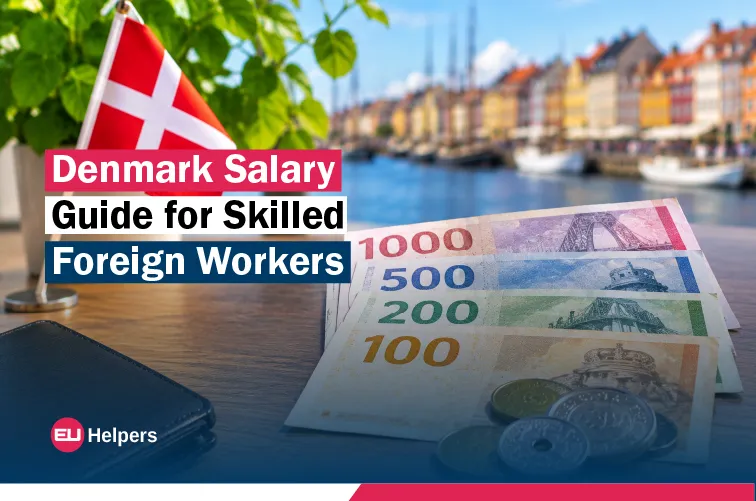

Denmark Salary Guide for Skilled Foreign Workers
Denmark (Danmark — Kingdom of Denmark) offers skilled foreign workers one of the highest-paying labour markets in Europe, built on strong collective agreements, generous employer pension contributions and a famously flexible yet secure working culture. Demand is steady across IT, life sciences, green energy, healthcare, construction and shipping, with Copenhagen and Aarhus leading on pay. This EU Helpers guide walks through realistic gross monthly salary ranges by sector, with context on Danish taxes, take-home pay, benefits and the Danish krone — international candidates can explore Danish opportunities through EU Helpers. Denmark has been an EU member since 1973, a Schengen member since 2001 (fully applied from March 2001), is NOT in the eurozone (it keeps the Danish krone, DKK, under a euro opt-out and pegs it closely to the euro through ERM II), and has been a founding NATO member since 1949 and a Council of Europe member since 1949.
Essential Context: Denmark's Salary Landscape
Denmark combines high gross salaries with high personal taxes, a model that funds free healthcare, education and strong social protection.
| Consideration | Denmark Reality |
|---|---|
| Currency | Danish krone (DKK) — NOT eurozone; pegged to the euro at roughly 7.46 DKK per €1 |
| Minimum wage | No statutory minimum wage — pay floors are set by sector collective agreements (overenskomster), typically around 125–140 DKK/hour |
| Average gross salary | Approximately 50,000–55,000 DKK/month for full-time employees (~€6,700–€7,400) |
| Copenhagen premium | Typically 5–15% above the national average, higher in IT, finance and pharma |
| Personal income tax | 8% labour market contribution (AM-bidrag) plus municipal tax (~25%) and state tax of 12.01% / 19.51% / 27.01% / 32.01% by bracket |
| Social security | Mostly tax-funded; employee pays the 8% AM-bidrag and a small fixed ATP amount; employer costs are modest by EU standards |
| EU/EEA status | EU member since 1973; Schengen since 2001; euro opt-out |
Employer costs in Denmark are low compared with Southern Europe, but labour-market pension contributions under collective agreements (often 10–15%+ of salary combined) add meaningful long-term value on top of the cash figure.
Denmark Salary Ranges by Sector
The following gross monthly ranges reflect typical compensation for skilled foreign workers in Denmark, usually quoted before pension contributions. Exact salaries depend on the applicable collective agreement, employer size, seniority, Danish-language skills and location, and most Danish offers are discussed as monthly gross pay.
| Sector / Role | Entry (DKK) | Mid-level (DKK) | Senior (DKK) |
|---|---|---|---|
| Software Developer | 40,000–48,000 | 50,000–62,000 | 65,000–85,000+ |
| Data / Cloud Engineer | 42,000–50,000 | 55,000–68,000 | 70,000–90,000 |
| Pharma / Life-Science Scientist | 42,000–50,000 | 55,000–68,000 | 70,000–90,000 |
| Civil / Mechanical Engineer | 42,000–48,000 | 52,000–62,000 | 65,000–80,000 |
| Wind Turbine Service Technician | 32,000–38,000 | 39,000–45,000 | 46,000–55,000 |
| Physician (hospital) | 45,000–52,000 | 60,000–75,000 | 80,000–100,000+ |
| Registered Nurse (sygeplejerske) | 34,000–37,000 | 38,000–42,000 | 43,000–50,000 |
| Social & Healthcare Assistant (SOSU) | 28,000–31,000 | 31,000–34,000 | 34,000–37,000 |
| Electrician / Plumber | 33,000–38,000 | 38,000–44,000 | 45,000–52,000 |
| Carpenter / Bricklayer | 32,000–37,000 | 37,000–43,000 | 44,000–50,000 |
| Chef | 28,000–32,000 | 33,000–38,000 | 40,000–50,000 |
| Hotel / Restaurant Staff | 25,000–28,000 | 28,000–32,000 | 32,000–36,000 |
| Truck Driver (C/CE) | 30,000–34,000 | 34,000–38,000 | 38,000–43,000 |
| Accountant / Finance Analyst | 38,000–45,000 | 48,000–58,000 | 60,000–80,000 |
| Shipping / Logistics Coordinator | 36,000–42,000 | 45,000–55,000 | 58,000–75,000 |
At the fixed peg of roughly 7.46 DKK to €1, dividing by 7.5 gives a quick euro estimate (45,000 DKK ≈ €6,000). Denmark does not use 13th or 14th month salaries; instead, salaried staff receive paid holiday plus a holiday supplement (ferietillæg) of about 1%, and many employers pay pension on top of the quoted salary. Always check whether an offer is quoted including or excluding pension, because the difference can be 10% or more.
IT & Technology Salaries
Copenhagen is the centre of Danish tech, with Aarhus as a strong second hub. Large employers such as Microsoft Development Center Copenhagen, Netcompany, Systematic, Trustpilot, Pleo, Unity and the digital arms of banks and pharma companies hire international developers in English. Mid-level software engineers typically earn 50,000–62,000 DKK gross per month, while senior engineers, architects and tech leads commonly reach 65,000–85,000 DKK and above. Cloud, data engineering, cybersecurity and machine-learning skills attract the strongest premium. Many IT roles include employer pension, health insurance, flexible hours and a culture of leaving the office on time.
Life Sciences & Pharmaceutical Salaries
Denmark's life-science cluster is one of the largest in Europe relative to its size. Novo Nordisk, Novonesis, Lundbeck, Genmab, LEO Pharma and Coloplast employ thousands of scientists, engineers, quality specialists and production technicians, mostly in the Greater Copenhagen area and around Kalundborg. Research scientists and process engineers typically earn 55,000–68,000 DKK at mid-level, with senior scientists, validation leads and managers reaching 70,000–90,000 DKK or more. Production and laboratory technicians earn closer to 35,000–45,000 DKK. GMP experience, PhD qualifications and regulatory affairs expertise are the most valuable credentials.
Green Energy & Wind Salaries
Denmark is a global leader in wind power. Vestas, Ørsted and Siemens Gamesa (with major sites in Brande and Aalborg) recruit engineers, project managers and service technicians internationally. Wind turbine service technicians typically earn 39,000–45,000 DKK gross at mid-level, with offshore rotation roles adding allowances that can lift total pay well above 50,000 DKK. Electrical, structural and grid engineers earn similar packages to other engineering roles, around 52,000–75,000 DKK. GWO safety certificates and high-voltage authorisations add value.
Healthcare & Caregiving Salaries
Healthcare in Denmark is largely public and run by the five regions and the municipalities, with pay set by collective agreements. Registered nurses typically earn 34,000–42,000 DKK gross monthly plus pension, with specialist and night-shift supplements increasing the total. Social and healthcare assistants (social- og sundhedsassistent) in elderly care earn approximately 28,000–37,000 DKK. Hospital physicians earn substantially more, typically 60,000–100,000+ DKK depending on specialisation and on-call duty. Foreign nurses and doctors must obtain authorisation from the Danish Patient Safety Authority (Styrelsen for Patientsikkerhed) and usually need strong Danish-language skills before practising.
Construction & Skilled Trades Salaries
Infrastructure projects such as the Fehmarnbelt tunnel, Copenhagen metro extensions and large housing developments keep demand high for skilled trades. Electricians, plumbers, carpenters, bricklayers and welders working under collective agreements typically earn 33,000–52,000 DKK gross per month, and piecework (akkord) arrangements on building sites can push earnings higher. Site managers and construction engineers earn approximately 50,000–75,000 DKK. Foreign workers should insist on pay that matches the relevant collective agreement, which trade unions actively enforce.
Shipping & Logistics Salaries
Denmark is a maritime nation, home to A.P. Moller-Maersk, DSV, DFDS, Torm and Norden. Shipping operators, chartering specialists, logistics coordinators and supply-chain analysts typically earn 45,000–55,000 DKK at mid-level, with senior chartering and operations managers reaching 60,000–75,000 DKK or more. Truck drivers in road freight earn around 30,000–43,000 DKK depending on routes, night work and overtime.
Tax, Social Security & Take-Home Pay
Danish income tax is high but transparent. First, the 8% labour market contribution (AM-bidrag) is deducted from gross pay. Income tax is then calculated after a personal allowance (personfradrag) of roughly 54,000 DKK per year, combining municipal tax (kommuneskat, approximately 22–27%, averaging about 25%), state bottom tax (bundskat) of 12.01%, a middle tax (mellemskat) of 7.5% on higher income, a top tax (topskat) of a further 7.5%, and a top-top tax of 5% on very high income. Church tax (around 1%) applies only to members of the Church of Denmark. An employment deduction (beskæftigelsesfradrag) further reduces the tax bill. For a skilled foreign worker earning 50,000 DKK gross per month, net take-home is typically around 31,000–33,000 DKK before any employee pension contribution. Highly paid foreign hires and researchers can apply for the researcher and expat tax scheme (forskerskatteordningen), which typically taxes salary at approximately 32.8% in total (27% plus AM-bidrag) for up to seven years, provided monthly pay stays above a threshold of roughly 65,000 DKK.
Cost of Living Context
Copenhagen is one of Europe's more expensive cities. A one-bedroom apartment in central Copenhagen typically rents for 12,000–17,000 DKK per month, while Aarhus rents are generally 9,000–12,000 DKK and Odense or Aalborg 7,000–10,000 DKK. A monthly grocery budget for one person sits around 2,500–3,500 DKK. A monthly public transport pass in Copenhagen costs roughly 400–900 DKK depending on zones, and many people simply cycle. A meal at a mid-range restaurant usually costs 250–400 DKK per person. A skilled foreign worker on 30,000+ DKK net can live comfortably in Copenhagen, and noticeably more comfortably in Aarhus, Odense or Aalborg.
Benefits Beyond Base Salary
Total compensation in Denmark goes well beyond the monthly salary figure:
- Labour-market pension: employer contributions of typically 8–12% plus around 4% from the employee under collective agreements.
- Paid holiday: five weeks of paid holiday plus a holiday supplement of about 1%, with many agreements adding extra days off.
- Health insurance: private health insurance is common in IT, pharma, finance and engineering roles.
- Canteen and lunch schemes: subsidised workplace lunches are standard in offices and many production sites.
- Parental leave: generous statutory leave, with many employers topping up pay during leave.
- Relocation support: help with housing search, CPR registration and family relocation for recruited international hires.
Final Guidance
Denmark's salary landscape rewards skilled foreign workers with high gross pay, strong collective agreements and valuable pension contributions, balanced by high taxes and a high cost of living, especially in Copenhagen. Realistic gross monthly ranges run from around 25,000 DKK in hospitality through 35,000–50,000 DKK in skilled trades and nursing to 65,000–90,000+ DKK for senior IT, pharma and engineering specialists. Understanding AM-bidrag, municipal tax, the expat tax scheme and what is included on top of salary is key to comparing offers. Combined with EU membership since 1973, Schengen access, a stable krone and an excellent work-life balance, Denmark is a rewarding Nordic destination. International candidates can explore Danish opportunities through EU Helpers. EU Helpers supports skilled foreign workers with Danish salary benchmarking, offer-letter review and coordination with SIRI on residence and work permits.
FAQs
Skilled foreign workers in Denmark typically earn between 35,000 and 75,000 DKK gross per month (approximately €4,700 to €10,000), depending on sector and seniority. The national average for full-time employees sits at approximately 50,000–55,000 DKK. IT, pharma, engineering and finance roles sit at the top end, while hospitality, elderly care and transport pay less. Most offers also include employer pension contributions on top of the quoted salary, which adds significant value.
Denmark has no statutory minimum wage. Instead, minimum pay is set through collective agreements (overenskomster) negotiated between unions and employer organisations, typically around 125–140 DKK per hour in sectors such as hospitality, cleaning and retail. For work permits, the Danish Agency for International Recruitment and Integration (SIRI) requires salary and employment conditions to match usual Danish standards. EU Helpers helps check whether an offer meets the relevant collective agreement level.
The highest-paying sectors for skilled foreign workers are pharmaceuticals and life sciences (Novo Nordisk, Lundbeck, Genmab), information technology, engineering, green energy, finance and shipping. Senior specialists, physicians and managers in these fields commonly earn 65,000–100,000+ DKK gross per month. Skilled trades and nursing also pay well by European standards because pay is anchored in strong collective agreements.
Copenhagen typically pays 5–15% more than comparable roles elsewhere, with the biggest premium in IT, finance, consulting and pharma headquarters. Because collective agreements apply nationwide, the gap for nurses, trades and care workers is much smaller. Aarhus, Odense and Aalborg offer slightly lower salaries but considerably lower rents, so net purchasing power can be similar or better outside the capital.
Employees pay an 8% labour market contribution (AM-bidrag) first, then income tax made up of municipal tax (approximately 25% on average), state bottom tax of 12.01%, and middle, top and top-top taxes on higher income. A personal allowance and an employment deduction reduce the bill. On a 50,000 DKK gross monthly salary, net pay is typically around 31,000–33,000 DKK. Highly paid foreign hires may qualify for the expat tax scheme at approximately 32.8% in total.
Accommodation is rarely included in Danish salaries, except in some agricultural, seasonal hospitality or offshore roles. Instead, benefits focus on labour-market pension (often 10–15% combined), five or more weeks of paid holiday, subsidised canteen lunches, health insurance and parental leave top-ups. Many international employers offer relocation packages with temporary housing and help finding an apartment, which is valuable given tight rental markets.
A single skilled worker in Copenhagen typically needs around 20,000–25,000 DKK net per month for a comfortable lifestyle. Central one-bedroom rents run 12,000–17,000 DKK, groceries 2,500–3,500 DKK and transport 400–900 DKK, while dining out costs 250–400 DKK per person. In Aarhus, Odense or Aalborg, rent is 25–45% lower, so the same net salary goes considerably further.
Danish salaries are paid in Danish krone (DKK), as Denmark has a euro opt-out and is not in the eurozone. The krone is pegged closely to the euro at roughly 7.46 DKK per €1, so exchange-rate risk for euro comparisons is low. Salaries are paid monthly into a NemKonto bank account, usually on the last working day of the month.
Check the relevant collective agreement and sector benchmarks first, and confirm whether the offer is quoted including or excluding pension. Danish negotiations are typically calm and fact-based, so present your experience, certifications and market data rather than aggressive demands. Ask about pension percentage, extra holiday days, the expat tax scheme and relocation support. EU Helpers reviews offer letters against sector benchmarks before you sign.
EU Helpers supports skilled foreign workers with Danish salary benchmarking against collective agreements and sector ranges, offer-letter review for pension, holiday and tax-scheme clarity, and employer coordination with the Danish Agency for International Recruitment and Integration (Styrelsen for International Rekruttering og Integration — SIRI) for residence and work permits (opholds- og arbejdstilladelse) under the Pay Limit Scheme (Beløbsordningen), Fast-track scheme (Fast-track-ordningen) or Positive List (Positivlisten). We also guide CPR number (CPR-nummer) registration, tax card (skattekort) setup with the Danish Tax Agency (Skattestyrelsen), MitID and NemKonto, document translation by state-authorised translators (statsautoriseret translatør) and apostille, and Copenhagen, Aarhus or Odense relocation.
Still have questions? Get in touch
Ready to work in Denmark?
EU Helpers guides non-EU workers through Denmark’s work authorization. From SIRI and Danish Agency for International Recruitment coordination to Pay Limit Scheme, Positive List and Fast-Track routes, we make your Denmark move seamless with distinctive Nordic EU member positioning.