
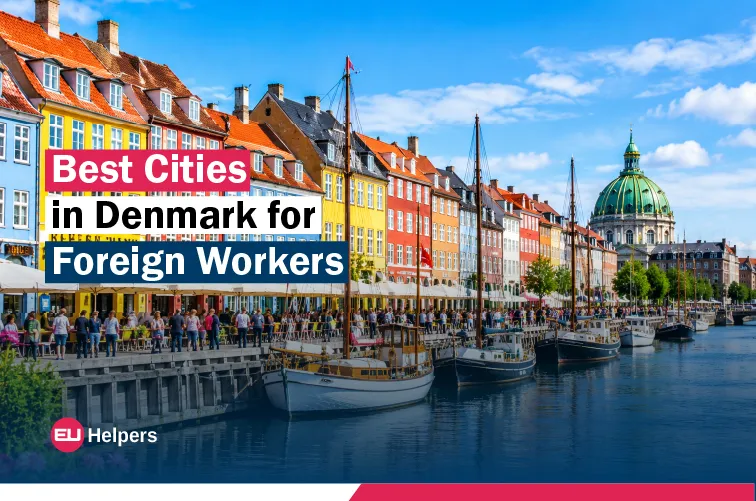

Best Cities in Denmark for Foreign Workers
Denmark (Danmark — Kingdom of Denmark) has only about six million people, yet where you settle decides which employers you can reach and how much of your salary goes on rent. Copenhagen dominates for life sciences, shipping, finance, IT and green-energy headquarters; Aarhus anchors wind energy, food and a fast-growing tech scene; Odense has built one of Europe's best-known robotics clusters; Aalborg combines engineering, wireless technology and heavy industry; Esbjerg is the country's offshore energy capital; and the Jutland towns of Billund, Vejle, Kolding and Herning offer LEGO, logistics, fashion and wind jobs at noticeably lower living costs. This EU Helpers guide compares the best Danish cities for foreign workers across sector mix, salary, cost of living and quality of life — international candidates can explore Danish opportunities through EU Helpers. Denmark has been an EU member since 1973, a founding NATO member since 1949, a full Schengen participant since 2001 and a founding Council of Europe member since 1949; it is NOT a eurozone member and uses the Danish krone (DKK), which is pegged closely to the euro at approximately 7.46 DKK to €1.
Essential Context: How Danish Cities Compare
Denmark's eight most relevant city areas for foreign workers break down roughly as follows.
| City | Population (approx.) | Lead sectors | Cost of living |
|---|---|---|---|
| Copenhagen | ~1.4 million (urban area) | Life sciences, shipping, finance, IT, green energy | Highest in Denmark |
| Aarhus | ~300,000 (urban area) | Wind energy, food, IT, port, research | High |
| Odense | ~185,000 | Robotics, automation, healthcare, research | Moderate |
| Aalborg | ~120,000 | Engineering, wireless tech, cement, wind blades | Moderate |
| Esbjerg | ~70,000 | Offshore wind, oil & gas, port, maritime | Moderate to low |
| Billund & Vejle | ~6,000 / ~60,000 | LEGO, aviation, tourism, logistics | Moderate to low |
| Kolding & Triangle Region | ~63,000 (Kolding) | Logistics, distribution, design, manufacturing | Moderate to low |
| Herning (with Ikast–Brande) | ~50,000 | Fashion and textiles, wind, exhibitions | Low |
Denmark has no statutory minimum wage: pay is set through collective agreements (overenskomster) and individual contracts, and the national average gross salary is typically around 50,000–55,000 DKK/month (approximately €6,700–7,400). Copenhagen usually pays 5–15% above that, while rents in Jutland and on Funen can be 30–50% lower, which often gives provincial cities the better purchasing power.
Copenhagen — The Capital
Copenhagen (København) is Denmark's economic engine and the default choice for most skilled foreign workers.
Lead sectors: Life sciences and pharmaceuticals (Novo Nordisk, Novonesis, Lundbeck, Coloplast), shipping and logistics (A.P. Moller-Maersk, DSV), green energy (Ørsted), finance (Danske Bank, Nordea Denmark), consumer brands (Carlsberg, Pandora), IT and software, plus universities and research at the University of Copenhagen and DTU in Lyngby.
Salary context: Copenhagen typically pays 5–15% above the national average. Senior software engineers and life-science specialists commonly reach 60,000–85,000+ DKK gross monthly (approximately €8,000–11,400); mid-level professionals earn 45,000–60,000 DKK; graduate and junior roles usually start around 35,000–42,000 DKK.
Cost of living: Highest in Denmark. Central one-bedroom rents typically run 11,000–16,000 DKK/month (approximately €1,500–2,150), with Vesterbro, Nørrebro, Frederiksberg and Østerbro at the top of the range. Deposits of up to three months' rent are common. Groceries for one person run around 3,000–4,000 DKK/month.
Who it fits: Pharma and biotech scientists, software and data professionals, shipping and finance specialists, green-energy engineers, and anyone who wants the largest English-speaking expat community in Denmark.
Permit route: Most non-EU hires come through the Pay Limit Scheme (Beløbsordningen), the Fast-track scheme for SIRI-certified employers, or the EU Blue Card, with CPR registration at International House Copenhagen after arrival.
Aarhus — Jutland's Business Capital
Aarhus is Denmark's second-largest city and the commercial heart of Jutland, about three hours from Copenhagen by train.
Lead sectors: Wind energy (Vestas headquarters), food and dairy (Arla Foods), retail (Salling Group, with JYSK nearby), defence and aerospace electronics (Terma), IT and software (Systematic and a growing start-up scene), the Port of Aarhus (Denmark's largest container port), and research at Aarhus University and Aarhus University Hospital.
Salary context: Typically 0–10% below Copenhagen for comparable roles. Wind-energy engineers and senior IT professionals commonly earn 50,000–75,000 DKK gross monthly; mid-level professionals 42,000–55,000 DKK; logistics and port roles 32,000–42,000 DKK.
Cost of living: High but noticeably lower than Copenhagen. Central one-bedroom rents usually 8,500–12,500 DKK/month; neighbourhoods like Frederiksbjerg, Trøjborg and the newer Aarhus Ø harbourfront are popular with internationals.
Who it fits: Wind and energy engineers, food scientists, software developers, researchers, and professionals who want a big-city feel with shorter commutes and easier access to nature and beaches.
Odense — Europe's Robotics City
Odense, Denmark's third-largest city, sits on the island of Funen roughly midway between Copenhagen and Jutland, with fast rail links in both directions.
Lead sectors: Robotics and automation (Universal Robots, Mobile Industrial Robots and well over 100 companies in the Odense Robotics cluster), drones and test facilities, healthcare at Odense University Hospital (OUH), research at the University of Southern Denmark (SDU), plus heavy industry and offshore manufacturing at the Lindø port and industrial park.
Salary context: Robotics and automation engineers typically earn 45,000–70,000 DKK gross monthly; hospital doctors and specialist nurses follow national collective agreements; skilled trades and technicians 32,000–45,000 DKK.
Cost of living: Moderate. Central one-bedroom rents typically 7,000–10,000 DKK/month, roughly 35–45% below central Copenhagen.
Who it fits: Robotics, mechatronics and automation engineers, software developers working on control systems, healthcare professionals, researchers, and families looking for a compact, affordable university city.
Aalborg — Northern Jutland's Engineering Hub
Aalborg is the regional capital of North Jutland, set on the Limfjord and known for its engineering-focused university.
Lead sectors: Engineering and wireless technology (a long-standing telecoms and IoT cluster linked to Aalborg University), cement (Aalborg Portland), wind-turbine blade manufacturing (Siemens Gamesa), industrial and process equipment, healthcare at Aalborg University Hospital, and the Port of Aalborg.
Salary context: Engineers and IT specialists typically earn 45,000–65,000 DKK gross monthly; production technicians and skilled trades 32,000–45,000 DKK; graduate engineers often start around 38,000–43,000 DKK.
Cost of living: Moderate. Central one-bedroom rents usually 6,500–9,500 DKK/month.
Who it fits: Electronics, telecoms and software engineers, manufacturing and process specialists, researchers and PhD candidates, and anyone who values low housing costs with a full university-city lifestyle.
Esbjerg — Denmark's Offshore Energy Capital
Esbjerg, on Jutland's west coast, is built around a leading European offshore wind port and the Danish North Sea oil and gas sector.
Lead sectors: Offshore wind installation, operations and maintenance (Ørsted, Vestas and Siemens Gamesa service teams), oil and gas (TotalEnergies' Danish North Sea operations and service suppliers), maritime and port logistics, energy engineering contractors (such as Semco Maritime), and offshore training providers.
Salary context: Offshore wind technicians typically earn 40,000–55,000 DKK gross monthly, with rotation allowances and offshore supplements adding significantly; offshore engineers and project managers commonly reach 55,000–80,000 DKK. Onshore port and logistics roles 32,000–42,000 DKK.
Cost of living: Moderate to low. Central one-bedroom rents typically 6,000–8,500 DKK/month.
Who it fits: Wind turbine technicians with GWO certification, offshore engineers, HSE officers, marine and port specialists, and candidates with oil and gas experience transitioning into renewables.
Billund & Vejle — LEGO Country
Billund is a small town with an outsized international employer base, and nearby Vejle is the attractive fjord city where many Billund employees choose to live.
Lead sectors: Toys and consumer goods (the LEGO Group headquarters and global functions), aviation at Billund Airport (Denmark's second-busiest airport), tourism and theme parks (LEGOLAND Billund, LEGO House, Lalandia), plus logistics, manufacturing and services in Vejle.
Salary context: LEGO Group professional roles in IT, marketing, supply chain and engineering typically pay 45,000–70,000+ DKK gross monthly, broadly in line with Copenhagen for comparable seniority. Airport and tourism roles typically 28,000–38,000 DKK, with seasonal peaks in summer.
Cost of living: Moderate to low. Rents in Vejle typically 6,500–9,500 DKK/month for a central one-bedroom; Many Billund staff commute 25–35 minutes from Vejle or Kolding.
Who it fits: Digital, product, marketing and supply-chain professionals targeting LEGO, aviation and ground-handling staff, hospitality and theme-park workers, and families who want small-town living with a global employer.
Kolding & the Triangle Region — Logistics Crossroads
Kolding sits in the Triangle Region (Trekantområdet) alongside Fredericia and Vejle, where Jutland's main north–south and east–west motorways meet.
Lead sectors: Logistics and distribution centres, transport and freight forwarding, the Port of Fredericia and energy infrastructure, manufacturing and wholesale, plus design and higher education (Design School Kolding and SDU's Kolding campus).
Salary context: Logistics coordinators and supply-chain planners typically earn 38,000–50,000 DKK gross monthly; warehouse and forklift staff 28,000–36,000 DKK under collective agreements; engineers and managers 50,000–65,000 DKK.
Cost of living: Moderate to low. Central one-bedroom rents usually 6,000–9,000 DKK/month.
Who it fits: Supply-chain and logistics professionals, truck drivers with EU licences, warehouse supervisors, designers, and candidates who want central access to all of Jutland and Funen.
Herning — Fashion, Wind and Exhibitions
Herning, a former textile town in central Jutland, anchors a fashion, wind and events cluster with Ikast and Brande.
Lead sectors: Fashion and retail (BESTSELLER headquarters in Brande and many smaller fashion brands), wind energy (Siemens Gamesa sites in Brande and Ikast), MCH Messecenter Herning (Denmark's largest exhibition and concert venue), manufacturing and agriculture.
Salary context: Fashion buyers, designers and e-commerce professionals typically earn 38,000–55,000 DKK gross monthly; wind engineers 50,000–70,000 DKK; production workers 28,000–36,000 DKK.
Cost of living: Low. Central rents typically 5,500–8,000 DKK/month, among the lowest of any Danish city with a sizeable job market.
Who it fits: Fashion, merchandising and e-commerce specialists, wind-energy engineers, event and hospitality staff, and candidates prioritising low living costs.
Choosing the Right City for Your Profile
A quick match guide:
- Pharma, biotech, life sciences → Copenhagen first (Kalundborg and Aarhus as alternatives).
- IT, software, data, fintech → Copenhagen first, Aarhus second, Aalborg and Odense growing.
- Wind and green energy → Aarhus, Esbjerg, Copenhagen, Herning–Brande, Aalborg.
- Robotics and automation → Odense (very few alternatives at the same depth).
- Offshore oil, gas and maritime → Esbjerg first, Copenhagen for shipping headquarters.
- Logistics and distribution → Kolding and the Triangle Region, Aarhus port.
- Consumer goods and toys → Billund (LEGO), Copenhagen (Carlsberg, Pandora).
- Fashion and retail → Herning–Brande, Copenhagen.
- Research and academia → Copenhagen, Aarhus, Odense, Aalborg.
- Lowest cost of living with a job → Herning, Esbjerg, Aalborg, Kolding.
Permit Route Across Danish Cities
The work-permit framework is national, not city-specific. Every Danish city uses the same schemes administered by the Danish Agency for International Recruitment and Integration (SIRI — Styrelsen for International Rekruttering og Integration): the Pay Limit Scheme (Beløbsordningen) for jobs above an annually indexed salary threshold, the Supplementary Pay Limit Scheme, the Positive List (Positivlisten) for occupations in short supply, the Fast-track scheme for SIRI-certified employers, and the EU Blue Card. EU/EEA and Swiss citizens need no work permit but register for an EU residence document (EU-opholdsbevis). After arrival, everyone obtains a CPR number (personal identification number) through International House or the International Citizen Service (ICS) in Copenhagen, Aarhus, Odense or Aalborg, or the local Borgerservice, then MitID, a NemKonto account and a tax card from Skattestyrelsen. SIRI processing typically takes around one month, often faster under Fast-track.
Quality of Life Beyond Work
Each city has a distinct lifestyle: Copenhagen for cycling culture, harbour baths, design and the largest international community; Aarhus for a young, cultural city with beaches and forests on the doorstep; Odense for compact, family-friendly living with Hans Christian Andersen heritage; Aalborg for a lively student scene on the Limfjord; Esbjerg for North Sea coastline and the Wadden Sea National Park; Billund and Vejle for fjord landscapes and family attractions; Kolding for a central, walkable town with good design culture; and Herning for affordable living and major concerts and trade fairs. A typical 37-hour week and five to six weeks of paid holiday apply almost everywhere, and every city is within about four hours of Copenhagen by train or car.
Final Guidance
The best city in Denmark for a foreign worker depends far more on your sector and lifestyle than on any single ranking. Copenhagen leads for life sciences, shipping, finance and IT at the highest salaries and rents; Aarhus offers a strong second hub for wind energy, food and tech; Odense is the natural home for robotics and automation; Aalborg combines engineering and wireless technology with affordable living; Esbjerg anchors offshore wind and the North Sea energy sector; Billund, Vejle, Kolding and Herning offer LEGO, logistics, fashion and wind careers at noticeably lower costs. Across all eight areas the same national framework applies through SIRI — the Pay Limit Scheme, Positive List, Fast-track scheme and EU Blue Card — followed by CPR registration through International House or the International Citizen Service. With EU membership since 1973, Schengen since 2001 and a euro-pegged krone, Denmark offers a high-trust, high-wage destination with real city-level choice. International candidates can explore Danish opportunities through EU Helpers. EU Helpers supports foreign workers with Denmark city-sector matching, offer-letter review, SIRI permit coordination, Copenhagen / Aarhus / Odense / Aalborg / Esbjerg relocation planning, and clarity on the latest official requirements from Danish immigration authorities.
FAQs
For most skilled foreign workers Copenhagen is the default choice, as it concentrates life sciences, shipping, finance, IT, green-energy headquarters and the largest expat community, but robotics engineers often do better in Odense, offshore specialists in Esbjerg and wind engineers in Aarhus — EU Helpers matches your profile to the right city.
Copenhagen typically pays 5–15% above the national average of around 50,000–55,000 DKK gross monthly, while specialist employers such as Vestas in Aarhus, the LEGO Group in Billund and offshore energy firms in Esbjerg can match Copenhagen rates for comparable roles.
Herning, Esbjerg, Aalborg and Kolding have the lowest costs among cities with real job markets, with central one-bedroom rents commonly 5,500–9,500 DKK/month, often less than half of central Copenhagen.
Many internationals live in Frederiksberg, Vesterbro, Nørrebro, Østerbro or Amager, while those seeking lower rents commute by S-train or regional train from Roskilde, Køge, Hillerød or even Malmö in Sweden across the Øresund Bridge, typically in 25–45 minutes.
Aarhus (Vestas headquarters), Esbjerg (offshore wind port and service hub), Copenhagen (Ørsted headquarters and energy consultancies), Herning–Brande (Siemens Gamesa) and Aalborg (blade manufacturing) all offer strong green-energy careers depending on whether you work in engineering, manufacturing or offshore service.
Yes, Aarhus offers big-city amenities, a strong international university and major employers like Vestas, Arla and Terma, with rents typically 20–30% lower than Copenhagen and salaries usually within 10% of capital-city levels.
Odense leads for robotics and automation through its cluster of more than 100 companies including Universal Robots, while Aalborg is strong in wireless and electronics engineering and Copenhagen hosts large engineering consultancies and the DTU research environment.
The same national schemes apply everywhere: non-EU workers typically use the Pay Limit Scheme, Positive List, Fast-track scheme or EU Blue Card through SIRI, then register for a CPR number at International House, the International Citizen Service or the local Borgerservice after arrival, and EU Helpers can coordinate each step.
Copenhagen has by far the largest international community, with English-speaking workplaces, international schools and active expat networks, while Aarhus, Odense and Aalborg have growing communities centred on their universities, International Citizen Service offices and multinational employers.
EU Helpers matches you to the right Danish city based on sector, profile and lifestyle, pre-vets roles with Danish employers, reviews offer letters for gross-versus-net clarity, coordinates SIRI permit applications and supports CPR registration and relocation across Copenhagen, Aarhus, Odense, Aalborg, Esbjerg and beyond.
Still have questions? Get in touch
Ready to work in Denmark?
EU Helpers guides non-EU workers through Denmark’s work authorization. From SIRI and Danish Agency for International Recruitment coordination to Pay Limit Scheme, Positive List and Fast-Track routes, we make your Denmark move seamless with distinctive Nordic EU member positioning.