
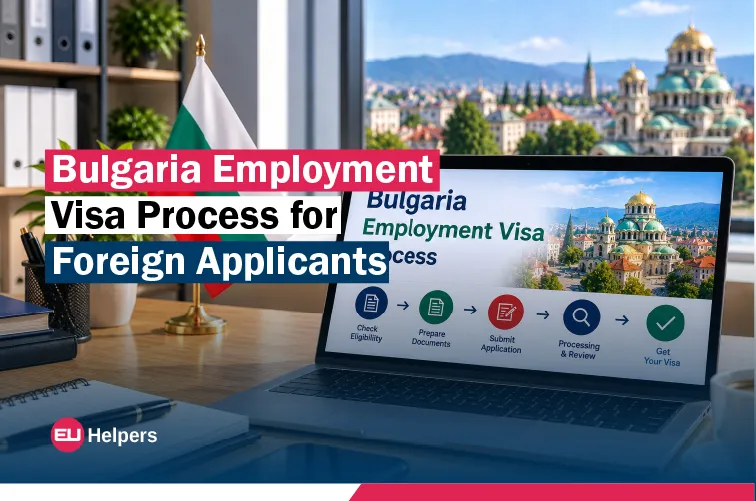

Bulgaria Employment Visa Process for Foreign Applicants
Bulgaria's employment visa process for foreign applicants involves clear sequential stages coordinated through Ministry of Interior handling residence permits through Migration Directorate (Дирекция "Миграция"), Employment Agency (Агенция по заетостта) under Ministry of Labour and Social Policy handling Single Permits and work permits, and Bulgarian embassies and consulates handling Long-Stay Visa (D) applications abroad. This EU Helpers guide walks through the Bulgaria employment visa process — foreign applicants can explore Bulgarian opportunities through EU Helpers. Bulgaria is EU member since 2007, Schengen member (fully joined for air and sea borders March 2024 with land borders integration completing January 2025), NOT currently eurozone but scheduled to adopt Euro on January 1, 2026 (currently uses Bulgarian Lev — BGN pegged to Euro), NATO member since 2004, and Council of Europe member since 1992, representing distinctive Southeastern European positioning with Cyrillic script heritage.
The Employment Visa Process Overview
Bulgaria employment visa process organizes into essential clear stages.
| Stage | Description |
|---|---|
| 1. Job offer | Secure Bulgarian employer sponsorship |
| 2. Single Permit application | Employer applies to Employment Agency |
| 3. Employment Agency processing | Labor market test and assessment |
| 4. Long-Stay Visa (D) application | At Bulgarian embassy or consulate |
| 5. Documentation preparation | Prepare comprehensive documents |
| 6. Long-Stay Visa issuance | Enabling entry to Bulgaria |
| 7. Travel to Bulgaria | Air access primarily |
| 8. Migration Directorate registration | Residence permit issuance |
| 9. Residence permit | Enabling legal residence |
| 10. Registration and settlement | Administrative processes |
Understanding these clear stages enables successful navigation of Bulgaria employment visa process.
Stage 1: Job Offer Coordination
Job offer coordination is foundational stage.
Job offer considerations include:
- Bulgarian employer registered in Bulgaria
- Bulgarian employer prepared to coordinate with Employment Agency for Single Permit application
- Employment contract terms meeting Bulgarian labor law standards
- Salary meeting Bulgarian standards and category-specific thresholds
- Position aligned with Bulgarian labor market
- Employment sectors including outsourcing and shared services (distinctive Sofia hub), IT sector (growing Sofia tech ecosystem), manufacturing, agriculture (distinctive Bulgarian rose oil, Bulgarian wine), tourism (Black Sea coast, mountains, cultural), pharmaceuticals, and various
Effective job offer coordination sets foundation for successful application.
Stage 2: Single Permit Application by Bulgarian Employer
Single Permit application involves Bulgarian employer coordinating with Employment Agency.
Single Permit application considerations include:
- Bulgarian employer submits Single Permit application to Employment Agency (Агенция по заетостта)
- Employer registration documents required
- Employment contract meeting Bulgarian labor law
- Justification for foreign worker recruitment
- Labor market test verifying position cannot be filled by Bulgarian or EU national
- Comprehensive supporting documentation
- Applicable fees
Bulgarian employer coordination represents essential foundation.
Stage 3: Employment Agency Processing
Employment Agency processing involves Single Permit assessment.
Employment Agency processing considerations include:
- Employment Agency evaluates employer application
- Labor market test assessment
- Verification of Bulgarian labor market conditions
- Confirmation of employer legitimacy
- Assessment of applicant qualifications
- Decision on Single Permit issuance
- Coordination with Migration Directorate for residence component
Employment Agency processing timeline varies by category.
Stage 4: Long-Stay Visa (D) Application
Long-Stay Visa (D) application at Bulgarian embassy or consulate follows Single Permit approval.
Long-Stay Visa considerations include:
- Application at Bulgarian embassy or consulate in country of residence
- Appointment booking through diplomatic mission
- Submission of Single Permit approval
- Complete documentation preparation
- Biometric data collection where required
- Applicable visa fees
- Consular processing
Long-Stay Visa (D) enables entry to Bulgaria for residence permit finalization.
Stage 5: Documentation Preparation
Documentation preparation involves comprehensive requirements.
Essential documents include:
- Valid passport with sufficient validity
- Single Permit approval documentation
- Employment contract
- Bulgarian employer registration documents
- Educational qualifications with Bulgarian translations by authorized translator (заклет преводач)
- Professional experience CV and reference letters
- Health insurance valid in Bulgaria
- Criminal record certificate from country of previous residence with apostille
- Biometric photographs
- Proof of accommodation in Bulgaria
- Financial resources evidence
Documentation preparation typically requires 3-4 weeks with Bulgarian translation requirements adding preparation time.
Stage 6: Long-Stay Visa Issuance
Long-Stay Visa issuance enables entry.
Long-Stay Visa issuance considerations include:
- Bulgarian embassy or consulate issues Long-Stay Visa (D) following successful processing
- Visa enables entry to Bulgaria for residence permit finalization
- Validity period specified on visa
- Travel to Bulgaria within validity period essential
- Entry provisions per visa terms
Long-Stay Visa represents essential entry framework.
Stage 7: Travel to Bulgaria
Travel to Bulgaria involves available access options.
Travel considerations include:
- Sofia Airport (Летище София) as primary international gateway with extensive European and international connections
- Varna Airport (Black Sea coast — distinctive tourism gateway)
- Burgas Airport (Black Sea coast)
- Plovdiv Airport (regional)
- Extensive rail connections with distinctive Bulgarian rail network (BDŽ — Български държавни железници)
- Land borders with Romania, Serbia, North Macedonia, Greece, and Turkey
- Bulgaria's Schengen membership (fully integrated 2024/2025) enables seamless travel throughout Schengen area
Sofia Airport is primary international gateway.
Stage 8: Migration Directorate Registration
Migration Directorate registration enables residence permit finalization.
Migration Directorate registration considerations include:
- Registration with Migration Directorate (Дирекция "Миграция") under Ministry of Interior at local office
- Long-Stay Visa (D) validity
- Single Permit documentation
- Complete documentation
- Biometric data collection
- Applicable fees
Migration Directorate registration should occur within specified timeframe after arrival.
Stage 9: Residence Permit Issuance
Residence permit issuance enables legal residence.
Residence permit issuance considerations include:
- Residence permit issued as part of Single Permit
- Legal residence status established
- Combined with work authorization enables legal work
- Validity period specified
- Renewal essential before expiry
- Residence permit represents essential identification
Stage 10: Registration and Settlement
Registration and settlement involves administrative processes.
Registration considerations include:
- Local address registration
- Tax registration where required
- Social security registration
- Healthcare arrangements
- Banking arrangements
- Various administrative processes
- Preparation for Euro adoption January 2026
Employment Sectors in Bulgaria
Different Bulgarian sectors offer varying opportunities.
Outsourcing and shared services sector: Distinctive Sofia European outsourcing hub with multinational shared services centers providing outsourcing opportunities.
IT sector: Growing Bulgarian tech ecosystem with distinctive Sofia tech scene providing tech opportunities.
Manufacturing sector: Textile, automotive components, machinery various.
Agriculture sector: Distinctive Bulgarian rose oil production (Bulgaria as world's largest rose oil producer for perfumery — distinctive Valley of the Roses in Kazanlak region), distinctive Bulgarian wine heritage, various agricultural products.
Tourism sector: Growing Black Sea coastal tourism (Varna, Burgas, Sunny Beach, UNESCO Nessebar), mountain tourism (Rila, Pirin UNESCO National Park, Rhodope), cultural tourism (Sofia, Plovdiv UNESCO 2019 European Capital of Culture, UNESCO Rila Monastery), and distinctive Bulgarian hospitality.
Pharmaceutical sector: Sopharma and various operations.
Financial services sector: Sofia financial sector.
Construction sector: Various operations.
Language Considerations
Bulgarian (Български) is official language using Cyrillic script reflecting distinctive Bulgarian linguistic identity (Bulgaria as birthplace of Cyrillic alphabet developed by disciples of Saints Cyril and Methodius in 9th century Preslav Literary School). Documentation for work permit and visa applications requires translations by authorized translator (заклет преводач). English usage growing particularly in outsourcing, IT sector, and international business. Learning Bulgarian enhances integration and career advancement.
Salary Expectations
Salary considerations: Bulgarian salaries reflect developing economy context (generally lower than Western European countries though competitive within Southeastern European region). Professionals particularly in IT sector, outsourcing, international business, and specialized sectors receive competitive Bulgarian compensation. Sofia typically offers highest Bulgarian compensation. Combined with Bulgaria's moderate cost of living, overall economics create attractive value proposition.
Cost of Living Considerations
Cost considerations: Bulgaria has moderate cost of living making Bulgaria relatively affordable EU destination. Sofia (София) as capital has highest Bulgarian costs. Plovdiv (Пловдив — UNESCO 2019 European Capital of Culture), Varna (Варна — Black Sea coast largest city), Burgas (Бургас — Black Sea coast), Ruse (Русе — Danube city), Stara Zagora (Стара Загора), and various cities have varying moderate costs. Rural Bulgaria particularly affordable. Bulgarian Lev (BGN) currency pegged to Euro with Euro adoption scheduled January 2026.
Cultural Considerations
Cultural considerations include distinctive Bulgarian character with rich cultural heritage, Cyrillic script heritage (Bulgaria as birthplace of Cyrillic alphabet), distinctive Bulgarian Orthodox Christian heritage, Bulgarian professional culture, distinctive Bulgarian social patterns, appreciation of Bulgarian gastronomy (banitsa — distinctive Bulgarian pastry, shopska salad — distinctive Bulgarian salad, kebapche kyufte — distinctive Bulgarian grilled meats, tarator — distinctive Bulgarian cold yogurt soup, distinctive Bulgarian wine heritage, distinctive Bulgarian yogurt with Lactobacillus bulgaricus, various), distinctive Bulgarian folk music heritage (Bulgarian State Radio and Television Female Vocal Choir — distinctive Bulgarian sound), distinctive Bulgarian rose oil tradition (Valley of the Roses), rich Bulgarian literary heritage (Ivan Vazov distinctive Bulgarian national poet, Elias Canetti — Nobel Prize in Literature 1981 born in Ruse Bulgaria), and various UNESCO sites (Rila Monastery, Boyana Church Sofia, Kazanlak Thracian Tomb, Sveshtari Thracian Tomb, Ancient City of Nessebar, Rock-Hewn Churches of Ivanovo, Madara Rider, Pirin National Park, Srebarna Nature Reserve, various).
Family Considerations
Family reunification available for spouse and children requires valid relationship documentation, adequate financial resources, adequate Bulgarian accommodation, health insurance coverage, and processing at appropriate authorities. Family reunification processing reflects Bulgarian administrative framework.
Long-term Considerations
Long-term considerations include permanent residence typically after 5 years continuous residence with work permit, Bulgarian citizenship by naturalization typically available after 5 years continuous residence with Bulgarian language proficiency and integration requirements, and Bulgaria generally allowing dual citizenship for EU citizens and various circumstances. Long-term progression provides EU citizenship benefits including EU mobility.
Final Guidance
Bulgaria employment visa process for foreign applicants involves ten clear sequential stages: job offer coordination with Bulgarian employer registered in Bulgaria; Single Permit application by Bulgarian employer to Employment Agency (Агенция по заетостта) under Ministry of Labour and Social Policy; Employment Agency processing with labor market test; Long-Stay Visa (D) application at Bulgarian embassy or consulate in country of residence; documentation preparation with Bulgarian translations by authorized translator (заклет преводач) and apostille certification; Long-Stay Visa issuance enabling entry to Bulgaria; travel to Bulgaria through Sofia Airport as primary international gateway plus various regional airports (Varna Burgas Plovdiv) and rail land border options with Romania Serbia North Macedonia Greece Turkey (Bulgaria's Schengen full integration 2024/2025 enables seamless Schengen travel); Migration Directorate (Дирекция "Миграция") under Ministry of Interior registration; residence permit issuance as part of Single Permit; and registration and settlement including preparation for Euro adoption January 2026. Bulgaria's distinctive positioning as EU member since 2007 Schengen member with full integration 2024/2025 scheduled Euro adoption January 2026 NATO member since 2004 Council of Europe member since 1992 combined with distinctive Southeastern European Balkan geography Cyrillic script heritage (Bulgaria as birthplace of Cyrillic alphabet) rich cultural heritage (distinctive Bulgarian Orthodox heritage Bulgarian folk music Bulgarian rose oil Bulgarian gastronomy Bulgarian yogurt Bulgarian wine) and various UNESCO sites (Rila Monastery Boyana Church Nessebar Kazanlak Thracian Tomb Pirin National Park various) makes Bulgaria distinctive Southeastern European destination. Foreign applicants can explore Bulgarian opportunities through EU Helpers. EU Helpers supports foreign applicants with simplified Bulgaria employment visa process guidance including Bulgarian employer coordination, Employment Agency Single Permit coordination, Long-Stay Visa arrangements at Bulgarian embassies and consulates, documentation preparation with Bulgarian translations by authorized translator (заклет преводач) and apostille arrangements, Migration Directorate coordination, registration guidance, cultural context guidance for distinctive Bulgarian Southeastern European character with Cyrillic heritage, and clarity on the latest official requirements from Bulgarian immigration authorities.
FAQs
Bulgaria's employment visa process for foreign applicants involves ten clear sequential stages: job offer coordination with Bulgarian employer registered in Bulgaria, Single Permit application by Bulgarian employer to Employment Agency (Агенция по заетостта), Employment Agency processing with labor market test verifying position cannot be filled by Bulgarian or EU nationals, Long-Stay Visa (D) application at Bulgarian embassy or consulate in country of residence, documentation preparation with Bulgarian translations and apostille, Long-Stay Visa issuance enabling entry to Bulgaria, travel to Bulgaria through Sofia Airport, Migration Directorate registration under Ministry of Interior, residence permit issuance as part of Single Permit, and registration and settlement.
Bulgaria's Long-Stay Visa (D) for employment is essential visa route for foreign workers seeking Bulgarian employment. Long-Stay Visa requirements include qualifying Bulgarian job offer, Single Permit approval from Employment Agency, comprehensive documentation with Bulgarian translations by authorized translator (заклет преводач), and application at Bulgarian embassy or consulate in country of residence. Long-Stay Visa enables entry to Bulgaria for Migration Directorate registration and residence permit finalization following Employment Agency Single Permit approval representing essential entry framework.
Bulgaria's Single Permit through Employment Agency (Агенция по заетостта) under Ministry of Labour and Social Policy is distinctive Bulgarian unified system combining work and residence authorization into single procedure. Single Permit application submitted by Bulgarian employer includes employer registration documents, employment contract meeting Bulgarian labor law, justification for foreign worker recruitment, labor market test verifying position cannot be filled by Bulgarian or EU national, and comprehensive documentation. Employment Agency processing represents essential Bulgarian administrative framework.
Bulgaria's Migration Directorate (Дирекция "Миграция") under Ministry of Interior is central authority handling residence permits and various foreign national affairs. Migration Directorate role includes processing residence permit applications, foreign national registration following arrival with Long-Stay Visa (D), permanent residence permit applications, and various administrative processes. Understanding Migration Directorate role is essential for successful Bulgaria residence applications reflecting Bulgarian administrative framework.
Bulgaria is EU member since 2007, Schengen member (fully joined for air and sea borders March 2024 with land borders integration completing January 2025), NOT currently eurozone but scheduled to adopt Euro on January 1, 2026 (currently uses Bulgarian Lev — BGN pegged to Euro at fixed rate), NATO member since 2004, and Council of Europe member since 1992. Bulgaria's positioning combines full EU integration with distinctive Southeastern European character with Schengen and eurozone integration completing distinctive framework.
Bulgaria's travel arrangement involves multiple access options with Sofia Airport (Летище София) as primary international gateway with extensive European and international connections, Varna Airport (Black Sea coast — distinctive tourism gateway), Burgas Airport (Black Sea coast), Plovdiv Airport (regional), extensive rail connections through distinctive Bulgarian rail network (BDŽ — Български държавни железници), and land borders with Romania Serbia North Macedonia Greece Turkey. Bulgaria's Schengen full integration (2024/2025) enables seamless travel throughout Schengen area representing distinctive advantage.
Bulgaria's language requirement centers on Bulgarian (Български) as official language using Cyrillic script reflecting distinctive Bulgarian linguistic identity (Bulgaria as birthplace of Cyrillic alphabet developed by disciples of Saints Cyril and Methodius in 9th century Preslav Literary School — distinctive Bulgarian linguistic heritage). Documentation for work permit and visa applications requires translations by authorized translator (заклет преводач). English usage growing particularly in outsourcing, IT sector, and international business. Learning Bulgarian enhances integration and career advancement.
Bulgaria's sectors with opportunities for foreign applicants include distinctive Sofia outsourcing and shared services (major European outsourcing hub with multinational shared services centers), growing IT sector (distinctive Sofia tech ecosystem), manufacturing (textile automotive components machinery), agriculture (distinctive Bulgarian rose oil production Bulgaria as world's largest rose oil producer Valley of the Roses, Bulgarian wine heritage), tourism (Black Sea coastal tourism Varna Burgas Sunny Beach UNESCO Nessebar, mountain tourism Rila Pirin Rhodope, cultural tourism Sofia Plovdiv UNESCO Rila Monastery UNESCO), pharmaceuticals (Sopharma various), and financial services (Sofia).
Bulgaria has moderate cost of living making Bulgaria relatively affordable EU destination. Sofia (София) as capital has highest Bulgarian costs. Plovdiv (Пловдив — UNESCO 2019 European Capital of Culture), Varna (Варна — Black Sea coast largest city), Burgas (Бургас — Black Sea coast), Ruse (Русе — Danube city), Stara Zagora (Стара Загора), and various cities have varying moderate costs. Rural Bulgaria particularly affordable. Combined with growing Bulgarian salaries particularly in Sofia and IT/outsourcing sectors, moderate cost of living creates attractive value proposition. Bulgarian Lev (BGN) currency pegged to Euro with Euro adoption scheduled January 2026.
EU Helpers supports foreign applicants with simplified Bulgaria employment visa process guidance including Bulgarian employer coordination for employment sectors (distinctive Sofia outsourcing and shared services with multinational shared services centers, growing IT sector with distinctive Sofia tech ecosystem, manufacturing with textile automotive components machinery, agriculture with distinctive Bulgarian rose oil Bulgarian wine, tourism with Black Sea coast mountains cultural sites, pharmaceuticals with Sopharma, and various), Employment Agency (Агенция по заетостта) Single Permit coordination with labor market test consideration, Long-Stay Visa (D) arrangements at Bulgarian embassies and consulates, documentation preparation with Bulgarian translations by authorized translator (заклет преводач) and apostille arrangements, Migration Directorate (Дирекция "Миграция") coordination under Ministry of Interior, registration guidance, cultural context guidance for distinctive Bulgarian Southeastern European character with Cyrillic heritage, and clarity on the latest official requirements from Bulgarian immigration authorities.
Still have questions? Get in touch
Ready to work in Bulgaria?
EU Helpers guides foreign applicants through Bulgaria's employment visa process. From Single Permit to residence permit, we make your Bulgarian employment journey seamless with distinctive Southeastern European positioning and rich Cyrillic heritage.