
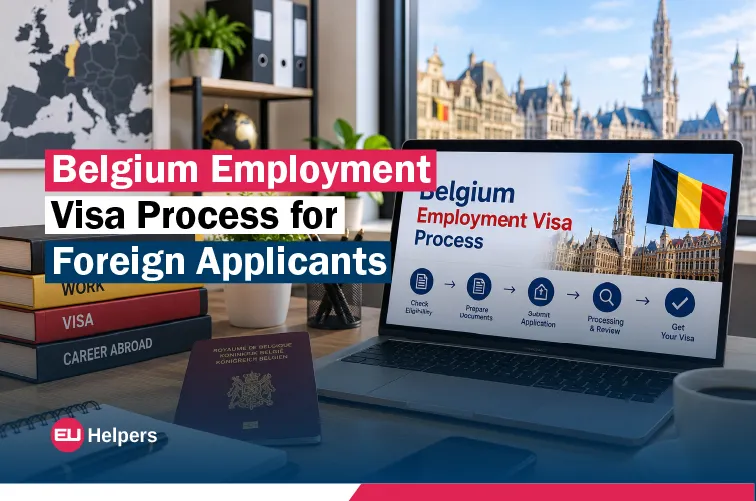

Belgium Employment Visa Process for Foreign Applicants
Belgium's employment visa process for foreign applicants involves clear sequential stages coordinated through distinctive federal structure with regional employment ministries (VDAB in Flanders, Le Forem in Wallonia, Actiris in Brussels-Capital, ADG in German-speaking Community) handling employment authorization, Belgian Federal Public Service Home Affairs (FPS Home Affairs) handling residence permits, and Belgian embassies and consulates handling visa applications abroad. This EU Helpers guide walks through the Belgium employment visa process — foreign applicants can explore Belgian opportunities through EU Helpers. Belgium is EU founding member since 1957, Schengen founding member since 1985 (Schengen Agreement signed in Belgian town of Schengen shared with Luxembourg), eurozone founding member since 1999, NATO founding member since 1949 with NATO headquarters in Brussels, and Council of Europe founding member since 1949, representing distinctive EU institutional heart positioning.
The Employment Visa Process Overview
Belgium employment visa process organizes into essential clear stages.
| Stage | Description |
|---|---|
| 1. Route evaluation | Optimal Belgian visa route selection |
| 2. Job offer coordination | Secure Belgian employer sponsorship |
| 3. Regional determination | Flanders Wallonia Brussels or German-speaking Community |
| 4. Documentation preparation | Translations and apostille |
| 5. Employer Single Permit application | To regional employment ministry |
| 6. Regional processing | Employment component evaluation |
| 7. Federal processing | Residence component |
| 8. Visa D issuance | For entry from abroad |
| 9. Travel to Belgium | European access |
| 10. Municipal registration | For residence permit |
Understanding these clear stages enables successful navigation of Belgium employment visa process.
Stage 1: Route Evaluation
Route evaluation is foundational stage.
Route considerations include:
- Single Permit (Combined Permit — distinctive Belgian unified system)
- EU Blue Card for highly qualified professionals with EU mobility possibilities
- Professional Card for self-employed activity
- Researcher Permit for research activities
- Intra-Corporate Transferee for multinational transfers
- Seasonal Worker for agriculture and tourism
- Family Reunification pathways
Effective route evaluation sets foundation for successful application.
Stage 2: Job Offer Coordination
Job offer coordination involves Belgian employer partnership.
Job offer considerations include:
- Belgian employer registered in Belgium
- Belgian employer prepared to coordinate with regional employment ministry
- Employment contract terms meeting Belgian labor law standards
- Salary meeting Belgian standards and category-specific thresholds
- Position aligned with Belgian labor market
- Employment sectors including EU institutional employment (Brussels), NATO employment (Brussels), diamond trade (Antwerp), chemicals and pharmaceuticals, food and beverage (Belgian chocolate Belgian beer), port operations (Antwerp), financial services, and various
Effective job offer coordination sets foundation for successful application.
Stage 3: Regional Determination
Regional determination represents distinctive Belgian federal step.
Regional determination considerations include:
- Flemish Region (Flanders): VDAB — Vlaamse Dienst voor Arbeidsbemiddeling en Beroepsopleiding
- Wallonia Region: Le Forem
- Brussels-Capital Region: Actiris
- German-speaking Community: ADG — Arbeitsamt der Deutschsprachigen Gemeinschaft
- Regional differences in labor market conditions and shortage occupations
- Regional processing procedures
Regional determination reflects distinctive Belgian federal structure.
Stage 4: Documentation Preparation
Documentation preparation involves comprehensive requirements.
Essential documents include:
- Valid passport with sufficient validity
- Employment contract
- Educational qualifications with translations by sworn translator (beëdigd vertaler / traducteur juré / vereidigter Übersetzer depending on region)
- Professional experience CV and reference letters
- Health insurance valid in Belgium
- Criminal record certificate from country of previous residence with apostille
- Biometric photographs
- Proof of accommodation in Belgium
- Financial resources evidence
- Language considerations (Dutch French or German)
- Medical certificate where required
Documentation preparation typically requires 3-4 weeks with translation requirements adding preparation time.
Stage 5: Employer Single Permit Application
Employer Single Permit application to regional employment ministry.
Employer application considerations include:
- Belgian employer submits Single Permit application to relevant regional employment ministry
- Application through VDAB (Flanders), Le Forem (Wallonia), Actiris (Brussels), or ADG (German-speaking Community)
- Employer registration documents
- Employment contract meeting Belgian labor law
- Complete documentation submission
- Employer justification for foreign worker recruitment
- Applicable fees
Employer Single Permit application represents essential Belgian administrative step.
Stage 6: Regional Processing
Regional processing involves employment component evaluation.
Regional processing considerations include:
- Regional employment ministry evaluates employment component
- Assessment of labor market considerations
- Verification of employer legitimacy
- Assessment of applicant qualifications
- Regional labor market considerations
- Decision on employment authorization
Regional processing timeline varies by region.
Stage 7: Federal Processing
Federal processing involves residence component.
Federal processing considerations include:
- Federal Immigration Office processes residence component
- Coordination with regional decision
- Comprehensive documentation review
- Applicant background verification
- Decision on residence authorization
Federal processing coordinated with regional decision.
Stage 8: Visa D Long-Stay Issuance
Following approval, visa D long-stay issued for entry.
Visa D issuance considerations include:
- Application at Belgian embassy or consulate in country of residence
- Following Single Permit approval
- Complete documentation submission
- Biometric data collection where required
- Applicable visa fees
- Visa D enabling entry to Belgium
Visa D represents essential entry framework.
Stage 9: Travel to Belgium
Travel to Belgium involves European access options.
Travel considerations include:
- Brussels Airport (Zaventem — Belgium's primary international gateway)
- Brussels South Charleroi Airport (secondary)
- Antwerp Airport (regional)
- Liège Airport (regional)
- Extensive rail connections through distinctive Belgian rail network (SNCB — Société nationale des chemins de fer belges / NMBS — Nationale Maatschappij der Belgische Spoorwegen) with high-speed connections to Netherlands (Amsterdam via Thalys / Eurostar) France (Paris via Thalys / Eurostar) Germany (Cologne Frankfurt via Thalys / ICE) UK (London via Eurostar)
- Belgium's Schengen founding membership enabling seamless travel throughout Schengen area
Belgium's central Western European position provides extensive travel connectivity.
Stage 10: Municipal Registration
Municipal registration involves distinctive Belgian requirement.
Municipal registration considerations include:
- Registration at municipal office (commune / gemeente / Gemeinde) within days after arrival
- Address registration essential
- Residence permit (electronic card — carte de séjour électronique / elektronische verblijfstitel) issued following registration
- Required for various subsequent administrative processes
- Distinctive Belgian administrative requirement
Municipal registration completes Belgian immigration process.
Employment Sectors in Belgium
Different Belgian sectors offer varying opportunities.
EU institutional employment: Distinctive Brussels EU institutional heart with European Commission, European Council, Council of the European Union, European External Action Service, various providing distinctive EU career opportunities not available in most other locations.
NATO employment: NATO headquarters in Brussels providing distinctive international security career opportunities.
Diamond trade sector: Antwerp as world diamond capital with Antwerp World Diamond Centre and various diamond operations providing distinctive diamond industry opportunities.
Chemicals and pharmaceuticals sector: Distinctive Belgian pharmaceutical sector with UCB (Belgian pharmaceutical company), Janssen Pharmaceuticals (Belgian arm of Johnson & Johnson), GSK Belgium operations, various.
Food and beverage sector: Distinctive Belgian chocolate industry (Godiva, Neuhaus, Leonidas, Callebaut, various), distinctive Belgian beer culture (Trappist beers Chimay Rochefort Orval Westmalle Westvleteren Achel, various Belgian brewing traditions — UNESCO Belgian Beer Culture).
Port operations sector: Antwerp as major European port (one of Europe's largest ports).
Financial services sector: Brussels financial sector.
Automotive sector: Belgian automotive assembly operations.
Language Considerations
Belgium has three official languages reflecting distinctive Belgian multilingual character: Dutch (Nederlands) in Flanders spoken by approximately 60%, French (Français) in Wallonia and Brussels spoken by approximately 40%, and German (Deutsch) in small German-speaking Community in eastern Belgium spoken by less than 1%. Documentation requires translations depending on region by sworn translator (beëdigd vertaler / traducteur juré / vereidigter Übersetzer). Brussels is officially bilingual Dutch-French. English usage growing particularly in international business and EU institutional employment.
Salary Expectations
Salary considerations: Belgian salaries reflect advanced economy with competitive compensation particularly in EU institutional employment (Brussels), financial services, chemicals and pharmaceuticals (UCB Janssen GSK Belgium), diamond trade (Antwerp), and specialized sectors. Brussels typically offers highest Belgian compensation. EU Blue Card salary threshold higher than standard Belgian salaries. Combined with Belgium's moderate to high cost of living, overall economics reflect Belgian standards. Euro (EUR) currency reflects Belgium's eurozone founding membership.
Cost of Living Considerations
Cost considerations: Belgium has moderate to high cost of living. Brussels (Bruxelles / Brussel) as capital and EU institutional heart has highest Belgian costs. Antwerp (major Belgian city and port), Ghent (distinctive Flemish historic city), Bruges (UNESCO medieval city), Liège (Walloon city on Meuse), Charleroi, Namur (Wallonia capital), Leuven (distinctive university city with KU Leuven), and various cities have varying costs. Rural Belgium and smaller cities generally more affordable.
Cultural Considerations
Cultural considerations include distinctive Belgian federal multilingual character with three official languages (Dutch French German) and three regions (Flanders Wallonia Brussels-Capital), distinctive Belgian character combining Flemish and Walloon cultural traditions, Belgian professional culture (professional etiquette, meeting culture, direct but polite communication), distinctive Belgian social patterns, appreciation of Belgian gastronomy (distinctive Belgian chocolate world-renowned including Godiva Neuhaus Leonidas Callebaut various, distinctive Belgian beer culture UNESCO with Trappist beers various, Belgian fries — pommes frites/frieten distinctive Belgian dish, Belgian waffles including Brussels waffles and Liège waffles, mussels and fries — moules-frites/mosselen-friet distinctive Belgian dish, various), distinctive Belgian artistic heritage (Flemish Primitives Van Eyck Van der Weyden Memling, Bruegel family, Rubens with distinctive Antwerp studio, Magritte with distinctive Belgian surrealism), distinctive Belgian comic tradition (Tintin by Hergé, Smurfs by Peyo, various — distinctive Belgian bande dessinée / stripverhaal tradition), and various UNESCO sites (Grand-Place Brussels, Historic Centre of Bruges, Victor Horta buildings Brussels UNESCO Art Nouveau, Notre-Dame Cathedral Tournai, Neolithic Flint Mines at Spiennes, Plantin-Moretus Museum Antwerp, Stoclet House Brussels, Beguinages of Flanders, Belfries of Belgium and France, various).
Family Considerations
Family reunification available for family members with adequate documentation. Family members of Single Permit and EU Blue Card holders typically have work rights. Family reunification processing reflects Belgian administrative framework.
Long-term Considerations
Long-term considerations include permanent residence typically after 5 years continuous residence with integration requirements, Belgian citizenship by naturalization typically after 5 years continuous residence with integration requirements including language proficiency (Dutch, French, or German depending on region). Belgium generally allows dual citizenship.
Final Guidance
Belgium employment visa process for foreign applicants involves ten clear sequential stages: route evaluation across Single Permit EU Blue Card Professional Card Researcher Permit Intra-Corporate Transferee and various; job offer coordination with Belgian employer registered in Belgium; regional determination between Flanders (VDAB) Wallonia (Le Forem) Brussels-Capital (Actiris) or German-speaking Community (ADG); documentation preparation with translations by sworn translator (beëdigd vertaler / traducteur juré / vereidigter Übersetzer depending on region) and apostille certification; employer Single Permit application to relevant regional employment ministry; regional processing for employment component; federal processing for residence component through Federal Immigration Office; visa D long-stay issuance at Belgian embassy or consulate; travel to Belgium through Brussels Airport (Zaventem) as primary international gateway plus various regional airports and extensive rail connections through SNCB/NMBS with high-speed Thalys Eurostar ICE connections; and municipal registration at commune / gemeente / Gemeinde for residence permit (electronic card) issuance. Belgium's distinctive positioning as EU founding member since 1957 Schengen founding member since 1985 eurozone founding member since 1999 NATO founding member since 1949 with NATO headquarters in Brussels Council of Europe founding member since 1949 combined with distinctive EU institutional heart three official languages (Dutch French German) distinctive federal structure with three regions rich cultural heritage (distinctive Belgian chocolate Belgian beer culture UNESCO Flemish Primitives Rubens Magritte Belgian comics tradition) and various UNESCO sites (Grand-Place Brussels Historic Centre of Bruges Victor Horta buildings Belfries various) makes Belgium distinctive Western European destination. Foreign applicants can explore Belgian opportunities through EU Helpers. EU Helpers supports foreign applicants with simplified Belgium employment visa process guidance including Belgian employer coordination, regional employment ministry coordination (VDAB Le Forem Actiris ADG), Single Permit coordination, EU Blue Card coordination, Federal Immigration Office coordination, Belgian embassy or consulate coordination, documentation preparation with translations and apostille arrangements, municipal registration guidance, cultural context guidance for distinctive Belgian federal multilingual character, and clarity on the latest official requirements from Belgian immigration authorities.
FAQs
Belgium's employment visa process for foreign applicants involves ten clear sequential stages: route evaluation across Single Permit EU Blue Card and various options, job offer coordination with Belgian employer registered in Belgium, regional determination (Flanders Wallonia Brussels German-speaking Community), documentation preparation with translations by sworn translator and apostille, employer Single Permit application to relevant regional employment ministry (VDAB Le Forem Actiris ADG), regional processing for employment component, federal processing for residence component, visa D long-stay issuance at Belgian embassy or consulate, travel to Belgium through Brussels Airport, and municipal registration at commune / gemeente / Gemeinde for residence permit issuance.
Belgium's Single Permit (Combined Permit — Gecombineerde Vergunning / Permis Unique) process is distinctive Belgian unified system combining work and residence authorization. Belgian employer submits Single Permit application to relevant regional employment ministry (VDAB in Flanders, Le Forem in Wallonia, Actiris in Brussels, ADG in German-speaking Community) which evaluates employment component. Federal Immigration Office processes residence component. Following approval, visa D long-stay issued at Belgian embassy or consulate for entry, then municipal registration at commune / gemeente / Gemeinde for residence permit issuance.
Belgium's EU Blue Card process provides route for highly qualified professionals with higher education qualification (typically university degree) or equivalent professional experience, qualifying Belgian job offer with salary meeting EU Blue Card threshold, employment contract for at least one year, comprehensive documentation, EU mobility possibilities representing distinctive advantage, and family members ability to accompany with work rights. EU Blue Card enables validity per employment contract with renewal possibilities offering distinctive EU mobility advantage.
Belgium's regional employment ministry coordination reflects distinctive federal structure with different ministries per region. Flemish Region uses VDAB (Vlaamse Dienst voor Arbeidsbemiddeling en Beroepsopleiding), Wallonia Region uses Le Forem, Brussels-Capital Region uses Actiris, and German-speaking Community uses ADG (Arbeitsamt der Deutschsprachigen Gemeinschaft). Regional employment ministry evaluates employment component of Single Permit application with regional differences in labor market conditions, shortage occupations, and processing procedures representing distinctive Belgian federal framework.
Belgium is EU founding member since 1957, Schengen founding member since 1985 (Schengen Agreement signed in Belgian town of Schengen shared with Luxembourg), eurozone founding member since 1999 (Euro — EUR currency), NATO founding member since 1949 with NATO headquarters in Brussels, and Council of Europe founding member since 1949. Belgium's positioning combines full EU integration with distinctive EU institutional heart hosting European Commission European Council Council of the European Union and NATO headquarters representing distinctive Western European institutional center.
Belgium's travel arrangement involves multiple access options with Brussels Airport (Zaventem) as primary international gateway, Brussels South Charleroi Airport (secondary), Antwerp Airport and Liège Airport (regional), extensive rail connections through distinctive Belgian rail network SNCB/NMBS with high-speed connections including Thalys (Amsterdam Paris Cologne), Eurostar (London Amsterdam Paris), ICE (Cologne Frankfurt), and Belgium's Schengen founding membership enabling seamless travel throughout Schengen area after arrival representing distinctive advantage.
Belgium has three official languages reflecting distinctive Belgian multilingual character: Dutch (Nederlands) in Flanders spoken by approximately 60% of Belgians, French (Français) in Wallonia and Brussels spoken by approximately 40% of Belgians, and German (Deutsch) in small German-speaking Community in eastern Belgium spoken by less than 1%. Documentation requires translations depending on region by sworn translator (beëdigd vertaler / traducteur juré / vereidigter Übersetzer). Brussels is officially bilingual Dutch-French. English usage growing particularly in international business and EU institutional employment.
Belgium's sectors with opportunities for foreign applicants include EU institutional employment (distinctive Brussels EU institutional heart with European Commission European Council Council of the European Union European External Action Service various providing distinctive EU career opportunities), NATO employment (NATO headquarters in Brussels), diamond trade (Antwerp as world diamond capital with Antwerp World Diamond Centre), chemicals and pharmaceuticals (UCB Janssen Pharmaceuticals GSK Belgium various), food and beverage (distinctive Belgian chocolate industry Godiva Neuhaus Leonidas Callebaut various, Belgian beer culture UNESCO with Trappist beers), port operations (Antwerp), and financial services.
Belgium has moderate to high cost of living. Brussels (Bruxelles / Brussel) as capital and EU institutional heart has highest Belgian costs. Antwerp (major Belgian city and port), Ghent (distinctive Flemish historic city), Bruges (UNESCO medieval city), Liège (Walloon city on Meuse), Charleroi, Namur (Wallonia capital), Leuven (distinctive university city with KU Leuven), and various cities have varying costs. Rural Belgium and smaller cities generally more affordable. Euro (EUR) currency reflects Belgium's eurozone founding membership since 1999.
EU Helpers supports foreign applicants with simplified Belgium employment visa process guidance including Belgian employer coordination for employment sectors (EU institutional Brussels, NATO Brussels, diamond trade Antwerp, chemicals and pharmaceuticals with UCB Janssen GSK Belgium, food and beverage with Belgian chocolate Belgian beer UNESCO, port operations Antwerp, financial services, and various), regional employment ministry coordination (VDAB Le Forem Actiris ADG), Single Permit coordination as distinctive Belgian unified system, EU Blue Card coordination, Professional Card evaluation for self-employed, Federal Immigration Office coordination, Belgian embassy or consulate coordination, documentation preparation with translations by sworn translator (beëdigd vertaler / traducteur juré / vereidigter Übersetzer depending on region) and apostille arrangements, municipal registration guidance (commune / gemeente / Gemeinde), cultural context guidance for distinctive Belgian federal multilingual character at EU institutional heart, and clarity on the latest official requirements from Belgian immigration authorities.
Still have questions? Get in touch
Ready to work in Belgium?
EU Helpers guides foreign applicants through Belgium's employment visa process. From Single Permit to residence permit, we make your Belgian employment journey seamless with distinctive federal EU founding member positioning and Brussels EU institutional heart.