
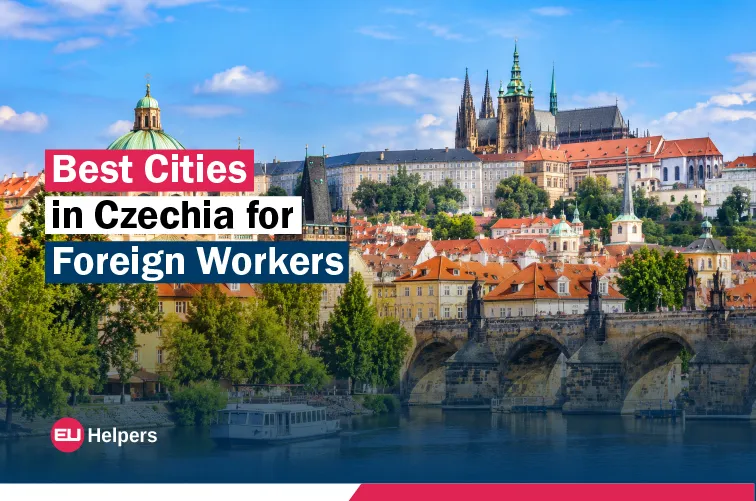

Best Cities in the Czech Republic for Foreign Workers
The Czech Republic (Česká republika — Czechia) is compact, but your choice of city shapes salary, sector and daily life more than national averages suggest. Prague dominates for IT, finance, shared services and regional headquarters; Brno has grown into the country's second tech and research hub; Plzeň and Mladá Boleslav run on engineering and automotive production; Ostrava is reinventing a heavy-industry past with IT and engineering; and Liberec, Olomouc, Hradec Králové and Pardubice offer manufacturing, healthcare and university jobs at lower living costs. This EU Helpers guide compares the best Czech cities for foreign workers across sector mix, salary, cost of living and quality of life — international candidates can explore Czech opportunities through EU Helpers. The Czech Republic has been an EU member since 1 May 2004, a NATO member since 1999, and a Schengen member since 21 December 2007. It is NOT in the eurozone and uses the Czech koruna (CZK; roughly 24–25 CZK to €1), and it has been a Council of Europe member since 1993. The official language is Czech (čeština).
Essential Context: How Czech Cities Compare
The eight most relevant Czech cities and urban areas for foreign workers break down roughly as follows.
| City | Population (approx.) | Lead sectors | Cost of living |
|---|---|---|---|
| Prague (Praha) | ~1,350,000 | IT, finance, shared services, headquarters | Highest in the country |
| Brno | ~400,000 | Software, R&D, shared services, universities | Moderate to high |
| Ostrava | ~285,000 | Engineering, IT, automotive supply, energy | Low |
| Plzeň | ~185,000 | Engineering, electronics, brewing | Moderate |
| Liberec | ~105,000 | Automotive components, glass, textiles | Low to moderate |
| Olomouc | ~100,000 | Healthcare, education, light industry | Low to moderate |
| Hradec Králové / Pardubice | ~95,000 each | Healthcare, electronics, chemicals, logistics | Low to moderate |
| Mladá Boleslav | ~50,000 (large commuter workforce) | Automotive (Škoda Auto and suppliers) | Moderate |
Across the country, the average gross monthly wage is approximately 50,000–52,000 CZK (around €2,050–€2,150), with Prague well above that figure and most regions below it. Because rents fall sharply outside the capital, a solid regional salary often buys more than an entry-level Prague role.
Prague — The Capital
Prague is the Czech Republic's economic engine and the default choice for most skilled foreign workers.
Lead sectors: IT and software (developers, QA, DevOps, data and cybersecurity specialists), shared services and business process centres (finance, HR, procurement and customer support in English, German and other languages), banking and insurance (Česká spořitelna, Komerční banka, ČSOB), consulting, energy (ČEZ), tourism and hospitality.
Salary context: Prague typically pays 20–30% above the national average, with average gross monthly wages around 66,000 CZK (roughly €2,700). Senior software engineers commonly earn approximately 90,000–140,000+ CZK gross monthly; multilingual shared-services specialists 40,000–60,000 CZK; team leads 60,000–90,000 CZK; junior roles generally start around 35,000–50,000 CZK.
Cost of living: Highest in the country. A one-bedroom flat in central districts such as Vinohrady, Karlín or Holešovice typically costs 20,000–30,000 CZK/month before utilities; outer districts are cheaper.
Who it fits: IT professionals, multilingual shared-services staff, finance and consulting specialists, English teachers, and newcomers who want the largest English-speaking community.
Permit route: Employee card (zaměstnanecká karta) or EU Blue Card (modrá karta EU), applied for at a Czech embassy and decided by the Ministry of the Interior's Department for Asylum and Migration Policy (Odbor azylové a migrační politiky — OAMP), with card collection at an OAMP office after arrival.
Brno — The Moravian Tech Hub
Brno is the country's second-largest city and the capital of South Moravia, roughly two hours from Prague by train or motorway.
Lead sectors: Software development and open-source engineering (Red Hat's major engineering centre), IT services and shared services (Kyndryl, AT&T, Honeywell), scientific instruments and R&D (Thermo Fisher Scientific electron microscopy), universities (Masaryk University, Brno University of Technology) and research centres such as CEITEC.
Salary context: Typically 5–15% below Prague for comparable roles. Senior developers often earn approximately 80,000–120,000 CZK gross monthly; shared-services specialists 38,000–55,000 CZK.
Cost of living: Noticeably lower than Prague. Central one-bedroom rents typically 15,000–22,000 CZK/month.
Who it fits: Software engineers, QA and support engineers, researchers and academics, multilingual shared-services staff, and anyone wanting a lively university city.
Ostrava — Industry Reinvented
Ostrava is the centre of the Moravian-Silesian Region near the Polish and Slovak borders, historically built on coal mining and steel.
Lead sectors: Mechanical and electrical engineering, IT services and software (Tietoevry and a growing cluster of local tech firms), automotive production and supply chains in the wider region (Hyundai Motor Manufacturing Czech at Nošovice), energy and the VŠB – Technical University of Ostrava.
Salary context: Regional averages sit below the national figure. Skilled trades such as welders, electricians and CNC operators typically earn 35,000–50,000 CZK gross monthly; engineers 50,000–80,000 CZK; experienced IT professionals can approach Brno rates.
Cost of living: Among the lowest of any large Czech city. Central one-bedroom rents typically 11,000–16,000 CZK/month.
Who it fits: Engineers, welders and industrial technicians, IT specialists who want low living costs, and candidates with heavy-industry or energy backgrounds.
Plzeň — Engineering and Beer
Plzeň (Pilsen) sits in West Bohemia about an hour from Prague and close to the German border.
Lead sectors: Heavy and transport engineering (Škoda Group rail vehicles, Doosan Škoda Power turbines), electronics and air-conditioning manufacturing (Panasonic, Daikin), automotive suppliers, brewing (Plzeňský Prazdroj, home of Pilsner Urquell).
Salary context: Close to the national average and above it for engineers. Production operators typically earn 32,000–42,000 CZK gross monthly; skilled technicians 40,000–55,000 CZK; design and process engineers 55,000–85,000 CZK. German-speaking candidates have an edge.
Cost of living: Moderate. Central one-bedroom rents typically 13,000–18,000 CZK/month.
Who it fits: Mechanical and electrical engineers, production and quality specialists, German speakers, and those wanting a mid-sized city near Prague and Bavaria.
Mladá Boleslav — The Car-Making City
Mladá Boleslav is a small Central Bohemian city about an hour north-east of Prague, dominated by Škoda Auto's headquarters and main plant.
Lead sectors: Automotive assembly, engineering and R&D at Škoda Auto, a dense ring of component suppliers and logistics providers. Toyota's plant in nearby Kolín adds further production jobs.
Salary context: Automotive wages are among the best outside Prague for production roles. Assembly and logistics operators typically earn 35,000–48,000 CZK gross monthly including shift allowances; maintenance technicians 45,000–60,000 CZK; automotive engineers 60,000–95,000 CZK.
Cost of living: Moderate; the rental market is tight because of the large workforce. One-bedroom rents typically 13,000–18,000 CZK/month, and many workers live in surrounding towns or employer-arranged housing.
Who it fits: Production operators, forklift drivers, maintenance and robotics technicians, automotive engineers, and candidates focused on saving money rather than city life.
Liberec — North Bohemian Manufacturing
Liberec lies in North Bohemia beneath the Ještěd mountain, close to the German and Polish borders.
Lead sectors: Automotive components (Denso and other suppliers), glass and jewellery in the nearby Jablonec nad Nisou area (Preciosa), technical textiles and the Technical University of Liberec.
Salary context: Slightly below the national average. Factory operators typically 32,000–42,000 CZK gross monthly; skilled technicians 40,000–55,000 CZK; engineers 50,000–75,000 CZK.
Cost of living: Low to moderate. Central one-bedroom rents typically 12,000–16,000 CZK/month.
Who it fits: Manufacturing and quality workers, glass and materials specialists, engineers, and outdoor lovers drawn to the nearby mountains.
Olomouc — Central Moravia's University City
Olomouc is a historic university city in Central Moravia, about an hour north-east of Brno.
Lead sectors: Healthcare (University Hospital Olomouc), higher education (Palacký University), smaller-scale IT and shared services, food processing and light manufacturing.
Salary context: Moderate. Healthcare professionals and academics are paid on public-sector scales; IT and engineering roles typically 45,000–75,000 CZK gross monthly; production roles 30,000–40,000 CZK.
Cost of living: Low to moderate. Central one-bedroom rents typically 12,000–17,000 CZK/month.
Who it fits: Doctors, nurses and researchers (after recognition of qualifications), academics, and candidates wanting a calm, affordable city.
Hradec Králové and Pardubice — East Bohemian Twin Cities
Hradec Králové and Pardubice sit about 20 km apart in East Bohemia and function as one linked labour market.
Lead sectors: Healthcare and medical research (University Hospital Hradec Králové and Charles University's faculties there), electronics manufacturing (Foxconn in Pardubice), chemicals and explosives (Synthesia, Explosia), logistics and IT services.
Salary context: Near or slightly below the national average. Electronics and chemicals operators typically earn 32,000–42,000 CZK gross monthly; technicians and lab specialists 40,000–55,000 CZK; engineers and IT staff 50,000–80,000 CZK.
Cost of living: Low to moderate. Central one-bedroom rents typically 12,000–17,000 CZK/month.
Who it fits: Healthcare workers, chemists and lab technicians, electronics and logistics staff, and families seeking affordable housing near Prague.
Choosing the Right City for Your Profile
A quick match guide:
- IT, software, data, finance, consulting → Prague first, Brno a strong second.
- Shared services & multilingual support → Prague and Brno, with smaller centres in Ostrava and Olomouc.
- Automotive production & engineering → Mladá Boleslav, Plzeň, Ostrava region, Kolín.
- Heavy and mechanical engineering → Plzeň, Ostrava, Brno.
- Electronics manufacturing → Pardubice, Plzeň.
- Research & academia → Brno, Prague, Olomouc, Hradec Králové.
- Healthcare → Hradec Králové, Olomouc, Prague, Brno.
- Glass, textiles & materials → Liberec and Jablonec nad Nisou.
- Tourism & hospitality → Prague first, then Český Krumlov, Karlovy Vary and Brno.
- Lowest cost of living with a job → Ostrava, Liberec, Olomouc, Hradec Králové.
Permit Route Across Czech Cities
The work and residence framework is national, not city-specific. Non-EU workers in every Czech city typically use the employee card (zaměstnanecká karta), a combined work and residence permit tied to a vacancy listed in the Labour Office's central register (Úřad práce ČR), or the EU Blue Card (modrá karta EU) for highly qualified roles that meet the salary threshold set annually by the Ministry of Labour and Social Affairs. Applications are usually lodged at a Czech embassy and decided by OAMP at the Ministry of the Interior (Ministerstvo vnitra); intra-company transferee cards and government fast-track programmes such as Qualified Employee and Key and Scientific Staff apply uniformly too. After arrival you register your address, collect your card, join Czech public health insurance and the Czech Social Security Administration (ČSSZ) system, and may be assigned a birth number (rodné číslo). Typical timelines from signed offer to arrival run approximately 2–4 months.
Quality of Life Beyond Work
Each city has a distinct feel: Prague for cosmopolitan energy, culture and the largest expat community; Brno for a young, student-driven atmosphere and South Moravian wine country; Ostrava for affordability, music festivals and mountain access; Plzeň for beer culture and a compact centre close to Bavaria; Mladá Boleslav for a work-focused life with Prague an hour away; Liberec for skiing and hiking on the doorstep; Olomouc for baroque architecture and a relaxed pace; and Hradec Králové and Pardubice for green, family-friendly living. Public transport is cheap and reliable, and most of these cities are one to three hours from Prague, so weekend travel — even to Vienna, Berlin or Kraków — is easy.
Final Guidance
The best city in the Czech Republic for a foreign worker depends mainly on your sector and lifestyle priorities rather than on any single "best" ranking. Prague leads for IT, finance and shared services at the country's highest salaries but also its highest rents; Brno offers a serious tech and research alternative at lower cost; Plzeň, Mladá Boleslav and the Ostrava region anchor engineering and automotive careers; and Liberec, Olomouc, Hradec Králové and Pardubice trade narrower job choice for affordable, comfortable living. In every city the same national employee card and EU Blue Card framework applies through the Labour Office and OAMP, with typical timelines of 2–4 months from signed offer to arrival. With EU membership since 2004, NATO since 1999, Schengen since 2007 and a central European location, the Czech Republic gives skilled foreign workers real city-level choice. International candidates can explore Czech opportunities through EU Helpers. EU Helpers supports foreign workers with city-sector matching, offer-letter review, employee card and Blue Card coordination, relocation planning and clarity on the latest official requirements from Czech immigration authorities.
FAQs
For most skilled foreign workers, Prague is the default best choice because it concentrates IT, finance, shared services, headquarters and the largest English-speaking community at the country's highest salaries. However, "best" depends on your sector — software engineers and researchers often do just as well in Brno, automotive staff in Mladá Boleslav or Plzeň, and engineers in Ostrava. EU Helpers matches your profile to the right city.
Prague pays the highest salaries overall, with average gross monthly wages around 66,000 CZK, roughly 25–30% above the national average. Brno comes second for IT and research roles, typically 5–15% below Prague. For production and engineering jobs, Mladá Boleslav and Plzeň often pay above regional averages thanks to Škoda Auto, Škoda Group and their suppliers.
Ostrava has the lowest cost of living among the large Czech cities, with central one-bedroom rents typically 11,000–16,000 CZK/month and cheaper dining and services than the capital. Liberec, Olomouc, Hradec Králové and Pardubice are close behind at roughly 12,000–17,000 CZK. Even Brno is noticeably cheaper than Prague, where comparable flats often cost 20,000–30,000 CZK.
Many foreign professionals choose Vinohrady, Žižkov, Karlín, Smíchov or Holešovice for their transport links, cafés and English-friendly services. Families often prefer Dejvice or Břevnov, while budget-conscious workers look at commuter towns like Beroun, Kladno and Říčany. EU Helpers can help identify commuting-friendly neighbourhoods.
Mladá Boleslav is the heart of Czech car-making as home to Škoda Auto's headquarters and main plant, surrounded by suppliers. Plzeň is strong for engineering, electronics and rail vehicles, the Ostrava region has Hyundai's Nošovice plant and many suppliers, and Toyota builds cars in Kolín. Liberec and Pardubice add automotive components and electronics manufacturing.
Brno is the clear alternative, with major engineering and services centres from Red Hat, Kyndryl, AT&T and Honeywell, two large technical universities and a busy startup scene. Ostrava has a growing IT cluster, and Plzeň and Hradec Králové offer smaller pools of software and IT services roles. English is the working language in many of these teams.
Yes, especially for software engineers, researchers, scientific-instrument specialists and multilingual shared-services staff. Salaries are typically only 5–15% lower than in Prague while rents are significantly cheaper, and the large student population keeps the city young and international.
The same national framework applies in every Czech city: non-EU workers typically need an employee card (zaměstnanecká karta) tied to a registered Labour Office vacancy, or an EU Blue Card (modrá karta EU) for highly qualified roles above the salary threshold. Applications are usually lodged at a Czech embassy and decided by OAMP at the Ministry of the Interior. EU, EEA and Swiss citizens need no work permit and simply register their stay.
Prague has by far the largest expat community, with international schools, English-speaking doctors, co-working spaces, active online groups and many multinational employers. Brno has a fast-growing international population tied to its tech companies and universities. Regional cities have smaller but growing foreign communities, often centred on specific employers.
EU Helpers matches foreign workers to the right Czech city based on sector, profile and lifestyle across Prague, Brno, Ostrava, Plzeň, Mladá Boleslav, Liberec, Olomouc, Hradec Králové and Pardubice, pre-vets roles with Czech employers, reviews offer letters for gross-versus-net pay in koruna, coordinates employee card and EU Blue Card applications with the Labour Office (Úřad práce ČR) and OAMP at the Ministry of the Interior, prepares documents with official Czech translations and apostille, supports health insurance and ČSSZ enrolment, and provides clarity on the latest official requirements from Czech immigration authorities.
Still have questions? Get in touch
Ready to work in Czechia?
EU Helpers guides non-EU workers through Czechia’s work authorization. From Ministry of the Interior OAMP coordination to Employee Card, EU Blue Card and Highly Qualified routes, we make your Czechia move seamless with distinctive Central European EU member positioning.