
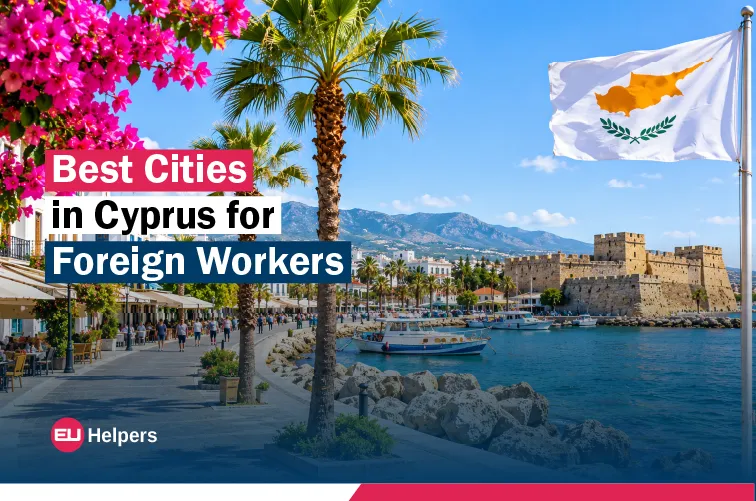

Best Cities in Cyprus for Foreign Workers
Cyprus (Κύπρος / Kıbrıs — Republic of Cyprus) is a small island, so "cities" here really means a handful of compact towns and their surrounding districts, all within about 90 minutes of each other by motorway. Even so, the town you choose decides your sector, salary and lifestyle. Limassol dominates for shipping, fintech, forex brokerage and international tech; Nicosia is the administrative, banking and professional-services capital; Larnaca combines the main airport with logistics and a fast-growing seafront; Paphos lives on tourism, golf, construction and a large retiree community; and Ayia Napa, Protaras and Paralimni in the Famagusta district run on resort seasons. This EU Helpers guide compares the best Cypriot towns for foreign workers across sector mix, salary, cost of living and quality of life — international candidates can explore Cypriot opportunities through EU Helpers. Cyprus has been an EU member since 1 May 2004 and a eurozone member since 1 January 2008 (the Cyprus pound was replaced by the euro), is NOT a Schengen member (it applies its own national visa rules), is NOT a NATO member, and has been a Council of Europe member since 1961. Greek and Turkish are the official languages, while English is widely used in business. This guide covers the areas under the effective control of the Republic of Cyprus; the northern part of the island operates under separate administration and different rules.
Essential Context: How Cypriot Towns Compare
The Republic of Cyprus has five government-controlled districts, and the most relevant towns for foreign workers break down roughly as follows.
| Town | Population (approx., urban area) | Lead sectors | Cost of living |
|---|---|---|---|
| Limassol | ~200,000 | Shipping, fintech, forex, tech, tourism | Highest in Cyprus |
| Nicosia | ~250,000 (southern part) | Government, banking, professional services, education | Moderate to high |
| Larnaca | ~90,000 | Airport, aviation, logistics, tourism, construction | Moderate |
| Paphos | ~70,000 | Tourism, golf, construction, real estate, healthcare | Moderate |
| Ayia Napa / Protaras | ~3,000–5,000 residents (summer peak much higher) | Seasonal resort hospitality, nightlife, water sports | Moderate (summer high) |
| Paralimni | ~15,000 | Services, retail, construction for the resort coast | Low to moderate |
| Polis Chrysochous / Latchi | ~2,000 | Boutique hospitality, marine tourism, agriculture | Low |
| Troodos villages (Platres, Kakopetria) | Small villages | Agrotourism, mountain hospitality, wine | Low |
Because Cyprus uses the euro and rents vary sharply between towns, the same salary can feel very different in Limassol and in Paralimni. Many employers also pay a 13th salary, which is worth factoring into any comparison.
Limassol — Shipping, Fintech and International Business
Limassol is Cyprus's second-largest city and the island's most international business hub, with a modern seafront skyline and a large foreign workforce.
Lead sectors: Ship management and maritime services (Limassol is one of Europe's largest ship-management centres, with firms such as Columbia Shipmanagement and Bernhard Schulte Shipmanagement), forex and online brokerage, fintech and payments, software and gaming studios, fund administration, law and accounting firms, and the Port of Limassol. Hospitality is also strong, including the City of Dreams Mediterranean integrated resort.
Salary context: Limassol typically pays the highest salaries in Cyprus. Senior software engineers and quantitative or compliance specialists often earn €4,000–7,000+ gross monthly; mid-level developers, ship-management officers and compliance analysts around €2,500–4,000; junior office and support roles commonly start around €1,400–2,000.
Cost of living: Highest on the island. Central or seafront one-bedroom rents typically run €1,200–1,900 per month, with Germasogeia and the Marina area at the top of that range. Groceries for one person often total €300–450 per month.
Who it fits: Software engineers, fintech and forex professionals, maritime officers and superintendents, compliance and AML specialists, accountants, multilingual customer-support staff, and anyone wanting the largest international community and the liveliest seafront lifestyle.
Permit route: Companies of foreign interest in Limassol frequently use the Business Facilitation Unit fast-track for highly paid employees; other employers go through the Department of Labour and the Civil Registry and Migration Department (CRMD).
Nicosia — The Capital
Nicosia (Λευκωσία) is the capital and the seat of government, ministries, the Central Bank of Cyprus and most banking headquarters. It is inland, so it trades beach access for a more year-round working rhythm.
Lead sectors: Public administration and EU-related bodies, banking (Bank of Cyprus, Hellenic Bank), Big Four audit and advisory firms, law firms, telecoms (Cyta), universities (University of Cyprus and several private universities), healthcare, and a cluster of tech companies including the game developer Wargaming.
Salary context: Professional-services and banking salaries sit close to Limassol for senior roles but are typically 10–20% lower in the middle bands. Audit seniors and finance analysts often earn €2,000–3,500 gross monthly; experienced IT and data specialists €3,000–5,500; university and research roles vary widely by grant and contract.
Cost of living: Moderate to high. One-bedroom rents typically run €750–1,200 per month, with Strovolos, Engomi and Aglantzia popular with professionals. Summers are hot and air conditioning adds to utility bills.
Who it fits: Accountants and auditors, lawyers, bankers, data and IT staff, academics and researchers, healthcare professionals, and candidates who value a more local, less touristic way of life.
Permit route: The same national framework applies: Department of Labour approval or the Business Facilitation Unit route, followed by registration with the CRMD, whose central offices are in Nicosia.
Larnaca — Airport, Logistics and a Growing Seafront
Larnaca is home to Larnaca International Airport, the island's main air gateway, and sits roughly 45 minutes from both Nicosia and Limassol.
Lead sectors: Aviation and airport services, travel and ground handling, logistics and warehousing, tourism along the Finikoudes seafront and Mackenzie, construction linked to the port and marina redevelopment, and a growing base of tech and back-office companies attracted by lower rents than Limassol.
Salary context: Typically close to the national average. Airport and logistics staff often earn €1,300–2,200 gross monthly; skilled aviation technicians and engineers €2,200–3,800; tech and back-office roles approach Nicosia levels.
Cost of living: Moderate, usually 20–35% below Limassol. One-bedroom rents commonly €800–1,200 per month.
Who it fits: Aviation professionals, logistics coordinators, hospitality staff, construction trades, and remote or hybrid workers who want airport access and a central base between the two main business cities.
Paphos — Tourism, Golf and Lifestyle
Paphos, on the west coast, combines a UNESCO-listed archaeological town with a busy resort strip and its own international airport.
Lead sectors: Hotels and resorts, golf and leisure resorts (Aphrodite Hills and others), real estate development and construction, property management, private healthcare, retail, and services for a large community of foreign residents and retirees. Some international companies have also opened offices here.
Salary context: Hospitality salaries are usually set under sector agreements, with front-line staff often earning €1,200–1,700 gross monthly and experienced chefs, F&B and front-office managers €1,800–3,200. Construction trades typically earn €1,400–2,400.
Cost of living: Moderate. One-bedroom rents commonly €750–1,150 per month, with Kato Paphos and Chlorakas higher in the tourist season.
Who it fits: Hotel and resort professionals, chefs, golf and spa staff, real estate and property-management specialists, construction trades, nurses and carers, and candidates seeking a slower coastal lifestyle.
Ayia Napa and Protaras — Resort Seasons
Ayia Napa and neighbouring Protaras, in the government-controlled part of the Famagusta district, are Cyprus's best-known beach resorts.
Lead sectors: Hotels and all-inclusive resorts, bars and nightlife, restaurants, water sports, diving, boat tours, the Ayia Napa Marina, and seasonal construction and maintenance before each summer.
Salary context: Highly seasonal. Peak-season (roughly April–October) hospitality roles often pay €1,200–1,800 gross monthly for front-line staff and more for chefs and supervisors, and many hotels include accommodation and meals. Winter employment is limited to a smaller number of year-round hotels and services.
Cost of living: Moderate in winter, high in summer. Staff housing provided by employers often removes rent entirely during the season.
Who it fits: Waiters, bartenders, housekeeping and front-desk staff, chefs, dive instructors, animation teams and lifeguards on seasonal contracts.
Paralimni — Famagusta District Service Hub
Paralimni is the largest town in the government-controlled Famagusta district and acts as the year-round service centre for the Ayia Napa–Protaras coast.
Lead sectors: Retail and supermarkets, local government services, construction and renovation, vehicle and equipment maintenance, agriculture (the area is known for potatoes), and support services for the resort coast.
Salary context: Typically below the national average outside hospitality. Retail and service staff often earn €1,100–1,600 gross monthly; skilled trades €1,400–2,200.
Cost of living: Low to moderate. One-bedroom rents commonly €600–900 per month, making it a practical year-round base for workers employed in the resorts.
Who it fits: Construction and maintenance trades, retail staff, agricultural workers, and seasonal resort employees who want cheaper year-round housing a few minutes inland.
Polis Chrysochous and the Troodos Villages — Smaller Hubs
Polis Chrysochous and nearby Latchi in the far northwest, and mountain villages such as Platres and Kakopetria in the Troodos range, offer a very different Cyprus.
Lead sectors: Boutique and luxury hospitality around Latchi and the Akamas peninsula, marine tourism, agriculture and citrus in the Chrysochou valley, mountain hotels, agrotourism guesthouses, wineries, and winter visitors to Mount Olympus.
Salary context: Modest and often seasonal. Hospitality and agrotourism roles typically pay €1,100–1,700 gross monthly, sometimes with accommodation; skilled chefs and managers at boutique hotels can earn more.
Cost of living: Low, though rental supply is thin, so employer-provided housing matters. Winters in the Troodos are cold, and a car is essentially required in both areas.
Who it fits: Hospitality professionals who prefer quiet, nature-focused settings, agricultural and winery workers, and candidates prioritising low costs and outdoor life over career breadth.
Choosing the Right City for Your Profile
A quick match guide:
- Software, fintech, forex, gaming → Limassol first, Nicosia second, Larnaca growing.
- Banking, audit, law, public sector → Nicosia first, Limassol second.
- Shipping and maritime → Limassol (very few alternatives).
- Aviation, airport and logistics → Larnaca first, Paphos second.
- Premium hospitality and resorts → Limassol, Paphos, Ayia Napa, Protaras.
- Seasonal summer tourism → Ayia Napa, Protaras, Paphos (roughly April–October).
- Construction and real estate → Limassol, Paphos, Larnaca.
- Academia and research → Nicosia.
- Agriculture and agrotourism → Paralimni area, Polis Chrysochous, Troodos villages.
- Lowest cost of living with a job → Paralimni, Polis, Troodos villages.
Permit Route Across Cypriot Towns
The work-permit framework is national, not town-specific. EU, EEA and Swiss citizens can work freely and register their residence with the Civil Registry and Migration Department (CRMD, Τμήμα Αρχείου Πληθυσμού και Μεταναστεύσεως). Non-EU nationals usually follow one of three routes. For general employment, the employer obtains Department of Labour (Τμήμα Εργασίας) approval, which typically involves showing that no suitable local or EU candidate is available, before the CRMD issues a temporary residence and employment permit. Companies of foreign interest registered with the Business Facilitation Unit can use a fast-track route for highly paid employees and key staff, with a minimum gross monthly salary threshold that is typically around €2,500 for highly paid staff. Highly qualified candidates can also apply for the EU Blue Card through the CRMD, with an annual gross salary threshold set by the Ministry of Labour (approximately €43,600 at the most recent setting). After arrival, workers register for an Alien Registration Certificate (ARC), a Tax Identification Code (TIC), social insurance and the General Healthcare System (GeSY). Typical timelines from signed offer to arrival run about 6–12 weeks depending on the route and season.
Quality of Life Beyond Work
Each town has a distinct character: Limassol for cosmopolitan seafront living, marina dining and the largest expat community; Nicosia for a local, café-centred capital with its walled old town and year-round culture; Larnaca for a relaxed seafront, salt lake and easy flights; Paphos for archaeology, golf and a gentler pace; Ayia Napa and Protaras for beaches and summer nightlife; Paralimni for affordable, practical everyday life; and Polis and the Troodos villages for hiking, wine and quiet. Cyprus enjoys long, hot summers and mild winters, English is widely spoken, and with the whole southern coast linked by motorway, weekend trips to any part of the island are easy wherever you base yourself. A car is strongly recommended outside central Limassol and Nicosia, as public transport is limited.
Final Guidance
The best town in Cyprus for a foreign worker depends almost entirely on your sector and lifestyle preferences, not on which town is objectively "best." Limassol leads for shipping, fintech, forex and tech careers at the island's highest salaries but also its highest rents; Nicosia anchors banking, audit, law, government and academia with a more local feel; Larnaca blends airport access, logistics and a growing tech presence at moderate cost; Paphos centres on tourism, golf, construction and real estate; Ayia Napa and Protaras dominate seasonal resort hospitality, with Paralimni as their affordable year-round base; and Polis Chrysochous and the Troodos villages offer very low costs in exchange for a narrow, mostly seasonal job market. Across every town the same national rules apply through the Department of Labour, the Business Facilitation Unit and the Civil Registry and Migration Department, including the EU Blue Card for highly qualified staff. Combined with EU membership since 2004, the euro since 2008, its own national visa regime outside Schengen, widespread English and a sunny Mediterranean lifestyle, Cyprus gives skilled foreign workers a compact destination with real choice between towns. International candidates can explore Cypriot opportunities through EU Helpers. EU Helpers supports foreign workers with town and sector matching, offer-letter review, permit coordination, Limassol / Nicosia / Larnaca / Paphos relocation planning, and clarity on the latest official requirements from Cypriot immigration authorities.
FAQs
For most skilled foreign workers Limassol is the strongest choice, thanks to its concentration of shipping, fintech, forex and tech employers, the island's highest salaries and its large international community. However, "best" depends on your sector: banking, audit, law and academic professionals often do better in Nicosia, aviation and logistics staff in Larnaca, and resort staff in Paphos or Ayia Napa. EU Helpers matches your profile to the right town.
Limassol typically pays the highest salaries in Cyprus, especially in software engineering, fintech, forex brokerage, compliance and ship management, where senior roles often reach €4,000–7,000+ gross monthly. Nicosia comes close for senior banking, audit and legal roles. Many employers in both cities also pay a 13th salary, so always compare annual packages rather than monthly figures.
Paralimni, Polis Chrysochous and the Troodos villages have the lowest living costs, with one-bedroom rents often around €600–900 per month, although housing supply in the smaller villages is limited. Larnaca and Paphos are moderately priced, typically 20–35% below Limassol, while Limassol's seafront districts are the most expensive places to rent on the island.
Yes. Cyprus is small, and its "cities" are really compact towns and districts within about 90 minutes of each other by motorway, but each one has a clearly different job market, rent level and lifestyle. Shipping and fintech cluster in Limassol, government and banking in Nicosia, aviation in Larnaca and seasonal tourism in Ayia Napa, so the choice still shapes your career.
Most Nicosia workers live in suburbs such as Strovolos, Engomi, Aglantzia or Lakatamia, which offer good access to ministries, banks and universities. Some choose Larnaca and commute about 45 minutes by motorway for seaside living and slightly lower rents. A car makes either option far easier, because public transport between and within towns is limited.
Limassol is the clear choice. It hosts most of the island's ship-management companies, the main commercial port and the related legal, insurance, crewing and technical services, making it one of Europe's largest ship-management centres. Larnaca has a smaller port and marina presence, but for maritime officers, superintendents and fleet specialists, Limassol offers by far the most opportunities.
Limassol and Paphos offer the most year-round hotel and resort roles, including luxury properties and integrated resorts, while Ayia Napa and Protaras provide the largest number of seasonal summer jobs from roughly April to October. Seasonal employers often include staff accommodation and meals, and experienced chefs, F&B managers and front-office supervisors command the strongest pay.
No. The same national framework applies in every town: Department of Labour approval for general employment, the Business Facilitation Unit fast-track for companies of foreign interest, and the EU Blue Card for highly qualified staff, all finalised through the Civil Registry and Migration Department. EU Helpers can explain which route fits your employer and role.
Limassol has the largest and most international expat community, with many English-speaking professionals, international schools and active social groups. Paphos has a large community of foreign residents and retirees, while Larnaca and Nicosia have smaller but growing international populations. Ayia Napa and Protaras attract lively seasonal communities of hospitality workers each summer.
EU Helpers matches your sector, salary expectations and lifestyle to the right town across Limassol, Nicosia, Larnaca, Paphos, Ayia Napa, Protaras and Paralimni, pre-vets relevant roles with Cypriot employers, reviews offer letters for gross-versus-net and 13th-salary clarity, coordinates Department of Labour, Business Facilitation Unit, EU Blue Card and CRMD permit steps, and helps with relocation, ARC registration and GeSY healthcare guidance.