
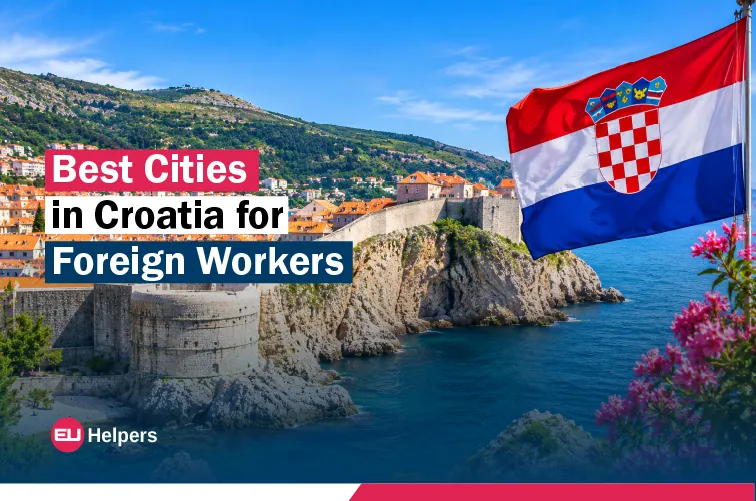

Best Cities in Croatia for Foreign Workers
Croatia (Hrvatska — Republic of Croatia) is small, yet the city you choose changes your salary, sector and working calendar more than national averages suggest. Zagreb dominates for IT, finance, pharmaceuticals and head-office roles; Split, Zadar and Dubrovnik run on Adriatic tourism with strong seasonal peaks; Rijeka owns the country's main port and logistics corridor; Pula and the wider Istria region blend premium hospitality with a surprising tech scene; and Osijek and Varaždin offer manufacturing, agri-food and IT jobs at far lower living costs. This EU Helpers guide compares the best Croatian cities for foreign workers across sector mix, salary, cost of living and quality of life — international candidates can explore Croatian opportunities through EU Helpers. Croatia has been an EU member since 1 July 2013, a NATO member since 2009, a Schengen member since 1 January 2023, a eurozone member since 1 January 2023 (the Croatian kuna was replaced by the euro at 7.53450 kuna per euro), and a Council of Europe member since 1996. The official language is Croatian (hrvatski).
Essential Context: How Croatian Cities Compare
Croatia's eight most relevant cities for foreign workers break down roughly as follows.
| City | Population (approx.) | Lead sectors | Cost of living |
|---|---|---|---|
| Zagreb | ~770,000 | IT, finance, pharmaceuticals, telecoms, public sector | Highest year-round |
| Split | ~160,000 | Tourism, construction, shipbuilding, services | High (summer spike) |
| Rijeka | ~110,000 | Port, logistics, energy, healthcare, education | Moderate |
| Osijek | ~95,000 | Agri-food, IT outsourcing, education | Low |
| Zadar | ~70,000 | Tourism, aquaculture, food and drink, logistics | Moderate (summer spike) |
| Pula / Istria | ~52,000 (Istria county ~195,000) | Hospitality, tech, manufacturing | Moderate (summer spike) |
| Varaždin | ~45,000 | Manufacturing, food processing, IT | Low |
| Dubrovnik | ~41,000 (summer peak much higher) | Premium hospitality, cruise tourism | Highest in season |
Croatia's national minimum wage is approximately €1,050 gross per month, and the national average gross salary is approximately €2,100–2,200 per month, with Zagreb typically 10–20% above that average. Net pay is typically around 70–75% of gross for average earners, and since everything is priced in euro, comparing offers across cities is straightforward.
Zagreb — The Capital
Zagreb is Croatia's economic engine and the default choice for most skilled foreign workers who want year-round employment.
Lead sectors: IT and software (Infobip, Ericsson Nikola Tesla, Span, and Rimac Group in nearby Sveta Nedelja), banking (Zagrebačka banka, Privredna banka Zagreb), pharmaceuticals (Pliva, part of Teva), telecoms (Hrvatski Telekom), energy head offices (INA, HEP), construction and logistics.
Salary context: Zagreb typically pays 10–20% above the national average, putting typical gross salaries at approximately €2,300–2,600 per month. Senior software engineers commonly earn €3,500–5,500+ gross; mid-level finance and IT roles €2,200–3,500; construction trades and logistics workers typically €1,200–1,800; entry-level roles start close to the €1,050 minimum wage.
Cost of living: Highest year-round in Croatia. Central one-bedroom rents typically €650–900/month; Novi Zagreb and Dubrava are cheaper. Groceries roughly €250–350/month.
Who it fits: IT, finance and pharmaceutical professionals, engineers, and construction and logistics workers wanting year-round contracts and the largest expat community.
Permit route: Stay and work permit (dozvola za boravak i rad) applied for by the employer at the MUP police administration (policijska uprava), usually after a labour market test (test tržišta rada) by HZZ; highly qualified candidates can use the EU Blue Card (plava karta EU).
Split — Dalmatia's Capital
Split is Croatia's second-largest city, the main hub of Dalmatia and the busiest ferry port for the central Adriatic islands.
Lead sectors: Tourism and hospitality (hotels, restaurants, nautical charter to Brač and Hvar), construction, shipbuilding and ship repair (Brodosplit), ferry operations (Jadrolinija), healthcare and a growing remote-work community.
Salary context: Year-round roles typically sit close to the national average. Hospitality salaries peak in season: chefs typically €1,600–2,800 gross per month, waiters and receptionists €1,200–1,700, often with accommodation and meals included. Construction trades typically earn €1,200–1,900.
Cost of living: High and seasonal. Central one-bedroom rents typically €700–1,000/month; long-term supply is tight, so staff housing is a major benefit.
Who it fits: Chefs, hotel and F&B staff, charter crew, construction trades, shipyard welders and remote professionals.
Rijeka — Croatia's Main Port
Rijeka sits on the Kvarner Gulf and is Croatia's largest cargo port and third-largest city.
Lead sectors: Port and logistics (Luka Rijeka and the Rijeka Gateway container terminal), freight toward Central Europe, energy (INA's Urinj refinery and the Krk LNG terminal), healthcare, the university, and Kvarner tourism in Opatija.
Salary context: Logistics and port roles typically pay near or slightly above the national average. Crane, forklift and terminal operators typically earn €1,300–2,000 gross per month; engineers and energy specialists €2,200–3,500; nurses and care staff typically €1,300–1,900.
Cost of living: Moderate. Central one-bedroom rents typically €500–700/month, noticeably lower than Zagreb or Split.
Who it fits: Port, maritime and logistics specialists, drivers and warehouse staff, energy technicians and healthcare workers.
Zadar — Northern Dalmatia's Growth City
Zadar is a fast-growing coastal city with a busy low-cost airport and a ferry port serving the Zadar archipelago.
Lead sectors: Tourism (Zadar, Nin, Pag, Biograd na Moru), aquaculture and fish processing (Cromaris and tuna farms), food and drink (Maraska), construction and the Gaženica port.
Salary context: Hospitality wages similar to Split in season: chefs typically €1,500–2,600 gross per month, housekeeping and service staff €1,150–1,600, often with housing. Aquaculture and fish-processing operators typically earn €1,100–1,500.
Cost of living: Moderate, with a strong summer spike. Off-season rents typically €550–800/month in central Zadar.
Who it fits: Hospitality staff wanting a calmer alternative to Split, aquaculture workers and construction trades.
Dubrovnik — Premium Hospitality Peak
Dubrovnik is Croatia's southernmost major city and its most famous tourist destination, with a large cruise port and international airport.
Lead sectors: Premium hotels (Adriatic Luxury Hotels, Valamar and international chains), fine dining, cruise and excursion services, and yacht tourism.
Salary context: Highly seasonal. Peak-season (May–October) hospitality salaries are among the highest in Croatia: experienced chefs typically €2,000–3,200 gross per month, senior front-office and F&B managers higher, with accommodation and meals frequently included. Winter employment is limited to year-round hotels and local services.
Cost of living: The most expensive city in Croatia during the season. Long-term rents typically €800–1,200/month and very scarce, which is why staff housing is common in hospitality contracts.
Who it fits: International chefs, sommeliers, F&B and front-office managers, spa and housekeeping staff on seasonal contracts.
Pula and Istria — Hospitality Meets Tech
Pula is the largest city in Istria, Croatia's westernmost peninsula, close to the Italian and Slovenian borders.
Lead sectors: Hospitality (Arena Hospitality Group in Pula, Maistra in Rovinj, Valamar in Poreč), tech (Infobip was founded in nearby Vodnjan), food and wine, and marinas.
Salary context: Tourism wages typically match Split and Zadar in season, with chefs typically €1,500–2,800 gross per month. Tech roles at Istrian employers can approach Zagreb levels, with developers typically €2,500–4,500 gross.
Cost of living: Moderate, with summer spikes. Central Pula rents typically €550–750/month off-season; Rovinj and Poreč are pricier.
Who it fits: Hospitality professionals wanting longer seasons, and software engineers who prefer coastal living near Italy.
Osijek — Eastern Croatia's Hub
Osijek is the capital of Slavonia, set on the Drava river near the Hungarian and Serbian borders.
Lead sectors: Agri-food (Žito, Kandit confectionery, grain and meat processing), IT outsourcing for international clients, metal processing and the university.
Salary context: Below the national average outside IT. Factory and food-processing operators typically earn €1,050–1,400 gross per month; skilled trades €1,200–1,700; software developers typically €1,800–3,500.
Cost of living: Among the lowest in Croatia. Central one-bedroom rents typically €350–500/month.
Who it fits: Agri-food and production workers, and IT professionals trading Zagreb salaries for much lower costs.
Varaždin — Northern Manufacturing Centre
Varaždin sits about an hour north of Zagreb near the Slovenian and Hungarian borders and is known for its baroque old town.
Lead sectors: Food processing (Vindija dairy and Koka poultry), textiles, metal and automotive-component manufacturing around Čakovec, and IT fed by the Faculty of Organization and Informatics (FOI).
Salary context: Moderate. Factory operators typically earn €1,050–1,450 gross per month; skilled trades and technicians €1,300–1,900; IT specialists typically €1,800–3,500.
Cost of living: Low. Central rents typically €400–550/month.
Who it fits: Production workers, food-industry specialists, technicians and IT professionals wanting small-city living near Zagreb.
Choosing the Right City for Your Profile
A quick match guide:
- IT, software, finance, pharmaceuticals → Zagreb first; Pula/Istria, Osijek and Varaždin as lower-cost alternatives.
- Shared services and head-office roles → Zagreb (very few alternatives).
- Port, logistics, maritime → Rijeka first, Split and Zadar second.
- Energy and refining → Rijeka and Krk, plus Zagreb head offices.
- Premium hospitality → Dubrovnik, Split, Istria (Rovinj, Poreč, Pula).
- Seasonal summer tourism → Dubrovnik, Split, Zadar, Hvar, Istria (May–October).
- Construction trades → Zagreb year-round; Split, Zadar and Istria for hotel and residential projects.
- Manufacturing and food processing → Varaždin, Osijek, Zagreb surroundings.
- Aquaculture and fish processing → Zadar and northern Dalmatia.
- Lowest cost of living with a job → Osijek, Varaždin, Rijeka.
Permit Route Across Croatian Cities
The work-permit framework is national, not city-specific. Under the Aliens Act (Zakon o strancima), non-EU workers in every Croatian city typically need a stay and work permit (dozvola za boravak i rad), a combined single permit that the employer usually applies for at the police administration or police station (policijska uprava / policijska postaja) of the Ministry of the Interior (MUP) where the company is based. In most cases the Croatian Employment Service (HZZ) first carries out a labour market test or issues an opinion, although some occupations and categories are exempt. Highly qualified candidates can apply for an EU Blue Card (plava karta EU) with a salary threshold tied to the national average gross salary, and seasonal workers in tourism and agriculture use seasonal stay and work permits. Remote workers can consider temporary stay for digital nomads (privremeni boravak digitalnih nomada). Every worker also needs a personal identification number (OIB), police address registration and HZZO health insurance. Typical timeline from signed offer to arrival is approximately 6–12 weeks.
Quality of Life Beyond Work
Each city has a distinct lifestyle: Zagreb for café culture and the largest expat community; Split for Mediterranean city life with islands nearby; Rijeka for a relaxed port-city feel; Zadar for sunsets, a compact old town and island hopping; Dubrovnik for a world-famous setting and an intense tourist season; Pula and Istria for Roman heritage, wine, truffles and proximity to Italy; Osijek for green, flat, affordable continental living; and Varaždin for baroque charm and quick access to Zagreb, Slovenia and Austria. The A1 and A6 motorways put most cities 2–5 hours apart, so weekend travel is easy wherever you base yourself.
Final Guidance
The best city in Croatia for a foreign worker depends almost entirely on your sector and how you feel about seasonal work, not on which city is objectively "best." Zagreb leads for IT, finance, pharmaceuticals and head-office careers at salaries typically 10–20% above the national average of approximately €2,100–2,200 gross, with the most stable year-round market; Split, Zadar, Dubrovnik and Istria offer the strongest hospitality pay during the May–October season, often with staff housing; Rijeka anchors port, logistics and energy; and Osijek and Varaždin trade narrower sector choice for the lowest living costs. Across all eight cities the national stay and work permit (dozvola za boravak i rad) framework applies uniformly through HZZ and the MUP police administrations, with the EU Blue Card available for highly qualified roles, and typical timelines from signed offer to arrival run 6–12 weeks. With EU membership since 2013, NATO since 2009, and Schengen and the euro since 1 January 2023, Croatia offers real city-level choice. International candidates can explore Croatian opportunities through EU Helpers. EU Helpers supports foreign workers with Croatia city-sector matching, offer-letter review, stay and work permit coordination, Zagreb / Split / Rijeka / Dubrovnik relocation planning, and clarity on the latest official requirements from Croatian immigration authorities.
FAQs
For most skilled foreign workers, Zagreb is the default best choice because it concentrates IT, finance, pharmaceuticals, telecoms and head-office roles, offers the most stable year-round employment and pays typically 10–20% above the national average. However, "best" depends on your sector. Hospitality staff often earn more in season in Dubrovnik, Split or Istria, and port specialists do best in Rijeka. EU Helpers matches your profile to the right city.
Zagreb pays the highest salaries overall, with typical gross pay approximately €2,300–2,600 per month against a national average of about €2,100–2,200. Senior IT and finance roles in Zagreb commonly reach €3,500–5,500+ gross. During the summer season, experienced chefs and managers in Dubrovnik and Split can also earn well above the national average, usually with accommodation included.
Osijek and Varaždin have the lowest cost of living among Croatia's main cities, with central one-bedroom rents typically €350–550 per month and groceries, utilities and dining noticeably cheaper than on the coast. Rijeka is a good middle ground at roughly €500–700 for a central flat. Dubrovnik and Split are the most expensive during the tourist season, and Zagreb is the most expensive year-round.
Most Zagreb office workers live within the city itself, with Donji Grad, Gornji Grad, Trešnjevka and Maksimir popular with expats for their trams, parks and cafés. Novi Zagreb and Dubrava offer lower rents with good public transport links. Some workers choose nearby towns such as Samobor, Velika Gorica or Zaprešić for cheaper housing and commute by bus or train. EU Helpers can help identify commuting-friendly neighbourhoods.
Dubrovnik, Split and Istria lead for Croatian hospitality, followed by Zadar and the Dalmatian islands such as Hvar and Brač. Dubrovnik offers top seasonal pay but the highest rents. Istria's large hotel groups such as Maistra, Valamar and Arena Hospitality Group often run longer seasons. Most contracts run May–October.
Rijeka is the clear leader as Croatia's largest cargo port, with container, bulk and rail operations linking the Adriatic to Central Europe. Split and Zadar offer ferry, passenger port and smaller cargo operations, while Zagreb hosts major road-freight and warehouse hubs.
Yes, especially for port, logistics, maritime and energy specialists, healthcare workers and academics. Rijeka offers a moderate cost of living, with rents typically 20–30% below Zagreb, and a seaside setting with Opatija and the Učka mountains nearby. Its job market is smaller and less international than Zagreb's, and IT and finance options are more limited.
The same national framework applies in every Croatian city. Most non-EU workers need a stay and work permit (dozvola za boravak i rad), applied for by the employer at the MUP police administration, usually after a labour market test or opinion from the Croatian Employment Service (HZZ). Highly qualified candidates can use the EU Blue Card (plava karta EU), and seasonal workers use seasonal permits. After arrival you register your address, obtain an OIB and collect your biometric residence card.
Zagreb has by far the strongest expat community, with the largest number of international professionals, co-working spaces, international schools and multinationals. Split has a large and growing community of remote workers and digital nomads, especially outside peak season. Istria attracts many international residents thanks to its proximity to Italy and Slovenia. Other cities have smaller but growing foreign populations.
EU Helpers matches foreign workers to the right Croatian city based on sector, profile and lifestyle preferences across all eight cities. We pre-vet relevant roles with Croatian employers and review offer letters for gross-versus-net clarity, seasonal terms and staff-housing value. We coordinate stay and work permit (dozvola za boravak i rad) and EU Blue Card steps with HZZ and the MUP police administrations, and prepare documents with Croatian translations and apostille arrangements. We also guide relocation, OIB, address registration and HZZO health insurance, with clarity on the latest official requirements from Croatian immigration authorities.
Still have questions? Get in touch
Ready to work in Croatia?
EU Helpers guides non-EU workers through Croatia’s work authorization. From Ministry of Interior coordination to Single Permit and EU Blue Card, we make your Croatia move seamless with distinctive Adriatic EU, Schengen and eurozone member positioning.