
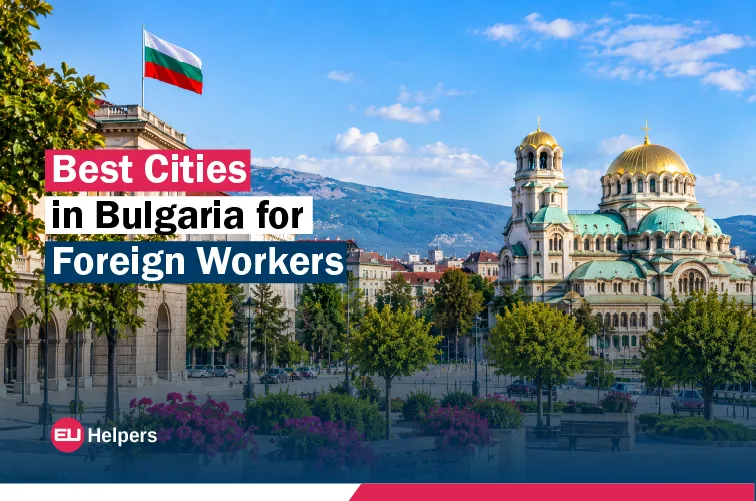

Best Cities in Bulgaria for Foreign Workers
Bulgaria (България — Republic of Bulgaria) is compact, yet the city you choose shapes your salary, sector and lifestyle far more than national averages suggest. Sofia dominates for IT, software, BPO and shared services; Plovdiv and Stara Zagora carry the manufacturing and energy backbone; Varna and Burgas combine ports, industry and summer tourism on the Black Sea; Ruse owns the Danube gateway to Romania; and Veliko Tarnovo, Blagoevgrad and Bansko offer smaller-city or seasonal options at very low cost. This EU Helpers guide compares the best Bulgarian cities for foreign workers across sector mix, salary, cost of living and quality of life — international candidates can explore Bulgarian opportunities through EU Helpers. Bulgaria has been an EU member since 1 January 2007, a NATO member since 2004, a full Schengen member since January 2025 (air and sea borders from March 2024, land borders from January 2025), a eurozone member since 1 January 2026 (the Bulgarian lev was replaced at a fixed rate of 1.95583 lev per euro), and a Council of Europe member since 1992.
Essential Context: How Bulgarian Cities Compare
Bulgaria's eight most relevant city areas for foreign workers break down roughly as follows.
| City | Population (approx.) | Lead sectors | Cost of living |
|---|---|---|---|
| Sofia | ~1.25 million | IT, software, BPO, shared services, finance | Highest in Bulgaria |
| Plovdiv | ~340,000 | Manufacturing, electronics, logistics, IT | Moderate |
| Varna | ~330,000 | Port, shipbuilding, chemicals, tourism, IT | Moderate (summer spike) |
| Burgas | ~200,000 | Refining, port, Black Sea hospitality | Moderate (summer spike) |
| Stara Zagora | ~120,000 | Energy, mining, food and drink, manufacturing | Low |
| Ruse | ~130,000 | Danube logistics, automotive components, machinery | Low |
| Veliko Tarnovo | ~65,000 | Education, heritage tourism, services | Low |
| Bansko / Blagoevgrad | ~8,000 / ~65,000 (winter peak much higher in Bansko) | Ski hospitality, education, services | Moderate in season / Low |
Bulgaria's national statutory minimum wage is EUR 620.20 gross per month, and the national average gross salary was approximately EUR 1,369 per month in the final quarter of 2025, with Sofia city well above that at roughly EUR 1,900. With a flat 10% income tax and low living costs, moderate salaries stretch far outside the capital.
Sofia — The Capital and Tech Hub
Sofia is Bulgaria's economic engine and the default choice for most skilled foreign workers.
Lead sectors: IT and software development (SAP Labs Bulgaria, Progress, Chaos, Bosch.IO and hundreds of outsourcing and product companies), BPO and multilingual customer support (TELUS Digital, Sutherland, Concentrix, HP and IBM shared-service centres), finance and banking (UniCredit Bulbank, DSK Bank, UBB) and professional services.
Salary context: Sofia typically pays 30–60% more than comparable roles elsewhere in Bulgaria. Senior software engineers commonly earn EUR 3,500–6,000+ gross monthly; multilingual BPO agents with German, French, Dutch or Nordic languages typically earn EUR 1,200–2,000, with team leads higher; junior office roles start around EUR 900–1,300.
Cost of living: Highest in Bulgaria. Central one-bedroom rents typically EUR 550–900/month, highest in Lozenets and Oborishte.
Who it fits: Software engineers, QA and DevOps specialists, multilingual customer-support and BPO staff, finance and shared-service professionals, English teachers and young professionals seeking the largest expat community.
Permit route: Single residence and work permit (единно разрешение за пребиваване и работа) or EU Blue Card (Синя карта на ЕС), applied for by the employer through the Migration Directorate (Дирекция „Миграция") of the Ministry of Interior, with an opinion from the Employment Agency (Агенция по заетостта).
Plovdiv — Bulgaria's Industrial Heartland
Plovdiv is Bulgaria's second-largest city, about 1.5 hours from Sofia by motorway.
Lead sectors: Manufacturing in the Trakia Economic Zone (Тракия икономическа зона), home to plants of Liebherr, ABB, Schneider Electric, Sensata Technologies and many automotive and electronics suppliers; logistics serving the Sofia–Istanbul corridor; agriculture and food processing on the Thracian plain; a growing IT and outsourcing scene.
Salary context: Below Sofia but rising quickly with industrial investment. Machine operators and assemblers typically earn EUR 800–1,200 gross monthly; skilled technicians, CNC operators and maintenance electricians EUR 1,100–1,800; engineers and IT specialists EUR 1,800–3,500.
Cost of living: Roughly 20–30% lower than Sofia. Central one-bedroom rents typically EUR 350–550/month.
Who it fits: Production and process engineers, CNC and maintenance technicians, electronics assemblers, logistics coordinators, and IT professionals wanting lower rents than Sofia.
Varna — The Black Sea Capital
Varna is Bulgaria's largest coastal city and third-largest overall, known as the country's "sea capital."
Lead sectors: Port of Varna logistics and shipping, shipbuilding and ship repair, the chemical and cement cluster in nearby Devnya (Solvay Sodi, Agropolychim, Devnya Cement), Black Sea hospitality at Golden Sands, St. Constantine and Helena and Albena, medical and maritime universities, and a solid IT and outsourcing sector.
Salary context: The Varna region's average gross salary was approximately EUR 1,280 per month in late 2025. Port, maritime and chemical-industry technicians typically earn EUR 1,100–2,000 gross; IT specialists EUR 1,800–3,500; summer hospitality staff EUR 800–1,300 with accommodation and meals often included.
Cost of living: Moderate; rents spike in summer. Central one-bedroom rents typically EUR 400–650/month outside the season.
Who it fits: Maritime and port specialists, chemical process operators, marine engineers, software developers seeking a coastal base, and seasonal hotel and resort staff.
Burgas — Refining, Port and Riviera Resorts
Burgas is Bulgaria's southern Black Sea hub and the gateway to Sunny Beach, Nessebar and Sozopol.
Lead sectors: Oil refining at Lukoil Neftochim Burgas, one of the largest refineries in the Balkans; Port of Burgas logistics; summer resort hospitality on the southern coast; resort construction.
Salary context: Refinery and petrochemical technicians typically earn EUR 1,300–2,500 gross monthly, with specialist engineers higher. Seasonal hospitality pay is typically EUR 800–1,400 for line staff and EUR 1,500–2,500+ for experienced chefs and F&B managers, usually with staff housing.
Cost of living: Moderate in winter, with sharp summer rent increases near the resorts. Central one-bedroom rents typically EUR 350–550/month off-season.
Who it fits: Refinery operators, process and HSE engineers, port workers, chefs, bartenders, front-desk and housekeeping staff for the May–October season. Seasonal work routes often fit best for resort roles.
Stara Zagora — Energy and Mining Centre
Stara Zagora sits in central southern Bulgaria at the heart of the country's largest energy complex.
Lead sectors: Energy and mining around the Maritsa Iztok (Марица-изток) lignite field and power plants, including Mini Maritsa Iztok, Maritsa East 2, ContourGlobal Maritsa East 3 and AES Galabovo; brewing (Zagorka, part of Heineken); the Zagore Economic Zone; machinery and food processing; the nearby Kazanlak engineering cluster.
Salary context: Energy and mining roles are among the best paid outside Sofia, typically EUR 1,300–2,500 gross for technicians and operators. General factory operators earn EUR 750–1,100; engineers EUR 1,800–3,000.
Cost of living: Low. Central one-bedroom rents typically EUR 250–400/month.
Who it fits: Power-plant and mining technicians, electrical and mechanical engineers, heavy-equipment operators, and food and beverage production specialists.
Ruse — The Danube Gateway
Ruse is Bulgaria's largest Danube port and sits directly across the river from Giurgiu, Romania, linked by the Danube Bridge.
Lead sectors: River-port and cross-border logistics, automotive components (Montupet, WITTE Automotive and other suppliers), machine-building and metalworking, textiles,.
Salary context: Below the national average outside skilled industry. Factory operators typically earn EUR 700–1,000 gross; skilled trades and technicians EUR 900–1,500; engineers EUR 1,500–2,500.
Cost of living: Among the lowest of Bulgaria's large cities. Central one-bedroom rents typically EUR 250–400/month. Bucharest is about 1.5 hours away by road.
Who it fits: Logistics and freight specialists, automotive and metalworking technicians, welders, machinists.
Bansko and Blagoevgrad — Ski Seasons and University Town
Bansko is Bulgaria's leading ski resort, in the Pirin mountains, while Blagoevgrad is the nearby regional centre and university town.
Lead sectors: In Bansko, winter ski hospitality (December–April) plus a well-known digital-nomad community. In Blagoevgrad, higher education (South-West University and the American University in Bulgaria), public services and cross-border trade.
Salary context: Highly seasonal in Bansko. Ski instructors, chefs and hotel staff typically earn EUR 800–1,500 gross per month in season, often with accommodation and ski pass included. Blagoevgrad region wages sit below the national average.
Cost of living: Moderate in Bansko during peak season, low the rest of the year. Blagoevgrad central rents typically EUR 250–400/month.
Who it fits: Ski instructors, chefs, F&B and spa staff for the winter season, remote workers, and academics or education staff in Blagoevgrad. Veliko Tarnovo, the historic former capital, is a similar low-cost option with a university and heritage tourism.
Choosing the Right City for Your Profile
A quick match guide:
- IT, software, data, finance → Sofia first; Plovdiv and Varna as lower-cost alternatives.
- BPO & multilingual customer support → Sofia first, Plovdiv and Varna growing.
- Manufacturing, electronics & automotive → Plovdiv (Trakia Economic Zone), Ruse, Stara Zagora.
- Energy, mining & power generation → Stara Zagora (Maritsa Iztok).
- Refining & petrochemicals → Burgas; chemicals in Varna–Devnya.
- Port, logistics & maritime → Varna and Burgas on the Black Sea, Ruse on the Danube.
- Summer hospitality → Varna (Golden Sands, Albena) and Burgas (Sunny Beach, Nessebar, Sozopol).
- Winter hospitality → Bansko, plus Borovets and Pamporovo.
- Education & academia → Sofia, Plovdiv, Veliko Tarnovo, Blagoevgrad.
- Lowest cost of living with a job → Ruse, Stara Zagora, Veliko Tarnovo, Blagoevgrad.
Permit Route Across Bulgarian Cities
The work-permit framework is national, not city-specific. Most non-EU workers in every Bulgarian city use the single residence and work permit, which the employer applies for through the Migration Directorate of the Ministry of Interior; the Employment Agency checks the labour-market test (typically a vacancy advertised for around 15 days) and the employer's foreign-worker quota, typically up to 20% of staff or 35% for SMEs. The EU Blue Card skips the labour-market test and requires a salary of at least 1.5 times the national average gross wage, approximately EUR 2,050 per month at recent levels. Seasonal work (up to nine months), intra-corporate transfer and short-term registration routes through the Employment Agency also apply uniformly. After arrival you receive a residence card and a personal number for foreigners (ЛНЧ — LNCh), used for tax and social security. Typical timeline from signed offer to arrival is about 3–4 months.
Quality of Life Beyond Work
Each city has a distinct lifestyle: Sofia for cosmopolitan buzz, international schools and skiing on Vitosha; Plovdiv for its Roman theatre, artsy Kapana district and relaxed pace; Varna for beaches, sea gardens and a lively summer scene; Burgas for lakes, coastal promenades and quick access to the southern resorts; Stara Zagora for wide boulevards, parks and mineral springs; Ruse for Danube riverside living and easy trips to Bucharest; Veliko Tarnovo for medieval heritage and student life; and Bansko for mountain living and a strong remote-work community. Full Schengen membership means no border checks to Greece or Romania.
Final Guidance
The best city in Bulgaria for a foreign worker depends almost entirely on your sector and lifestyle preferences, not on which city is objectively "best." Sofia leads for IT, BPO and finance at Bulgaria's highest salaries and costs; Plovdiv and Stara Zagora anchor manufacturing, electronics, energy and mining; Varna and Burgas blend Black Sea living with real industry (ports, chemicals, refining) and summer hospitality; Ruse offers Danube logistics and automotive work at very low cost; and Bansko, Blagoevgrad and Veliko Tarnovo suit seasonal, academic and lifestyle-led moves. Across every city the national single permit and EU Blue Card framework applies uniformly through the Employment Agency and the Migration Directorate, with offer-to-arrival typically 3–4 months. With EU membership since 2007, NATO since 2004, full Schengen since 2025, the euro since 1 January 2026 and low living costs, Bulgaria offers real city-level choice. International candidates can explore Bulgarian opportunities through EU Helpers. EU Helpers supports foreign workers with Bulgaria city-sector matching, offer-letter review, single permit and EU Blue Card coordination, Sofia / Plovdiv / Varna / Burgas relocation planning, and clarity on the current official requirements from Bulgarian immigration authorities.
FAQs
For most skilled foreign workers, Sofia is the default best choice because it concentrates IT, software, BPO, finance and shared services, the largest expat community and Bulgaria's highest salaries. However, "best" depends on your sector — manufacturing specialists often do better in Plovdiv, energy workers in Stara Zagora, maritime and resort staff in Varna or Burgas, and ski-season staff in Bansko. EU Helpers matches your profile to the right city.
Sofia pays the highest salaries overall, with the city's average gross salary approximately EUR 1,900 per month against a national average of roughly EUR 1,370. Senior software engineers in Sofia typically earn EUR 3,500–6,000+ gross monthly. Outside the capital, the Burgas refinery, the Maritsa Iztok energy complex near Stara Zagora and specialist roles in Varna's port and chemical cluster pay well above local averages.
Ruse, Stara Zagora, Veliko Tarnovo and Blagoevgrad have the lowest cost of living among Bulgaria's main cities, with central one-bedroom rents typically EUR 250–400/month and groceries, utilities and dining noticeably cheaper than in Sofia. Plovdiv is roughly 20–30% cheaper than the capital while still offering a broad job market, and even Varna and Burgas are noticeably cheaper than Sofia outside the summer season.
Most Sofia office workers live within the city — Lozenets, Oborishte, Ivan Vazov, Mladost (near Business Park Sofia) and the centre are popular with international staff. The metro links most business districts, so choosing a flat near a metro line makes daily commuting easy. EU Helpers can help identify commuting-friendly neighbourhoods.
Plovdiv is the strongest choice thanks to the Trakia Economic Zone, which hosts plants of Liebherr, ABB, Schneider Electric, Sensata Technologies and many automotive and electronics suppliers. Stara Zagora is the leader for energy and mining engineering around Maritsa Iztok, while Ruse offers automotive components and machine-building. Skilled technicians and engineers in these cities typically earn EUR 1,100–3,000 gross monthly depending on role.
Varna and Burgas lead for Black Sea hospitality, together with nearby resorts such as Golden Sands, Albena, Sunny Beach, Nessebar and Sozopol. The season typically runs May to October, and many employers include accommodation and meals. Varna offers more year-round work thanks to its larger urban economy, while winter hospitality shifts to Bansko, Borovets and Pamporovo.
Yes, especially for manufacturing, electronics, logistics and food-processing specialists, and increasingly for IT professionals who want lower rents. Plovdiv is about 1.5 hours from Sofia by motorway and has a vibrant old town. Salaries are lower than in the capital, but rents and everyday costs are typically 20–30% lower as well.
The same national framework applies in every Bulgarian city. Most non-EU workers need a single residence and work permit, applied for by the employer through the Migration Directorate of the Ministry of Interior with an Employment Agency opinion, followed by a type D visa. Highly qualified candidates earning at least 1.5 times the national average wage can use the EU Blue Card, and seasonal and intra-corporate transfer routes are also national.
Sofia has by far the strongest expat community, with international professionals, English-speaking co-working spaces, international schools and many multinational employers. Varna and Plovdiv have growing international communities, Bansko is known for its digital-nomad scene, and Veliko Tarnovo and nearby villages have long attracted British and other European residents.
EU Helpers matches foreign workers to the right Bulgarian city based on sector, profile and lifestyle across Sofia, Plovdiv, Varna, Burgas, Stara Zagora, Ruse, Veliko Tarnovo, Bansko and Blagoevgrad, pre-vets roles with Bulgarian employers, and reviews offer letters for gross-versus-net clarity under the flat 10% income tax and social contributions. We coordinate single permit and EU Blue Card applications with the Employment Agency and the Migration Directorate, prepare documents with Bulgarian translations and apostilles, guide you through the type D visa, residence card and personal number for foreigners (ЛНЧ), and help with city-specific relocation and current official requirements.
Still have questions? Get in touch
Ready to work in Bulgaria?
EU Helpers guides non-EU workers through Bulgaria’s work authorization. From Migration Directorate and Employment Agency coordination to Single Permit, EU Blue Card and Seasonal Worker routes, we make your Bulgaria move seamless with distinctive Balkan EU member positioning.