
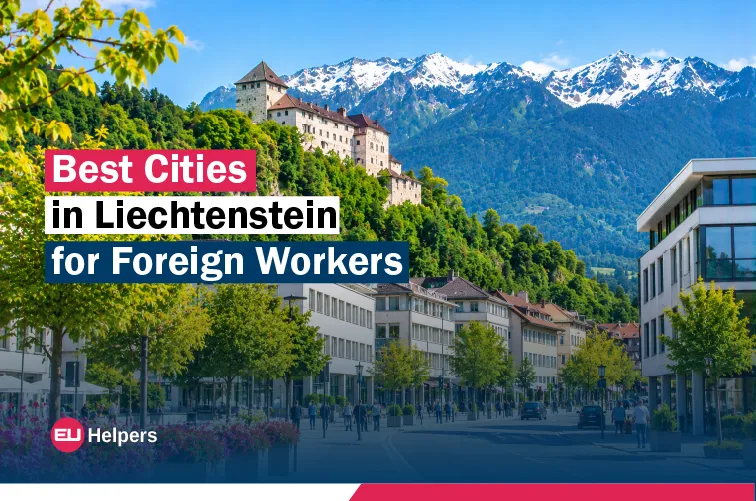

Best Cities in Liechtenstein for Foreign Workers
Liechtenstein (Fürstentum Liechtenstein — Principality of Liechtenstein) covers about 160 km² between Switzerland and Austria, with roughly 39,000 residents. It has no cities in the usual sense — only 11 municipalities (Gemeinden), the largest of which, Schaan and Vaduz, have around 6,000 inhabitants each — so in this guide "city" means municipality. Liechtenstein also has more jobs than working residents: typically around 55–57% of employees live in Switzerland or Austria and commute in daily, so for many foreign workers the real question is whether to live in Liechtenstein at all. This EU Helpers guide compares the main municipalities and the cross-border towns where most commuters live, across sector mix, salary, cost of living and quality of life — international candidates can explore Liechtenstein opportunities through EU Helpers. Liechtenstein is NOT an EU member, but it has been part of the European Economic Area (EEA) since 1995 and a member of the European Free Trade Association (EFTA); it joined the Schengen Area in 2011, uses the Swiss franc (CHF) under a customs and currency union with Switzerland rather than the euro, and is NOT a NATO member.
Essential Context: How Liechtenstein's Municipalities Compare
The places most relevant to foreign workers in and around Liechtenstein break down roughly as follows.
| Place | Population (approx.) | Lead sectors | Cost of living |
|---|---|---|---|
| Vaduz | ~6,000 | Banking, trust and fiduciary services, government, culture | Very high |
| Schaan | ~6,200 | Industry (Hilti, Ivoclar, Hilcona), logistics, retail | Very high |
| Balzers | ~4,800 | High-tech coatings, vacuum technology, manufacturing | High |
| Triesen | ~5,700 | Residential, SMEs, education, crafts | High |
| Eschen–Nendeln | ~4,700 | Automotive components, manufacturing, logistics | High |
| Ruggell and Gamprin-Bendern (Unterland) | ~2,500 and ~1,800 | Industrial estates, SMEs, trades | High (slightly lower rents) |
| Swiss Rhine Valley (Buchs, Sargans, St. Gallen) | Buchs ~13,000; St. Gallen ~76,000 | Cross-border base, local industry and services | High but below Liechtenstein |
| Vorarlberg, Austria (Feldkirch and nearby) | Feldkirch ~36,000 | Cross-border base, hospital, education, industry | Moderate to high |
There is no general statutory minimum wage; pay is set by contract and, in many sectors, by collective agreements (Gesamtarbeitsverträge — GAV) with minimum scales. The median gross monthly wage is approximately CHF 7,400 (roughly €7,900 at about €1.05–1.07 per franc), but housing is scarce, so where you live shapes your budget as much as where you work.
Vaduz — The Capital
Vaduz is the capital and seat of the Prince, the National Government (Regierung) and Parliament (Landtag), and the centre of Liechtenstein's financial industry.
Lead sectors: Private banking and wealth management (LGT, Liechtensteinische Landesbank and VP Bank are headquartered here), trust and fiduciary companies (Treuhand), insurance, legal and tax advisory, public administration, the University of Liechtenstein, the National Hospital (Landesspital) and heating-technology maker Hoval.
Salary context: Vaduz typically offers the strongest salaries for office roles. Experienced banking, compliance and IT professionals commonly earn CHF 8,000–12,000+ gross monthly (about €8,500–12,800); junior and administrative roles typically start around CHF 5,000–6,000 (about €5,300–6,400), often paid 13 times a year.
Cost of living: Very high. One-bedroom flats typically rent for about CHF 1,600–2,300 per month (roughly €1,700–2,450), with Swiss-level prices for groceries and dining.
Who it fits: Banking and compliance professionals, fiduciaries, lawyers, IT specialists in finance, healthcare and academic staff.
Permit route: EEA nationals need an APA registration as a cross-border commuter, or a residence permit (Aufenthaltsbewilligung) won through the EEA quota or lottery; non-EEA nationals need an employer-led work authorisation from the Migration and Passport Office (Ausländer- und Passamt — APA), which is generally limited to managers, specialists and other highly qualified workers.
Schaan — The Industrial Heart
Schaan, just north of Vaduz, is the most populous municipality and the main industrial and rail hub.
Lead sectors: Construction technology (Hilti's global headquarters), dental materials (Ivoclar), food production (Hilcona), audio connectors (Neutrik), logistics, retail and commercial services along the main road to Vaduz.
Salary context: Engineering, R&D and IT roles at the large industrial groups typically pay CHF 7,500–11,000+ gross monthly (about €8,000–11,700). Skilled production workers, technicians and logistics staff commonly earn CHF 5,000–7,000 (about €5,300–7,500), depending on the collective agreement and experience.
Cost of living: Very high, broadly similar to Vaduz.
Who it fits: Engineers, R&D scientists, industrial software developers, supply-chain specialists and production technicians.
Balzers — Precision Technology in the South
Balzers is Liechtenstein's southernmost municipality, on the Swiss border near Sargans.
Lead sectors: Thin-film and surface coatings (Oerlikon Balzers), vacuum and measurement technology (Inficon has a major site here), precision engineering and local trades.
Salary context: High-tech engineering and physics roles typically pay CHF 7,500–11,000 gross monthly (about €8,000–11,700); technicians and machine operators commonly CHF 5,000–7,000 (about €5,300–7,500).
Cost of living: High, though rents are often slightly below Vaduz. Many Balzers employees live in nearby Swiss towns such as Sargans, Bad Ragaz or Trübbach.
Who it fits: Physicists, materials and coating engineers, vacuum-technology specialists, precision mechanics and quality engineers.
Triesen — Residential Living Between Vaduz and Balzers
Triesen lies between Vaduz and Balzers, with mountain Triesenberg above it.
Lead sectors: Small and medium-sized manufacturing and service firms, crafts and construction trades, education (the Private University in the Principality of Liechtenstein is based here), retail and local services.
Salary context: Close to the national level. Skilled trades typically earn CHF 5,000–6,500 gross monthly (about €5,300–6,950); office and technical roles in SMEs CHF 6,000–9,000 (about €6,400–9,600).
Cost of living: High. Popular with families and Vaduz workers, as the capital is a short bus ride away.
Who it fits: Residence-permit holders wanting a quieter base near Vaduz, tradespeople and educators.
Eschen–Nendeln — Unterland Manufacturing
Eschen, with the village of Nendeln, is the largest municipality of the Unterland (Lower Country) in the north.
Lead sectors: Automotive components (thyssenkrupp Presta's steering-systems operations), metalworking and plastics, logistics and warehousing, construction, local services.
Salary context: Production engineers and IT specialists typically earn CHF 7,000–10,000 gross monthly (about €7,500–10,700); machine operators, CNC technicians and warehouse staff CHF 4,800–6,500 (about €5,100–6,950).
Cost of living: High, with rents often a little below Vaduz and Schaan; convenient for commuters from Feldkirch.
Who it fits: Automotive and production engineers, CNC machinists, quality and maintenance technicians.
Ruggell and Bendern — The Northern Industrial Estates
Ruggell is Liechtenstein's northernmost municipality, on the Austrian border, and Bendern is the main village of Gamprin; with Mauren and Schellenberg they make up the rest of the Unterland.
Lead sectors: Industrial estates with medium-sized manufacturers, engineering suppliers, logistics, construction and agriculture.
Salary context: Similar to the Unterland average. Skilled production and trade roles typically pay CHF 4,800–6,500 gross monthly (about €5,100–6,950); engineering and specialist roles higher.
Cost of living: High, though among the most affordable housing in the country; village life is quiet.
Who it fits: Production workers, tradespeople, logistics staff and daily commuters from Vorarlberg.
Swiss Rhine Valley — Buchs, Sargans and St. Gallen
Across the Rhine in the canton of St. Gallen, towns such as Buchs, Sevelen, Sargans and Bad Ragaz house many of Liechtenstein's commuters — typically around 60% of commuters live in Switzerland. Buchs is minutes from Schaan; the city of St. Gallen is about an hour away.
Lead sectors (local): Local industry and services in Buchs and Sargans; St. Gallen adds universities, insurance and a broader job market for partners.
Cost of living: High but usually below Liechtenstein, with more housing on offer. One-bedroom rents in Buchs or Sargans commonly run about CHF 1,200–1,700 (roughly €1,300–1,800).
Commuter context: Living in Switzerland requires a Swiss residence permit from the cantonal migration office, separate from Liechtenstein's system and generally easier for EU/EFTA nationals. Under the Liechtenstein–Switzerland double taxation agreement, commuters are generally taxed in their country of residence, while social-security contributions are normally paid where you work (Liechtenstein's AHV-IV-FAK schemes plus occupational pension). Health-insurance rules for commuters should be checked individually.
Who it fits: Workers without a Liechtenstein residence permit, families wanting more housing choice and Swiss schools.
Vorarlberg, Austria — Feldkirch and Surroundings
Vorarlberg, Austria's westernmost state, is home to around a third of Liechtenstein's commuters. Feldkirch is the main base, with Rankweil, Frastanz and Dornbirn also common.
Lead sectors (local): A regional hospital and services in Feldkirch, and strong industry across Vorarlberg.
Cost of living: Moderate to high by Austrian standards but clearly below Liechtenstein. One-bedroom rents typically run about €800–1,200 per month, so a Swiss-franc salary goes noticeably further.
Commuter context: Living in Austria requires registration (and, for non-EEA nationals, an Austrian residence title) under Austrian rules. Under the Austria–Liechtenstein double taxation agreement, cross-border commuters are generally taxed in Austria, with Liechtenstein typically able to withhold a small source tax that is credited against Austrian tax. Social-security contributions are normally paid in Liechtenstein. Independent tax advice is recommended.
Who it fits: Budget-conscious workers, families and EEA nationals without a Liechtenstein permit.
Choosing the Right Base for Your Profile
A quick match guide:
- Private banking, wealth management, trust services → Vaduz (very few alternatives).
- Industrial engineering, R&D, construction technology → Schaan.
- Coatings, vacuum and precision technology → Balzers.
- Automotive components and manufacturing → Eschen–Nendeln.
- Production, trades and logistics in SMEs → Ruggell, Bendern, Mauren and the Unterland estates.
- Quieter residential base near Vaduz → Triesen or Triesenberg.
- No Liechtenstein residence permit, Swiss lifestyle → Buchs, Sargans or St. Gallen.
- Lowest cost of living with a Liechtenstein salary → Feldkirch and Vorarlberg.
- Working in the south, living in Switzerland → Balzers job, home in Sargans or Bad Ragaz.
- Working in the north, living in Austria → Eschen or Ruggell job, home in Feldkirch.
Permit Route Across Liechtenstein Municipalities
The permit framework is national, not municipal, and every municipality relies on the same Migration and Passport Office (Ausländer- und Passamt — APA). EEA nationals can work in Liechtenstein freely as cross-border commuters after the employer registers them with the APA, but taking up residence is limited by a strict annual quota: typically 56 residence permits a year for employed EEA citizens, half allocated by public draw (lottery) held twice a year and half by government decision. Swiss nationals have a small separate quota. Non-EEA nationals generally need employer-led authorisation, which is restricted to managers, specialists and other highly qualified workers after the employer shows no suitable candidate was available locally; non-EEA cross-border commuters need a cross-border commuter permit (Grenzgängerbewilligung) and must also hold residence rights in Switzerland or the EEA country where they live. Timelines typically range from a few weeks for EEA commuters to several months for non-EEA specialists.
Quality of Life Beyond Work
Each base has a distinct lifestyle: Vaduz for culture, museums and restaurants; Schaan for transport links; Balzers for a quiet southern village with trails; Triesen and Triesenberg for family living, with the Malbun ski area above; the Unterland for rural calm and Rhine cycle paths; Buchs and St. Gallen for Swiss town life; and Feldkirch for a medieval old town and Austrian prices. Balzers to Ruggell is about 25 minutes by car, and Zurich airport roughly 90 minutes away.
Final Guidance
The best place for a foreign worker in Liechtenstein depends less on which municipality is "best" and more on your sector, your nationality and whether you can obtain residence. Vaduz leads for banking and trust services; Schaan concentrates industrial headquarters; Balzers specialises in coatings and vacuum technology; Eschen–Nendeln and the Unterland offer manufacturing and logistics; Triesen is a quieter residential base. Because residence permits are tightly limited by quota and lottery, most foreign workers live in the Swiss Rhine Valley or in Vorarlberg and commute daily, with tax and social-security rules to check before signing. With EEA membership since 1995, Schengen since 2011, the Swiss franc, high wages and no general statutory minimum wage, Liechtenstein rewards skilled candidates who plan carefully. International candidates can explore Liechtenstein opportunities through EU Helpers. EU Helpers supports foreign workers with location matching, offer-letter review, APA permit guidance and cross-border housing planning.
FAQs
For most skilled foreign workers, Vaduz or Schaan offers the strongest job market, with Vaduz leading in banking and trust services and Schaan in industry and R&D. Because residence permits are tightly limited, the best home base is often Buchs, Sargans or Feldkirch. EU Helpers helps match your profile to the right workplace and home base.
Liechtenstein has only about 39,000 residents but more jobs than its own workforce can fill, and housing is scarce and expensive. EEA residence permits are capped by quota and partly allocated by lottery, and non-EEA residence is limited to highly qualified workers. So more than half of employees typically commute daily from Switzerland or Austria, often in 10–30 minutes.
Vaduz typically pays the highest office salaries, especially in private banking, compliance, wealth management and fund administration. Engineering and R&D roles at the industrial headquarters in Schaan and the high-tech firms in Balzers can match those levels. There is no general statutory minimum wage, but many sectors have collective agreements with minimum scales.
Feldkirch and the rest of Vorarlberg in Austria are usually the most affordable bases, with one-bedroom rents commonly around €800–1,200 a month and prices in euros. Buchs and Sargans are cheaper than Liechtenstein but still at Swiss levels, and inside Liechtenstein the Unterland tends to have slightly lower rents.
Under Liechtenstein's double taxation agreements with Switzerland and Austria, cross-border commuters who return home daily are generally taxed in their country of residence. In the Austrian case, Liechtenstein can typically withhold a small source tax that is credited against Austrian tax. Social-security contributions are normally paid in Liechtenstein as the country of work. Independent tax advice is recommended.
Schaan is the main industrial hub, home to Hilti's headquarters, Ivoclar and Hilcona. Balzers specialises in coatings and vacuum technology through companies such as Oerlikon Balzers and Inficon. Eschen–Nendeln hosts automotive-component production, and Ruggell and Bendern have industrial estates.
Liechtenstein is not an EU member but has belonged to the European Economic Area since 1995 and to EFTA, which gives EEA citizens access to its labour market subject to residence quotas. It joined the Schengen Area in 2011. It uses the Swiss franc under a customs and currency union with Switzerland, not the euro, and it is not a NATO member.
The same national rules apply everywhere, administered by the Migration and Passport Office (Ausländer- und Passamt — APA). EEA nationals can commute in after employer registration, but living in Liechtenstein requires a residence permit from the annual quota or lottery. Non-EEA nationals need employer-led authorisation limited to managers, specialists and other highly qualified workers, plus residence rights in Switzerland or the EEA if commuting.
German is the official language, and most workplaces, authorities and daily life operate in German, with the local Alemannic dialect widely spoken. Some banking, industrial and R&D roles use English, but German helps significantly with permits, housing and integration.
EU Helpers matches foreign workers to the right Liechtenstein workplace and home base, comparing Vaduz, Schaan, Balzers, Triesen, Eschen–Nendeln and the Unterland with commuter towns such as Buchs, Sargans, St. Gallen and Feldkirch. The team reviews offer letters in Swiss francs, explains APA registration, the EEA quota and lottery and non-EEA specialist rules, and flags cross-border tax and social-security points to check. EU Helpers also supports housing searches on both sides of the border.
Still have questions? Get in touch
Ready to work in Liechtenstein?
EU Helpers guides non-EU workers through Liechtenstein's work authorisation. From Immigration and Passport Office coordination to quota-based residence and work permit routes, we make your move clear, with distinctive Alpine EEA positioning.