
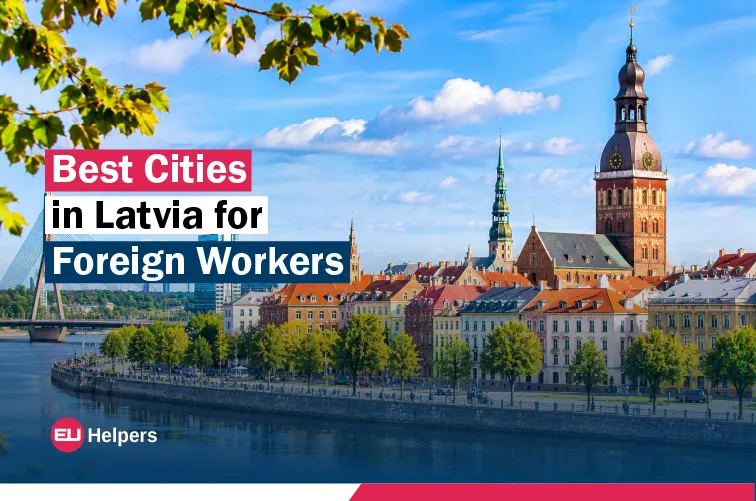

Best Cities in Latvia for Foreign Workers
Latvia (Latvija — Republic of Latvia) has roughly 1.86 million people, and that small scale shapes every decision about where to work. Put plainly: Riga dominates. Together with the surrounding Pierīga region it holds roughly half of the population and most international employers, English-speaking roles and expat infrastructure. Jūrmala works as Riga's seaside suburb and resort; Liepāja and Ventspils carry port and industrial careers on the Baltic coast; Daugavpils and Rēzekne anchor manufacturing in eastern Latgale; and Jelgava and Valmiera offer compact regional economies with lower living costs. This EU Helpers guide compares the best Latvian cities for foreign workers across sector mix, salary, cost of living and quality of life — international candidates can explore Latvian opportunities through EU Helpers. Latvia has been an EU member and a NATO member since 2004, joined the Schengen Area in 2007 and adopted the euro (EUR) in 2014,; the official language is Latvian (latviešu valoda).
Essential Context: How Latvian Cities Compare
Latvia's eight most relevant cities for foreign workers break down roughly as follows.
| City | Population (approx.) | Lead sectors | Cost of living |
|---|---|---|---|
| Riga (Rīga) | ~590,000 | IT, shared services, finance, logistics, aviation | Highest in Latvia |
| Daugavpils | ~78,000 | Electronics, optics, metalworking, food processing | Low |
| Liepāja | ~67,000 | Port, SEZ manufacturing, textiles, metalwork | Low to moderate |
| Jelgava | ~55,000 | Manufacturing, agri-food, university research | Low to moderate |
| Jūrmala | ~52,000 | Resort hospitality, spa and rehabilitation, Riga commuting | Moderate to high (summer spike) |
| Ventspils | ~33,000 | Freeport, maritime, high-tech park, light industry | Low to moderate |
| Rēzekne | ~26,000 | SEZ industry, logistics, food processing | Low |
| Valmiera | ~23,000 | Glass fibre, dairy, regional services, education | Low to moderate |
Official statistics typically show average gross pay in Riga and Pierīga around 10% above the national average of roughly €1,850–€1,900 gross a month, while Latgale (Daugavpils, Rēzekne) sits roughly a third below Riga. Net pay is typically around three quarters of gross, and living costs fall faster than salaries outside the capital.
Riga — The Capital
Riga is Latvia's economic engine and, for most skilled foreign workers, the default and often the only realistic choice.
Lead sectors: IT and software (Tietoevry, Accenture, startups such as Printful), shared service centres for Nordic and international groups, banking and fintech (Swedbank, SEB, Luminor), aviation (airBaltic), logistics through the Freeport of Riga, construction, and hospitality.
Salary context: Riga typically pays 10–30% more than comparable roles elsewhere in Latvia. Senior software engineers typically earn €3,500–6,000+ gross monthly; multilingual shared-services specialists €1,600–2,800; mid-level finance and analytics staff €2,000–3,500; entry-level customer-service and junior roles start around €1,100–1,500.
Cost of living: Highest in Latvia. Central one-bedroom rents typically €450–750/month, with the Quiet Centre (Klusais centrs) at the top; outer districts such as Purvciems or Imanta run €350–500. Groceries typically €250–350/month, and heating raises winter utility bills.
Who it fits: IT professionals, multilingual shared-services staff, finance and fintech specialists, aviation and logistics professionals, and anyone wanting the strongest expat community and international schools.
Permit route: Long-term residence permit with the right to work (uzturēšanās atļauja ar tiesībām strādāt) or an EU Blue Card (ES zilā karte), with the employer first registering the vacancy with the State Employment Agency (Nodarbinātības valsts aģentūra — NVA) and then submitting the invitation to the Office of Citizenship and Migration Affairs (Pilsonības un migrācijas lietu pārvalde — PMLP).
Jūrmala — Riga's Seaside Resort
Jūrmala is a long resort town on the Gulf of Riga, about 25 km and roughly 30–40 minutes by train from central Riga.
Lead sectors: Resort hotels and spas, medical rehabilitation (Ķemeri and Jaunķemeri have a long sanatorium tradition), summer hospitality around Majori and Jomas iela, and conference tourism. Many residents simply commute to Riga.
Salary context: Hospitality pay is broadly in line with Riga, typically €1,000–1,600 gross for front-line staff and €1,800–3,000 for chefs, spa managers and hotel supervisors, with peak-season demand from June to August.
Cost of living: Moderate to high. Long-term rents in winter typically €400–650/month, but summer short-let demand pushes prices up sharply near the beach. Groceries and services are close to Riga levels.
Who it fits: Hotel and spa professionals, chefs and F&B managers, rehabilitation therapists, and Riga office workers who prefer quiet coastal living and do not mind a daily train commute.
Daugavpils — Latgale's Industrial Centre
Daugavpils is Latvia's second-largest city, in the southeast near the Lithuanian and Belarusian borders, roughly three hours from Riga by road or rail.
Lead sectors: Electronics and optics (Axon Cable, SMD Baltic, Regula Baltija, Pulsar Optics), metal structures (East Metal, Belmast), rail rolling-stock repair (Daugavpils Locomotive Repair Plant) and food processing (Latvijas Maiznieks, Latgales Piens), supported by Latgale Special Economic Zone tax incentives.
Salary context: Below the national average outside skilled technical roles. Machine operators and assembly workers typically earn €900–1,300 gross; welders, CNC operators and electricians €1,200–1,900; engineers and quality specialists €1,600–2,800.
Cost of living: Among the lowest in Latvia. Central one-bedroom rents typically €200–350/month, with groceries and dining clearly cheaper than Riga.
Who it fits: Electronics and optics technicians, welders and metalworkers, engineers, food-processing specialists, and Russian speakers — Daugavpils has a majority Russian-speaking population, although Latvian remains the official working language and is increasingly required.
Liepāja — Port City on the Baltic Coast
Liepāja is Latvia's third-largest city and its windiest, on the southwestern coast roughly two and a half to three hours from Riga.
Lead sectors: Port of Liepāja stevedoring and logistics (Stena Line ferry services, bulk and agricultural terminals), manufacturing in the Liepāja Special Economic Zone (Lauma Fabrics textiles and medical products, Interspiro breathing equipment, Caljan conveyor systems, Röchling plastic parts, Yokohama TWS wheel rims, metal processing), ship repair, and higher education at Liepāja University.
Salary context: Close to or slightly below the national average. Port workers and crane operators typically earn €1,100–1,800 gross; skilled production technicians €1,100–1,700; engineers and production managers €1,800–3,000.
Cost of living: Low to moderate. One-bedroom rents typically €250–450/month, with the beachside areas and renovated city centre at the upper end.
Who it fits: Port and logistics specialists, manufacturing technicians and engineers, textile and plastics specialists, maritime trades, and anyone wanting a real seaside city well below Riga costs.
Jelgava — Riga's Southern Neighbour
Jelgava sits about 45 km southwest of Riga, roughly 40–50 minutes by train, and is the centre of the fertile Zemgale farming region.
Lead sectors: Manufacturing in the city's industrial zones (metalworking, plastics, construction materials, food processing), agri-food and grain trading, logistics along the Riga–Lithuania corridor, and research and teaching at the Latvia University of Life Sciences and Technologies (Latvijas Biozinātņu un tehnoloģiju universitāte).
Salary context: Slightly below Riga. Production workers typically earn €1,000–1,500 gross; skilled trades and technicians €1,300–2,000; engineers and agronomists €1,700–2,800. Many residents commute to higher-paying Riga roles.
Cost of living: Low to moderate. One-bedroom rents typically €300–450/month, noticeably below Riga for comparable quality.
Who it fits: Manufacturing technicians, agri-food and agricultural specialists, researchers and doctoral candidates, and Riga workers who want lower rent with a manageable commute.
Ventspils — Freeport and Technology Park
Ventspils is a compact, well-kept port city on the northwestern Kurzeme coast, about two and a half hours from Riga.
Lead sectors: Freeport of Ventspils cargo handling, diversified after Russian transit volumes fell; maritime services; the Ventspils High Technology Park for IT, electronics and engineering companies; light manufacturing; and Ventspils University of Applied Sciences, home to the Ventspils International Radio Astronomy Centre.
Salary context: Around the national average for technical roles. Port and terminal staff typically earn €1,100–1,800 gross; electronics and IT technicians €1,300–2,200; engineers and specialists €1,800–3,000.
Cost of living: Low to moderate. One-bedroom rents typically €250–400/month.
Who it fits: Port and maritime specialists, electronics and engineering technicians, researchers in radio astronomy and space technology, and families wanting a quiet, safe coastal town.
Valmiera — Vidzeme's Regional Hub
Valmiera is the main city of northern Vidzeme, about 110 km and roughly an hour and a half by road from Riga, on the edge of Gauja National Park.
Lead sectors: Glass-fibre manufacturing (Valmiera Glass — Valmieras stikla šķiedra — is one of Europe's notable producers), dairy and food processing, wood and furniture, regional healthcare and public services, and Vidzeme University of Applied Sciences (Vidzemes Augstskola).
Salary context: Moderate. Production operators typically earn €1,000–1,400 gross; maintenance technicians and mechatronics specialists €1,300–2,000; engineers and managers €1,800–3,000.
Cost of living: Low to moderate. One-bedroom rents typically €250–400/month, with a small but tight rental market.
Who it fits: Materials and process engineers, maintenance and mechatronics technicians, food-industry specialists, and candidates who want a small, green, outdoor-oriented city.
Rēzekne — Eastern Latgale Logistics and Industry
Rēzekne is the cultural heart of Latgale, where the historic Riga–Moscow and Warsaw–St Petersburg railway lines cross, about three hours from Riga.
Lead sectors: Factories, warehousing and exporters in the Rēzekne Special Economic Zone, dairy and food processing, wood products, construction materials, and the Rēzekne Academy of Technologies (Rēzeknes Tehnoloģiju akadēmija).
Salary context: Among the lowest in Latvia. Production and warehouse workers typically earn €850–1,200 gross; skilled trades €1,100–1,600; engineers and managers €1,500–2,400.
Cost of living: Among the lowest in Latvia. One-bedroom rents typically €180–300/month.
Who it fits: Production and logistics workers, wood and food-industry specialists, Russian and Latgalian speakers, and candidates prioritising very low living costs over salary.
Choosing the Right City for Your Profile
A quick match guide:
- IT, software, data, fintech → Riga (very few alternatives).
- Shared services & multilingual support → Riga almost exclusively.
- Banking, finance, aviation → Riga.
- Port, logistics, maritime → Riga, Liepāja and Ventspils.
- Hotels, spas & rehabilitation → Jūrmala first, Riga second.
- Electronics, optics & metalworking → Daugavpils, Liepāja, Jelgava.
- Glass fibre & materials → Valmiera.
- Agri-food & food processing → Jelgava, Daugavpils, Rēzekne, Valmiera.
- Research & universities → Riga, Jelgava, Ventspils, Liepāja.
- Lowest cost of living with a job → Rēzekne, Daugavpils, Liepāja.
Permit Route Across Latvian Cities
The work-authorisation framework is national, not city-specific. In every Latvian city the employer typically registers the vacancy with the NVA, where it generally must stay open for at least 10 working days, then submits an invitation with the employment contract and your qualifications to the PMLP. For short-term work you apply for a long-stay visa with work rights at a Latvian embassy or consulate; for longer contracts you receive a residence permit with the right to work, and highly qualified candidates with a contract of at least one year and pay of roughly 1.5 times the national average gross salary (lower for listed shortage occupations) can use the EU Blue Card. After arrival you register with the State Revenue Service (Valsts ieņēmumu dienests — VID). Typical timelines from signed offer to arrival run approximately 6–12 weeks, depending on route and nationality.
Quality of Life Beyond Work
Each city has a distinct lifestyle: Riga for Art Nouveau architecture, cafés, nightlife and the largest expat community; Jūrmala for beaches, pine forests and spas; Daugavpils for affordable, multilingual living; Liepāja for wind, surf and music; Jelgava for quiet living near Riga; Ventspils for tidy parks and beaches; Valmiera for Gauja National Park hiking; and Rēzekne for Latgalian culture. None of these cities is more than roughly three hours from Riga, and Riga International Airport, the largest in the Baltics, connects the country to Europe.
Final Guidance
The best city in Latvia for a foreign worker depends almost entirely on your sector, and in a country this small Riga is the answer for most skilled international careers. Riga leads for IT, shared services, finance, aviation and logistics at Latvia's highest salaries but also its highest costs; Jūrmala and Jelgava let you live outside the capital while staying within reach of it; Liepāja and Ventspils combine port and industrial work with coastal living; Daugavpils and Rēzekne anchor manufacturing in Latgale at the lowest living costs; and Valmiera offers glass-fibre and food-industry careers in a green regional setting. Across all eight cities the same national framework applies: NVA vacancy registration, a PMLP invitation, then a residence permit with the right to work or an EU Blue Card. With EU and NATO membership since 2004, Schengen since 2007 and the euro since 2014, Latvia is a straightforward EU destination — if you match the city to your sector. International candidates can explore Latvian opportunities through EU Helpers. EU Helpers supports foreign workers with Latvia city-sector matching, offer-letter review, PMLP and NVA coordination, relocation planning, and clarity on current official requirements from Latvian immigration authorities.
FAQs
For most skilled foreign workers, Riga is the clear best choice because it concentrates IT, shared services, finance, aviation and the country's largest expat community at Latvia's highest salaries. However, port specialists can do well in Liepāja or Ventspils, manufacturing technicians in Daugavpils or Jelgava, and hospitality staff in Jūrmala. EU Helpers matches your profile to the right city.
Riga and the surrounding Pierīga region pay the highest salaries, with official averages typically around 10% above the national figure and far higher for IT, fintech and senior shared-services roles. Specialist engineering roles in Liepāja, Ventspils and Valmiera can approach Riga levels. Latgale cities such as Daugavpils and Rēzekne have the lowest average pay.
Rēzekne and Daugavpils have the lowest cost of living in Latvia, with one-bedroom rents commonly around €180–350/month and groceries, dining and services noticeably cheaper than in Riga. Liepāja, Ventspils and Valmiera follow closely.
Most Riga office workers live in the city itself — the Quiet Centre, Old Town, Āgenskalns and Teika are popular with expats. Some commute by train from Jūrmala or Jelgava in roughly 30–50 minutes. EU Helpers can help identify commuting-friendly neighbourhoods near your employer.
Daugavpils, Liepāja and Jelgava. Daugavpils has a strong cluster of electronics, optics, cable assembly and metal-structure manufacturers supported by the Latgale Special Economic Zone. Liepāja combines textiles, plastics, breathing equipment and metal processing inside its Special Economic Zone, while Jelgava and Valmiera add metalworking, food processing and glass-fibre production.
Riga, Liepāja and Ventspils host Latvia's three major ports. The Freeport of Riga offers the widest range of logistics and freight-forwarding roles, Liepāja combines ferry, bulk and agricultural terminals with Special Economic Zone industry, and the Freeport of Ventspils adds maritime services and ship navigation electronics.
Yes, especially for manufacturing and agri-food specialists, researchers at the Latvia University of Life Sciences and Technologies, and Riga workers who want lower rent. A train journey of roughly 40–50 minutes makes commuting to Riga realistic. Salaries are slightly lower than in the capital, but housing costs fall further.
The same national framework applies in every Latvian city. Your employer registers the vacancy with the State Employment Agency (NVA) and submits an invitation to the Office of Citizenship and Migration Affairs (PMLP). You then receive either a long-stay visa with work rights for short-term work, a residence permit with the right to work (uzturēšanās atļauja), or an EU Blue Card for highly qualified roles.
Riga has by far the strongest expat community, with the largest number of international professionals, English-speaking meetups, co-working spaces, international schools and multinational employers. Other cities have smaller international populations, often linked to universities, factories and ports.
EU Helpers matches foreign workers to the right Latvian city based on sector, profile and lifestyle across Riga, Jūrmala, Daugavpils, Liepāja, Jelgava, Ventspils, Valmiera and Rēzekne. We pre-vet roles with Latvian employers, review offer letters for gross-versus-net clarity, and coordinate NVA vacancy registration, PMLP invitations, residence permits and EU Blue Card applications. We also help with document translation and legalisation, State Revenue Service (VID) registration, your personal code (personas kods), accommodation and healthcare guidance.
Still have questions? Get in touch
Ready to work in Latvia?
EU Helpers guides non-EU workers through Latvia's work authorisation. From Office of Citizenship and Migration Affairs coordination to temporary residence for employment and EU Blue Card routes, we make your Latvia move smooth, with distinctive Baltic positioning.