
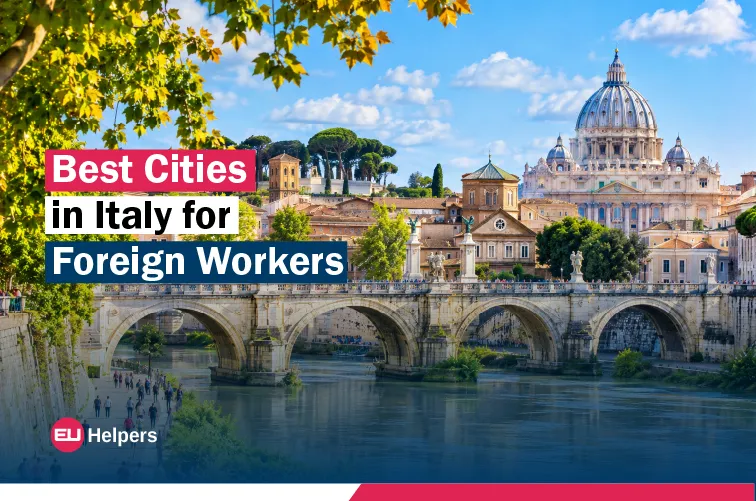

Best Cities in Italy for Foreign Workers
Italy (Repubblica Italiana — Italian Republic) has one of Europe's most regionally diverse labour markets, so the city you choose shapes your salary and career more than almost anywhere else in the EU. Milan dominates for finance, fashion, consulting and IT; Rome concentrates public institutions, UN food agencies, energy and aerospace headquarters; Turin and Bologna are the engineering heartlands of the north; Florence blends luxury fashion with tourism; Naples and Genoa anchor shipping and aerospace; and Verona, Padua and Venice combine export manufacturing, logistics and tourism. This EU Helpers guide compares the best Italian cities for foreign workers across sector mix, salary, cost of living and quality of life — international candidates can explore Italian opportunities through EU Helpers. Italy is a founding member of the European Communities (Treaty of Rome, 1957), a Schengen member applying the rules since 1997, a eurozone member since 1999 (euro cash since 2002), a founding NATO member since 1949, and a founding Council of Europe member since 1949.
Essential Context: How Italian Cities Compare
Italy's eight most relevant cities and city clusters for foreign workers break down roughly as follows.
| City | Population (approx.) | Lead sectors | Cost of living |
|---|---|---|---|
| Milan (Milano) | ~1,370,000 (metro ~3,200,000) | Finance, fashion, IT, consulting, life sciences | Highest in Italy |
| Rome (Roma) | ~2,750,000 | Public sector, UN agencies, energy, aerospace, tourism | High |
| Turin (Torino) | ~850,000 | Automotive, aerospace, IT services, food | Moderate |
| Bologna | ~390,000 | Motor Valley, packaging machinery, food, research | High (tight housing market) |
| Florence (Firenze) | ~360,000 | Fashion and leather, tourism, energy turbines, pharma | High |
| Naples (Napoli) | ~910,000 | Aerospace, shipping, tech academies, tourism | Moderate to low |
| Genoa (Genova) | ~560,000 | Port, shipbuilding, energy engineering, robotics | Moderate to low |
| Verona, Padua & Venice | ~255,000 / ~210,000 / ~250,000 | Agri-food, logistics, manufacturing, tourism | Moderate (Venice high) |
Italy has no statutory national minimum wage — instead, national collective agreements (Contratti Collettivi Nazionali di Lavoro — CCNL) set sector minimums that cover the large majority of employees. Average gross salaries typically sit around €32,000–37,000 per year, many CCNLs pay a thirteenth month (tredicesima) and some a fourteenth (quattordicesima), and pay in Milan and the north typically runs 15–30% above the south. Housing costs vary even more, so southern salaries can stretch further.
Milan — The Economic Capital
Milan (Milano), capital of Lombardy, is Italy's financial and business engine and the default choice for most skilled foreign workers in the private sector.
Lead sectors: Banking and finance (Intesa Sanpaolo, UniCredit, Mediobanca, Euronext Milan), fashion and luxury (Prada, Giorgio Armani, Dolce & Gabbana), consulting, IT and digital (Bending Spoons, Satispay, Microsoft and Google Italian offices), energy (Eni in San Donato Milanese, A2A, Snam), life sciences and hospitals (Humanitas, San Raffaele), design and trade fairs.
Salary context: Milan typically pays at the top of Italian ranges — often 15–30% above comparable roles in the south. Senior software engineers commonly earn approximately €50,000–75,000+ gross annually; mid-level professionals around €35,000–48,000; graduate and junior roles start around €26,000–32,000.
Cost of living: Highest in Italy. Central one-bedroom rents typically run €1,100–1,600/month; Brera, Porta Nuova and Navigli sit at the top, NoLo and Città Studi are cheaper.
Who it fits: Finance, consulting and IT professionals, fashion and design specialists, life-sciences researchers, and young professionals seeking Italy's largest international community.
Permit route: Employer requests a nulla osta al lavoro from the Sportello Unico per l'Immigrazione at the Prefecture — within Decreto Flussi quotas or, for highly qualified roles, via the EU Blue Card (Carta Blu UE) — then the permesso di soggiorno at the Questura after arrival.
Rome — The Capital
Rome (Roma) is Italy's political capital and largest city, with an economy shaped by government, international institutions and tourism.
Lead sectors: Public administration and embassies, UN food agencies (FAO, World Food Programme, IFAD), energy (Enel and Eni headquarters), aerospace (Leonardo, Thales Alenia Space, ESA's ESRIN in Frascati), transport (Ferrovie dello Stato), media and film (RAI, Cinecittà), and a vast tourism market.
Salary context: Private-sector salaries typically sit slightly below Milan for comparable roles. Engineers and IT specialists commonly earn €38,000–60,000 gross annually; experienced hotel and restaurant managers €35,000–50,000; hospitality staff typically from CCNL minimums of roughly €1,500–1,800 gross monthly.
Cost of living: High. One-bedroom rents typically €900–1,300/month in central districts such as Prati, Trastevere and Monti; cheaper in San Lorenzo, Pigneto and the outer districts along the metro.
Who it fits: International-organisation staff, aerospace and energy engineers, hospitality professionals, media specialists and English teachers.
Turin — Italy's Engineering Powerhouse
Turin (Torino), capital of Piedmont, is the historic home of the Italian car industry and a leading centre for aerospace and engineering.
Lead sectors: Automotive (Stellantis at Mirafiori, Iveco Group, a deep supplier base and design studios), aerospace (Leonardo, Thales Alenia Space, Avio Aero), IT services (Reply headquarters), food (Lavazza, Ferrero nearby in Alba), and research at Politecnico di Torino.
Salary context: Engineering salaries track close to Milan. Automotive and aerospace engineers typically earn €35,000–55,000 gross annually, senior specialists more; skilled technicians and machinists roughly €1,800–2,400 gross monthly under the metalworking collective agreement (CCNL Metalmeccanici).
Cost of living: Moderate — among the best value of Italy's large northern cities. One-bedroom rents typically €600–850/month in central areas such as San Salvario, Vanchiglia and Crocetta.
Who it fits: Automotive and aerospace engineers, embedded developers, e-mobility specialists, and professionals wanting northern pay with lower housing costs.
Bologna — Heart of the Motor and Packaging Valleys
Bologna, capital of Emilia-Romagna, combines Europe's oldest university with one of Italy's richest manufacturing regions.
Lead sectors: The "Motor Valley" (Ducati, Lamborghini, Ferrari and Maserati around Modena), packaging machinery (IMA, Coesia, Marchesini), food (Barilla in Parma), supercomputing (the Bologna Tecnopolo with the ECMWF data centre and CINECA), logistics and university research.
Salary context: Emilia-Romagna pays among the highest regional wages in Italy. Mechanical and automation engineers typically earn €35,000–55,000 gross annually; data and HPC specialists more; skilled production workers roughly €1,800–2,300 gross monthly under the metalworking CCNL.
Cost of living: High for its size, with a tight rental market driven by students. One-bedroom rents typically €850–1,200/month inside the historic centre; Modena and Reggio Emilia are noticeably cheaper.
Who it fits: Mechanical and automation engineers, food-technology specialists, data and HPC researchers, and PhD candidates.
Florence — Fashion, Craft and Tourism
Florence (Firenze), capital of Tuscany, is a global tourism destination and the production heartland of Italian luxury leather goods.
Lead sectors: Fashion and leather (Gucci, Salvatore Ferragamo and luxury suppliers around Scandicci), tourism, energy turbines (Baker Hughes / Nuovo Pignone), pharmaceuticals (Menarini), Chianti wine, and international education (European University Institute).
Salary context: Moderate. Engineers and pharma specialists typically earn €35,000–50,000 gross annually; luxury product developers and pattern makers €28,000–40,000; hospitality staff from CCNL minimums of roughly €1,500–1,800 gross monthly.
Cost of living: High, driven by tourist demand for short-term rentals. One-bedroom rents typically €900–1,300/month in the centre; Prato, Campi Bisenzio and Sesto Fiorentino are cheaper bases.
Who it fits: Fashion and leather specialists, hospitality and luxury-retail staff, energy and pharma engineers, and international educators.
Naples — The South's Industrial and Maritime Hub
Naples (Napoli), capital of Campania, is southern Italy's largest city and its leading industrial, port and tourism hub.
Lead sectors: Aerospace (Leonardo and Avio Aero around Pomigliano d'Arco), automotive (Stellantis Pomigliano), shipping (Grimaldi Group headquarters, Port of Naples), digital (the Apple Developer Academy at University of Naples Federico II), and tourism across the Amalfi Coast, Capri and Pompeii.
Salary context: Typically 15–30% below Milan for comparable roles. Aerospace and mechanical engineers commonly earn €30,000–45,000 gross annually; IT developers €28,000–40,000; seasonal hotel and restaurant staff on the coast earn CCNL rates, often with accommodation included.
Cost of living: Moderate to low. One-bedroom rents typically €650–950/month in Chiaia and Vomero, less in other districts.
Who it fits: Aerospace engineers, maritime specialists, junior developers, and seasonal Amalfi Coast hospitality staff (roughly April–October, often via Decreto Flussi seasonal quotas).
Genoa — Italy's Leading Port
Genoa (Genova), capital of Liguria, is Italy's busiest port city and a centre for shipbuilding, energy engineering and robotics research.
Lead sectors: Port and logistics, cruise lines (Costa Crociere headquarters), shipbuilding (Fincantieri at Sestri Ponente), energy engineering (Ansaldo Energia), robotics research (Italian Institute of Technology — IIT), and the Erzelli technology park.
Salary context: Close to the national average, with premiums for maritime skills. Naval architects and energy engineers typically earn €35,000–55,000 gross annually; port and logistics coordinators €28,000–40,000; dockworkers and crane operators follow the port CCNL with shift premiums.
Cost of living: Moderate to low for the north. One-bedroom rents typically €550–800/month in central areas such as Carignano and Castelletto.
Who it fits: Maritime and logistics specialists, naval architects, robotics researchers and cruise-industry professionals.
Verona, Padua and Venice — The Veneto Cluster
The Veneto is one of Italy's most export-driven regions, with dense networks of manufacturers, logistics hubs and tourism.
Lead sectors: Verona — wine, agri-food, logistics (Quadrante Europa), Calzedonia, Lake Garda tourism; Padua — university research, medtech, logistics; Venice — tourism, shipbuilding at Marghera, port; plus eyewear (Luxottica in Belluno province) and appliances (De'Longhi in Treviso).
Salary context: Close to Milan for manufacturing and engineering. Mechanical engineers typically earn €33,000–50,000 gross annually; logistics coordinators €28,000–38,000; skilled production workers roughly €1,700–2,200 gross monthly under sector CCNLs.
Cost of living: Moderate in Verona and Padua (one-bedroom rents typically €700–950/month); high in historic Venice, which is why most workers live in Mestre or Padua and commute by train.
Who it fits: Production engineers, supply-chain specialists, wine professionals and hospitality staff for Venice and Lake Garda.
Choosing the Right City for Your Profile
A quick match guide:
- Finance, consulting, fashion management, marketing → Milan (very few alternatives).
- IT, software, data → Milan first, Turin, Bologna and Rome growing.
- International organisations, public-sector related, NGOs → Rome.
- Automotive and e-mobility → Turin, Bologna and Modena (Motor Valley), Naples area.
- Aerospace and defence → Turin, Rome, Naples, Genoa.
- Machinery, packaging and automation → Bologna, Veneto, Lombardy industrial belt (Bergamo, Brescia).
- Port, shipping, maritime → Genoa first, Naples, Venice and Trieste.
- Luxury fashion and leather production → Florence, Milan.
- Tourism and hospitality → Rome, Florence, Venice, Amalfi Coast, Lake Garda (seasonal peaks).
- Lowest cost of living with a job → Naples, Genoa, Bari and other southern cities, Turin among large northern cities.
Permit Route Across Italian Cities
The work-permit framework is national, not city-specific. In every Italian city the employer applies for a work authorisation (nulla osta al lavoro) through the Sportello Unico per l'Immigrazione at the local Prefecture — within the quotas of the Decreto Flussi for most non-EU workers, or outside quotas for highly qualified routes such as the EU Blue Card (Carta Blu UE), intra-corporate transferees and researchers. The worker obtains a work visa from the Italian consulate, signs the contratto di soggiorno at the Sportello Unico after arrival and applies for the permesso di soggiorno at the Questura; a codice fiscale is needed for work, housing and healthcare. Typical timelines from signed offer to arrival run approximately 2–4 months, longer for quota-based applications.
Quality of Life Beyond Work
Each city has a distinct lifestyle: Milan for international buzz and access to the lakes and Alps; Rome for history and culture; Turin for elegant arcades, cafés and mountain weekends; Bologna for food, a lively student scene and central rail connections; Florence for Renaissance art and Tuscan countryside; Naples for warmth, street life and the Bay of Naples; Genoa for sea and Ligurian Riviera living; and the Veneto for wine country, Lake Garda and the Dolomites. The high-speed rail network links Turin, Milan, Bologna, Florence, Rome and Naples in a few hours, so weekend travel across Italy is easy wherever you base yourself.
Final Guidance
The best city in Italy for a foreign worker depends almost entirely on your sector and lifestyle preferences, not on which city is objectively "best." Milan leads for finance, consulting, fashion and IT careers at Italy's highest salaries but also its highest costs; Rome concentrates international organisations, energy and tourism; Turin and Bologna offer strong engineering careers; Florence combines luxury fashion with tourism; Naples and Genoa anchor shipping and aerospace at lower costs; and the Veneto blends manufacturing, logistics and hospitality. Across all eight locations the same national framework applies — nulla osta through the Sportello Unico per l'Immigrazione, Decreto Flussi quotas or the EU Blue Card, and the permesso di soggiorno from the Questura — with typical timelines of approximately 2–4 months from signed offer to arrival. With no statutory minimum wage but CCNL sector minimums, average salaries of roughly €32,000–37,000 per year, and northern pay typically 15–30% above the south, Italy rewards matching your sector to the right region. Combined with founding EU membership, Schengen and euro status and NATO membership since 1949, Italy offers real city-level choice. International candidates can explore Italian opportunities through EU Helpers. EU Helpers supports foreign workers with Italy city-sector matching, offer-letter review, nulla osta and permit coordination, relocation planning, and clarity on the latest official requirements from Italian immigration authorities.
FAQs
For most skilled foreign workers, Milan is the default best choice because it concentrates finance, consulting, fashion, IT and the largest international business community at Italy's highest salaries. However, "best" depends on your sector — automotive and aerospace engineers often do better in Turin or Bologna, international-organisation staff in Rome, and maritime specialists in Genoa. EU Helpers matches your profile to the right city.
Milan pays the highest salaries overall, typically 15–30% above comparable roles in the south and comfortably above the national average of roughly €32,000–37,000 gross per year. Bologna, Turin and the Veneto pay close to Milan for engineering roles.
Among major cities, Naples, Genoa and Bari have the lowest cost of living — one-bedroom rents commonly €550–950/month, with food and everyday costs noticeably cheaper than in Milan. Turin offers the best value in the north.
Many Milan workers live in NoLo, Città Studi or Lambrate, or commute from Monza, Bergamo or Pavia by regional train to save on rent. EU Helpers can help identify commuting-friendly neighbourhoods.
Turin and Bologna. Turin is home to Stellantis's Mirafiori complex, Iveco Group and a deep aerospace cluster, while Bologna and Modena form the Motor Valley with Ducati, Lamborghini, Ferrari and Maserati plus world-leading packaging machinery makers. Engineers typically earn €35,000–55,000 gross annually.
Rome, Florence and Venice offer the most year-round hospitality work, while the Amalfi Coast, Capri, Lake Garda and the Dolomites peak seasonally. Pay follows the tourism CCNL, typically from roughly €1,500–1,800 gross monthly, with higher pay in luxury hotels and accommodation often included for seasonal roles under the Decreto Flussi.
Yes, especially for automotive, aerospace, IT services and engineering professionals. Turin offers northern salaries close to Milan for technical roles, rents roughly half of central Milan, and a high-speed train connection to Milan in about an hour.
The same national framework applies everywhere: your employer obtains a nulla osta from the Sportello Unico per l'Immigrazione, either within Decreto Flussi quotas or outside quotas for the EU Blue Card and other highly qualified routes. After arrival you sign the contratto di soggiorno, apply for the permesso di soggiorno at the Questura and obtain a codice fiscale.
Milan has the largest international professional community, with English-speaking employers, international schools and active expat networks. Rome has a big community tied to embassies, UN agencies and universities, and Florence hosts many international students and creatives.
EU Helpers matches foreign workers to the right Italian city based on sector, profile and lifestyle across Milan, Rome, Turin, Bologna, Florence, Naples, Genoa and the Veneto, reviews offer letters for CCNL and gross-vs-net clarity, and coordinates nulla osta, permesso di soggiorno and relocation steps.
Still have questions? Get in touch
Ready to work in Italy?
EU Helpers guides non-EU workers through Italy’s work authorisation. From Sportello Unico coordination to Decreto Flussi quota, Nulla Osta and EU Blue Card routes, we make your Italy move straightforward, with distinctive Southern European positioning.