
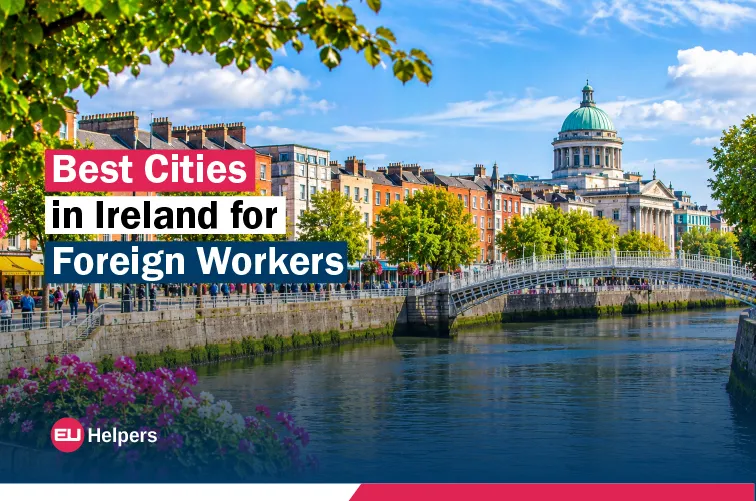

Best Cities in Ireland for Foreign Workers
Ireland (Éire) has around 5.3 million inhabitants and an unusually concentrated job market: Dublin and its commuter belt hold most tech, finance and head-office roles, Cork, Galway, Limerick and Waterford anchor regional clusters in pharma, medical devices and semiconductors, and towns such as Dundalk, Athlone and Sligo host major multinational plants with easier housing. This EU Helpers guide compares the best Irish cities for foreign workers across sector mix, salary, cost of living and quality of life — international candidates can explore Irish opportunities through EU Helpers. Ireland has been an EU member since 1973 and adopted the euro in 1999 (notes and coins from 2002). It is NOT in the Schengen area (it shares the Common Travel Area with the UK) and NOT a NATO member, following a policy of military neutrality. Irish and English are official languages; English is the working language.
Essential Context: How Irish Cities Compare
Ireland's eight most relevant cities and towns for foreign workers break down roughly as follows.
| City / area | Population (approx.) | Lead sectors | Cost of living |
|---|---|---|---|
| Dublin | ~1.26 million (city and suburbs) | Tech, finance, aircraft leasing, pharma, healthcare, public sector | Highest in Ireland |
| Cork | ~220,000 | Pharma and biopharma, tech, port, healthcare | High |
| Galway | ~85,000 | Medtech, software, healthcare, tourism, education | High (very tight housing) |
| Limerick & Shannon | ~100,000 (Limerick city) | Semiconductors, biopharma, aviation, financial services | Moderately high |
| Waterford | ~60,000 | Pharma, medical devices, healthcare, education | Moderate |
| Drogheda & Dundalk | ~45,000 each | Biologics, logistics, retail, Dublin commuting | Moderate to high |
| Athlone | ~23,000 | Telecoms R&D, pharma, medtech, education | Moderate |
| Sligo | ~20,000 | Pharma, diagnostics, healthcare, education | Moderate |
The national minimum wage is approximately €14.15 per hour (around €2,390 per month full-time), and average earnings are approximately €1,070 per week, or roughly €4,600–4,700 gross per month, with Dublin typically 10–25% higher. The catch is housing: rental supply is at historic lows, and rent is the biggest factor in where you can realistically live.
Dublin — The Capital
Dublin is Ireland's economic, political and cultural centre and the default choice for most skilled foreign workers.
Lead sectors: Technology around the Docklands "Silicon Docks" (Google, Meta, Microsoft, Salesforce, Stripe), banking and funds in the IFSC (Citi, State Street, Bank of Ireland, AIB), aircraft leasing (AerCap, SMBC Aviation Capital), pharma headquarters, HSE teaching hospitals (St James's, Mater, Beaumont), Dublin Airport and Ryanair, hospitality, construction and central government.
Salary context: Dublin typically pays 10–25% above the national average. Experienced software engineers commonly earn €5,500–9,000+ gross monthly at multinationals, with senior and staff roles higher; finance and fund-administration professionals €3,800–7,500; staff nurses roughly €3,100–4,500 depending on increments and allowances; hospitality and retail staff often close to the minimum wage, €2,400–3,000.
Cost of living: Highest in Ireland and among the highest in Europe. A one-bedroom apartment typically costs €1,900–2,400 a month, more in central areas; a room in a shared house commonly runs €900–1,300. Listings attract dozens of applicants, so many newcomers start in short-term or shared accommodation.
Who it fits: Software, data and cloud specialists, finance and aviation-leasing professionals, doctors and nurses, multilingual operations staff, and anyone seeking the largest international community.
Permit route: Critical Skills or General Employment Permit from the Department of Enterprise, Tourism and Employment (DETE), then an Irish Residence Permit (IRP) card through Immigration Service Delivery (ISD) after arrival.
Cork — Ireland's Second City
Cork is Ireland's second-largest city and the economic capital of Munster.
Lead sectors: Pharma and biopharma in the Cork Harbour cluster (Pfizer and Johnson & Johnson at Ringaskiddy, Eli Lilly in Kinsale), Apple's European headquarters at Hollyhill, tech (Dell Technologies and a growing software scene), Port of Cork logistics, Cork University Hospital, UCC and Munster Technological University, food and tourism.
Salary context: Typically close to or slightly below Dublin for comparable multinational roles. Process, validation and quality engineers in pharma commonly earn €4,000–6,500 gross monthly; experienced software engineers €4,500–7,500; manufacturing operators on shift €2,800–3,800 including shift premiums.
Cost of living: High, though below Dublin. One-bedroom apartments typically cost €1,500–1,900 a month, and rents are rising quickly.
Who it fits: Pharma engineers, scientists and operators, quality and regulatory specialists, tech staff, healthcare professionals, and candidates who want a real city with a strong local identity.
Galway — The West's Medtech Hub
Galway is the west's largest city and a leading European medical-device cluster.
Lead sectors: Medical technology (Medtronic, Boston Scientific, Aerogen and many start-ups and suppliers), software (SAP and smaller tech firms), University Hospital Galway, the University of Galway, tourism along the Wild Atlantic Way, arts and creative industries.
Salary context: Medtech R&D, design and manufacturing engineers typically earn €3,800–6,500 gross monthly; experienced software developers €4,000–6,500; technicians and production staff €2,700–3,600; hospitality staff mostly €2,400–3,000.
Cost of living: High for its size. Galway has one of the tightest rental markets in the country, with one-bedroom apartments commonly €1,500–1,900 a month and strong competition from students.
Who it fits: Medtech engineers and quality specialists, software developers, healthcare staff and researchers, and candidates who want a compact, lively city close to Connemara.
Limerick and Shannon — Mid-West Industry and Aviation
Limerick is Ireland's third-largest city, and together with Shannon, 25 minutes away, forms the Mid-West's main jobs hub.
Lead sectors: Semiconductors (Analog Devices), biopharma and manufacturing in Raheen (Regeneron, Dell Technologies), medical devices (Stryker, Cook Medical), financial services (Northern Trust), aviation and leasing around Shannon Airport and the Shannon Free Zone, and the University of Limerick.
Salary context: Typically slightly below Cork and Dublin. Electronics and process engineers commonly earn €3,800–6,000 gross monthly; biopharma technicians and operators €2,800–4,000; aviation maintenance engineers €3,500–5,500; fund-services staff €3,000–4,500.
Cost of living: Moderately high. One-bedroom apartments typically cost €1,300–1,700 a month; rents are climbing fast but housing is somewhat easier to find than in Dublin, Cork or Galway.
Who it fits: Semiconductor engineers, biopharma and medtech staff, aircraft maintenance and leasing professionals, fund administrators, and candidates seeking better value in a university city.
Waterford — The South-East's Pharma and Medtech Centre
Waterford is Ireland's oldest city and the main economic centre of the South-East.
Lead sectors: Pharma (Sanofi, Teva), contact lenses (Bausch + Lomb), pharmaceutical packaging (West Pharmaceutical Services), software (Red Hat), University Hospital Waterford, South East Technological University (SETU) and heritage tourism.
Salary context: Moderate. Process and quality engineers typically earn €3,600–5,500 gross monthly; manufacturing operators €2,700–3,500; nurses and healthcare staff on national public pay scales, so roughly the same as in Dublin before allowances.
Cost of living: Among the most affordable Irish cities, with one-bedroom apartments commonly €1,100–1,400 a month; nearby Kilkenny is an attractive alternative base.
Who it fits: Pharma and medtech operators and engineers, healthcare professionals, and candidates prioritising lower rent and short commutes.
Drogheda and Dundalk — The M1 Corridor
Drogheda and Dundalk sit on the M1 and Dublin–Belfast rail line in County Louth, north of Dublin.
Lead sectors: Biologics and pharma services in Dundalk (WuXi Biologics, Almac), Our Lady of Lourdes Hospital in Drogheda, logistics along the Dublin–Belfast corridor, retail and construction, plus Dublin commuting.
Salary context: Local roles typically pay below Dublin; biologics technicians and operators €2,800–4,000 gross monthly, scientists and engineers €3,800–5,500. Many residents keep Dublin salaries while paying lower rents.
Cost of living: Moderate to high. One-bedroom apartments typically cost €1,300–1,700 a month, below Dublin but rising.
Who it fits: Biologics staff, logistics specialists, healthcare workers, and Dublin-based employees willing to commute for more space.
Athlone — The Midlands Hub
Athlone sits on the River Shannon in the centre of Ireland, about 75 minutes from Dublin.
Lead sectors: Telecoms software R&D (Ericsson), pharma manufacturing (Alkermes), medical devices (Teleflex), engineering, the Technological University of the Shannon (TUS), retail and services for the Midlands.
Salary context: Moderate. Software developers and test engineers typically earn €3,800–6,000 gross monthly; pharma and medtech technicians €2,700–3,700; engineers €3,800–5,500.
Cost of living: Moderate. One-bedroom apartments typically cost €1,100–1,500 a month.
Who it fits: Telecoms and software engineers, pharma and medtech staff, and candidates who want a central, affordable base.
Sligo — The North-West's Life-Sciences Town
Sligo is the largest town in the north-west, set between Benbulben and the Atlantic.
Lead sectors: Pharma (AbbVie), diagnostics and medical devices (Abbott), Sligo University Hospital, Atlantic Technological University (ATU) Sligo, tourism, surfing and outdoor recreation.
Salary context: Below Dublin outside multinationals. Pharma and diagnostics engineers typically earn €3,500–5,500 gross monthly; technicians and operators €2,600–3,500; healthcare staff on national public pay scales.
Cost of living: Moderate. One-bedroom apartments typically cost €1,000–1,400 a month, among the lowest of any town with a major multinational presence.
Who it fits: Pharma and diagnostics specialists, healthcare staff, and anyone prioritising scenery and lower rent over salary.
Choosing the Right City for Your Profile
A quick match guide:
- Software, cloud, data, fintech → Dublin first, then Cork, Galway and Athlone (telecoms).
- Banking, funds, aircraft leasing → Dublin, with Limerick/Shannon for leasing and fund services.
- Pharma and biopharma → Cork (Ringaskiddy), Dublin, Limerick, Waterford, Dundalk, Sligo.
- Medical devices → Galway first, then Limerick, Waterford, Athlone.
- Semiconductors and electronics → Limerick and Dublin's commuter belt.
- Aviation and maintenance → Dublin Airport and Shannon.
- Healthcare (doctors, nurses) → every city with a university hospital; regional hospitals often recruit fastest.
- Hospitality and tourism → Dublin, Galway, Cork and the Wild Atlantic Way.
- Lowest rent with a skilled job → Sligo, Waterford, Athlone.
Permit Route Across Irish Cities
The employment-permit framework is national, not city-specific. Every Irish city uses the same permits issued by the Department of Enterprise, Tourism and Employment (DETE): the Critical Skills Employment Permit for occupations on the Critical Skills Occupations List (currently from approximately €40,904 a year with a relevant degree, or approximately €68,911 for most other eligible roles), and the General Employment Permit for other eligible jobs (currently from approximately €36,605 a year, usually subject to a labour market needs test). After arrival you register with Immigration Service Delivery (ISD), or the local registration office outside Dublin, for your Irish Residence Permit (IRP) card, and apply for a Personal Public Service (PPS) number. EU/EEA, Swiss and UK citizens need no permit. Typical timelines from signed offer to arrival run 8–14 weeks.
Quality of Life Beyond Work
Each city has a distinct lifestyle: Dublin for the biggest international community, culture and nightlife; Cork for harbour, food culture and West Cork beaches; Galway for festivals, traditional music and Connemara; Limerick for sport and Shannon Airport connections; Waterford for a compact historic centre and the Greenway; Drogheda and Dundalk for quick links to Dublin and Belfast; Athlone for a central Shannon-side base; and Sligo for surfing and mountains.
Final Guidance
The best city in Ireland for a foreign worker depends on your sector, your salary and — above all — how much rent you can carry. Dublin leads for tech, finance and leasing careers at salaries typically 10–25% above the national average, but has the hardest housing market; Cork and Limerick combine strong pharma, semiconductor and tech clusters with somewhat lower rents; Galway is the home of medtech, with very tight housing; and Waterford, Athlone, Sligo and the M1 corridor offer multinational careers at lower cost. Everywhere, the same framework applies: DETE employment permits, IRP registration through Immigration Service Delivery, and a PPS number. With EU membership since 1973, the euro, English as the working language and wages well above the EU average, Ireland offers real city-level choice — provided housing is planned early. International candidates can explore Irish opportunities through EU Helpers. EU Helpers supports foreign workers with Ireland city-sector matching, offer-letter review, employment-permit coordination, Dublin / Cork / Galway / Limerick relocation planning, and clarity on the latest official requirements from Irish immigration authorities.
FAQs
For most skilled foreign workers Dublin is the default choice because it concentrates tech, finance, aircraft leasing, head offices and the largest international community at Ireland's highest salaries. However, "best" depends on your sector and housing budget: pharma staff often do better in Cork, medtech engineers in Galway and semiconductor specialists in Limerick. EU Helpers matches your profile to the right city.
Dublin pays the highest salaries overall, typically 10–25% above the national average of roughly €4,600–4,700 gross per month, especially in tech, finance and aircraft leasing. Multinational pharma, medtech and semiconductor roles in Cork, Galway and Limerick often come close for experienced engineers, and public-sector pay scales for nurses and doctors are national, so they barely vary between cities.
Among towns with major multinational employers, Sligo, Waterford and Athlone have the lowest rents, with one-bedroom apartments typically €1,000–1,500 a month compared with €1,900–2,400 in Dublin. Limerick and the Drogheda–Dundalk area sit in the middle, while Cork and Galway are expensive relative to their size because rental supply is so limited.
Very hard in Dublin, Galway and Cork, where rental supply is at historic lows and good listings attract dozens of applicants within hours. Plan short-term accommodation for your first weeks, budget for a deposit plus the first month's rent, have references and proof of employment ready, and consider shared housing or commuter towns while you search.
Many Dublin workers share houses or apartments in the city and inner suburbs to stay close to work and public transport. Others commute by DART, Luas, commuter rail or bus from towns such as Drogheda, Maynooth, Naas or Bray, trading a 45–75 minute journey for lower rent and more space. EU Helpers can help identify commuter-friendly areas.
Cork leads for pharma and biopharma around Ringaskiddy and Cork Harbour, while Galway is the national centre for medical devices. Limerick, Waterford, Dundalk, Athlone and Sligo also host major life-sciences plants, so engineers, scientists, quality specialists and technicians have strong options across the country, often with lower rents outside the two largest clusters.
Yes, especially for pharma, biopharma, Apple and tech roles. Salaries are close to Dublin for many multinational jobs, rents are somewhat lower although still rising, and Cork offers its own international airport, a busy port, a strong food culture and easy access to the coast, giving many foreign workers a better balance of career and lifestyle.
The same national framework applies in every Irish city: a Critical Skills Employment Permit or General Employment Permit from the Department of Enterprise, Tourism and Employment, followed by registration with Immigration Service Delivery for an IRP card and a PPS number for tax and services. EU/EEA, Swiss and UK citizens can work without a permit.
Dublin has by far the largest international community, with many nationalities working across tech, finance and healthcare, plus countless clubs, sports teams and networking groups. Cork and Galway also have sizeable, welcoming expat and student populations, and regional towns increasingly have active international communities around their multinational employers. EU Helpers can point newcomers to local networks.
EU Helpers matches foreign workers to the right Irish city by sector, salary and housing budget across Dublin, Cork, Galway, Limerick, Waterford and regional towns, pre-vets roles with Irish employers, reviews offer letters for gross-versus-net clarity, coordinates employment permits, IRP registration and PPS number guidance, and helps plan relocation including short-term accommodation.
Still have questions? Get in touch
Ready to work in Ireland?
EU Helpers guides non-EU workers through Ireland’s work authorisation. From Department of Enterprise, Trade and Employment coordination to Critical Skills and General Employment Permit routes, we make your Ireland move clear, with distinctive English-speaking EU positioning.