
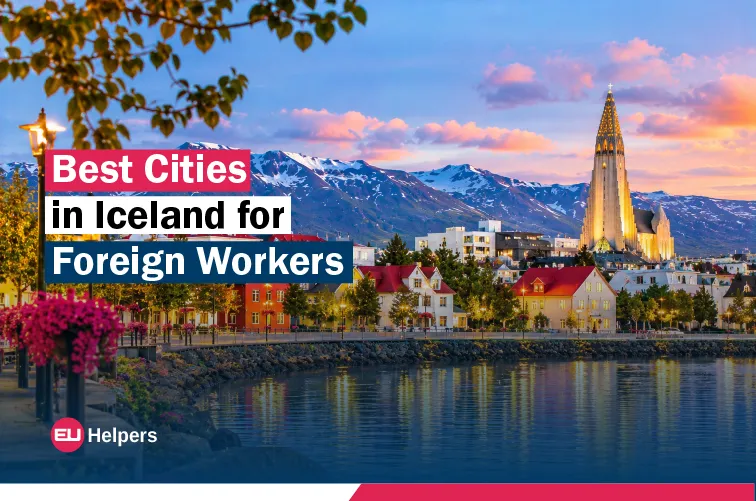

Best Cities in Iceland for Foreign Workers
Iceland (Ísland) has only about 390,000–400,000 inhabitants, so "cities" here really means one capital region and a scattering of towns — and that makes the choice of location more decisive, not less. Roughly two-thirds of the population lives in the capital region around Reykjavík, which concentrates almost all tech, finance, life-sciences, government and head-office jobs; Reykjanesbær lives off Keflavík International Airport; Akureyri is the only sizeable town outside the south-west; and small regional communities such as Selfoss, Reyðarfjörður, Ísafjörður and Vestmannaeyjar run on tourism, aluminium, fishing and fish processing. This EU Helpers guide compares the best Icelandic towns for foreign workers across sector mix, salary, cost of living and quality of life — international candidates can explore Icelandic opportunities through EU Helpers. Iceland is NOT an EU member, but it has been part of the European Economic Area (EEA) since 1994 and a member of the European Free Trade Association (EFTA) since 1970; it is a full Schengen participant since 2001, NOT in the eurozone (it uses the Icelandic króna, ISK), a founding NATO member since 1949 and a Council of Europe member since 1950. Icelandic is the official language; English is widely spoken.
Essential Context: How Icelandic Towns Compare
Iceland's eight most relevant locations for foreign workers break down roughly as follows.
| Town / area | Population (approx.) | Lead sectors | Cost of living |
|---|---|---|---|
| Reykjavík | ~140,000 (capital region ~250,000) | Tech, life sciences, healthcare, finance, tourism, public sector | Highest in Iceland |
| Kópavogur & Hafnarfjörður | ~40,000 and ~30,000 | Services, retail, aluminium, logistics, construction | High |
| Reykjanesbær (Keflavík) | ~22,000–24,000 | Airport, aviation, tourism, logistics | Moderately high |
| Akureyri | ~20,000 | Healthcare, education, fisheries, services, winter tourism | Moderate for Iceland |
| Selfoss & South Iceland | ~10,000 (Selfoss) | Tourism, agriculture, dairy, construction | Moderate |
| Egilsstaðir & Reyðarfjörður | ~2,500 and ~1,300 | Aluminium smelting, energy, services | Moderate (housing scarce) |
| Ísafjörður | ~2,700 | Fisheries, aquaculture, marine biotech, tourism | Moderate |
| Vestmannaeyjar | ~4,500 | Fishing, fish processing, tourism | Moderate |
Iceland is one of Europe's most expensive countries but also pays some of its highest wages, set through sector-wide collective agreements rather than a statutory minimum wage. Euro figures use roughly ISK 145 = €1.
Reykjavík — The Capital
Reykjavík is Iceland's economic and political centre and the default choice for most skilled foreign workers.
Lead sectors: Software and gaming (CCP Games), life sciences and biotech (Alvotech, deCODE genetics, Embla Medical / Össur), healthcare at Landspítali, the National University Hospital, finance (Arion Banki, Íslandsbanki, Landsbankinn), tourism and hospitality, construction, the University of Iceland and Reykjavík University, and central government.
Salary context: Reykjavík pays the most varied and typically the highest salaries in the country. Experienced software engineers, specialists and senior professionals commonly earn well above the national average of roughly ISK 900,000+ (approx. €6,200+) gross monthly in total wages, while hospitality, cleaning and entry-level roles are paid at collective-agreement rates negotiated by unions such as Efling and VR.
Cost of living: Highest in Iceland. A one-bedroom flat in a central district such as Miðborg, Vesturbær or Hlíðar commonly costs around ISK 230,000–320,000 (approx. €1,600–2,200) per month; groceries and eating out are well above the EU average.
Who it fits: Tech and gaming professionals, biotech and pharma scientists, doctors and nurses, finance specialists, hospitality managers, academics, and anyone wanting the largest international community.
Permit route: Non-EEA workers typically need an employer-sponsored work permit (atvinnuleyfi) approved by the Directorate of Labour (Vinnumálastofnun) and a residence permit (dvalarleyfi) issued by the Directorate of Immigration (Útlendingastofnun), followed by an identity number (kennitala) from Registers Iceland (Þjóðskrá Íslands). EEA and EFTA citizens need no permit and simply register.
Kópavogur and Hafnarfjörður — The Capital Region Suburbs
Kópavogur and Hafnarfjörður are Iceland's second- and third-largest municipalities, but in practice they form part of one continuous capital-region labour market with Reykjavík, Garðabær and Mosfellsbær.
Lead sectors: Retail and services (Smáralind shopping centre in Kópavogur), food-tech engineering (JBT Marel in neighbouring Garðabær), aluminium smelting at Rio Tinto's ISAL plant at Straumsvík near Hafnarfjörður, harbour and logistics activity at Hafnarfjörður port, construction, and public services.
Salary context: Pay broadly matches Reykjavík for equivalent roles, since employers recruit from the same pool. Smelter and trades roles often add shift allowances.
Cost of living: High, but rents are often slightly below central Reykjavík for comparable space.
Who it fits: Families who want more space and good schools, engineers and industrial technicians, logistics and construction workers, and Reykjavík office workers who are happy to commute by car or Strætó bus.
Reykjanesbær — Keflavík Airport Hub
Reykjanesbær, which includes Keflavík and Njarðvík, sits about 45–50 minutes by road from Reykjavík on the Reykjanes peninsula and grew rapidly around Keflavík International Airport.
Lead sectors: Aviation and airport operations (Isavia, ground handling, Icelandair and other airlines, duty-free and catering), tourism (Blue Lagoon and Reykjanes UNESCO Global Geopark), logistics and air cargo, construction, and fish processing in nearby harbours.
Salary context: Airport and aviation roles are typically paid under collective agreements with shift premiums that can lift take-home pay noticeably.
Cost of living: Moderately high but generally cheaper than the capital region.
Who it fits: Airport ground staff, aviation technicians, cabin crew bases, logistics workers, tourism staff and workers looking for lower rents with access to Reykjavík. Be aware that volcanic activity on the peninsula since 2021 has periodically disrupted parts of the area, notably around Grindavík.
Akureyri — The Capital of the North
Akureyri is Iceland's largest town outside the capital region and the service centre for all of North Iceland.
Lead sectors: Healthcare (Akureyri Hospital — Sjúkrahúsið á Akureyri), higher education (University of Akureyri), fisheries and seafood (Samherji is headquartered here), food production, retail and services, and year-round tourism including whale watching, Mývatn and Hlíðarfjall ski area.
Salary context: Collective agreements apply nationally, so base pay for many roles is similar to the capital; there are simply fewer high-end private-sector positions. Healthcare and fisheries offer the strongest professional openings.
Cost of living: Moderate by Icelandic standards. One-bedroom rents are typically noticeably below Reykjavík, often around ISK 180,000–240,000 (approx. €1,250–1,650) per month, though supply is tight.
Who it fits: Nurses, doctors and care workers, fisheries and seafood professionals, teachers and academics, tourism guides, and anyone wanting town life at a slower pace.
Selfoss and South Iceland — Tourism Country
Selfoss, in the municipality of Árborg about an hour from Reykjavík, is the hub of South Iceland — the most visited region in the country, covering the Golden Circle and the south coast towards Vík.
Lead sectors: Tourism and hospitality (hotels, guesthouses, tour operators and restaurants along the Golden Circle and Ring Road), agriculture and dairy (Mjólkursamsalan has a major dairy in Selfoss), greenhouse horticulture in Hveragerði and Flúðir, construction and transport.
Salary context: Tourism and farm jobs are paid at collective-agreement rates; many rural hotels offer staff housing.
Cost of living: Moderate. Rents in Selfoss are below the capital region.
Who it fits: Hotel and restaurant staff, chefs, tour guides and drivers, farm and greenhouse workers, and construction trades. A driving licence is usually essential.
Egilsstaðir and Reyðarfjörður — East Iceland Industry
East Iceland combines Egilsstaðir, the regional service and airport town, with the fjord communities of Fjarðabyggð, including Reyðarfjörður.
Lead sectors: Aluminium smelting at Alcoa Fjarðaál in Reyðarfjörður — one of the region's largest employers — supported by hydropower from Landsvirkjun's Fljótsdalur station; fisheries and processing in Eskifjörður and Neskaupstaður; healthcare, education and public services in Egilsstaðir; and growing tourism.
Salary context: Smelter jobs are typically among the better-paid industrial roles outside the capital, with shift premiums and structured training.
Cost of living: Moderate, but rental housing is genuinely scarce, so securing accommodation before arrival is important.
Who it fits: Process operators, electricians, mechanics and maintenance technicians, engineers, healthcare staff, and people who enjoy remote fjord living and outdoor life.
Ísafjörður — Westfjords Fisheries
Ísafjörður is the largest town in the Westfjords, one of Europe's most remote and dramatic regions.
Lead sectors: Fishing and fish processing, salmon aquaculture across the Westfjords (Arctic Fish, Arnarlax), marine biotech (Kerecis, known for fish-skin wound products, was founded here), the regional hospital, the University Centre of the Westfjords, and summer tourism including cruise calls.
Salary context: Fish-processing and aquaculture roles are paid at national collective-agreement rates with overtime and bonus opportunities during busy periods; specialist marine and biotech roles pay more.
Cost of living: Moderate, with limited rental stock.
Who it fits: Fish-processing and aquaculture workers, marine scientists, healthcare staff, and people comfortable with long winters and isolation.
Choosing the Right Town for Your Profile
A quick match guide:
- Tech, gaming, software, finance → Reykjavík (very few alternatives).
- Life sciences, biotech, pharma → Reykjavík capital region; Ísafjörður for marine biotech.
- Healthcare → Reykjavík (Landspítali), Akureyri, plus regional hospitals nationwide.
- Aviation and airport → Reykjanesbær (Keflavík).
- Aluminium and heavy industry → Hafnarfjörður (Straumsvík), Reyðarfjörður (Alcoa Fjarðaál).
- Fishing and fish processing → Vestmannaeyjar, Ísafjörður, Akureyri, East Fjords.
- Tourism and hospitality → Reykjavík, Selfoss and the south coast, Akureyri and Mývatn.
- Agriculture and greenhouses → South Iceland (Selfoss, Hveragerði, Flúðir).
- Construction trades → Capital region, Reykjanesbær, Selfoss.
- Lower cost of living with a job → Akureyri, Selfoss, smaller regional towns with employer housing.
Vestmannaeyjar (the Westman Islands), reached by ferry from Landeyjahöfn, deserves a special mention: its fishing companies, including Vinnslustöðin and Ísfélag, run large processing plants that regularly recruit for the fishing seasons.
Permit Route Across Icelandic Towns
The permit framework is national, not town-specific. EEA and EFTA citizens can live and work anywhere in Iceland without a permit and register with Registers Iceland to obtain a kennitala. Non-EEA citizens typically need an employer-backed temporary work permit (tímabundið atvinnuleyfi) assessed by the Directorate of Labour, together with a residence permit based on work issued by the Directorate of Immigration. The main categories cover jobs requiring expert knowledge, labour-shortage positions, athletes and service contracts. Outside the capital, applications and biometrics can usually be handled through the District Commissioners' offices (Sýslumenn). Processing commonly takes several weeks to a few months, so plan ahead.
Quality of Life Beyond Work
Each location has its own rhythm: Reykjavík for cafés, concerts, geothermal pools and the largest international community; Kópavogur and Hafnarfjörður for family-friendly suburbs with city access; Reykjanesbær for lower rents and the airport on your doorstep; Akureyri for a lively northern town with skiing and a strong cultural scene; Selfoss for South Iceland landscapes within reach of the capital; Egilsstaðir and Reyðarfjörður for quiet fjords, forests and outdoor life; Ísafjörður for dramatic Westfjords nature and a tight-knit community; and Vestmannaeyjar for island life built around the sea. Everywhere, expect long summer days, dark winters, excellent swimming pools and high safety; winter travel between towns can be slow, so remoteness matters.
Final Guidance
The best town in Iceland for a foreign worker depends almost entirely on your sector, because outside the capital region each community is built around one or two industries. Reykjavík and its suburbs dominate for tech, life sciences, finance, healthcare and government at Iceland's highest costs; Reykjanesbær lives off Keflavík airport and aviation; Akureyri offers the most complete town life outside the south-west; Selfoss and South Iceland lead for tourism and agriculture; Reyðarfjörður and Egilsstaðir centre on aluminium and East Iceland services; and Ísafjörður and Vestmannaeyjar revolve around fishing and aquaculture. Across every location the same national framework applies: EEA and EFTA citizens register for a kennitala, while non-EEA workers typically need a work permit through the Directorate of Labour and a residence permit through the Directorate of Immigration. With EEA membership since 1994, Schengen since 2001, founding NATO membership and high collective-agreement wages, Iceland offers a small but rewarding labour market. International candidates can explore Icelandic opportunities through EU Helpers. EU Helpers supports foreign workers with Iceland town-sector matching, offer-letter review, permit coordination, Reykjavík / Reykjanesbær / Akureyri / regional relocation planning, and clarity on the latest official requirements from Icelandic authorities.
FAQs
For most skilled foreign workers, Reykjavík and its capital region are the default best choice because they hold roughly two-thirds of Iceland's population and almost all tech, life-sciences, finance, healthcare and government employers. However, the best location depends on your sector: aviation workers do better in Reykjanesbær, aluminium technicians in Reyðarfjörður or Hafnarfjörður, and fish-processing staff in Vestmannaeyjar or Ísafjörður. EU Helpers matches your profile to the right town.
Reykjavík offers the highest and most varied salaries overall, especially in tech, biotech, finance and senior professional roles. Because most pay is set by national collective agreements, base wages for many jobs are similar across the country. Industrial roles such as smelter work in Reyðarfjörður or Straumsvík, and fishing-season work in Vestmannaeyjar, can pay very well once shift premiums, overtime and catch bonuses are included.
No part of Iceland is cheap, but Akureyri, Selfoss and smaller regional towns are typically less expensive than the capital region, mainly because rents are lower. In rural tourism, fisheries and industrial jobs, employer-provided accommodation often makes the biggest difference to real living costs.
Many Reykjavík office workers live in central districts such as Miðborg, Vesturbær, Hlíðar or Laugardalur if they want walkability. Others choose Kópavogur, Garðabær, Hafnarfjörður or Mosfellsbær for more space and slightly lower rents, commuting by car or Strætó bus in roughly 15–30 minutes. EU Helpers can help identify commuting-friendly neighbourhoods.
For fishing and fish processing, Vestmannaeyjar, Ísafjörður, Akureyri and the East Fjords towns are the strongest options, with major employers such as Samherji, Vinnslustöðin and Ísfélag. For aluminium and heavy industry, Reyðarfjörður hosts Alcoa Fjarðaál and Hafnarfjörður sits next to the ISAL smelter at Straumsvík.
Reykjavík has the most year-round hotel and restaurant jobs, while Selfoss, the Golden Circle and the south coast towards Vík have the highest concentration of rural hotels, guesthouses and tour operators. Reykjanesbær benefits from the airport and the Blue Lagoon area, and Akureyri and Mývatn serve North Iceland tourism. Summer is the peak hiring season, and rural employers frequently include staff accommodation.
Yes, especially for healthcare workers, teachers and academics, fisheries and seafood professionals, and tourism staff. Akureyri offers a hospital, a university, a ski area and an active cultural life with noticeably lower rents than the capital. The trade-off is a smaller private-sector job market.
The same national rules apply everywhere in Iceland. EEA and EFTA citizens need no work permit and simply register with Registers Iceland for a kennitala. Non-EEA citizens typically need an employer-backed work permit (atvinnuleyfi) from the Directorate of Labour (Vinnumálastofnun) and a residence permit (dvalarleyfi) from the Directorate of Immigration (Útlendingastofnun), with categories for expert knowledge, labour shortages, athletes and service contracts.
Reykjavík and the capital region have by far the largest international community, with English-speaking workplaces and active online groups. Reykjanesbær has one of the highest shares of foreign residents in the country thanks to airport and tourism jobs. Akureyri, Selfoss and fishing towns such as Vestmannaeyjar and Ísafjörður also have sizeable and growing foreign-born populations.
EU Helpers matches foreign workers to the right Icelandic town based on sector, profile and lifestyle preferences across Reykjavík, Kópavogur, Hafnarfjörður, Reykjanesbær, Akureyri, Selfoss, Reyðarfjörður, Egilsstaðir, Ísafjörður and Vestmannaeyjar. We pre-vet relevant roles with Icelandic employers, review offer letters for gross-versus-net pay and collective-agreement terms, and coordinate work permit and residence permit applications with the Directorate of Labour and the Directorate of Immigration. We also guide you through kennitala registration with Registers Iceland, tax card setup with Skatturinn, healthcare registration, housing searches and relocation, and provide clarity on the latest official requirements from Icelandic authorities.
Still have questions? Get in touch
Ready to work in Iceland?
EU Helpers guides non-EU workers through Iceland’s work authorisation. From Directorate of Immigration and Directorate of Labour coordination to specialist work permit routes, we make your Iceland move smooth, with distinctive Nordic Schengen positioning.