
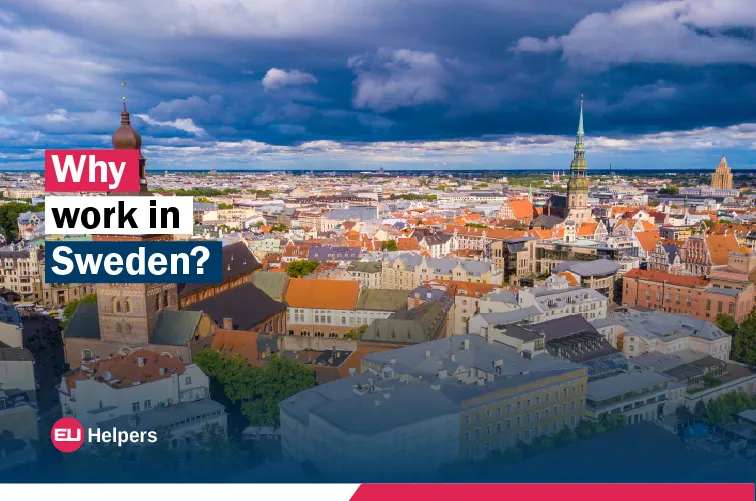
Why Work in Sweden? A Complete EU Helpers Guide for International Professionals
Sweden, the dynamic Nordic nation on the Scandinavian Peninsula bordering Norway to the west and north, Finland to the northeast, and connected to Denmark via the iconic Öresund Bridge to the south, and facing the Baltic Sea, the Gulf of Bothnia, and the Kattegat, occupies an exceptionally attractive position in Northern Europe for those seeking the rare combination of full EU integration (Sweden joined the EU in 1995 alongside Austria and Finland, joined Schengen in 2001, and NATO in March 2024 ending its long tradition of military non-alignment following the Russian invasion of Ukraine — though Sweden is NOT in the eurozone, having chosen not to adopt the euro in a 2003 referendum and continuing to use the Swedish krona SEK), one of the world's leading tech ecosystems (Stockholm being called "the Unicorn Factory" for producing more unicorns per capita than almost any European city — with famous Swedish tech successes including Spotify — the global music streaming leader headquartered in Stockholm, Klarna — the buy-now-pay-later fintech, Skype — the pioneering video calling service originally developed with Estonian founders and sold to Microsoft for $8.5 billion in 2011, Ericsson — the global telecommunications equipment leader headquartered in Stockholm, Mojang — creator of Minecraft founded in Stockholm and acquired by Microsoft for $2.5 billion in 2014, King — creator of Candy Crush Saga acquired by Activision Blizzard, iZettle acquired by PayPal, Voi Technology — the electric scooter sharing service, Klarna, Truecaller, and many others), exceptional Nordic social welfare tradition (Sweden pioneered the Nordic welfare state model — Folkhemmet — the "People's Home" concept developed in the 1930s emphasizing universal welfare, with comprehensive universal healthcare through Landstingen — the regional healthcare system, among the world's most generous parental leave with up to 480 days per child that can be shared between parents encouraging shared parenting responsibilities, extensive paid vacation with a minimum of 25 days annually plus public holidays, universal education from preschool through university, comprehensive unemployment protection, and extensive social protections making Sweden one of the world's most comprehensive welfare states), exceptional gender equality (Sweden consistently ranks among the world's most gender-equal countries, with feminist foreign policy officially adopted in 2014 as the world's first, exceptional gender parity in political representation with women representing about half of parliament, exceptional Swedish parental leave supporting both mothers and fathers encouraging shared parenting responsibilities — Sweden was the first country to introduce paid parental leave for fathers in 1974, and consistently high rankings in the World Economic Forum Global Gender Gap Report), distinctive Swedish culture (with distinctive Swedish concepts including lagom — meaning "just right," "moderation," or "not too much, not too little" being central to Swedish worldview and cultural identity often described as the Swedish equivalent of Danish hygge or Norwegian koselig, fika — the Swedish coffee break tradition central to social and workplace culture involving coffee typically with pastries like cinnamon buns — kanelbullar — and taken seriously as a social ritual, mysig — Swedish coziness culture, allemansrätten — the "Right of Public Access" the famous Swedish concept allowing everyone to freely enjoy nature and cross private land as long as no damage is caused, and jantelagen — the Law of Jante the Nordic cultural concept discouraging individualistic self-promotion though this is evolving), rich cultural heritage including 15 UNESCO World Heritage Sites (the Royal Palace of Drottningholm — the residence of the Swedish royal family often called "Sweden's Versailles" with its distinctive Baroque architecture and gardens, Birka and Hovgården — Viking Age archaeological sites revealing 8th-10th century Norse trading heritage, the Hanseatic Town of Visby on Gotland — one of northern Europe's best-preserved medieval Hanseatic towns from the 12th-14th centuries, the Church Town of Gammelstad in Luleå — 400 historic wooden houses around a 15th-century stone church, the Naval Port of Karlskrona — an intact 17th-century Baroque naval city, the Agricultural Landscape of Southern Öland — millennia-old agricultural landscape, the High Coast/Kvarken Archipelago shared with Finland — dramatic post-glacial landscape, the Struve Geodetic Arc shared with multiple countries — 19th-century scientific survey chain, the Mining Area of the Great Copper Mountain in Falun — 1000-year-old copper mining heritage, Skogskyrkogården — the Woodland Cemetery in Stockholm — masterpiece of 20th-century architecture designed by Gunnar Asplund and Sigurd Lewerentz, the Rock Carvings in Tanum — Bronze Age rock art, the Engelsberg Ironworks — 17th-19th century industrial heritage, the Laponian Area — Arctic cultural landscape of the indigenous Sami people, and the Grimeton Radio Station — early 20th-century wireless communication landmark), exceptional design tradition (Swedish design is internationally recognized with famous companies including IKEA — the world's largest furniture retailer founded 1943 by Ingvar Kamprad revolutionizing global furniture retail with flat-pack furniture and Scandinavian design principles, H&M — Hennes & Mauritz — one of the world's largest fashion retailers founded 1947, Volvo — famous for safety-focused design and pioneering safety innovations including the three-point seatbelt invented at Volvo in 1959 and given away to competitors as a life-saving safety measure, Electrolux — global home appliances leader, Ericsson, Absolut Vodka, and many others — plus distinctive Swedish designers), exceptional literary heritage and Nobel Prize connection (Sweden hosts most Nobel Prize ceremonies annually every December 10 except the Peace Prize which is awarded in Oslo, honoring Alfred Nobel — the Swedish inventor and industrialist who established the Nobel Prizes through his 1895 will with his fortune from inventing dynamite, with famous Swedish authors including Astrid Lindgren — creator of Pippi Longstocking one of the world's most beloved children's book characters, Selma Lagerlöf — the first woman to win the Nobel Prize in Literature in 1909, August Strindberg — the pioneering modernist playwright, Stieg Larsson — the Millennium Trilogy including The Girl with the Dragon Tattoo, Henning Mankell — the Wallander series, and many others; famous Swedish filmmakers including Ingmar Bergman — one of history's greatest directors), significant renewable energy leadership (Sweden is one of Europe's renewable energy leaders with substantial hydropower — providing about 45% of electricity, wind — growing rapidly, and biomass energy, with ambitious climate targets aiming to be carbon-neutral by 2045 making Sweden one of the most ambitious countries globally), automotive industry (Volvo Cars — now owned by Chinese Geely but with strong Swedish operations and headquartered in Gothenburg, famous for safety innovations including the three-point seatbelt and committed to all-electric by 2030 making Volvo one of the world's earliest major automakers to commit to full electrification, Volvo Group — trucks and heavy equipment, Scania — heavy trucks, and significant Swedish automotive engineering heritage), distinctive Swedish music heritage (with famous Swedish music successes including ABBA — one of the world's best-selling music acts of all time with over 400 million albums sold and the pop group whose reunion concert Voyage in 2022 pioneered virtual performance technology, Roxette, Ace of Base, Avicii — the pioneering electronic music producer, Robyn, Zara Larsson, and many others, plus Sweden being one of the world's largest music exporters per capita and Stockholm being one of the world's most influential pop music production centers), exceptional Swedish nature (with vast forests covering approximately 68% of the country making Sweden one of Europe's most forested nations, over 100,000 lakes and 220,000 islands, the spectacular Swedish Lapland in the far north with the famous ICEHOTEL in Jukkasjärvi — one of the world's most famous ice hotels rebuilt each winter from ice and snow, opportunities for viewing the Northern Lights during winter months, the Sami indigenous heritage with the Sami people being Europe's only indigenous population, the extensive Stockholm Archipelago with about 30,000 islands making it the world's second-largest archipelago, Gotland — Sweden's largest island in the Baltic Sea, the Bothnian Bay, and diverse landscapes), the famous Swedish concept of Allemansrätten (Right of Public Access) allowing everyone to freely enjoy nature and cross private land as long as no damage is caused — a distinctively Nordic legal principle enshrined in the Swedish Constitution making outdoor recreation exceptionally accessible, exceptional Swedish sports tradition (with Sweden having produced world-class athletes across ice hockey — with Swedish players being major NHL stars including Zlatan Ibrahimović in football considered one of the greatest football players ever, tennis with Björn Borg — the legendary Swedish tennis champion, Bjorn Borg style, and many others; plus Sweden hosting the 1912 Stockholm Olympics considered one of the best-organized modern Olympics), exceptional coffee culture (Swedes are among the world's biggest coffee consumers per capita), Christmas traditions (with distinctive Swedish Christmas traditions including Lucia — the Feast of Saint Lucia celebrated December 13 with young women wearing crowns of candles processing through darkened homes symbolizing light in darkness), midsummer celebrations (Midsommar — one of Sweden's most important cultural celebrations held around June 21 with maypoles, traditional foods, and songs), and significant Swedish diaspora connections (with substantial Swedish communities particularly in the US — notably in Minnesota where over 1 million Americans have Swedish heritage, Canada, Argentina, and other countries). With a population of approximately 10.5 million and covering about 450,295 square kilometers (making Sweden the third-largest country in the EU by area after France and Spain, though with much of the land being sparsely populated northern territory), Sweden has firmly established itself as one of the world's most attractive Nordic destinations. The capital Stockholm (the vibrant historic capital and main business, IT, and cultural hub, often called the "Venice of the North" as it is built on 14 islands connected by 57 bridges spanning the archipelago where Lake Mälaren meets the Baltic Sea, with iconic landmarks including the Royal Palace — Kungliga slottet — one of Europe's largest royal palaces with over 600 rooms and the official residence of the Swedish monarch King Carl XVI Gustaf, the Vasa Museum — Vasamuseet — the world's most visited maritime museum housing the extraordinarily well-preserved 17th-century Swedish warship Vasa that sank in Stockholm harbor on its maiden voyage in 1628 after sailing only about 1,300 meters and was raised remarkably intact in 1961 becoming one of the world's greatest maritime archaeological finds, the ABBA Museum — Sweden's tribute to the iconic pop group, the historic Gamla Stan — Old Town — one of Europe's best-preserved medieval city centers with cobblestone streets and colorful buildings including the famous narrow Mårten Trotzigs gränd — the narrowest street in Stockholm, the Stockholm City Hall — Stadshuset — the iconic building where Nobel Prize banquets are held every December 10, Skansen — the world's oldest open-air museum founded in 1891 by Artur Hazelius preserving traditional Swedish culture and buildings, Djurgården — the royal park island with several major museums including the Vasa Museum, ABBA Museum, and Nordiska Museet, the Moderna Museet — modern art museum, the Nationalmuseum — Sweden's premier art museum, the historic Slussen area with waterfront views, Södermalm — the hip creative district known for cafés, boutiques, and vibrant cultural scene, Östermalm — the elegant residential and shopping district, and Stockholm's growing reputation as one of Europe's most significant tech capitals — often called "the Unicorn Factory" with more unicorns per capita than almost anywhere in the world), along with Gothenburg (Göteborg — Sweden's second-largest city on the west coast facing the Kattegat Sea, home to Volvo headquarters and the famous Liseberg amusement park — one of Scandinavia's most popular attractions, plus the Universeum science center and the historic Haga district with charming café culture), Malmö (Sweden's third-largest city in southern Sweden connected to Copenhagen via the iconic Öresund Bridge — the Öresundsbron opened in 2000 as one of Europe's most spectacular engineering achievements, with the iconic Turning Torso — Scandinavia's tallest building at 190 meters designed by Santiago Calatrava and completed in 2005 with its distinctive twisted design), Uppsala (with Uppsala University founded 1477 — one of the oldest universities in the Nordic countries and Northern Europe's oldest university, plus the historic Uppsala Cathedral — Scandinavia's largest cathedral where Swedish monarchs were traditionally coronated), Västerås, Örebro, Linköping (with strong technology and defense industry including SAAB — the Swedish aerospace and defense company), Helsingborg, Jönköping, Norrköping, Lund (with Lund University — one of Sweden's most prestigious universities founded in 1666), and Umeå (in northern Sweden — European Capital of Culture 2014), host major Swedish and multinational companies, technology hubs, financial institutions, and innovative start-ups. For applicants from anywhere considering Sweden, the country offers structured immigration pathways including the standard work permit (arbetstillstånd), the EU Blue Card, the ICT permit (intra-corporate transferee), the certified employer fast-track program (offering expedited processing for employers meeting certain criteria — as fast as around 10 business days), the D visa (long-stay visa), self-employment residence permits, the researcher route, family reunification provisions, student- and graduate-related provisions, and a clear long-term route toward Swedish permanent residence and eventually Swedish citizenship with full EU citizenship benefits. At EU Helpers, candidates regularly ask the fundamental question: why should I consider Sweden specifically?
This complete EU Helpers guide answers that question in depth and walks you through the genuine, practical, and long-term reasons that make Sweden one of Europe's — and the world's — most uniquely attractive destinations.
Why Sweden Is Genuinely Distinctive Among European Destinations
Sweden occupies an exceptionally distinctive position in Europe and the world — EU/Schengen/NATO member (though outside the eurozone), one of the world's leading tech ecosystems, exceptional Nordic welfare tradition, exceptional gender equality, distinctive Swedish culture, exceptional design tradition, and exceptional literary and Nobel Prize heritage.
Full EU, Schengen, and NATO Integration (Outside Eurozone)
Sweden is an EU member (since 1995), Schengen member (since 2001), NATO member (since March 2024 — ending its long tradition of military non-alignment following the Russian invasion of Ukraine), and Council of Europe founding member. Sweden is NOT in the eurozone, using the Swedish krona (SEK).
One of the World's Leading Tech Ecosystems
Stockholm has developed as one of Europe's leading tech ecosystems, often called "the Unicorn Factory" for producing more unicorns per capita than almost any European city. Famous Swedish tech successes include Spotify, Klarna, Skype (originally), Ericsson, Mojang (Minecraft), King (Candy Crush), Truecaller, and many others.
Exceptional Nordic Social Welfare Tradition
Sweden pioneered the Nordic welfare state model — Folkhemmet — the "People's Home" concept developed in the 1930s. Sweden has comprehensive universal healthcare, among the world's most generous parental leave (up to 480 days per child), extensive paid vacation (minimum 25 days annually plus public holidays), universal education, and comprehensive social protections making Sweden one of the world's most comprehensive welfare states.
Exceptional Gender Equality
Sweden consistently ranks among the world's most gender-equal countries with feminist foreign policy officially adopted in 2014 as the world's first, exceptional gender parity in political representation, and Sweden being the first country to introduce paid parental leave for fathers in 1974.
Distinctive Swedish Cultural Concepts
Swedish culture features distinctive concepts including lagom (meaning "just right" or "moderation" — central to Swedish worldview), fika (the Swedish coffee break tradition central to social and workplace culture), mysig (Swedish coziness), allemansrätten (Right of Public Access), and jantelagen (Law of Jante).
Exceptional Design Tradition
Swedish design is internationally recognized with famous companies including IKEA (the world's largest furniture retailer founded 1943 by Ingvar Kamprad), H&M (one of the world's largest fashion retailers), Volvo (famous for safety-focused design), Electrolux, Ericsson, Absolut Vodka, and many others.
Nobel Prize Heritage
Sweden hosts most Nobel Prize ceremonies annually every December 10 (except the Peace Prize which is in Oslo), honoring Alfred Nobel — the Swedish inventor and industrialist who established the Nobel Prizes through his 1895 will.
Exceptional Literary Heritage
Swedish literary heritage includes Astrid Lindgren (creator of Pippi Longstocking), Selma Lagerlöf (the first woman to win the Nobel Prize in Literature in 1909), August Strindberg (pioneering modernist playwright), Stieg Larsson (Millennium Trilogy), and famous Swedish filmmakers including Ingmar Bergman.
15 UNESCO World Heritage Sites
Sweden has 15 UNESCO World Heritage Sites including the Royal Palace of Drottningholm, Birka and Hovgården (Viking Age sites), the Hanseatic Town of Visby, Karlskrona Naval Port, Skogskyrkogården (Woodland Cemetery), and many others.
World-Leading Renewable Energy
Sweden is one of Europe's renewable energy leaders with substantial hydropower (about 45% of electricity), wind, and biomass energy. Sweden's ambitious climate targets aim for carbon-neutral by 2045, making Sweden one of the most ambitious countries globally.
Exceptional Music Heritage
Sweden has produced ABBA (one of the world's best-selling music acts of all time with over 400 million albums sold), Roxette, Ace of Base, Avicii, Robyn, and many others. Sweden is one of the world's largest music exporters per capita.
Certified Employer Fast-Track
Migrationsverket's certified employer fast-track program offers work permit processing as fast as around 10 business days for certified employers.
Top Financial Reasons to Consider Sweden
The financial rationale for working in Sweden centers around high salaries combined with exceptional social benefits.
High Salary Levels
Swedish salaries are among Europe's highest, reflecting Sweden's Nordic welfare traditions and high cost of living. High salary levels apply particularly in tech, senior management, healthcare, and specialized professional roles.
Exceptional Total Compensation Through Nordic Benefits
Swedish employment includes exceptional benefits — comprehensive universal healthcare, among the world's most generous parental leave (up to 480 days per child that can be shared between parents), extensive paid vacation (minimum 25 days annually plus public holidays), and other comprehensive benefits providing substantial total compensation value.
Strong Worker Protections
Sweden has strong labor laws providing comprehensive protections through the Nordic welfare state model.
Universal Healthcare
Sweden has universal healthcare through Landstingen (regional healthcare system) consistently providing quality care for residents.
Free Educational System Including Higher Education
Sweden offers free public education through university level for EU/EEA/Swiss students, with modest fees for other students (with the exception of tuition-free doctoral studies for all).
Comprehensive Pension System
Sweden's pension system provides comprehensive retirement benefits for workers contributing to the system.
Lifestyle and Quality-of-Life Benefits
Beyond money, Sweden offers an exceptional lifestyle combining distinctive Nordic character, exceptional nature, and unique cultural heritage.
Vibrant Capital Stockholm
Stockholm combines extraordinary historical heritage (the Royal Palace — one of Europe's largest with over 600 rooms, the Vasa Museum housing the extraordinarily well-preserved 17th-century Swedish warship, the historic Gamla Stan — one of Europe's best-preserved medieval city centers with cobblestone streets, the Stockholm City Hall — Stadshuset — where Nobel Prize banquets are held, Skansen — the world's oldest open-air museum founded 1891, Djurgården royal park island), exceptional modern character (as one of Europe's leading tech ecosystems — "the Unicorn Factory," vibrant café culture with distinctive Södermalm creative district and elegant Östermalm, exceptional dining scene), unique geography (built on 14 islands connected by 57 bridges — often called "the Venice of the North"), and rich cultural scene.
Charming Gothenburg, Malmö, and Other Swedish Cities
Gothenburg (Göteborg — Sweden's second-largest city on the west coast, home to Volvo headquarters, Liseberg amusement park, Universeum science center, historic Haga district). Malmö (Sweden's third-largest city connected to Copenhagen via the iconic Öresund Bridge, with the Turning Torso — Scandinavia's tallest building designed by Santiago Calatrava). Uppsala (with the oldest university in the Nordic countries founded 1477, plus Scandinavia's largest cathedral). Lund (with prestigious Lund University founded 1666). Linköping (with SAAB defense industry). Each city offers distinctive character.
Iconic Öresund Bridge
The Öresund Bridge (Öresundsbron), opened in 2000, is one of Europe's most spectacular engineering achievements connecting Sweden's Malmö with Denmark's Copenhagen, creating the integrated Öresund Region.
Spectacular Swedish Nature
Sweden has exceptional natural beauty including vast forests (covering approximately 68% of the country making Sweden one of Europe's most forested nations), over 100,000 lakes, 220,000 islands, the extensive Stockholm Archipelago (about 30,000 islands — the world's second-largest archipelago), Gotland (Sweden's largest island in the Baltic Sea), the Bothnian Bay, and diverse landscapes.
Swedish Lapland and Sami Heritage
The spectacular Swedish Lapland in the far north features the famous ICEHOTEL in Jukkasjärvi (one of the world's most famous ice hotels rebuilt each winter), Northern Lights viewing opportunities during winter months, the Sami indigenous heritage with the Sami being Europe's only indigenous population, and dramatic Arctic landscapes.
Famous Allemansrätten
The distinctively Swedish Allemansrätten (Right of Public Access) allows everyone to freely enjoy nature and cross private land as long as no damage is caused. This Nordic legal principle is enshrined in the Swedish Constitution making outdoor recreation exceptionally accessible.
Rich Cultural Heritage
Sweden has rich cultural heritage spanning the Viking Age (approximately 793-1066 AD with Sweden being a major Viking homeland), the Kalmar Union (1397-1523 uniting Nordic countries), the Swedish Empire (17th century when Sweden was one of Europe's great powers), the Age of Freedom (1719-1772), the modern Swedish democracy, and the pioneering Nordic welfare state.
Distinctive Swedish Cuisine
Swedish cuisine features distinctive specialties including köttbullar (Swedish meatballs — famously popularized globally through IKEA), gravlax (cured salmon), knäckebröd (crisp bread), sill (pickled herring — traditional Swedish staple), semla (traditional cardamom bun with cream), kanelbullar (cinnamon buns central to fika culture), Prinsesstårta (Princess Cake), lingonberry jam (accompanying many Swedish dishes), Swedish Christmas smörgåsbord tradition, and modern Nordic cuisine using distinctive local ingredients.
Swedish Coffee and Fika Culture
Swedes are among the world's biggest coffee consumers per capita. The distinctive Swedish fika culture — the coffee break tradition central to social and workplace culture — involves coffee typically with pastries and is taken seriously as a social ritual.
Swedish Music Scene
Sweden has exceptional music heritage including ABBA (one of the world's best-selling music acts of all time — with the reunion concert Voyage in 2022 pioneering virtual performance technology), Roxette, Ace of Base, Avicii, Robyn, Zara Larsson, and many others. Stockholm is one of the world's most influential pop music production centers.
Distinctive Swedish Traditions
Sweden has distinctive traditions including Midsommar (one of Sweden's most important cultural celebrations held around June 21 with maypoles, traditional foods, and songs), Lucia (Feast of Saint Lucia celebrated December 13 with young women wearing crowns of candles), Swedish Christmas traditions including glögg (mulled wine), and Kräftskiva (crayfish party celebration in August).
Exceptional Safety
Sweden generally ranks as a safe country with reasonable safety levels.
Distinctive Swedish Character
Swedes are known for reserved character (often described as reserved but genuinely warm once known), strong social trust, environmental consciousness, egalitarian values, love of nature (particularly outdoor activities), and consensus-oriented culture.
Swedish Weather
Sweden has diverse weather with cold snowy winters (especially in the north), pleasant summers (particularly in the south), long summer days with near-continuous daylight in the north (Midnight Sun), and dark winter days with short daylight hours in northern regions.
Growing International Community
Sweden's growing tech ecosystem, Nordic welfare attractiveness, and certified employer fast-track have created growing international communities, particularly in Stockholm.
Family-Friendly Society
Sweden has exceptionally family-friendly culture with among the world's most generous parental leave (up to 480 days per child that can be shared between parents), family allowances, public childcare (dagis), and family-friendly workplace policies.
Career Growth and Professional Opportunities
Sweden's career environment offers exceptional opportunities across multiple sectors.
Exceptional Career Pathways in Technology
For IT and tech professionals, Sweden offers exceptional opportunities through Stockholm's world-leading tech ecosystem anchored by Spotify, Klarna, Ericsson, Mojang, King, and many others.
Career Pathways in Automotive
For automotive professionals, Sweden's automotive industry (Volvo Cars committing to all-electric by 2030, Volvo Group, Scania) creates opportunities.
Career Pathways in Renewable Energy
For renewable energy professionals, Sweden's ambitious climate targets (carbon-neutral by 2045) create opportunities.
Career Pathways in Healthcare
For healthcare professionals, Sweden's demographic-driven demand creates opportunities.
Certified Employer Fast-Track Opportunities
The certified employer fast-track program (offering processing as fast as around 10 business days for certified employers) makes Sweden's immigration attractive for foreign talent hired by qualifying employers.
Strong Foundation for Nordic and European Careers
As an EU/Schengen/NATO member with strong Nordic connections, Sweden provides an excellent foundation for Nordic and European careers.
Residency, Work Permit, and Legal Benefits
Working legally in Sweden comes with structured immigration pathways.
Structured Permit System
Foreign workers obtain residence through dedicated schemes including the standard work permit (arbetstillstånd), EU Blue Card, ICT permit, certified employer fast-track, D visa, self-employment routes, researcher route, family reunification provisions, and other pathways.
Certified Employer Fast-Track
The distinctive Migrationsverket certified employer fast-track program offers expedited work permit processing for qualifying employers.
Family Reunification
Sweden allows qualifying workers and residents to bring close family members.
Pathway to Swedish Citizenship and EU Benefits
After qualifying continuous residence in Sweden (typically 5 years for most nationalities, reduced to 3 years for spouses of Swedish citizens, or 2 years for Nordic citizens) and meeting other requirements, foreign nationals may obtain Swedish citizenship. Swedish citizenship grants full EU citizenship benefits. Note that Sweden allows dual citizenship.
Healthcare, Education, and Social Benefits
Swedish public services are exceptionally well-regarded.
Universal Healthcare
Sweden has universal healthcare through Landstingen (regional healthcare system) consistently providing quality care for residents at very low cost or free.
Free Educational System
Sweden offers free public education through university level for EU/EEA/Swiss students, with modest fees for other students. Swedish universities include Uppsala University (founded 1477 — Northern Europe's oldest), Lund University (founded 1666), Stockholm University, KTH Royal Institute of Technology, Chalmers University of Technology, and many others.
Exceptional Parental Leave
Sweden has among the world's most generous parental leave with up to 480 days per child that can be shared between parents encouraging shared parenting responsibilities.
Strong Social Protections
Registered workers benefit from comprehensive contributions through Försäkringskassan (Swedish Social Insurance Agency) including pensions, healthcare, family allowances, unemployment protection, and other benefits.
Practical Considerations for Working in Sweden
While Sweden offers compelling benefits, applicants should also understand practical considerations.
Swedish Language Importance
Swedish is important for many contexts, though English is widely used and highly proficient across the Swedish population, particularly in tech, international business, and Stockholm.
High Cost of Living
Sweden has a moderately high cost of living, with Stockholm being particularly expensive. Balanced against strong social benefits, Sweden offers attractive overall value.
High Tax Levels
Sweden has relatively high tax levels supporting the comprehensive Nordic welfare state. Residents receive substantial returns through universal healthcare, free education, and other benefits.
Weather and Darkness Considerations
Sweden's northern location creates significant seasonal variation with short daylight hours in winter (particularly in the north) and long summer days. This may affect some people significantly.
Cultural Adjustments
Swedish culture has distinctive features including reserved interpersonal style (often described as reserved but genuinely warm once known), consensus-oriented decision-making, egalitarian values, environmental consciousness, and the distinctive concepts of lagom, fika, and jantelagen.
Required Documents and Step-by-Step Overview
While exact requirements depend on the specific permit and applicant profile, the general route involves coordination with the Migrationsverket (Swedish Migration Agency), Swedish embassies and consulates abroad, and other authorities.
Practical Tips for International Applicants Considering Sweden
Tips From EU Helpers for Considering Sweden
Carefully evaluate which permit category fits your profile. If possible, target certified employers to benefit from fast-track processing. Target Swedish employers in strong sectors — IT (Stockholm ecosystem), automotive (Volvo, Scania), telecommunications (Ericsson), retail (IKEA, H&M), healthcare, renewable energy. Take advantage of Sweden's exceptional Nordic welfare and quality of life. Plan for tight housing markets particularly in Stockholm. Develop Swedish language skills for daily life and broader integration while leveraging English (widely spoken). Embrace Swedish culture — fika, lagom, allemansrätten, distinctive traditions. Always rely on the latest official guidance.
Final Guidance
Why work in Sweden? Because few countries in Europe — or in the world — combine such a unique mix of full EU/Schengen/NATO integration (though outside the eurozone using the Swedish krona), one of the world's leading tech ecosystems (Stockholm being called "the Unicorn Factory" — with Spotify, Klarna, Ericsson, Mojang, King, and many others), exceptional Nordic social welfare tradition (Folkhemmet — the "People's Home" concept, with universal healthcare, among the world's most generous parental leave — up to 480 days per child, extensive paid vacation), exceptional gender equality (Sweden consistently ranks among the world's most gender-equal countries, with feminist foreign policy adopted in 2014 as the world's first, and being the first country to introduce paid parental leave for fathers in 1974), distinctive Swedish culture (lagom — meaning "just right" or moderation central to Swedish worldview, fika — the coffee break tradition, mysig coziness, allemansrätten Right of Public Access, jantelagen Law of Jante), rich cultural heritage with 15 UNESCO sites (Royal Palace of Drottningholm, Viking Age Birka and Hovgården, Hanseatic Town of Visby, Karlskrona Naval Port, Skogskyrkogården Woodland Cemetery, and many others), exceptional design tradition (IKEA — the world's largest furniture retailer, H&M — one of the world's largest fashion retailers, Volvo — famous for safety innovations including the three-point seatbelt invented at Volvo in 1959 and given away to competitors, Electrolux, Ericsson, Absolut Vodka), Nobel Prize heritage (Sweden hosts most Nobel Prize ceremonies annually every December 10 honoring Alfred Nobel — the Swedish inventor who established the Nobel Prizes through his 1895 will), exceptional literary heritage (Astrid Lindgren — creator of Pippi Longstocking, Selma Lagerlöf — first woman to win the Nobel Prize in Literature in 1909, August Strindberg, Stieg Larsson, and Ingmar Bergman), world-leading renewable energy (Sweden's ambitious carbon-neutral by 2045 target), automotive industry (Volvo Cars committing to all-electric by 2030, Volvo Group, Scania), exceptional music heritage (ABBA with over 400 million albums sold, Roxette, Ace of Base, Avicii, Robyn, plus Sweden being one of the world's largest music exporters per capita), exceptional Swedish nature (68% forest coverage, over 100,000 lakes, 220,000 islands, Stockholm Archipelago with 30,000 islands — the world's second-largest archipelago, Swedish Lapland with ICEHOTEL and Northern Lights, Sami indigenous heritage), the famous Allemansrätten (Right of Public Access — enshrined in the Swedish Constitution), Migrationsverket's certified employer fast-track program (offering some of Europe's fastest work permit processing — as fast as around 10 business days for certified employers), and a clear pathway to Swedish citizenship with full EU benefits (and Sweden allowing dual citizenship). For international IT and tech professionals drawn to Stockholm's world-leading tech ecosystem (with Spotify, Klarna, Ericsson, and many others), automotive professionals attracted to Volvo Cars' EV transformation and Volvo Group and Scania operations, renewable energy professionals attracted to Sweden's ambitious climate targets, financial services and fintech professionals attracted to Klarna's global significance, telecommunications professionals attracted to Ericsson's global leadership, healthcare professionals attracted to Sweden's demographic-driven demand and exceptional universal healthcare, or lifestyle migrants attracted to Sweden's exceptional Nordic character, gender equality, family-friendly society, and quality of life, Sweden stands out as one of Europe's — and the world's — most uniquely attractive destinations. EU Helpers supports international applicants at every stage — from evaluating eligibility and selecting the right permit route (standard work permit, EU Blue Card, ICT permit, certified employer fast-track, self-employment routes, researcher route, family-based residence, or others) to preparing documents, employer coordination, embassy navigation, Migrationsverket timeline planning, and planning a smooth transition. If Sweden is on your radar as a future work destination, EU Helpers can help you move forward with clarity, confidence, and the latest accurate information.
FAQs
Sweden offers a unique combination of EU/Schengen/NATO membership (though outside the eurozone), one of the world's leading tech ecosystems (Stockholm being called "the Unicorn Factory"), exceptional Nordic welfare tradition (Folkhemmet with universal healthcare and among the world's most generous parental leave), exceptional gender equality, distinctive Swedish culture (lagom, fika), rich cultural heritage with 15 UNESCO sites, exceptional design tradition (IKEA, H&M, Volvo), Nobel Prize heritage, world-leading renewable energy, certified employer fast-track program, and a clear pathway to Swedish citizenship with full EU benefits.
Sweden is an EU member (since 1995) and Schengen member (since 2001), but is NOT in the eurozone — using the Swedish krona (SEK). Sweden is also a NATO member (since March 2024) and Council of Europe founding member.
Sweden uses the Swedish krona (SEK). Sweden is not in the eurozone, having chosen not to adopt the euro in a 2003 referendum.
Stockholm has produced more billion-dollar tech companies (unicorns) per capita than almost any other European city, earning the nickname "the Unicorn Factory." Successes include Spotify, Klarna, Skype (originally), Mojang, King, iZettle, and many others.
Spotify is the global music streaming leader, headquartered in Stockholm, Sweden. Founded in 2006, Spotify is one of Sweden's most successful global tech companies with hundreds of millions of users worldwide.
Klarna is the Swedish buy-now-pay-later (BNPL) fintech leader, headquartered in Stockholm. Klarna is one of Europe's most valuable fintech companies and a global leader in payments innovation.
IKEA is the world's largest furniture retailer, founded in Sweden in 1943 by Ingvar Kamprad. IKEA revolutionized global furniture retail with flat-pack furniture and Scandinavian design principles, becoming one of Sweden's most globally recognized brands.
Volvo Cars is Sweden's iconic automotive company, famous for safety-focused design including inventing the three-point seatbelt in 1959 and giving the patent away to competitors as a life-saving safety measure. Volvo Cars is committed to all-electric by 2030.
ABBA is one of the world's best-selling music acts of all time with over 400 million albums sold. The Swedish pop group's reunion concert Voyage in 2022 pioneered virtual performance technology.
Fika is the Swedish coffee break tradition central to social and workplace culture involving coffee typically with pastries like kanelbullar (cinnamon buns). Fika is taken seriously as a social ritual and is central to Swedish worldview.
Lagom is the distinctive Swedish concept meaning "just right," "moderation," or "not too much, not too little." Central to Swedish worldview and cultural identity, lagom is often described as the Swedish equivalent of Danish hygge or Norwegian koselig.
Allemansrätten (Right of Public Access) is the famous Swedish concept allowing everyone to freely enjoy nature and cross private land as long as no damage is caused. This distinctively Nordic legal principle is enshrined in the Swedish Constitution.
Sweden has among the world's most generous parental leave with up to 480 days per child that can be shared between parents encouraging shared parenting responsibilities. Sweden was the first country to introduce paid parental leave for fathers in 1974.
Sweden consistently ranks among the world's most gender-equal countries with feminist foreign policy officially adopted in 2014 as the world's first, exceptional gender parity in political representation, and being the first country to introduce paid parental leave for fathers in 1974.
Sweden hosts most Nobel Prize ceremonies annually every December 10 (except the Peace Prize which is in Oslo), honoring Alfred Nobel — the Swedish inventor and industrialist who established the Nobel Prizes through his 1895 will with his fortune from inventing dynamite. The Nobel Prize banquets are held at Stockholm City Hall (Stadshuset).
The Öresund Bridge (Öresundsbron), opened in 2000, is one of Europe's most spectacular engineering achievements connecting Sweden's Malmö with Denmark's Copenhagen, creating the integrated Öresund Region.
Stockholm is Sweden's vibrant historic capital, often called the "Venice of the North" as it is built on 14 islands connected by 57 bridges. The city features iconic landmarks including the Royal Palace, Vasa Museum housing the 17th-century Swedish warship, historic Gamla Stan (Old Town), Stockholm City Hall (where Nobel Prize banquets are held), Skansen (world's oldest open-air museum), and Stockholm's growing reputation as "the Unicorn Factory."
Sweden has 15 UNESCO World Heritage Sites including the Royal Palace of Drottningholm, Birka and Hovgården (Viking Age sites), Hanseatic Town of Visby, Karlskrona Naval Port, Skogskyrkogården (Woodland Cemetery), and many others.
Swedish cuisine features distinctive specialties including köttbullar (Swedish meatballs — famously popularized globally through IKEA), gravlax (cured salmon), knäckebröd (crisp bread), sill (pickled herring), semla (traditional cardamom bun), kanelbullar (cinnamon buns), Prinsesstårta (Princess Cake), lingonberry jam, Swedish Christmas smörgåsbord tradition, and modern Nordic cuisine.
Swedish is the official language. English is widely used and highly proficient across the Swedish population, particularly in tech, international business, and Stockholm. Sweden has some of the highest English proficiency in Europe outside English-speaking countries.
Sweden generally ranks as a safe country with reasonable safety levels, though like other major countries requires normal urban awareness.
Sweden has diverse weather with cold snowy winters (especially in the north), pleasant summers (particularly in the south), long summer days with near-continuous daylight in the north (Midnight Sun), and dark winter days with short daylight hours in northern regions.
Sweden has a moderately high cost of living, with Stockholm being particularly expensive. Balanced against strong social benefits (universal healthcare, free education, generous parental leave up to 480 days per child), Sweden offers attractive overall value.
Yes. Qualifying workers and residents can usually apply for family reunification for spouses, registered partners, and dependent children. EU Blue Card holders benefit from favorable family reunification provisions.
After qualifying continuous residence in Sweden (typically 5 years for most nationalities, reduced to 3 years for spouses of Swedish citizens, or 2 years for Nordic citizens) and meeting other requirements, foreign nationals may obtain Swedish citizenship by naturalization. Swedish citizenship grants full EU citizenship benefits. Sweden allows dual citizenship.
EU Helpers supports international applicants with eligibility assessment, permit category selection (including certified employer opportunities for fast-track processing), document preparation, employer or sponsor coordination, embassy navigation, Migrationsverket timeline planning, and clarity on the latest official requirements tailored to your career goals.