
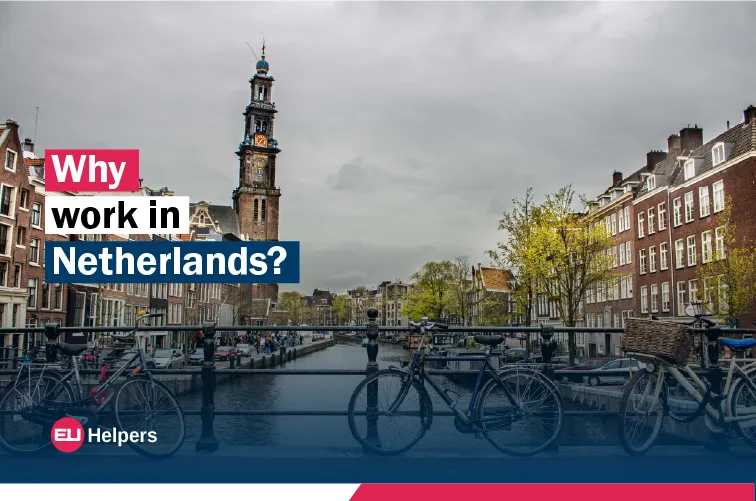

Why Work in Netherlands? A Complete EU Helpers Guide for International Professionals
The Netherlands, the dynamic Northwestern European nation in the heart of Europe and one of the European Union's founding members, occupies a uniquely attractive position in Europe for those seeking exceptional career opportunities, world-class quality of life, full EU integration, innovative work environment, exceptional English proficiency, distinctive tax advantages through the 30% ruling, one of Europe's most efficient skilled migration frameworks, and access to one of Europe's most desirable countries to live and work. With a population of approximately 17.8 million and covering about 41,850 square kilometers, the Netherlands has firmly established itself as one of the most attractive, internationally connected, and innovative work destinations in the European Union for international professionals, IT and tech specialists, semiconductor and high-tech experts (particularly through ASML and the Brainport Eindhoven ecosystem), financial services professionals, engineering experts, life sciences and pharmaceutical specialists, logistics and maritime professionals, agriculture and agritech experts, business consultants, founders, entrepreneurs, and recent graduates from top universities globally. As an EU and Schengen member state, a eurozone member, a NATO member, and a founding member of the European Union (the Netherlands was one of the original six founding members of the European Coal and Steel Community and later the European Economic Community), with exceptional standard of living (consistently ranking among the world's top countries on quality of life, happiness, education, healthcare, and competitiveness indices), exceptional English proficiency (consistently ranking among the world's top countries for English proficiency among non-native speakers), world-class universities (including Delft University of Technology, the University of Amsterdam, Utrecht University, Leiden University, Wageningen University & Research, Erasmus University Rotterdam, and others), vibrant historic cities, rich cultural heritage (with UNESCO sites including the canals of Amsterdam, the windmills of Kinderdijk, Schokland, the Wadden Sea, the Beemster Polder, the Defence Line of Amsterdam, the Van Nellefabriek factory in Rotterdam, the Rietveld Schröder House in Utrecht, and others), exceptional infrastructure, world-renowned cycling culture (with over 35,000 km of cycle paths nationwide), and Amsterdam as one of Europe's most important financial, business, and innovation hubs, the Netherlands consistently ranks among the most desirable countries in Europe to live and work. Cities like Amsterdam (the vibrant capital and major financial, tech, and cultural hub), Rotterdam (Europe's largest port and a major business center with bold modern architecture), The Hague (the seat of the Dutch government and home to many international institutions), Utrecht (a charming historic university city with the Netherlands' tallest church tower), Eindhoven (Europe's high-tech innovation capital, home to ASML and the Brainport Eindhoven region), Groningen, Leiden (the birthplace of Rembrandt and the home of Leiden University, the Netherlands' oldest), Delft (with its famous Delft Blue pottery and the Delft University of Technology), and Wageningen (the agricultural and food innovation hub) host major Dutch and multinational companies, technology hubs, financial institutions, manufacturing leaders, and innovative start-ups. For applicants from Asia, Africa, Latin America, the Americas, and Europe, the Netherlands offers structured immigration pathways including the famous Highly Skilled Migrant permit (Kennismigrant) through recognized sponsors (one of Europe's fastest skilled migration routes), the orientation year (Zoekjaar) for recent graduates, the Startup Visa, the self-employment route, the distinctive DAFT-based residence for US nationals, and a clear long-term route toward Dutch permanent residence and eventually Dutch citizenship. At EU Helpers, candidates regularly ask the fundamental question: why should I consider Netherlands specifically?
This complete EU Helpers guide answers that question in depth and walks you through the genuine, practical, and long-term reasons that make Netherlands one of Europe's most uniquely attractive destinations. Whether you are considering a role under the famously fast Highly Skilled Migrant permit through a recognized sponsor (one of Europe's fastest skilled migration routes), the EU Blue Card, the ICT permit, the orientation year (Zoekjaar) for recent graduates, the Startup Visa for innovative founders, the self-employment route, the distinctive DAFT route for US nationals, or family-based residence, this article walks you through everything you need to know — from the famous Highly Skilled Migrant program and 30% ruling tax advantage to exceptional English proficiency, world-class quality of life, strong career opportunities, innovative environment, exceptional cycling culture, rich cultural heritage, and welcoming immigration framework.
Why Netherlands Is Genuinely Unique Among European Destinations
The Netherlands occupies an unusually attractive position in Europe — small enough to feel manageable and well-connected, yet powerful enough to host major financial services, the world's leading semiconductor equipment company (ASML), one of Europe's largest ports (Rotterdam), exceptional agricultural innovation, world-class universities, and one of Europe's most efficient immigration frameworks for skilled workers.
Famous Highly Skilled Migrant Program (Kennismigrant)
The Netherlands' Highly Skilled Migrant program through recognized sponsors is widely regarded as one of Europe's most efficient and streamlined skilled migration frameworks. Processing typically takes around 2 weeks, making it one of the world's fastest skilled migration routes. This exceptional efficiency is one of the Netherlands' most distinctive advantages.
Distinctive 30% Ruling Tax Advantage
The Netherlands' 30% ruling is one of Europe's most attractive tax provisions for qualifying foreign professionals, allowing 30% of salary to be paid tax-free for up to 5 years. This significantly enhances net compensation and is a major financial advantage of working in the Netherlands as a foreign professional.
Exceptional English Proficiency
The Netherlands consistently ranks among the world's top countries for English proficiency among non-native speakers. Many companies operate entirely in English, daily life functions well in English, and integration is exceptionally accessible for English-speaking foreign professionals.
World-Class Quality of Life
The Netherlands consistently ranks among the world's top countries on quality of life, happiness (consistently top 5-10 globally on the World Happiness Report), education, healthcare, and competitiveness indices.
Strategic Central European Location
The Netherlands' location at the heart of Northwestern Europe provides exceptional access to surrounding countries. Major European capitals (London, Paris, Brussels, Berlin) are easily accessible via high-speed train or short flights. Amsterdam Schiphol Airport is one of Europe's major hubs.
Semiconductor and High-Tech Leadership
The Netherlands is home to ASML, the world's most important semiconductor equipment manufacturer, and the broader Brainport Eindhoven ecosystem — one of Europe's most important innovation regions.
Major Port and Logistics Infrastructure
The Port of Rotterdam is Europe's largest port, making the Netherlands a major logistics and trade hub.
Innovative and Forward-Thinking Society
The Netherlands has a strong reputation for innovation, progressive policies, and forward-thinking approach across business, society, and government.
Top Financial Reasons to Consider Netherlands
The financial rationale for working in the Netherlands is exceptionally compelling, particularly given the 30% ruling.
30% Ruling — Major Tax Advantage
The 30% ruling allows qualifying foreign professionals to receive 30% of salary tax-free for up to 5 years, significantly enhancing net compensation. This is one of Europe's most attractive tax provisions for foreign professionals and a major financial reason to consider the Netherlands.
Competitive Salaries in Key Sectors
Dutch salaries are competitive within European averages, with particular strength in IT, semiconductor and high-tech (ASML and broader Brainport Eindhoven ecosystem), financial services, and senior management.
Strong Worker Protections and Benefits
The Netherlands has strong labor laws, mandatory paid vacation (typically 4 weeks minimum), public holidays, parental leave, sick leave protections, and other comprehensive worker protections.
Comprehensive Social Welfare System
The Netherlands has a generous and comprehensive social welfare system, including extensive healthcare coverage, family allowances, pension contributions, unemployment insurance, and other benefits.
Eurozone Currency Convenience
The Netherlands uses the euro, providing currency stability and convenience for European business and personal matters.
Cost of Living Considerations
Amsterdam, Utrecht, and other major Dutch cities have relatively high costs of living, particularly for housing (the Amsterdam housing market is notably competitive). The 30% ruling helps offset these costs for qualifying foreign professionals.
Lifestyle and Quality-of-Life Benefits
Beyond money, the Netherlands offers an exceptional lifestyle combining accessibility, innovation, cultural richness, and work-life balance.
Vibrant Capital Amsterdam
Amsterdam, the Netherlands' vibrant capital, combines historical heritage (the UNESCO-listed canals from the 17th century Dutch Golden Age, the Anne Frank House, the Rijksmuseum, the Van Gogh Museum, the Stedelijk Museum), modern character, exceptional café culture, vibrant dining scene, distinctive cycling-centric lifestyle, multicultural cosmopolitan character, and a uniquely international atmosphere.
Other Distinctive Cities
Rotterdam, with its bold modern architecture (rebuilt after WWII destruction) including the famous Cube Houses, the Erasmus Bridge, the Markthal, and a vibrant arts scene. The Hague, with its international institutional character (International Court of Justice, International Criminal Court), the Mauritshuis museum housing Vermeer's "Girl with a Pearl Earring," and the beach at Scheveningen. Utrecht, with its charming medieval center, the famous Dom Tower (the Netherlands' tallest church tower), and vibrant student life. Eindhoven, the innovative high-tech hub. Leiden, the historic university city. Delft, with its famous Delft Blue pottery and the canals.
Exceptional Cycling Culture
The Netherlands has the world's most extensive cycling infrastructure with over 35,000 km of dedicated cycle paths. Cycling is genuinely a primary mode of transport (the Netherlands has more bicycles than people). This creates a distinctive lifestyle benefit and supports healthy daily living.
Rich Cultural Heritage
The Netherlands has extraordinary cultural heritage including multiple UNESCO World Heritage Sites (the 17th-century Canal District of Amsterdam, the Mill Network at Kinderdijk-Elshout, Schokland, the Wadden Sea, the Beemster Polder, the Defence Line of Amsterdam, the Van Nellefabriek, the Rietveld Schröder House, and others), the artistic legacy of Dutch masters (Rembrandt, Vermeer, Van Gogh, Mondrian, and many others), centuries of architectural, musical, and literary tradition, and renowned tulip culture (with the famous Keukenhof gardens).
Distinctive Cuisine and Food Culture
Dutch cuisine has distinctive features including stroopwafels (caramel waffles), poffertjes (mini pancakes), bitterballen (savory snacks), haring (raw herring, a Dutch specialty), kibbeling (fried fish), excellent cheeses (Gouda, Edam, and many others — the Netherlands is famous for cheese), and exceptional Indonesian cuisine (a heritage of historical connections). The Netherlands also has a strong international restaurant scene, particularly in Amsterdam.
Temperate Climate
The Netherlands has a temperate maritime climate with mild summers and mild winters. Rain is frequent but rarely extreme. The climate supports year-round outdoor activities.
Excellent Safety
The Netherlands is generally a safe country with low crime rates, strong political stability, and exceptional safety standards.
Strong Work-Life Balance
The Netherlands values work-life balance exceptionally highly, with reasonable working hours, generous vacation entitlements, family-friendly workplace policies, and cultural emphasis on quality of life.
Family-Friendly Society
The Netherlands has a family-oriented culture with high-quality public childcare, family allowances, generous parental leave (including paid parental leave reforms), excellent education systems, and family-friendly workplace policies.
World-Class Educational Options
The Netherlands has world-class universities including TU Delft, the University of Amsterdam, Utrecht University, Leiden University, Wageningen University & Research, Erasmus University Rotterdam, the Vrije Universiteit Amsterdam, the University of Groningen, Maastricht University, and Tilburg University. International schools serve the substantial international community.
Excellent Public Transport
The Netherlands has excellent public transport, including the NS railway system, regional and metropolitan transit systems, and exceptional cycling infrastructure complementing public transport.
Easy Access to Surrounding Countries
The Netherlands' central European location means exceptional access to Belgium (Brussels by Thalys in 1h53m), Germany (Berlin by ICE in about 6 hours, Cologne in 2h40m), the UK (London by Eurostar in about 4 hours), France (Paris by Thalys in 3h20m), and beyond.
Multicultural Cosmopolitan Society
The Netherlands is one of Europe's most multicultural societies, with significant foreign communities particularly in Amsterdam, The Hague, and Rotterdam. This creates an exceptionally welcoming environment for international professionals.
Career Growth and Professional Opportunities
The Netherlands' career environment is exceptional, offering particularly strong opportunities in many sectors.
Strong Career Pathways in Technology
For IT and tech professionals, Amsterdam, Eindhoven, Utrecht, and Rotterdam offer exceptional opportunities at major Dutch and international companies. Companies like Booking.com, Adyen, Mollie, ASML, Philips, ING, and many others alongside major international tech companies create vibrant career ecosystems.
Semiconductor and High-Tech Careers
For semiconductor and high-tech professionals, the Netherlands offers exceptional opportunities through ASML and the broader Brainport Eindhoven ecosystem.
Financial Services Careers
For financial services professionals, Amsterdam's growing role as a European financial hub (particularly post-Brexit) creates exceptional opportunities.
International Affairs Careers
For those interested in international affairs, The Hague's role as home to the International Court of Justice, International Criminal Court, and many other international institutions creates distinctive opportunities.
Agritech and Food Innovation Careers
For agritech professionals, the Netherlands' global leadership in agricultural innovation (anchored by Wageningen University & Research) creates exceptional opportunities.
Opportunities for Entrepreneurs Through Multiple Routes
The Netherlands offers multiple distinctive routes for entrepreneurs including the Startup Visa, the self-employment route, and the DAFT route for US nationals.
Strong Foundation for International Careers
As an EU and Schengen member with central European location and exceptional English-speaking work environment, the Netherlands is an exceptional base for international careers.
Residency, Work Permit, and Legal Benefits
Working legally in the Netherlands comes with structured immigration pathways and strong legal protections within the EU framework.
Famously Fast Highly Skilled Migrant Permit
The Highly Skilled Migrant permit through recognized sponsors is one of Europe's fastest skilled migration routes, typically processed in around 2 weeks. This is one of the Netherlands' most distinctive advantages.
Structured Permit System
Foreign workers obtain residence through dedicated schemes including the Highly Skilled Migrant permit, EU Blue Card, ICT permit, orientation year, Startup Visa, self-employment, DAFT route, researcher permit, family reunification, and other pathways.
Family Reunification
The Netherlands allows qualifying workers and residents to bring close family members, with particularly favorable arrangements for Highly Skilled Migrant holders.
Pathway to Dutch Citizenship
After 5 years of legal residence and work in the Netherlands, foreign nationals may become eligible for Dutch citizenship by naturalization, provided they meet integration, language, and other requirements. Dutch citizenship grants full EU citizenship benefits.
Healthcare, Education, and Social Benefits
The Netherlands' public services are widely recognized for their exceptional quality.
High-Quality Healthcare System
The Netherlands has a high-quality healthcare system with universal coverage for residents through mandatory health insurance. Dutch healthcare is consistently ranked among Europe's best systems.
Excellent Educational System
The Netherlands offers high-quality public education, alongside excellent private and international schools (particularly serving the substantial expat community in Amsterdam, The Hague, Rotterdam, and Eindhoven).
Strong Social Protections
Registered workers benefit from comprehensive contributions toward pensions, healthcare, unemployment insurance, parental leave, and other social protections.
Practical Considerations for Working in the Netherlands
While the Netherlands offers compelling benefits, applicants should also understand some practical considerations.
Competitive Housing Markets
Amsterdam, Utrecht, and other major Dutch cities have notably competitive housing markets, particularly Amsterdam where rental availability is constrained.
Tax Considerations
The Netherlands has a progressive personal income tax system. The 30% ruling significantly mitigates this for qualifying foreign professionals, but tax planning is important.
Language Considerations
Dutch is the official language. Exceptional English proficiency means many functions of daily life work in English, particularly in major cities. Learning Dutch enhances integration and is appreciated.
Cultural Adjustments
Dutch culture has distinctive features including directness in communication, focus on consensus-building (the "polder model"), egalitarian workplace culture, and cycling-centric daily life — all requiring some adjustment.
Weather Considerations
The Netherlands has frequent rain and limited sunshine, which some find challenging.
Required Documents and Step-by-Step Overview
While exact requirements depend on the specific permit and applicant profile, the general route involves coordination with IND (for residence and most work permit aspects), UWV (for work permit aspects of the GVVA), the Dutch embassy or consulate for MVVs where required, and the local municipality for registration after arrival.
Practical Tips for International Applicants Considering Netherlands
Moving to the Netherlands is rewarding, but preparation makes the difference.
Tips From EU Helpers for Considering the Netherlands
Target Dutch employers that are recognized sponsors with IND — this is the single most important factor for fast processing through the Highly Skilled Migrant route. For recent graduates, evaluate the orientation year (Zoekjaar) as the optimal entry route. For US nationals, evaluate the DAFT route as an exceptionally favorable option. For innovative founders, evaluate the Startup Visa with approved Dutch facilitators. Consider 30% ruling planning carefully. Plan housing in Amsterdam, Rotterdam, Utrecht, Eindhoven, or other relevant cities, recognizing housing market competitiveness. Develop English proficiency (essential given the Netherlands' English-heavy work environment) while strengthening Dutch language skills. Always rely on the latest official guidance.
Final Guidance
Why work in Netherlands? Because few countries in Europe combine such a unique mix of the famous Highly Skilled Migrant program (one of Europe's fastest skilled migration routes through recognized sponsors), the distinctive 30% ruling tax advantage (one of Europe's most attractive tax provisions for foreign professionals), exceptional English proficiency (consistently among the world's top countries for English among non-native speakers), world-class quality of life (consistently among the world's top countries on happiness, education, healthcare, and competitiveness indices), strong career opportunities at major Dutch and international companies (including ASML — the world's most important semiconductor equipment manufacturer — and the broader Brainport Eindhoven high-tech ecosystem, plus major operations of Booking.com, Adyen, Philips, ING, and many others), Amsterdam's role as a major European tech and financial hub, The Hague's role as home to international institutions (International Court of Justice, International Criminal Court, and many others), exceptional cycling culture (with over 35,000 km of cycle paths), rich cultural heritage with multiple UNESCO sites (the canals of Amsterdam, windmills of Kinderdijk, and many others), strong social welfare, excellent healthcare and education, central European location with excellent transport connections, and a clear pathway to Dutch citizenship with full EU benefits. For international professionals seeking exceptional opportunities with one of Europe's most efficient immigration frameworks, the famous 30% ruling tax advantage, English-friendly work environment, world-class quality of life, and central European location, the Netherlands stands out as one of Europe's most uniquely attractive destinations. EU Helpers supports international applicants at every stage — from evaluating eligibility and selecting the right permit route to preparing documents, identifying recognized sponsors for fast Highly Skilled Migrant processing, comparing Highly Skilled Migrant, EU Blue Card, ICT, orientation year for graduates, Startup Visa, self-employment, DAFT route for US nationals, and family-based residence, 30% ruling planning, and planning a smooth transition. If the Netherlands is on your radar as a future work destination, EU Helpers can help you move forward with clarity, confidence, and the latest accurate information.
FAQs
The Netherlands offers a unique combination of the famous Highly Skilled Migrant program (one of Europe's fastest skilled migration routes), the distinctive 30% ruling tax advantage, exceptional English proficiency, world-class quality of life, strong career opportunities, innovative environment, central European location, rich cultural heritage, and clear pathway to Dutch citizenship with full EU benefits.
The 30% ruling is a Dutch tax provision allowing qualifying foreign professionals to receive 30% of salary tax-free for up to 5 years, significantly enhancing net compensation. It is one of Europe's most attractive tax provisions for foreign professionals.
The Highly Skilled Migrant permit (Kennismigrant) is the Netherlands' distinctive fast-track route for skilled foreign workers, widely regarded as one of Europe's most efficient skilled migration frameworks. It operates through employers registered as recognized sponsors with IND, with processing typically taking around 2 weeks.
The Netherlands consistently ranks among the world's top countries for English proficiency among non-native speakers. Many companies operate entirely in English, daily life functions well in English, and integration is exceptionally accessible for English-speaking foreign professionals.
Dutch salaries are competitive within European averages, with particular strength in IT, semiconductor and high-tech, financial services, and senior management. The 30% ruling significantly enhances net compensation for qualifying foreign professionals.
ASML is the Dutch company globally dominant in semiconductor lithography equipment, particularly EUV (extreme ultraviolet) lithography essential for advanced semiconductor manufacturing. ASML is one of the world's most strategically important companies and is headquartered in Veldhoven near Eindhoven.
Brainport Eindhoven is the high-tech innovation region around Eindhoven, anchored by ASML, Philips heritage, and many other high-tech companies. It is considered one of Europe's most important innovation regions.
The orientation year provides one year of residence to seek work or establish a business in the Netherlands. It is available to recent graduates from Dutch universities and top universities globally, with reduced Highly Skilled Migrant salary thresholds available to orientation year holders.
The Dutch-American Friendship Treaty provides US nationals with exceptionally favorable terms for establishing businesses in the Netherlands with a modest minimum investment, without standard self-employment points system requirements.
Yes. The Netherlands is one of Europe's most multicultural societies, with significant foreign communities particularly in Amsterdam, The Hague, Rotterdam, and Eindhoven. This creates an exceptionally welcoming environment for international professionals.
Amsterdam, Utrecht, and other major Dutch cities have relatively high costs of living, particularly for housing. The 30% ruling helps offset these costs for qualifying foreign professionals.
The Netherlands has a temperate maritime climate with mild summers and mild winters. Rain is frequent but rarely extreme.
Yes. The Netherlands is generally a safe country with low crime rates and strong political stability.
The Netherlands has the world's most extensive cycling infrastructure with over 35,000 km of dedicated cycle paths. Cycling is genuinely a primary mode of transport — the Netherlands has more bicycles than people. This creates a distinctive lifestyle benefit.
The Netherlands has multiple UNESCO World Heritage Sites including the 17th-century Canal District of Amsterdam, the Mill Network at Kinderdijk-Elshout, Schokland, the Wadden Sea, the Beemster Polder, the Defence Line of Amsterdam, the Van Nellefabriek, the Rietveld Schröder House, and others.
Yes. The Netherlands is an EU member state, a Schengen Area member, a eurozone member, a NATO member, and a founding member of the European Union.
The Netherlands uses the euro as its currency.
Yes. Qualifying workers can usually apply for family reunification for spouses and dependent children, with Highly Skilled Migrants typically benefiting from particularly favorable family reunification provisions.
After 5 years of legal residence and work in the Netherlands, foreign nationals may become eligible for Dutch citizenship by naturalization, provided they meet integration, language, and other requirements. Dutch citizenship grants full EU citizenship benefits.
EU Helpers supports international applicants with eligibility assessment, permit category selection (including the famously fast Highly Skilled Migrant permit, EU Blue Card, orientation year for graduates, Startup Visa, self-employment, DAFT for US nationals, and others), recognized sponsor identification, document preparation, 30% ruling planning, employer coordination, and clarity on the latest official requirements. The goal is to help you approach the Dutch work and residency process with accurate, up-to-date, and practical information tailored to your career goals.