
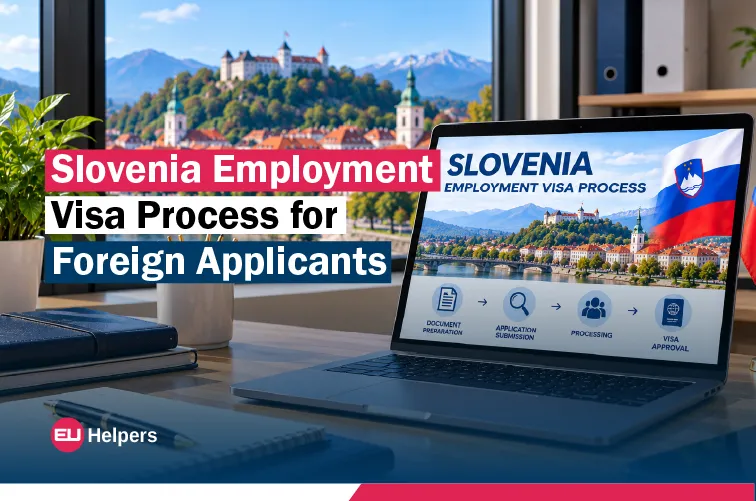

Slovenia Employment Visa Process for Foreign Applicants
Getting hired in Slovenia as a foreign applicant is less about a single visa stamp and more about a sequence: an employer makes an offer, someone files an application with the right office, the Employment Service gives its consent, and a combined permit is issued that lets you live and work in the country. Knowing who does each part, and in what order, prevents the most common delays. This EU Helpers guide follows the employment visa process from job offer to first day at work, covering the single permit (enotno dovoljenje za prebivanje in delo), the EU Blue Card and the shorter-term routes, and shows how candidates can plan ahead and explore Slovenian opportunities through EU Helpers. Slovenia has been a member of the European Union and NATO since 2004 and has used the euro and belonged to the Schengen Area since 2007.
Essential Context: Slovenia's Distinctive Character
| Consideration | Slovenia Reality |
|---|---|
| Who usually files | The worker abroad or the employer at the upravna enota |
| Who decides | The administrative unit (upravna enota) where the worker will live |
| Labour market check | ZRSZ consent requested by the administrative unit |
| Separate entry visa | Generally not needed once the permit is issued |
| Biometrics | Taken at the embassy or the administrative unit |
| After arrival | Address registration, EMŠO, tax number and ZZZS insurance |
| Status | EU and NATO since 2004, euro and Schengen since 2007 |
Because the residence and work decisions are merged into one procedure, there is one file and one final decision, but several institutions touch the file along the way. Applicants who understand that chain can tell where a case is stuck and who to contact.
Slovenia's Immigration Framework
The procedure runs under the Foreigners Act (Zakon o tujcih, ZTuj-2) and the Employment, Self-Employment and Work of Foreigners Act (Zakon o zaposlovanju, samozaposlovanju in delu tujcev, ZZSDT). The administrative unit (upravna enota) is the case owner: it receives the application, checks identity and residence conditions and issues the decision. The Employment Service of Slovenia (Zavod Republike Slovenije za zaposlovanje, ZRSZ) examines the employer and the job and returns its consent (soglasje) to the administrative unit. Slovenian embassies and consulates act as the front door for applicants who file from abroad, forwarding files and handing over permit cards.
Once the worker is in Slovenia, three more bodies come into play. The administrative unit records the address and assigns the personal identification number (EMŠO), the Financial Administration (Finančna uprava Republike Slovenije, FURS) provides the tax number (davčna številka), and the Health Insurance Institute (ZZZS) registers the worker for compulsory insurance after the employer files the registration form.
Main Slovenia Work Visa Routes
| Route | Purpose | Best Suited For |
|---|---|---|
| Single permit | One procedure for residence and employment | Most foreign employees with a contract |
| EU Blue Card | Fast-track style permit for high skills | Degree holders on salaries at or above the national average |
| Seasonal work permit | Short work stays issued by the ZRSZ | Farm, forestry and tourism seasonal staff |
| Intra-corporate transfer | Temporary move within a group | Staff of multinational companies |
| Digital nomad permit | One-year stay for remote work | Workers paid by foreign employers or clients |
| Family reunification | Joining a permit holder | Spouses, partners and children |
Single Permit Procedure: From Job Offer to Decision
The process starts with a signed employment contract or binding offer. The application can be filed by the worker at a Slovenian embassy or consulate in the country of nationality or legal residence, or in Slovenia at the administrative unit, where the employer frequently files on the worker's behalf with a written authorisation. Filing inside Slovenia is now also possible for some first-time applicants who are already lawfully present, which can save a trip abroad.
After the file is complete, the administrative unit asks the ZRSZ for consent on its own initiative. The Employment Service checks the employer's registration, tax and contribution record and compliance history, confirms the wage meets the minimum wage and collective agreement, and, where the labour market test applies, checks whether suitable unemployed candidates are registered. With consent in hand, the administrative unit issues the permit. In practice the whole process often takes several weeks to a few months, with larger administrative units such as Ljubljana typically busier. For certain shortage occupations, a confirmation of the filed application can allow work to begin before the final decision, provided the worker completes Slovene language training.
EU Blue Card Procedure
The Blue Card follows the same path but with a narrower assessment. The administrative unit checks the higher education qualification, or relevant ICT experience, and the ZRSZ confirms that the contract lasts at least six months and pays at least the average gross annual salary in Slovenia. The law expects a decision within about 30 days of a complete application, extended to about 60 days where additional fact-finding is needed. The family's applications can be processed at the same time, which avoids a second waiting period after arrival.
Seasonal, Transfer and Digital Nomad Procedures
Seasonal work permits for short stays are issued directly by the ZRSZ at the employer's request, while longer agricultural seasons go through the single permit. Intra-corporate transferees file through the administrative unit with evidence of prior employment in the group and an assignment letter. Digital nomads apply at an embassy or, if already lawfully in Slovenia, at the administrative unit, showing remote employment and income of at least twice the average net salary. That permit is issued for up to one year and needs no ZRSZ consent because the holder does not work for a Slovenian employer.
Required Documents
| Document | Purpose |
|---|---|
| Application form | Opens the case at the embassy or administrative unit |
| Passport copy and original | Identifies the applicant during biometrics |
| Employment contract | Forms the basis of the ZRSZ consent |
| Criminal record certificate | Supports the security check |
| Health insurance evidence | Covers the applicant until ZZZS registration |
| Diploma or experience proof | Required for the Blue Card and regulated jobs |
| Authorisation for the employer | Allows the employer to file and track the case |
Application Process Step-by-Step
Step 1 — Sign the contract. Agree the job, salary and start date with the Slovenian employer and sign the contract or binding offer.
Step 2 — Choose where to file. Decide whether you will file at an embassy abroad or whether the employer will file at the upravna enota.
Step 3 — Prepare legalised documents. Obtain apostilles or legalisation and certified Slovene translations for foreign public documents.
Step 4 — Submit and give biometrics. Lodge the application, pay the fee and provide fingerprints and a photograph.
Step 5 — Consent request. The administrative unit sends the file to the ZRSZ for labour market consent.
Step 6 — Respond to requests. Answer any request for additional documents quickly, as the clock stops while the file is incomplete.
Step 7 — Decision issued. The administrative unit issues the single permit or Blue Card once consent is granted.
Step 8 — Enter Slovenia. Collect the card and travel; the permit itself allows entry for visa-required nationals.
Step 9 — Register within eight days. Register your temporary address and receive your EMŠO, then request a tax number from FURS.
Step 10 — Insurance and first payslip. The employer registers you with the ZZZS and pension insurance before or on your first working day.
Fees and Costs
Budget for an administrative fee of typically around 100 euros for a first permit filed abroad, or about 70 euros if filed in Slovenia, plus roughly 15 euros for the card. Translation and apostille costs vary by country and can exceed the official fees. Salaries and prices are in euros. Ljubljana is the priciest city for rent, while Maribor, Celje, Kranj and Novo Mesto offer lower housing costs. Set aside savings for a rental deposit, usually one to three months of rent, and for living costs until your first salary arrives.
Slovenia's Distinctive Character
Slovenia is small enough that the capital, the Alps, the Karst and the Adriatic coast are all within a couple of hours' drive. Its industrial base runs from pharmaceuticals at Krka in Novo Mesto and Lek in Ljubljana to Renault production at Revoz and household appliances at Gorenje in Velenje. The Port of Koper connects Central Europe with global shipping, Maribor is the second city and an engineering hub, and Kranj and Celje host manufacturing and logistics firms. This mix explains why applications in transport, production and engineering are so common.
Pathway to Permanent Residence and Citizenship
The process does not end with the first permit. Workers extend their single permit, typically for up to three years at a time, and after five years of continuous lawful temporary residence they can usually apply for permanent residence, which requires a Slovene exam at A2 level. Naturalisation generally follows after ten years of residence, the last five continuous, with a Slovene language exam, proof of means and, as a rule, renunciation of previous citizenship.
Final Guidance
Treat the Slovenian employment visa process as a relay. Your employer and the ZRSZ carry the labour market part, the administrative unit carries the residence part, and you carry the documents and post-arrival registrations. Agree early on who files, check the file is complete before submission, and keep copies of every receipt and confirmation. Plan for several weeks of processing and prepare your EMŠO, tax number and insurance steps in advance. With a clear timeline, you can confidently explore Slovenian opportunities through EU Helpers.
FAQs
The process begins with a signed contract from a Slovenian employer. An application for a single permit is then filed at a Slovenian embassy or at the administrative unit (upravna enota), the administrative unit requests consent from the ZRSZ, and a decision is issued once consent is granted. After arrival, the worker registers an address, receives an EMŠO, obtains a tax number and is insured through the ZZZS. Each stage depends on the previous one being complete.
Slovenia joined the EU and NATO in 2004, adopted the euro in 2007 and entered the Schengen Area in 2007. Because it is a full EU member, it applies EU directives on the single permit, the Blue Card and long-term residence, so the process looks familiar to anyone who has applied elsewhere in the EU. A Slovenian permit allows short visits to other Schengen countries. Salaries, fees and costs are all in euros.
Timelines vary by administrative unit and by how complete the file is. Many applicants wait several weeks to a few months, with busier units such as Ljubljana often taking longer. The ZRSZ consent stage adds time, especially where a labour market test applies. Responding quickly to requests for extra documents and filing a complete application are the best ways to avoid delays.
The Blue Card procedure is designed to be quicker, with a legal expectation of a decision within about 30 days of a complete application, or about 60 days if extra fact-finding is needed. The applicant needs a higher education qualification or relevant ICT experience, a contract of at least six months and a salary of at least the national average gross wage. Family members' applications can be handled at the same time. This makes the Blue Card attractive for qualified professionals.
Yes, applicants already lawfully staying in Slovenia can typically file at the administrative unit, while others apply through a Slovenian embassy or consulate. You must show remote work for foreign employers or clients and income of at least twice the average net salary in Slovenia. The permit lasts up to one year and cannot be extended, though you can reapply after six months. No ZRSZ consent is involved because you do not work for a Slovenian company.
Expect to submit an application form, your passport, a signed employment contract, a criminal record certificate, proof of health insurance and a photograph. Blue Card applicants add diplomas or proof of ICT experience. If your employer files for you, a written authorisation is useful. Foreign documents normally need an apostille or legalisation and a certified Slovene translation.
Both, but in different roles. The administrative unit (upravna enota) owns the case, checks residence conditions and issues the final decision. The Employment Service of Slovenia (ZRSZ) examines the employer and the job and gives labour market consent to the administrative unit. The Ministry of the Interior sets the rules, and embassies accept applications filed abroad.
Plan for a rental deposit of one to three months and living costs until your first salary. In Ljubljana, one-bedroom rents typically fall between about 700 and 1,000 euros a month, while Maribor, Celje, Kranj and Novo Mesto are usually cheaper. Groceries and public transport are moderately priced. EU Helpers suggests arriving with enough savings to cover at least the first month comfortably.
Employers in manufacturing, transport and logistics, construction and healthcare file many applications. Industrial names include Krka, Lek, Revoz and Gorenje, and the Port of Koper supports a large logistics sector. Ljubljana's technology companies hire software developers and engineers. Hotels and restaurants in the Alps and on the coast recruit for the tourist season.
EU Helpers explains the full sequence, from contract signing and the choice between filing at an embassy or at the upravna enota to ZRSZ consent and the final decision. We help you understand which documents need an apostille, legalisation or certified Slovene translation and how to respond to requests for additional information. We also prepare you for the steps after arrival, including address registration within eight days, receiving your EMŠO, getting a tax number from FURS and ZZZS insurance registration. EU Helpers always encourages applicants to confirm current procedures with the official authorities.
Still have questions? Get in touch
Ready to work in Slovenia?
EU Helpers guides non-EU workers through Slovenia’s work authorization. From Upravne enote (administrative units) and ZRSZ coordination to Single Permit, EU Blue Card and Highly Qualified routes, we make your Slovenia move seamless with distinctive Alpine Adriatic EU member positioning.