
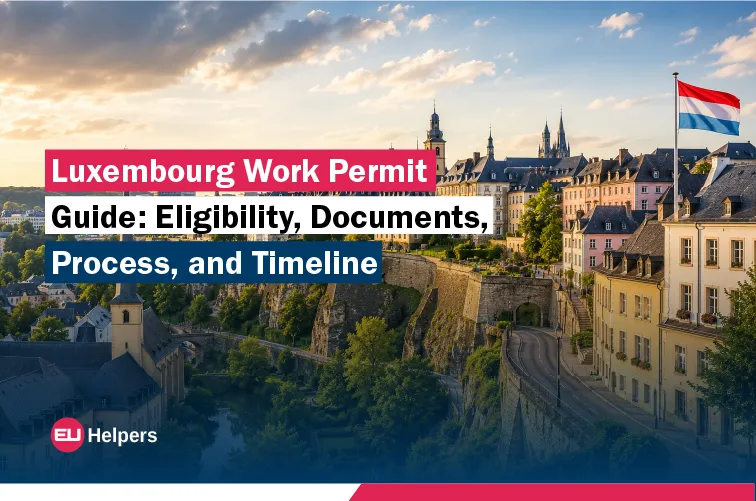

Luxembourg Work Permit Guide: Eligibility, Documents, Process, and Timeline
The Grand Duchy of Luxembourg (Grand-Duché de Luxembourg — Groussherzogtum Lëtzebuerg), an EU founding member since 1957 and Schengen founding member (with Schengen Agreement signed in Luxembourgish town of Schengen in 1985), operates a work permit system administered by the Immigration Directorate (Direction de l'immigration) under Ministry of Foreign and European Affairs handling residence permits, the National Employment Agency (Agence pour le développement de l'emploi — ADEM) handling employment authorizations, and Luxembourgish embassies handling visa applications abroad for visa-required nationals. This EU Helpers guide walks through Luxembourg's work permit landscape for international applicants — international candidates can explore Luxembourgish opportunities through EU Helpers. Luxembourg is an EU founding member (since 1957), Schengen founding member (Schengen Agreement signed in Luxembourg 1985), eurozone founding member (since 1999), NATO founding member (since 1949), and Council of Europe founding member (since 1949).
Essential Context: Luxembourg's Distinctive Character
Luxembourg offers distinctive character as major Western European financial hub with EU institutional presence.
| Consideration | Luxembourg Reality |
|---|---|
| Population | Approximately 660,000 |
| Territory | 2,586 sq km (one of smallest EU members) |
| Location | Western Europe, between Belgium France Germany |
| Capital | Luxembourg City (Ville de Luxembourg — Stad Lëtzebuerg) with approximately 130,000 residents |
| EU status | Founding member since 1957 |
| Schengen status | Schengen founding member (Agreement signed 1985) |
| Eurozone status | Founding member since 1999 |
| NATO status | Founding member since 1949 |
| Economic character | Major financial hub, EU institutions |
| Languages | Luxembourgish, French, German (all official) |
Luxembourg's founding membership in all major European institutions combined with major financial services sector, EU institutional presence, and trilingual character makes it distinctive Western European destination.
Luxembourg's Immigration Framework
Luxembourg's immigration framework operates through Immigration Directorate (Direction de l'immigration) under Ministry of Foreign and European Affairs as central authority handling residence permits, National Employment Agency (ADEM — Agence pour le développement de l'emploi) handling employment authorizations, and Luxembourgish embassies handling visa applications for visa-required nationals abroad. Luxembourg implements EU Single Permit Directive through combined work and residence permit system for most third-country nationals.
Main Luxembourg Work Permit Routes
Luxembourg offers several work permit routes for new applicants.
| Route | Purpose | Best Suited For |
|---|---|---|
| Salaried Worker Authorization | Employment authorization | Most common route |
| EU Blue Card | Highly qualified professionals | EU mobility advantages |
| ICT Permit | Intra-corporate transfers | Multinational transfers |
| Self-Employed Permit | Business establishment | Entrepreneurs |
| Investor Permit | Substantial investment | Investors |
| Researcher Permit | Research positions | Academic and research |
| Highly Qualified Worker | High-salary positions | Specialists |
| Family Reunification | Family basis | Family members |
The Salaried Worker Authorization is the most common route for third-country nationals seeking Luxembourgish employment.
Luxembourg Salaried Worker Authorization
Luxembourg's Salaried Worker Authorization is the primary route for third-country nationals seeking Luxembourgish employment.
Salaried Worker Authorization features include combined work and residence permit implementing EU Single Permit Directive, tied to specific employer and position (though changes possible with proper procedures), typical validity matching employment contract, and pathway to permanent residence and eventual Luxembourgish citizenship. Application processes through Immigration Directorate coordinated with ADEM for labor market considerations. Standard processing typically 2-3 months.
EU Blue Card in Luxembourg
Luxembourg implements the EU Blue Card for highly qualified professionals.
| EU Blue Card Requirement | Details |
|---|---|
| Qualifications | University degree (min. 3 years) or equivalent experience |
| Job offer | Meeting Blue Card salary threshold |
| Salary threshold | 1.5x average gross Luxembourgish salary |
| Contract duration | Minimum 12 months |
| Duration | Up to 4 years initially with renewal |
EU Blue Card advantages include exemption from Luxembourgish labor market test, EU mobility provisions after qualifying period, facilitated family reunification, and pathway to EU long-term resident status.
Eligibility Requirements for New Applicants
Luxembourg work permit eligibility centers on route-specific requirements.
For Salaried Worker Authorization through employer sponsorship, applicants must have firm Luxembourgish job offer, position typically requires labor market considerations (ADEM registration), salary meeting Luxembourgish standards, appropriate qualifications, health insurance, and clean criminal record.
For EU Blue Card, applicants must have university degree meeting Blue Card salary threshold and qualifying job offer.
Educational qualifications from foreign institutions may require recognition through Luxembourgish authorities particularly for regulated professions.
Required Documents
Luxembourg work permit applications require specific documentation.
| Document | Purpose |
|---|---|
| Valid passport | Identity with sufficient validity |
| Employment contract | Confirming Luxembourgish employment terms |
| Employer application | Immigration Directorate and ADEM applications |
| Educational qualifications | Diplomas with translations |
| Professional experience | CV and reference letters |
| Health insurance | Coverage valid in Luxembourg |
| Criminal record certificate | From country of previous residence |
| Translations | French, German, or English typically acceptable |
| Apostille certification | Where required by country of origin |
| Photographs | Recent biometric photos |
| Proof of accommodation | Luxembourgish address confirmation |
Foreign documents may be accepted in French, German, or English given Luxembourg's trilingual character (Luxembourgish, French, German are official languages plus English widely used). Apostille certification may be required depending on country of origin.
Application Process Step-by-Step
The Luxembourg work permit application follows a structured sequence.
Step 1 — Job offer and ADEM registration. Luxembourgish employer secures firm job offer and coordinates with ADEM for labor market considerations.
Step 2 — Temporary authorization application. Applicant applies for temporary authorization to stay from Immigration Directorate before entering Luxembourg.
Step 3 — Immigration Directorate processing. Immigration Directorate processes application coordinated with ADEM.
Step 4 — Temporary authorization approval. Immigration Directorate approves temporary authorization to stay.
Step 5 — Visa collection at Luxembourgish embassy (if applicable). Visa-required nationals collect long-stay visa at Luxembourgish embassy.
Step 6 — Travel to Luxembourg. Applicant travels to Luxembourg.
Step 7 — Declaration of arrival and medical examination. Applicant declares arrival at commune and undergoes required medical examination.
Step 8 — Residence permit application in Luxembourg. Applicant applies for residence permit through Immigration Directorate.
Step 9 — Residence permit collection. Applicant collects biometric residence permit.
Application Timeline
Luxembourg work permit processing timelines vary by circumstances.
| Application Type | Approximate Processing Time |
|---|---|
| Salaried Worker Authorization | Approximately 2-3 months |
| EU Blue Card | Approximately 1-2 months |
| ICT Permit | Approximately 1-2 months |
| Highly Qualified Worker | Approximately 1-2 months |
| Self-Employed Permit | Approximately 2-3 months |
| Investor Permit | Approximately 3-4 months |
| Researcher Permit | Approximately 1-2 months |
| Family Reunification | Approximately 3-6 months |
Processing times depend on completeness of documentation, complexity of the case, and current administrative workload.
Fees and Costs
Luxembourg work permit costs reflect Western European standards. Application fees vary by category. Long-stay visa fee varies. Translation costs vary (reduced given multilingual acceptance). Apostille costs vary by country. Health insurance ongoing costs apply.
Luxembourg has high cost of living compared to European averages particularly for housing given wealthy country status and limited space. However, Luxembourg salaries are among Europe's highest particularly in financial services sector reflecting country's wealth.
Family Members
Luxembourg work permit holders can bring immediate family members through family reunification.
Family reunification requires valid relationship documentation, adequate financial resources, adequate Luxembourgish accommodation, and health insurance coverage. EU Blue Card holders benefit from facilitated family reunification. Family members typically have right to work in Luxembourg during the primary applicant's permit period.
Luxembourg's Distinctive Character
Luxembourg offers distinctive advantages as Western European EU destination.
Geographic character: Luxembourg features Western European geography with rolling hills and forests (Ardennes in north, Gutland in south), Moselle River valley (wine-producing region along border with Germany), various small towns and villages, and continental climate. Luxembourg is one of Europe's smallest countries but wealthiest per capita.
Historic cities: Luxembourg City (Ville de Luxembourg — Stad Lëtzebuerg) as capital with UNESCO World Heritage historic center featuring medieval fortifications and old town on rocky promontory, distinctive Kirchberg plateau housing EU institutions including European Court of Justice European Investment Bank and other institutions. Various smaller Luxembourgish cities and towns including Esch-sur-Alzette as second-largest city and Grevenmacher as Moselle wine town.
Economic character: Luxembourg has highly developed economy with major financial services sector (Luxembourg is major European financial services hub particularly for investment funds — Luxembourg is world's second-largest investment fund center after United States, private banking, and various financial services), EU institutions (Luxembourg City hosts European Court of Justice, European Investment Bank, European Court of Auditors, and various other EU institutions), steel industry (historically significant with ArcelorMittal headquartered in Luxembourg), technology sector (growing particularly satellite services with SES as major satellite operator), and traditional sectors.
Cultural richness: Luxembourg's cultural heritage includes distinctive Luxembourgish identity combining French German and unique Luxembourgish elements, trilingual character (Luxembourgish as national language, French as administrative language particularly, German widely used), Grand Ducal monarchy (Luxembourg is world's only remaining Grand Duchy), various historic influences, and modern international character given EU institutional presence.
Sector Considerations
Different Luxembourgish sectors have varying immigration considerations.
Financial services: Luxembourg's major sector with private banking, investment funds (Luxembourg is world's second-largest investment fund center after United States with over €5 trillion in assets under management), insurance, and various financial services. Sector particularly welcomes international professionals with financial services expertise. Many positions qualify for EU Blue Card given competitive financial services compensation.
EU institutions: Distinctive Luxembourgish specialization with European Court of Justice, European Investment Bank, European Court of Auditors, and various other EU institutions creating substantial employment for EU civil servants and various support functions.
Technology and satellite services: Growing sector with SES (major satellite operator) and various tech companies.
Steel industry: Historically significant with ArcelorMittal headquartered in Luxembourg.
International consulting: Big Four accounting firms and international law firms have significant Luxembourg operations serving financial services sector.
Traditional sectors: Various sectors including wine production (Moselle wine region), tourism, and services.
Pathway to Permanent Residence and Citizenship
Luxembourg work permits provide pathway to permanent residence and eventually Luxembourgish citizenship. Permanent residence typically available after 5 years of continuous legal residence. Luxembourgish citizenship by naturalization typically available after 5 years of continuous residence with additional requirements including Luxembourgish language proficiency (Luxembourgish B1 level for speaking, A2 level for writing), integration into Luxembourgish society, sufficient income, clean criminal record, and other elements. Luxembourg allows dual citizenship since 2009.
Final Guidance
Luxembourg work permits operate through Immigration Directorate (Direction de l'immigration) under Ministry of Foreign and European Affairs as central authority handling residence permits, National Employment Agency (ADEM — Agence pour le développement de l'emploi) handling employment authorizations, and Luxembourgish embassies handling visa applications for visa-required nationals abroad. Main routes include Salaried Worker Authorization as most common route for third-country nationals combining work and residence through employer sponsorship implementing EU Single Permit Directive, EU Blue Card for highly qualified professionals with university degree meeting Blue Card salary threshold (1.5x average gross Luxembourgish salary) offering EU mobility advantages and labor market test exemption, ICT Permit for multinational intra-corporate transfers, Self-Employed Permit for entrepreneurs, Investor Permit for substantial investment, Researcher Permit for academic and research positions, Highly Qualified Worker for high-salary specialist positions, and Family Reunification. Standard Salaried Worker Authorization processing typically 2-3 months and EU Blue Card 1-2 months. Documentation may be accepted in French, German, or English given Luxembourg's trilingual character (Luxembourgish, French, German as official languages plus English widely used in financial services and international sectors). Luxembourg's status as EU founding member (since 1957 — Luxembourg is one of six founding members of European Economic Community), Schengen founding member (Schengen Agreement signed in Luxembourgish town of Schengen in 1985), eurozone founding member (since 1999), NATO founding member (since 1949), and Council of Europe founding member (since 1949) makes Luxembourg one of Europe's most integrated countries with comprehensive membership in all major European institutions since their founding, combined with the country's distinctive geography including Western European position between Belgium France Germany with rolling hills and forests (Ardennes in north, Gutland in south), Moselle River valley (wine-producing region along border with Germany), various small towns and villages, and continental climate (Luxembourg is one of Europe's smallest countries by size and population but wealthiest per capita), historic Luxembourg City (Ville de Luxembourg — Stad Lëtzebuerg) as capital with UNESCO World Heritage historic center featuring medieval fortifications and old town on rocky promontory plus distinctive Kirchberg plateau housing EU institutions including European Court of Justice European Investment Bank European Court of Auditors and various other EU institutions creating substantial EU institutional character, plus Esch-sur-Alzette as second-largest city and various smaller Luxembourgish cities and towns, highly developed economy with major financial services sector (Luxembourg is world's second-largest investment fund center after United States with over €5 trillion in assets under management, private banking, insurance, and various financial services), EU institutions employment, technology sector particularly satellite services with SES as major satellite operator, steel industry historically significant with ArcelorMittal headquartered in Luxembourg, and international consulting (Big Four accounting firms and international law firms have significant Luxembourg operations), high cost of living compared to European averages particularly for housing given wealthy country status and limited space, high Luxembourgish salaries among Europe's highest particularly in financial services, trilingual character with Luxembourgish (Lëtzebuergesch) as national language French as primary administrative language and German widely used plus English widely used in financial services and international sectors, cultural richness including distinctive Luxembourgish identity combining French German and unique Luxembourgish elements, Grand Ducal monarchy (Luxembourg is world's only remaining Grand Duchy), various historic influences, and modern international character given EU institutional presence makes Luxembourg one of Europe's most distinctive Western European EU destinations particularly given financial services concentration and comprehensive European integration since founding of major European institutions. International applicants can explore Luxembourg opportunities through EU Helpers. EU Helpers can support new international applicants with eligibility assessment, Salaried Worker Authorization application coordination through Immigration Directorate and ADEM, EU Blue Card evaluation for highly qualified professionals, ICT Permit evaluation for multinational transfers, Highly Qualified Worker evaluation for specialist positions, Self-Employed Permit evaluation for entrepreneurs, Investor Permit evaluation, document preparation including translations where needed (French, German, English often acceptable) and apostille arrangements, employer coordination throughout the application process, long-stay visa arrangements at Luxembourgish embassies where required, guidance on educational recognition procedures for regulated professions, and clarity on the latest official requirements from Luxembourgish immigration authorities.
FAQs
Luxembourg's main work permit routes for new applicants include Salaried Worker Authorization as most common route for third-country nationals combining work and residence through employer sponsorship, EU Blue Card for highly qualified professionals with university degree meeting Blue Card salary threshold (1.5x average gross Luxembourgish salary) offering EU mobility advantages and labor market test exemption, ICT Permit for multinational intra-corporate transfers, Self-Employed Permit for entrepreneurs establishing Luxembourgish business, Investor Permit for substantial investment, Researcher Permit for academic and research positions, Highly Qualified Worker for high-salary specialist positions, and Family Reunification. Applications processed through Immigration Directorate (Direction de l'immigration) coordinated with National Employment Agency (ADEM — Agence pour le développement de l'emploi).
Yes, Luxembourg IS founding member of all major European institutions — EU founding member since 1957 (one of six founding members of European Economic Community), Schengen founding member (Schengen Agreement signed in Luxembourgish town of Schengen in 1985 — Schengen area named after this Luxembourgish town), eurozone founding member since 1999 (adopted euro from start replacing Luxembourgish franc), NATO founding member since 1949, and Council of Europe founding member since 1949. This comprehensive founding membership in all major European institutions makes Luxembourg one of Europe's most integrated countries and reflects Luxembourg's central role in European integration since its founding.
Luxembourg's Salaried Worker Authorization is combined work and residence permit implementing EU Single Permit Directive as most common route for third-country nationals seeking Luxembourgish employment. Features include combined work and residence application through coordinated procedure with Immigration Directorate (Direction de l'immigration) handling residence aspects coordinated with National Employment Agency (ADEM — Agence pour le développement de l'emploi) for employment authorization, tied to specific employer and position (though changes possible with proper procedures), typical validity matching employment contract, and pathway to permanent residence and eventual Luxembourgish citizenship. Application processing typically 2-3 months.
Luxembourg's EU Blue Card is residence and work permit for highly qualified third-country professionals requiring qualifying university degree (minimum 3-year program) or equivalent experience, qualifying Luxembourgish job offer meeting Blue Card salary threshold (1.5x average gross Luxembourgish salary), minimum 12-month employment contract, health insurance valid in Luxembourg, and other supporting documentation. Advantages include exemption from Luxembourgish labor market test significantly speeding processing, EU mobility provisions allowing transition to other EU member states after qualifying period, facilitated family reunification, and pathway to EU long-term resident status. EU Blue Card duration up to 4 years initially with renewal possibilities.
Luxembourg work permit documentation requires valid passport with sufficient validity, employment contract confirming Luxembourgish employment terms, employer application to Immigration Directorate (Direction de l'immigration), educational qualifications with translations where needed (French, German, or English typically acceptable given Luxembourg's trilingual character plus English widely used), professional experience CV and reference letters, health insurance coverage valid in Luxembourg, criminal record certificate from country of previous residence, translations of foreign documents (French, German, English often acceptable), apostille certification (from countries party to Hague Apostille Convention) or diplomatic legalization where required, recent biometric photographs, and proof of accommodation in Luxembourg.
Luxembourg work permit processing times vary by route. Salaried Worker Authorization typically takes approximately 2-3 months. EU Blue Card typically 1-2 months. ICT Permit typically 1-2 months. Highly Qualified Worker typically 1-2 months. Self-Employed Permit typically 2-3 months. Investor Permit typically 3-4 months. Researcher Permit typically 1-2 months. Family Reunification typically 3-6 months. Total timeline from initial application through settled Luxembourgish arrival typically spans 3-4 months including temporary authorization to stay approval, long-stay visa collection where applicable, travel, arrival declaration and medical examination, and residence permit issuance.
Luxembourg's financial services sector represents major sector making Luxembourg one of world's leading financial centers. Sector features include Luxembourg as world's second-largest investment fund center after United States with over €5 trillion in assets under management, major European private banking hub, insurance sector particularly captive insurance and reinsurance, various financial services, and headquarters of major international financial institutions. Sector particularly welcomes international professionals with financial services expertise in fund administration, private banking, insurance, financial technology, and specialized financial services. Many positions qualify for EU Blue Card given competitive financial services compensation. Sector benefits from Luxembourg's EU integration, multilingual workforce, favorable regulatory framework, and central Western European location.
Luxembourg has three official languages: Luxembourgish (Lëtzebuergesch — national language of Luxembourg since 1984 constitutional recognition), French (primary administrative language), and German (widely used particularly in media). Luxembourgish is Moselle Franconian language with distinctive character combining Germanic base with French vocabulary influences. Trilingual character reflects Luxembourg's central Western European position between French-speaking, German-speaking, and Belgian-speaking areas. English is widely used in financial services and international sectors particularly in Luxembourg City given international workforce concentration. This linguistic accessibility makes Luxembourg distinctively accessible for international professionals with various European language backgrounds.
Luxembourg's sectors with international professional opportunities include financial services (major sector with Luxembourg as world's second-largest investment fund center after United States with over €5 trillion in assets under management, private banking, insurance, and various financial services), EU institutions employment (distinctive Luxembourgish specialization with European Court of Justice, European Investment Bank, European Court of Auditors, and various other EU institutions creating substantial employment), technology and satellite services (growing sector with SES as major satellite operator), steel industry (historically significant with ArcelorMittal headquartered in Luxembourg), international consulting (Big Four accounting firms and international law firms have significant Luxembourg operations serving financial services sector), and traditional sectors.
EU Helpers can support new international applicants with Luxembourg eligibility assessment, Salaried Worker Authorization application coordination through combined work and residence permit process with Immigration Directorate (Direction de l'immigration) coordinated with National Employment Agency (ADEM — Agence pour le développement de l'emploi), EU Blue Card evaluation for highly qualified professionals offering labor market test exemption and EU mobility, ICT Permit evaluation for multinational transfers, Highly Qualified Worker evaluation for specialist positions, Self-Employed Permit evaluation for entrepreneurs, Investor Permit evaluation for substantial investment, Researcher Permit evaluation for academic positions, document preparation including translations where needed (French, German, English often acceptable given Luxembourg's trilingual character) and apostille arrangements, employer coordination throughout the application process, long-stay visa arrangements at Luxembourgish embassies where required, guidance on educational recognition procedures for regulated professions, and clarity on the latest official requirements from Luxembourgish immigration authorities.
Still have questions? Get in touch
Ready to work in Luxembourg?
EU Helpers guides international professionals through Luxembourg's work permit system as major Western European EU financial hub. From Immigration Directorate authorization to residence permit, we help you navigate Luxembourg's framework.