
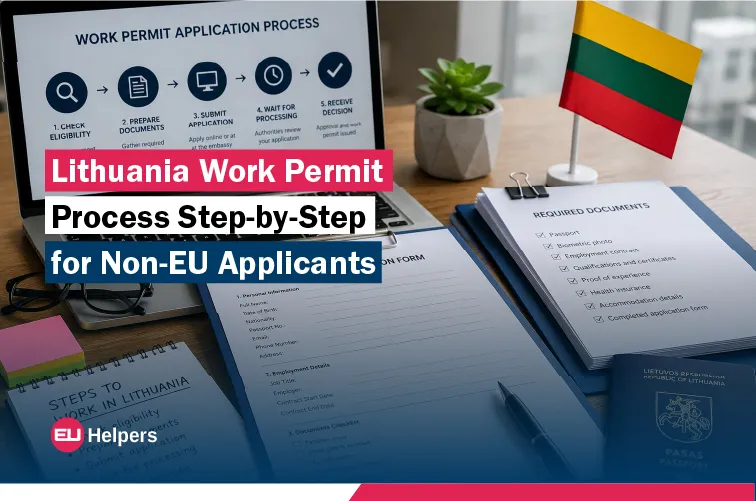

Lithuania Work Permit Process Step-by-Step for Non-EU Applicants
Lithuania's work permit process for non-EU applicants operates through coordinated authorities including Migration Department (Migracijos departamentas) under Ministry of Interior as central authority handling residence permits, Employment Service (Užimtumo tarnyba) handling work permits and labor market considerations, and Lithuanian embassies handling visa applications for visa-required nationals abroad. This EU Helpers guide walks through each step of the Lithuania work permit application process for non-EU applicants — international candidates can explore Lithuanian opportunities through EU Helpers. Lithuania is an EU member (since 2004), Schengen full member (since 2007), eurozone member (since 2015), NATO member (since 2004), and Council of Europe member (since 1993).
Understanding Lithuania's Process for Non-EU Applicants
Lithuania's process for non-EU applicants (third-country nationals) operates through coordinated authorities with distinct responsibilities. Understanding Lithuania's key features — Migration Department as central immigration authority coordinated with Employment Service for employment aspects, Employment Service job vacancy declaration requirement allowing Lithuanian and EU/EEA candidates opportunity to apply (typically 5 working days), and comprehensive integration in all major European institutions — is essential for realistic process planning.
Lithuania Work Permit Process Overview
The table below summarizes the complete Lithuania work permit process for non-EU applicants.
| Stage | Responsible Party | Approximate Timing |
|---|---|---|
| Job search and offer | Applicant | Variable (weeks to months) |
| Route determination | Applicant | Days |
| Employment Service job vacancy declaration | Employer | Typically 5 working days |
| Document preparation | Applicant | 3-5 weeks |
| Work permit application | Employer | Days |
| Employment Service processing | Authorities | 2-3 months |
| Work permit approval | Employment Service | Included in processing |
| National visa (D visa) application | Applicant | 15 working days |
| Travel to Lithuania | Applicant | Days |
| Residence permit application | Applicant | Days |
| Migration Department processing | Authorities | Included in overall timeline |
| Residence permit collection | Applicant | Weeks after application |
| Employment commencement | Applicant | Confirmed start date |
| Total process | All parties | 3-5 months typically |
Total timeline from initial job search through settled Lithuanian arrival typically spans 3-5 months for non-EU applicants.
Step 1: Job Search and Route Determination
Before pursuing Lithuanian employment, non-EU applicants should conduct realistic job search and route determination.
Route determination includes evaluating Standard Work Permit through employer sponsorship as most common route, EU Blue Card for highly qualified professionals with university degree meeting Blue Card salary threshold offering EU mobility advantages and labor market test exemption, ICT Permit for multinational intra-corporate transfers, Startup Visa for innovative entrepreneurs, or Researcher Permit for academic positions.
Job search strategies include targeting Lithuanian sectors with foreign worker demand (fintech as Lithuania's growing sector as major European fintech hub, IT sector particularly Vilnius, business services with international shared services and BPO operations, and laser technology as distinctive Lithuanian specialization), using LinkedIn and specialized recruitment platforms, engaging Lithuanian recruitment agencies, and networking through Lithuanian professional communities.
Step 2: Job Offer and Employer Coordination
The applicant secures a qualifying job offer from a Lithuanian employer and coordinates on application preparation.
Job offer confirmation includes written employment contract confirming Lithuanian employment terms with position, compensation meeting Lithuanian standards, contract duration, and route eligibility (Standard Work Permit, EU Blue Card, ICT Permit, or Startup Visa). Employer coordination includes discussing work permit application process, agreeing on documentation preparation timeline, understanding employer support commitments, and confirming employment start date allowing appropriate transition time.
Step 3: Employment Service Job Vacancy Declaration
For Standard Work Permit, Lithuanian employer coordinates with Employment Service through job vacancy declaration.
Employment Service job vacancy declaration includes employer registering position with Employment Service allowing Lithuanian and EU/EEA candidates opportunity to apply (mandatory step typically taking 5 working days), demonstrating position genuinely requires foreign worker recruitment after local search, and receiving work permit authorization. For EU Blue Card, this labor market test is waived given specialized nature.
Step 4: Document Preparation
The applicant prepares comprehensive documentation typically requiring 3-5 weeks.
Document preparation includes valid passport with sufficient validity, educational qualifications with translations (Lithuanian or English typically acceptable), criminal record certificate from country of previous residence with apostille and translation, health insurance valid in Lithuania, professional experience documentation, and recent biometric photographs.
Apostille certification is obtained from relevant authorities in countries party to the Hague Apostille Convention. For countries not party to the convention, diplomatic legalization through Lithuanian consular missions provides alternative validation.
Step 5: Work Permit Application
The employer applies for work permit through Employment Service.
Work permit application includes complete application documentation, employer supporting documentation demonstrating business need (waived for EU Blue Card given specialized nature), applicant supporting documents including apostilled and translated documents, applicable fees, and required supporting materials. Employment Service handles employment authorization aspects.
Step 6: Employment Service Processing
Employment Service processes work permit application.
Processing typically takes 2-3 months for Standard Work Permit, or expedited for EU Blue Card (with labor market test exemption).
Employment Service evaluates whether position genuinely requires foreign worker (unless exempt for EU Blue Card), whether qualifications match position requirements, whether salary meets Lithuanian standards, whether employer justification is adequate, and overall application quality.
Step 7: Work Permit Approval
With application approved, Employment Service issues work permit.
The work permit enables the applicant to proceed with national visa (D visa) application at Lithuanian embassy or residence permit application depending on circumstances.
Step 8: National Visa (D Visa) Application
For visa-required nationals, national visa (D visa) application at Lithuanian embassy in country of residence follows work permit approval.
Applicants from visa-required countries book appointment at Lithuanian embassy, submit visa application with work permit documentation, provide supporting documentation, pay applicable visa fees, and provide biometric information where required. D visa processing typically takes 15 working days.
Nationals of visa-exempt countries can travel to Lithuania directly though long-term Lithuanian employment requires residence permit regardless.
Step 9: Travel to Lithuania
With approvals in place, applicant travels to Lithuania.
Vilnius International Airport (Vilniaus tarptautinis oro uostas) serves as Lithuania's main international gateway. Kaunas International Airport provides additional connections. Lithuania is Schengen member since 2007 so travel from other Schengen countries doesn't involve border checks. Land borders with Latvia to north, Belarus and Russia's Kaliningrad exclave to east/south, and Poland to south provide additional options.
Coordination with Lithuanian employer for practical arrival helps including temporary accommodation guidance, orientation, and confirmed employment start.
Step 10: Residence Permit Application in Lithuania
The applicant applies for residence permit through Migration Department in Lithuania.
Residence permit application includes submitting complete application to Migration Department, providing biometric data (fingerprints, photograph), submitting supporting documents, paying applicable fees, and completing administrative procedures.
Step 11: Migration Department Processing and Residence Permit Collection
Migration Department processes residence permit application and issues biometric residence permit.
Processing typically takes 2-4 months for residence permit including work permit coordination. Following approval, applicant collects biometric residence permit from Migration Department. Residence permit serves as official identification and residence status evidence in Lithuania.
Step 12: Additional Lithuania Setup
The applicant completes additional Lithuania life setup arrangements.
| Setup Requirement | Purpose |
|---|---|
| Residence permit | Migration Department collection |
| Personal identification | Lithuanian identification |
| Tax registration | Lithuanian tax obligations |
| Social security registration | Lithuanian social security |
| Health insurance | Lithuanian healthcare access |
| Lithuanian bank account | Financial services |
| Housing arrangements | Permanent accommodation |
| Utilities setup | Essential services |
Lithuania's comprehensive administrative systems enable relatively straightforward setup for those meeting requirements.
Step 13: Employment Commencement and Ongoing Compliance
The applicant commences employment with the sponsoring Lithuanian employer on confirmed start date. Ongoing compliance requirements apply throughout the residence period.
Employment compliance: Working only for the sponsoring Lithuanian employer in the specified position (with proper procedures for employer changes), maintaining employment throughout permit period, and notifying authorities of significant employment changes.
Immigration compliance: Maintaining valid residence permit, timely renewals before expiry, notifying authorities of address changes and other significant changes, and maintaining tax and social security compliance.
Family Members
Non-EU applicants can bring immediate family members through family reunification.
Family reunification requires valid relationship documentation with apostille and translations, adequate financial resources to support family members, adequate Lithuanian accommodation, and health insurance coverage. EU Blue Card holders benefit from facilitated family reunification. Processing typically 3-6 months. Family members typically have right to work in Lithuania during the primary applicant's residence permit period.
Special Considerations for Different Sectors
Different Lithuanian routes have distinctive process considerations for non-EU applicants.
Fintech sector: Lithuania's growing sector as major European fintech hub particularly since Brexit welcomes international financial services professionals. Many positions qualify for EU Blue Card given competitive compensation.
Information technology: Growing sector particularly Vilnius. Many positions qualify for EU Blue Card given competitive tech salaries.
Business services: Growing sector particularly Vilnius with international shared services and BPO operations welcoming international multilingual professionals.
Laser technology: Distinctive Lithuanian specialization welcoming international engineers and specialists with laser technology expertise.
Final Guidance
The Lithuania work permit process for non-EU applicants involves thirteen main steps beginning with job search and route determination (evaluating Standard Work Permit through employer sponsorship as most common route, EU Blue Card for highly qualified professionals with university degree meeting Blue Card salary threshold — 1.5x average gross Lithuanian salary — offering EU mobility advantages and labor market test exemption, ICT Permit for multinational intra-corporate transfers, Startup Visa for innovative entrepreneurs with Startup Lithuania expert commission evaluation, or Researcher Permit for academic and research positions), securing qualifying job offer from Lithuanian employer with employer coordination, Employment Service job vacancy declaration allowing Lithuanian and EU/EEA candidates opportunity to apply (typically 5 working days — waived for EU Blue Card), comprehensive document preparation (3-5 weeks) with translations (Lithuanian or English typically acceptable) and apostille certification where required, work permit application through Employment Service (Užimtumo tarnyba), Employment Service processing typically 2-3 months for Standard Work Permit (or expedited for EU Blue Card), work permit approval, national visa (D visa) application at Lithuanian embassy for visa-required nationals typically 15 working days, travel to Lithuania (Vilnius International Airport as main international gateway plus Schengen membership since 2007 providing border-free travel from other Schengen countries and land borders with Latvia Belarus Russia's Kaliningrad exclave and Poland), residence permit application through Migration Department (Migracijos departamentas) providing biometric data and supporting documents, Migration Department processing and residence permit collection typically 2-4 months, completing additional Lithuania setup including personal identification, tax registration, social security registration, health insurance through Lithuanian social security system, Lithuanian bank account, housing arrangements, and utilities setup, commencing employment with sponsoring Lithuanian employer, and maintaining ongoing employment and immigration compliance including working only for sponsoring Lithuanian employer, maintaining valid residence permit, timely renewals, and tax and social security compliance. Total timeline from initial job search through settled Lithuanian arrival typically spans 3-5 months for non-EU applicants. Family reunification available through valid relationship documentation with apostille and translations, adequate financial resources, adequate Lithuanian accommodation, and health insurance coverage — processing typically 3-6 months. Special sector considerations include fintech as Lithuania's growing sector as major European fintech hub with many positions qualifying for EU Blue Card, IT sector particularly Vilnius, business services particularly Vilnius, and laser technology as distinctive Lithuanian specialization. Lithuania's status as EU member (since May 2004), Schengen full member (since 2007), eurozone member (since January 2015 adopting euro replacing Lithuanian litas), NATO member (since 2004), and Council of Europe member (since 1993), combined with the country's distinctive geography including Baltic Sea coast (short but distinctive coast including Curonian Spit as UNESCO World Heritage narrow peninsula shared with Russia's Kaliningrad), extensive forests, various lakes, rolling terrain, and continental climate (Lithuania is largest of three Baltic states), historic Vilnius as capital with UNESCO World Heritage historic old town as one of largest and best-preserved medieval old towns in Northern Europe featuring distinctive Baroque architecture, Kaunas as second-largest city and interwar capital, Klaipėda as major port city on Baltic coast, Šiauliai as major northern city, and Hill of Crosses near Šiauliai as distinctive religious site, developed economy with growing fintech sector (Lithuania as major European fintech hub particularly since Brexit — Lithuania granted more fintech licenses than any other EU country in recent years attracting many UK fintech companies to maintain EU access post-Brexit), IT sector particularly Vilnius, business services with international shared services and BPO operations, laser technology as distinctive Lithuanian specialization producing significant portion of world's scientific lasers, and traditional sectors, moderate cost of living compared to Western European averages creating favorable purchasing power, Lithuanian (lietuvių kalba) as official language (Baltic language along with Latvian as one of oldest Indo-European languages still spoken) with English widely used in international sectors, and cultural richness including distinctive Lithuanian identity, medieval Grand Duchy of Lithuania heritage (Grand Duchy was one of largest European states in medieval period spanning from Baltic to Black Sea), Catholic tradition, distinctive folk culture, and modern Baltic character makes Lithuania a distinctive Baltic EU destination for non-EU applicants. Pathway to Lithuanian citizenship available through naturalization typically after 10 years continuous residence with Lithuanian language proficiency, constitution knowledge, integration, sufficient income, clean criminal record, and other requirements. Lithuania generally does not allow dual citizenship (some exceptions apply). International candidates evaluating Lithuania opportunities can explore Lithuania pathways through EU Helpers. EU Helpers can support non-EU applicants with Lithuania opportunity evaluation particularly for fintech IT and business services sectors, document preparation including translations (Lithuanian or English typically acceptable) and apostille arrangements, employer coordination for Lithuanian employment through Migration Department (Migracijos departamentas) and Employment Service (Užimtumo tarnyba), EU Blue Card evaluation for highly qualified professionals offering labor market test exemption and EU mobility advantages, ICT Permit evaluation for multinational transfers, Startup Visa evaluation for entrepreneurs with Startup Lithuania expert commission navigation, Researcher Permit evaluation for academic positions, national visa (D visa) arrangements at Lithuanian embassies where required, residence permit application guidance at Migration Department in Lithuania, and clarity on the latest official requirements from Lithuanian immigration authorities.
FAQs
The complete Lithuania work permit process for non-EU applicants typically spans 3-5 months from initial application through settled Lithuanian arrival. This includes variable job search duration, Employment Service job vacancy declaration allowing Lithuanian and EU/EEA candidates opportunity to apply (typically 5 working days — waived for EU Blue Card), comprehensive document preparation with translations and apostille (3-5 weeks), work permit application and processing through Employment Service typically 2-3 months for Standard Work Permit (or expedited for EU Blue Card with labor market test exemption), national visa (D visa) application at Lithuanian embassy where applicable for visa-required nationals (15 working days), travel arrangements, residence permit application and Migration Department processing, and post-arrival setup.
Lithuania's Migration Department (Migracijos departamentas) under Ministry of Interior is central authority handling residence permits for foreign workers in Lithuania including non-EU applicants. Migration Department processes residence permit applications for Standard Work Permit, EU Blue Card, ICT Permit, Startup Visa, and other permit routes coordinated with Employment Service handling work permits and labor market considerations. Migration Department handles residence permit issuance after Lithuanian arrival with biometric data collection at Migration Department offices in Lithuania.
Lithuania's Employment Service (Užimtumo tarnyba) is authority handling work permits and labor market considerations for foreign workers in Lithuania coordinated with Migration Department. For non-EU applicants pursuing Standard Work Permit, Employment Service requires employer to declare job vacancy allowing Lithuanian and EU/EEA candidates opportunity to apply (typically 5 working days) before authorizing third-country national recruitment. This labor market test is waived for EU Blue Card given specialized nature. After successful vacancy declaration process, Employment Service issues work permit enabling national visa (D visa) application at Lithuanian embassy for visa-required nationals.
Visa requirements for Lithuania vary by nationality with Lithuania as Schengen member. Nationals of visa-required countries need national visa (D visa) from Lithuanian embassy for entry to Lithuania after work permit approval. Nationals of visa-exempt countries can travel to Lithuania directly without long-stay visa for short stays. However, long-term Lithuanian employment requires work permit and subsequent residence permit regardless of visa-exemption for short stays. Non-EU applicants should verify visa requirements based on nationality and plan accordingly. D visa processing at Lithuanian embassies typically takes 15 working days after work permit approval.
Lithuania work permit documentation requires valid passport with sufficient validity, employment contract confirming Lithuanian employment terms, Lithuanian employer application to Migration Department (Migracijos departamentas) coordinated with Employment Service (Užimtumo tarnyba), educational qualifications with translations (Lithuanian or English typically acceptable), professional experience CV and reference letters, health insurance coverage valid in Lithuania, criminal record certificate from country of previous residence, translations of foreign documents (Lithuanian or English often acceptable), apostille certification (from countries party to Hague Apostille Convention) or diplomatic legalization where required, recent biometric photographs, and proof of accommodation in Lithuania.
Lithuania's national visa (D visa) is long-stay visa required for visa-required non-EU applicants to enter Lithuania after work permit approval. D visa is applied for at Lithuanian embassy in country of residence following Employment Service work permit approval. Applicants book appointment at Lithuanian embassy, submit visa application with work permit documentation, provide supporting documentation, pay applicable visa fees, and provide biometric information where required. D visa processing typically takes 15 working days. D visa enables entry to Lithuania where residence permit application through Migration Department is completed. Non-EU applicants from visa-exempt countries do not require D visa but still require residence permit for long-term Lithuanian employment.
Lithuania has emerged as major European fintech hub particularly since Brexit creating significant opportunities for non-EU applicants. Fintech sector features include Lithuania granting more fintech licenses than any other EU country in recent years, many UK fintech companies establishing Lithuanian operations to maintain EU access post-Brexit including Revolut and various other fintech operations, various emerging Lithuanian fintech startups, favorable regulatory framework attracting fintech companies, Bank of Lithuania actively supporting fintech development, and growing employment opportunities for financial services professionals in fintech ecosystem. Vilnius serves as primary fintech hub with growing concentration of fintech companies particularly attractive for non-EU financial services professionals seeking EU-based positions.
Yes. Family members of non-EU Lithuania work permit holders can apply through family reunification procedures. Family reunification requires valid relationship documentation with apostille and translations, adequate financial resources to support family members, adequate Lithuanian accommodation, and health insurance coverage for each family member. EU Blue Card holders benefit from facilitated family reunification with reduced waiting periods and streamlined procedures. Processing typically 3-6 months. Family members typically have right to work in Lithuania during the primary applicant's residence permit period.
Lithuania has distinctive laser technology specialization producing significant portion of world's scientific lasers. Laser technology sector features include multiple Lithuanian laser technology companies (Ekspla, Šviesos konversija — also known as Light Conversion, and others), specialized scientific laser production, research and development in laser technology, and Vilnius University laser research center. Lithuania is distinctively concentrated in scientific and specialized laser applications with substantial global market share. Sector welcomes international engineers and specialists with laser technology expertise creating specialized career opportunities in this distinctive Lithuanian specialization particularly attractive for non-EU applicants with laser technology or specialized engineering backgrounds.
EU Helpers can support non-EU applicants with Lithuania opportunity evaluation particularly for fintech IT business services and laser technology sectors, document preparation including translations (Lithuanian or English typically acceptable) and apostille arrangements, employer coordination for Lithuanian employment through Migration Department (Migracijos departamentas) and Employment Service (Užimtumo tarnyba), EU Blue Card evaluation for highly qualified professionals offering labor market test exemption and EU mobility advantages, ICT Permit evaluation for multinational transfers, Startup Visa evaluation for innovative entrepreneurs with Startup Lithuania expert commission navigation, Researcher Permit evaluation for academic positions, Self-Employed Permit evaluation for entrepreneurs, national visa (D visa) arrangements at Lithuanian embassies where required, residence permit application guidance at Migration Department in Lithuania, cultural preparation, and clarity on the latest official requirements from Lithuanian immigration authorities.
Still have questions? Get in touch
Ready to work in Lithuania?
EU Helpers guides non-EU applicants through every stage of Lithuania's work permit process. From Migration Department authorization to residence permit collection, we make your Lithuanian move seamless.