
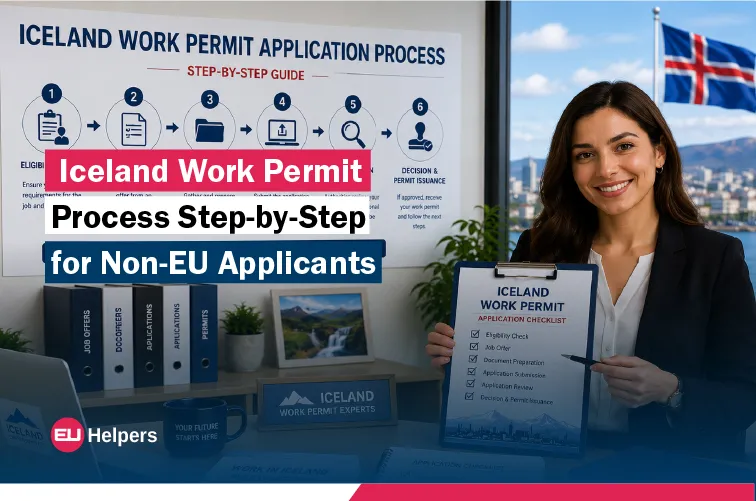

Iceland Work Permit Process Step-by-Step for Non-EU Applicants
Iceland's work permit process for non-EU applicants operates through coordinated authorities including Directorate of Labour (Vinnumálastofnun) handling work permits and labor market considerations, Directorate of Immigration (Útlendingastofnun) handling residence permits, Registers Iceland (Þjóðskrá Íslands) for kennitala registration, and Icelandic embassies handling visa applications for visa-required nationals abroad. Iceland is NOT an EU member — Iceland is EEA member providing access to EU single market and Schengen area (since 2001), plus NATO founding member since 1949. This EU Helpers guide walks through each step of the Iceland work permit application process for non-EU applicants — international candidates can explore Icelandic opportunities through EU Helpers. Iceland is an EEA member (since 1994), Schengen member (since 2001), NATO founding member (since 1949), and Council of Europe member (since 1950), but NOT an EU member and NOT eurozone member (Icelandic króna — ISK — remains national currency).
Understanding Iceland's Process for Non-EU Applicants
Iceland's process for non-EU applicants (third-country nationals) operates through coordinated authorities with distinct responsibilities. Understanding Iceland's key features — Directorate of Labour (Vinnumálastofnun) handling work permits and labor market assessment, Directorate of Immigration (Útlendingastofnun) handling residence permits, Iceland's small labor market requiring genuine local shortage or specialized qualifications for work authorization, Shortage Occupations Permit as priority route, Registers Iceland (Þjóðskrá Íslands) for kennitala (essential 10-digit personal identification number) registration, and non-EU/non-eurozone status while maintaining EEA and Schengen membership — is essential for realistic process planning.
Iceland Work Permit Process Overview
The table below summarizes the complete Iceland work permit process for non-EU applicants.
| Stage | Responsible Party | Approximate Timing |
|---|---|---|
| Job search and offer | Applicant | Variable (weeks to months) |
| Route determination | Applicant | Days |
| Labor market assessment | Employer/Directorate of Labour | Weeks |
| Document preparation | Applicant | 3-5 weeks |
| Work permit application | Employer | Days |
| Residence permit application | Applicant | Days |
| Application processing | Authorities | 1-4 months |
| Approval | Directorate of Labour/Immigration | Included in processing |
| Travel to Iceland | Applicant | Days |
| Registers Iceland kennitala registration | Applicant | Days after arrival |
| Employment commencement | Applicant | Confirmed start date |
| Total process | All parties | 3-5 months typically |
Total timeline from initial job search through settled Icelandic arrival typically spans 3-5 months.
Step 1: Job Search and Route Determination
Before pursuing Icelandic employment, non-EU applicants should conduct realistic job search and route determination.
Route determination includes evaluating Qualified Professional Permit as standard skilled worker route for skilled positions with Icelandic employer sponsorship, Shortage Occupations Permit as priority route for positions in confirmed shortage sectors offering streamlined processing, Athlete Permit for professional athletes with Icelandic sports organization contracts, Specialist Permit for specialized expertise, or Self-Employment Permit for business establishment.
Job search strategies include targeting Icelandic sectors particularly tourism and hospitality (major Icelandic growth sector welcoming multilingual international professionals), fishing and seafood (traditional Icelandic sector), aluminum (major industry benefiting from geothermal and hydroelectric energy), geothermal and renewable energy (Iceland is world leader), technology (growing sector particularly data centers benefiting from cool climate and cheap renewable energy), and healthcare (growing sector with shortage occupations).
Step 2: Job Offer and Route Selection
The applicant secures a qualifying job offer from an Icelandic employer and finalizes route selection.
For Qualified Professional Permit, appropriate qualifications (typically university degree or specialized skills), Icelandic employer sponsorship, and salary meeting Icelandic collective agreement standards. For Shortage Occupations Permit, position in confirmed shortage occupation and appropriate qualifications. For other routes, route-specific criteria verification.
Step 3: Labor Market Assessment at Directorate of Labour
Icelandic employer applies for work permit to Directorate of Labour with labor market assessment.
Labor market assessment includes employer submitting comprehensive documentation demonstrating position, qualifications required, and local labor market situation, Directorate of Labour evaluating whether Icelandic or EEA candidates are available for position, confirming genuine shortage or unique qualifications requiring foreign worker, and issuing work permit authorization. For Shortage Occupations Permit, labor market assessment is streamlined given pre-confirmed shortage status.
Step 4: Document Preparation
The applicant prepares comprehensive documentation typically requiring 3-5 weeks.
Document preparation includes valid passport with sufficient validity, educational qualifications with translations (Icelandic or English typically acceptable), criminal record certificate from country of previous residence, health insurance valid in Iceland, professional experience documentation, and recent biometric photographs.
Apostille certification is obtained from relevant authorities in countries party to the Hague Apostille Convention. For countries not party to the convention, diplomatic legalization provides alternative validation.
Step 5: Work Permit Application at Directorate of Labour
The Icelandic employer applies for work permit through Directorate of Labour (Vinnumálastofnun).
Work permit application includes complete application documentation, employer supporting documentation demonstrating business need and labor market assessment, applicant supporting documents including translated documents where required and apostille where needed, applicable fees, and required supporting materials.
Step 6: Residence Permit Application at Directorate of Immigration
Coordinated with work permit application, residence permit application proceeds through Directorate of Immigration (Útlendingastofnun).
Residence permit application includes complete application documentation, coordination with Directorate of Labour work permit authorization, applicant supporting documents, applicable fees, and required supporting materials.
Step 7: Application Processing
Directorate of Labour and Directorate of Immigration coordinate application processing.
Processing typically takes 2-4 months for Qualified Professional Permit and 1-3 months for Shortage Occupations Permit (streamlined given confirmed shortage status).
Application evaluation includes whether position genuinely requires foreign worker (given Iceland's small labor market), qualifications matching position requirements, salary meeting Icelandic collective agreement standards, employer justification adequacy, and overall application quality.
Step 8: Approval
With application approved, Directorate of Labour issues work permit and Directorate of Immigration issues residence permit authorization.
The approval enables the applicant to proceed with travel to Iceland.
Step 9: Travel to Iceland
With approvals in place, applicant travels to Iceland.
Keflavík International Airport (approximately 50 km from Reykjavík) serves as Iceland's main international gateway. Iceland is Schengen member since 2001 so travel from other Schengen countries doesn't involve border checks. Various regional airports serve Icelandic destinations. Ferry connections link Iceland with Faroe Islands and Denmark.
Coordination with Icelandic employer for practical arrival helps including temporary accommodation guidance, orientation, and confirmed employment start.
Step 10: Registers Iceland Registration for Kennitala
After Icelandic arrival, applicant must complete registration at Registers Iceland (Þjóðskrá Íslands) obtaining Icelandic ID number (kennitala).
Registers Iceland registration includes visiting Registers Iceland office, providing biometric data and documentation, obtaining kennitala (10-digit personal identification number essential for all administrative purposes in Iceland including tax matters, healthcare access, bank accounts, employment, telecommunications, and various administrative interactions), and completing administrative procedures. Kennitala is essential for daily life in Iceland — virtually all administrative interactions require kennitala.
Step 11: Additional Iceland Setup
The applicant completes additional Iceland life setup arrangements.
| Setup Requirement | Purpose |
|---|---|
| Kennitala | Registers Iceland registration |
| Tax registration | Icelandic Tax Authority (Skatturinn) |
| Icelandic Health Insurance | Sjúkratryggingar Íslands |
| Icelandic bank account | Financial services |
| Housing arrangements | Permanent accommodation |
| Utilities setup | Essential services |
| Registration with municipality | Local registration |
Iceland's administrative systems require multiple registrations for full Icelandic life setup. Kennitala (10-digit personal identification number) is essential Icelandic identifier obtained through Registers Iceland (Þjóðskrá Íslands) and is required for numerous other Icelandic administrative procedures.
Step 12: Employment Commencement and Ongoing Compliance
The applicant commences employment with the sponsoring Icelandic employer on confirmed start date. Ongoing compliance requirements apply throughout the residence period.
Employment compliance: Working only for the sponsoring Icelandic employer in the specified position (with proper procedures for employer changes), maintaining employment throughout permit period, and notifying authorities of significant employment changes.
Immigration compliance: Maintaining valid work permit and residence permit, timely renewals before expiry, notifying authorities of address changes and other significant changes, and maintaining tax and social security compliance.
Family Members
Non-EU applicants can bring immediate family members through Family Reunification Permit.
Family reunification requires valid relationship documentation with apostille and translations, adequate financial resources meeting Icelandic standards (Iceland's high cost of living affects requirements), adequate Icelandic accommodation, and health insurance coverage. Processing typically 3-6 months. Family members typically have right to work in Iceland during the primary applicant's permit period.
Special Considerations for Different Sectors
Different Icelandic routes have distinctive process considerations for non-EU applicants.
Tourism and hospitality: Major growth sector particularly welcoming multilingual international professionals given diverse international visitor base.
Fishing and seafood: Traditional Icelandic sector with distinctive expertise.
Aluminum: Major industry with international operations benefiting from geothermal and hydroelectric energy.
Geothermal and renewable energy: World-leading sector with specialized expertise particularly welcoming international specialists.
Technology: Growing sector particularly data centers benefiting from cool climate and cheap renewable energy.
Healthcare: Growing sector with shortage occupations providing accelerated processing through Shortage Occupations Permit.
Final Guidance
The Iceland work permit process for non-EU applicants involves twelve main steps beginning with job search and route determination (evaluating Qualified Professional Permit as standard skilled worker route for skilled positions with Icelandic employer sponsorship appropriate qualifications typically university degree or specialized skills labor market assessment by Directorate of Labour confirming shortage or unique qualifications and salary meeting Icelandic collective agreement standards, Shortage Occupations Permit as priority route for positions in confirmed shortage sectors — commonly healthcare engineering IT and specialized technical roles — offering streamlined processing 1-3 months, Athlete Permit for professional athletes with Icelandic sports organization contracts, Specialist Permit for specialized expertise, or Self-Employment Permit for business establishment), securing qualifying job offer from Icelandic employer with route selection finalization, labor market assessment at Directorate of Labour (Vinnumálastofnun) with employer submitting comprehensive documentation demonstrating position qualifications required and local labor market situation Directorate of Labour evaluating whether Icelandic or EEA candidates are available and confirming genuine shortage or unique qualifications requiring foreign worker (for Shortage Occupations Permit labor market assessment is streamlined given pre-confirmed shortage status), comprehensive document preparation (3-5 weeks) with translations (Icelandic or English typically acceptable — English often acceptable) and apostille certification where required, work permit application through Directorate of Labour, residence permit application through Directorate of Immigration (Útlendingastofnun) coordinated with work permit, application processing typically 2-4 months for Qualified Professional Permit or 1-3 months for Shortage Occupations Permit (streamlined given confirmed shortage status), approval enabling travel to Iceland, travel to Iceland (Keflavík International Airport as Iceland's main international gateway approximately 50 km from Reykjavík plus Schengen membership since 2001 providing border-free travel from other Schengen countries various regional airports serving Icelandic destinations and ferry connections linking Iceland with Faroe Islands and Denmark), Registers Iceland (Þjóðskrá Íslands) registration for kennitala (10-digit personal identification number essential for all administrative purposes in Iceland including tax matters healthcare access bank accounts employment telecommunications and various administrative interactions), completing additional Iceland setup including tax registration with Icelandic Tax Authority (Skatturinn), Icelandic Health Insurance (Sjúkratryggingar Íslands) registration for healthcare access, Icelandic bank account, housing arrangements, utilities setup, and municipality registration, commencing employment with sponsoring Icelandic employer, and maintaining ongoing employment and immigration compliance including working only for sponsoring Icelandic employer, maintaining valid work permit and residence permit, timely renewals, and tax and social security compliance. Total timeline from initial job search through settled Icelandic arrival typically spans 3-5 months. Family Reunification Permit available through valid relationship documentation with apostille and translations adequate financial resources meeting Icelandic standards (Iceland's high cost of living affects requirements) adequate Icelandic accommodation and health insurance coverage — processing typically 3-6 months. Special sector considerations include tourism and hospitality as major growth sector particularly welcoming multilingual international professionals, fishing and seafood as traditional Icelandic sector, aluminum as major industry, geothermal and renewable energy as world-leading sector particularly welcoming international specialists, technology growing particularly data centers, and healthcare as growing sector with shortage occupations providing accelerated processing through Shortage Occupations Permit. Iceland's status as EEA member since 1994 (providing EU single market access including labor market mobility for EEA citizens), Schengen member since 2001 (providing border-free travel across Schengen area), NATO founding member since 1949 (with distinctive status as sole NATO member without standing military — Iceland relies on U.S. defense agreement and NATO alliance for security), and Council of Europe member since 1950, but NOT an EU member and NOT eurozone member (Icelandic króna — ISK — remains national currency), combined with the country's distinctive character including volcanic geography as one of world's most geologically active regions (positioned on Mid-Atlantic Ridge), extensive glaciers including Vatnajökull as Europe's largest ice cap, numerous geysers and hot springs, dramatic waterfalls, Northern Lights visibility, midnight sun in summer and polar night in winter, and Arctic character as Europe's westernmost sovereign state, historic Reykjavík as capital and largest city (world's northernmost capital), Akureyri as second-largest city, and various smaller towns and villages, distinctive economy based on fishing tourism aluminum geothermal energy technology and financial services, notably high cost of living among Europe's highest, Icelandic (íslenska) as official language (North Germanic language closely related to Old Norse with English widely used and understood), and cultural richness including distinctive Icelandic identity Nordic heritage Norse mythology heritage saga tradition Viking heritage and distinctive Icelandic music tradition (including Björk Sigur Rós representing contemporary Icelandic music globally) makes Iceland a distinctive Nordic EEA destination for non-EU applicants seeking unique Nordic experience. Pathway to Icelandic citizenship available through naturalization typically after 7 years continuous residence (or reduced periods with Icelandic spouse or Nordic citizenship) with Icelandic language proficiency. International candidates evaluating Iceland opportunities can explore Iceland pathways through EU Helpers. EU Helpers can support non-EU applicants with Iceland opportunity evaluation particularly for tourism and hospitality fishing and seafood aluminum geothermal and renewable energy technology and healthcare sectors, Qualified Professional Permit application coordination through Directorate of Labour (Vinnumálastofnun) for work permits and labor market assessment and Directorate of Immigration (Útlendingastofnun) for residence permits, Shortage Occupations Permit evaluation for priority processing in confirmed shortage sectors, Athlete Permit evaluation for professional athletes, Specialist Permit evaluation for specialized expertise, Self-Employment Permit evaluation for entrepreneurs, document preparation including translations (Icelandic or English typically acceptable) and apostille arrangements, employer coordination for Icelandic employment through Directorate of Labour and Directorate of Immigration, residence permit application guidance in Iceland, Registers Iceland (Þjóðskrá Íslands) registration guidance for kennitala, and clarity on the latest official requirements from Icelandic immigration authorities.
FAQs
The complete Iceland work permit process for non-EU applicants typically spans 3-5 months from initial application through settled Icelandic arrival. This includes variable job search duration, labor market assessment at Directorate of Labour (Vinnumálastofnun), comprehensive document preparation with translations and apostille (3-5 weeks), work permit application through Directorate of Labour coordinated with residence permit application through Directorate of Immigration (Útlendingastofnun), application processing typically 2-4 months for Qualified Professional Permit or 1-3 months for Shortage Occupations Permit (streamlined given confirmed shortage status), travel to Iceland, Registers Iceland (Þjóðskrá Íslands) registration for kennitala (essential Icelandic ID number), and post-arrival setup.
Iceland's Directorate of Labour (Vinnumálastofnun) is central authority handling work permits and labor market considerations for foreign workers in Iceland including non-EU applicants. Directorate of Labour processes work permit applications from Icelandic employers with labor market assessment evaluating whether Icelandic or EEA candidates are available for position and confirming genuine shortage or unique qualifications requiring foreign worker. For Shortage Occupations Permit, labor market assessment is streamlined given pre-confirmed shortage status. Directorate of Labour coordinates with Directorate of Immigration (Útlendingastofnun) which handles residence permits.
Iceland's Directorate of Immigration (Útlendingastofnun) is central authority handling residence permits for foreign workers in Iceland including non-EU applicants. Directorate of Immigration processes residence permit applications coordinated with Directorate of Labour (Vinnumálastofnun) which handles work permits and labor market assessment. Directorate of Immigration also handles family reunification permits, asylum applications, and various other immigration matters. Coordinated approach between Directorate of Labour and Directorate of Immigration ensures both work and residence aspects addressed in comprehensive procedure.
Visa requirements for Iceland vary by nationality. Iceland is Schengen member since 2001 so Schengen visa arrangements apply. Nationals of visa-required countries need Schengen visa for entry to Iceland after work permit approval. Nationals of visa-exempt countries can travel to Iceland directly for short stays. However, long-term Icelandic employment requires work permit and residence permit regardless of visa-exemption for short stays. Non-EU applicants should verify visa requirements based on nationality and plan accordingly. EEA nationals benefit from freedom of movement given Iceland's EEA membership since 1994.
Iceland work permit documentation requires valid passport with sufficient validity, employment contract confirming Icelandic employment terms, Icelandic employer application to Directorate of Labour (Vinnumálastofnun), educational qualifications with translations (Icelandic or English typically acceptable), professional experience CV and reference letters, health insurance coverage valid in Iceland, criminal record certificate from country of previous residence, translations of foreign documents (English often acceptable for many purposes), apostille certification (from countries party to Hague Apostille Convention) or diplomatic legalization where required, recent biometric photographs, and proof of accommodation in Iceland.
Iceland's Qualified Professional Permit is standard skilled worker route for non-EU applicants requiring Icelandic employer sponsorship, appropriate qualifications (typically university degree or specialized skills), labor market assessment by Directorate of Labour confirming shortage or unique qualifications (Iceland's small labor market means positions require genuine local shortage or specialized qualifications), and salary meeting Icelandic collective agreement standards. Duration up to 2 years initially with renewal possibilities. Qualified Professional Permit represents most common professional route for non-EU skilled workers seeking Icelandic employment.
Iceland's kennitala is essential Icelandic identification number (10-digit personal identification number) required for all residents in Iceland including non-EU applicants. Kennitala serves as unique identifier for all administrative purposes in Iceland including tax matters, healthcare access, bank accounts, employment, telecommunications, and various administrative interactions. Non-EU residents obtain kennitala through Registers Iceland (Þjóðskrá Íslands) after Icelandic arrival typically as one of first administrative steps. Kennitala is essential for daily life in Iceland — virtually all administrative interactions require kennitala. Post-arrival registration at Registers Iceland is priority administrative step.
Iceland's Shortage Occupations Permit is particularly attractive route for non-EU professionals in confirmed shortage sectors given significant advantages. Shortage Occupations Permit features include streamlined processing (1-3 months typical processing compared to 2-4 months for Qualified Professional Permit), priority evaluation by Directorate of Labour given pre-confirmed shortage status, simplified labor market assessment given confirmed shortage, and generally smoother path to Icelandic employment. Shortage Occupations Permit requires position in confirmed shortage occupation, Icelandic employer sponsorship, and appropriate qualifications for role. Icelandic shortage occupations vary by economic needs — commonly include healthcare, engineering, IT, and specialized technical roles.
Yes. Family members of non-EU Iceland work permit holders can apply through Family Reunification Permit procedures. Family reunification requires valid relationship documentation with apostille and translations, adequate financial resources meeting Icelandic standards (Iceland's high cost of living affects requirements), adequate Icelandic accommodation, and health insurance coverage for each family member. Processing typically 3-6 months. Family members typically have right to work in Iceland during the primary applicant's permit period.
EU Helpers can support non-EU applicants with Iceland opportunity evaluation particularly for tourism and hospitality (as major Icelandic growth sector particularly welcoming multilingual international professionals) fishing and seafood (as traditional Icelandic sector) aluminum (as major industry benefiting from geothermal and hydroelectric energy) geothermal and renewable energy (as world-leading sector) technology (as growing sector particularly data centers) and healthcare (as growing sector with shortage occupations) sectors, Qualified Professional Permit application coordination through Directorate of Labour (Vinnumálastofnun) for work permits and labor market assessment and Directorate of Immigration (Útlendingastofnun) for residence permits, Shortage Occupations Permit evaluation for priority processing in confirmed shortage sectors (commonly healthcare, engineering, IT, and specialized technical roles) with streamlined processing advantages, Athlete Permit evaluation for professional athletes with Icelandic sports organization contracts, Specialist Permit evaluation for specialized expertise, Self-Employment Permit evaluation for entrepreneurs with viable business plans, document preparation including translations (Icelandic or English typically acceptable — English often acceptable for many purposes) and apostille arrangements, employer coordination for Icelandic employment through Directorate of Labour and Directorate of Immigration, residence permit application guidance in Iceland, Registers Iceland (Þjóðskrá Íslands) registration guidance for kennitala (10-digit personal identification number essential for all administrative purposes in Iceland), and clarity on the latest official requirements from Icelandic immigration authorities.
Still have questions? Get in touch
Ready to work in Iceland?
EU Helpers guides non-EU applicants through every stage of Iceland's work permit process. From Directorate of Labour to kennitala registration, we make your Icelandic move seamless.