
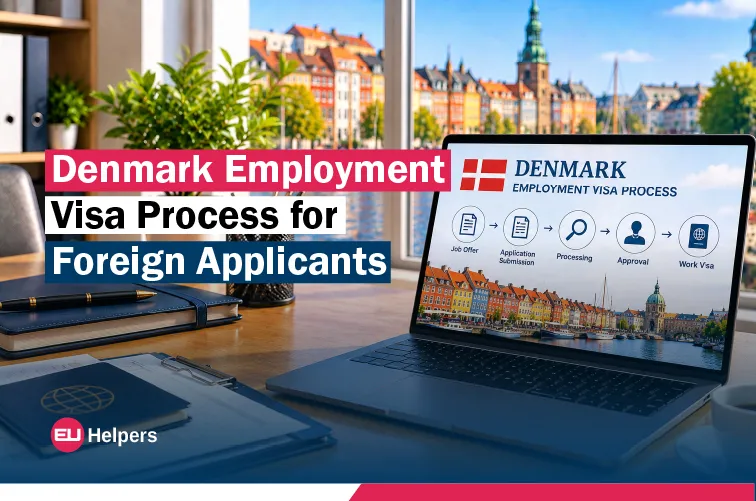

Denmark Employment Visa Process for Foreign Applicants
Denmark's employment visa process for foreign applicants involves clear sequential stages coordinated through Danish Agency for International Recruitment and Integration (Styrelsen for International Rekruttering og Integration — SIRI) under Ministry of Immigration and Integration handling work and residence permits, Danish Immigration Service (Udlændingestyrelsen) handling various residence permit matters, Danish embassies and consulates handling visa applications abroad, and local Danish authorities handling CPR (Personal Registration Number) registration. This EU Helpers guide walks through the Denmark employment visa process — foreign applicants can explore Danish opportunities through EU Helpers. Denmark is EU member since 1973, Schengen member since 2001, NOT eurozone member (Danish Krone — DKK pegged to Euro through ERM II), NATO founding member since 1949.
The Employment Visa Process Overview
Denmark employment visa process organizes into essential clear stages.
| Stage | Description |
|---|---|
| 1. Job offer | Secure Danish employer sponsorship |
| 2. Route evaluation | Multi-scheme framework choice |
| 3. Employer coordination | Preparation for SIRI application |
| 4. SIRI application submission | Central Danish authority processing |
| 5. Documentation preparation | Danish or English translations and apostille |
| 6. SIRI processing | Work and residence permit evaluation |
| 7. Approval and residence permit | Work authorization confirmation |
| 8. Travel to Denmark | Nordic access |
| 9. CPR registration | Personal Registration Number |
| 10. Registration and settlement | Administrative processes |
Understanding these clear stages enables successful navigation of Denmark employment visa process.
Stage 1: Job Offer Coordination
Job offer coordination is foundational stage.
Job offer considerations include:
- Danish employer registered in Denmark
- Danish employer prepared to coordinate with SIRI
- Employment contract terms meeting Danish labor law standards
- Salary meeting Danish standards and category-specific thresholds (Pay Limit approximately DKK 375,000 in 2024, higher for EU Blue Card)
- Position aligned with route requirements (Positive List for shortage occupations, or Pay Limit Scheme, or Fast-Track)
- Employment sectors including pharmaceuticals (Novo Nordisk Lundbeck), renewable energy (Vestas Ørsted), shipping (Maersk), design (Bang & Olufsen various), food industry (Arla Foods various), toys (LEGO), IT sector, financial services, and various
Effective job offer coordination sets foundation for successful application.
Stage 2: Route Evaluation
Route evaluation determines optimal Denmark visa pathway.
Route considerations include:
- Positive List for shortage occupations (Positive List for People with a Higher Education and Positive List for Skilled Work)
- Pay Limit Scheme for high-salary employment (approximately DKK 375,000 in 2024)
- Supplementary Pay Limit Scheme for shortage areas
- Distinctive Fast-Track Scheme through SIRI-certified employers with four tracks (Pay Limit Track Researcher Track Educational Track Short-Term Track)
- EU Blue Card for highly qualified professionals with EU mobility possibilities
- Researcher Scheme for research activities
- Establishment Card for Danish institution graduates
- Start-up Denmark for innovative entrepreneurs
Effective route evaluation optimizes application pathway reflecting distinctive Danish multi-scheme framework.
Stage 3: Employer Coordination
Employer coordination involves Danish employer preparing SIRI application.
Employer coordination considerations include:
- Danish employer prepares application relevant to chosen route
- Fast-Track certification status verification for Fast-Track applications
- Employer registration documents required
- Employment contract meeting Danish labor law standards
- Salary confirmation meeting Pay Limit or EU Blue Card thresholds where applicable
- Justification for foreign worker recruitment
- Comprehensive supporting documentation
- Applicable fees
Danish employer coordination represents essential foundation.
Stage 4: SIRI Application Submission
SIRI application submission involves central Danish authority processing.
SIRI application submission considerations include:
- Online application through SIRI online portal
- Route-specific application forms
- Complete documentation submission
- Applicable fees
- Applicant and employer signatures where required
- Distinctive digital application efficiency
SIRI application represents essential central Danish administrative step.
Stage 5: Documentation Preparation
Documentation preparation involves comprehensive requirements.
Essential documents include:
- Valid passport with sufficient validity
- Employment contract
- Danish employer registration documents (or Fast-Track certification)
- Educational qualifications with Danish or English translations
- Professional experience CV and reference letters
- Health insurance valid in Denmark
- Criminal record certificate from country of previous residence with apostille
- Biometric photographs
- Proof of accommodation in Denmark
- Financial resources evidence
Documentation preparation typically requires 3-4 weeks with translation requirements adding preparation time.
Stage 6: SIRI Processing
SIRI processing involves work and residence permit evaluation.
SIRI processing considerations include:
- Comprehensive documentation review
- Applicant background verification
- Employment terms verification
- Route-specific evaluation
- Decision on work and residence permit approval
- Distinctive Fast-Track advantage for certified employers
SIRI processing timeline varies by category with Fast-Track offering distinctive faster processing.
Stage 7: Approval and Residence Permit
Approval and residence permit issuance enables Denmark employment.
Approval considerations include:
- SIRI approval decision
- Work and residence permit issued
- Legal residence status established
- Legal work authorization included
- Validity period specified
- Renewal essential before expiry
- Distinctive combined framework
Approval represents essential milestone.
Stage 8: Travel to Denmark
Travel to Denmark involves Nordic access options.
Travel considerations include:
- Copenhagen Airport (Københavns Lufthavn — Kastrup) as primary international gateway (distinctive Nordic hub with extensive European and international connections)
- Billund Airport (distinctive tourism gateway with LEGO connection)
- Aarhus Airport (Jutland regional)
- Aalborg Airport (northern Jutland regional)
- Extensive rail connections through Danish State Railways (DSB — Danske Statsbaner) including distinctive Øresund Bridge connection to Sweden (Copenhagen-Malmö)
- Land borders with Germany (Jutland Peninsula)
- Denmark's Schengen membership since 2001 enables seamless travel throughout Schengen area
Copenhagen Airport is primary international gateway.
Stage 9: CPR Registration
CPR registration involves distinctive Danish requirement.
CPR (Central Person Register — Det Centrale Personregister) registration considerations include:
- Registration at local Danish authority (Kommune — municipality) within specified timeframe (typically 5 days) after arrival
- CPR number (personal registration number) issuance essential
- Required for virtually all Danish administrative processes (banking, healthcare, tax, employment)
- Distinctive Danish administrative requirement
- Coordination with residence permit
- Distinctive Danish system serving as personal identifier
CPR registration represents distinctive essential Danish step for foreign workers.
Stage 10: Registration and Settlement
Registration and settlement involves administrative processes.
Registration considerations include:
- Tax registration (with distinctive Danish high tax framework — SKAT)
- Healthcare arrangements through Danish public healthcare (distinctive universal Danish healthcare via CPR system)
- Banking arrangements (NemKonto — distinctive Danish easy-account system linked to CPR)
- Digital identification (MitID — distinctive Danish digital ID)
- Various administrative processes
- Distinctive Danish digital administration integration
Employment Sectors in Denmark
Different Danish sectors offer varying opportunities.
Pharmaceutical sector: Distinctive Novo Nordisk (world's largest insulin producer with distinctive Ozempic/Wegovy diabetes and weight-loss drugs — market capitalization making it one of Europe's most valuable companies), distinctive Lundbeck, and various providing substantial pharmaceutical opportunities.
Renewable energy sector: Distinctive Danish wind energy leadership with Vestas (world's largest wind turbine manufacturer) and Ørsted (major renewable energy company) providing renewable energy opportunities.
Shipping sector: Distinctive A.P. Møller-Mærsk (Maersk — one of world's largest container shipping companies) providing maritime opportunities.
Design and creative industries sector: Distinctive Danish design heritage with Bang & Olufsen Georg Jensen Royal Copenhagen various providing design opportunities.
Food industry sector: Distinctive Danish agricultural heritage with Arla Foods, Danish Crown, various providing food industry opportunities.
Toys sector: Distinctive LEGO (Billund Danish creation) providing distinctive Danish opportunities.
IT sector: Growing Danish tech ecosystem particularly Copenhagen with various tech companies.
Financial services sector: Distinctive Copenhagen financial sector.
Language Considerations
Danish (Dansk) is official language (North Germanic language distinctive Danish character). Documentation for work visa applications typically requires translations into Danish or English by authorized translator. English usage widespread throughout Denmark (distinctive Danish English proficiency among highest globally). Learning Danish enhances integration and career advancement significantly particularly for long-term Danish residence and eventual citizenship pursuit.
Salary Expectations
Salary considerations: Danish salaries reflect advanced Nordic economy with competitive compensation. Pay Limit threshold approximately DKK 375,000 in 2024. Highly qualified professionals in pharmaceuticals (Novo Nordisk), renewable energy (Vestas Ørsted), shipping (Maersk), IT sector, financial services, and specialized sectors receive substantial Danish compensation. Copenhagen typically offers highest Danish compensation. Combined with Denmark's high cost of living and distinctive high tax framework (highest income tax rates globally though offset by extensive welfare state), overall economics reflect Danish standards. Danish Krone (DKK) currency pegged to Euro through ERM II.
Cost of Living Considerations
Cost considerations: Denmark has high cost of living reflecting Danish advanced economy. Copenhagen (København) as capital has highest Danish costs (among most expensive European cities). Aarhus (Jutland — second largest Danish city), Odense (Funen — birthplace of Hans Christian Andersen), Aalborg (northern Jutland), and various cities have varying substantial costs though generally lower than Copenhagen.
Cultural Considerations
Cultural considerations include distinctive Danish character with rich cultural heritage, distinctive Danish concept of "hygge" (distinctive Danish coziness contentment concept — untranslatable Danish cultural concept), Danish professional culture (distinctive flat hierarchies work-life balance strong worker protections), distinctive Danish social patterns, appreciation of Danish gastronomy (smørrebrød distinctive Danish open-faced sandwiches, frikadeller distinctive Danish meatballs, distinctive Danish pastries wienerbrød "Danish", distinctive Danish beer Carlsberg founded 1847 Tuborg, distinctive New Nordic Cuisine movement with Noma Copenhagen — repeatedly named world's best restaurant, distinctive Danish smoked fish), distinctive Danish monarchy (constitutional monarchy — one of world's oldest continuously reigning monarchies with House of Glücksburg), distinctive Danish design heritage (Arne Jacobsen Hans Wegner Poul Henningsen Verner Panton), distinctive Danish literary heritage (Hans Christian Andersen distinctive fairy tale author, Søren Kierkegaard distinctive philosopher, Karen Blixen), distinctive Danish sporting heritage (football with Michael Laudrup Peter Schmeichel, handball world-leading, cycling), and various UNESCO sites.
Family Considerations
Family reunification available for spouse and children requires valid relationship documentation, adequate financial resources, adequate Danish accommodation, health insurance coverage, and processing at appropriate authorities. Family reunification processing reflects Danish administrative framework.
Long-term Considerations
Long-term considerations include permanent residence typically after 8 years continuous residence (may vary by category) with various requirements including Danish language proficiency, integration requirements, and employment stability. Danish citizenship by naturalization typically available with substantial residence and integration requirements including Danish language proficiency and citizenship test. Denmark generally has strict citizenship framework with limited dual citizenship (though changes since 2015 allow dual citizenship in various circumstances).
Final Guidance
Denmark employment visa process for foreign applicants involves ten clear sequential stages: job offer coordination with Danish employer registered in Denmark; route evaluation across distinctive Danish multi-scheme framework including Positive List (for shortage occupations Positive List for People with a Higher Education and Positive List for Skilled Work) Pay Limit Scheme (approximately DKK 375,000 in 2024 threshold) with Supplementary Pay Limit Scheme for shortage areas distinctive Fast-Track Scheme through SIRI-certified employers with four tracks (Pay Limit Educational Researcher Short-Term) EU Blue Card Researcher Scheme Establishment Card and Start-up Denmark; employer coordination for SIRI application; SIRI application submission through digital portal; documentation preparation with Danish or English translations and apostille certification; SIRI processing evaluation with distinctive Fast-Track advantage for certified employers; approval and residence permit issuance; travel to Denmark through Copenhagen Airport (Københavns Lufthavn Kastrup) as primary international gateway plus various regional airports (Billund Aarhus Aalborg) and rail land border options with Germany plus distinctive Øresund Bridge connection to Sweden (Denmark's Schengen membership since 2001 enables seamless Schengen travel); CPR (Central Person Register Det Centrale Personregister) registration at local Danish authority (Kommune municipality) within 5 days after arrival with CPR number essential for virtually all Danish administrative processes; and registration and settlement including SKAT tax registration NemKonto banking MitID digital ID distinctive Danish digital administration integration. Denmark's distinctive positioning as EU member since 1973 (one of longest-standing EU members) Schengen member since 2001 NOT eurozone (Danish Krone — DKK pegged to Euro through ERM II with distinctive Danish opt-out from Euro following 2000 referendum) NATO founding member since 1949 Nordic Council member distinctive Danish opt-outs distinctive Kingdom of Denmark including autonomous Greenland (Kalaallit Nunaat) and Faroe Islands (Føroyar) rich cultural heritage (distinctive hygge concept Danish design heritage Hans Christian Andersen Søren Kierkegaard distinctive Danish gastronomy New Nordic Cuisine Noma Copenhagen distinctive Carlsberg 1847 distinctive Danish monarchy one of oldest continuously reigning) and various UNESCO sites (Jelling Mounds Runic Stones and Church, Roskilde Cathedral, Kronborg Castle, Ilulissat Icefjord Greenland, Wadden Sea shared with Germany and Netherlands, Christiansfeld Moravian Church Settlement, Stevns Klint, Kujataa Greenland, Aasivissuit-Nipisat Greenland, Parforce Hunting Landscape in North Zealand, Viking-Age Ring Fortresses) makes Denmark distinctive Nordic destination. Foreign applicants can explore Danish opportunities through EU Helpers. EU Helpers supports foreign applicants with simplified Denmark employment visa process guidance including Danish employer coordination, distinctive multi-scheme framework guidance (Positive List Pay Limit Scheme Fast-Track EU Blue Card and various), SIRI (Styrelsen for International Rekruttering og Integration) application coordination under Ministry of Immigration and Integration, documentation preparation with Danish or English translations and apostille arrangements, CPR (Central Person Register) registration guidance at Kommune, SKAT tax registration guidance, NemKonto and MitID digital administration guidance, cultural context guidance for distinctive Danish Nordic character including distinctive hygge concept, and clarity on the latest official requirements from Danish immigration authorities.
FAQs
Denmark's employment visa process for foreign applicants involves ten clear sequential stages: job offer coordination with Danish employer registered in Denmark, route evaluation across distinctive Danish multi-scheme framework (Positive List Pay Limit Scheme Fast-Track EU Blue Card and various), employer coordination for SIRI application, SIRI application submission through digital portal, documentation preparation with Danish or English translations and apostille, SIRI processing evaluation, approval and residence permit issuance, travel to Denmark through Copenhagen Airport, CPR (Central Person Register) registration at local Kommune within 5 days after arrival, and registration and settlement including SKAT tax registration NemKonto banking and MitID digital ID.
Denmark's Positive List route is distinctive Danish route for shortage occupations. Danish government publishes two lists: Positive List for People with a Higher Education and Positive List for Skilled Work. Requirements include qualifying Danish job offer in listed occupation, educational qualifications matching occupation requirements, employment contract meeting Danish labor law standards, comprehensive documentation, and application through SIRI (Danish Agency for International Recruitment and Integration). Positive List represents distinctive Danish framework for shortage occupation recruitment.
Denmark's Pay Limit Scheme is distinctive Danish salary-based route with salary meeting minimum threshold (Pay Limit — annually updated, approximately DKK 375,000 in 2024). Supplementary Pay Limit Scheme provides lower threshold for shortage areas. Requirements include qualifying Danish job offer meeting salary threshold, employment contract meeting Danish labor law standards, comprehensive documentation, and application through SIRI. Pay Limit Scheme provides efficient framework for high-salary employment reflecting Danish approach to attracting talent through salary threshold.
Denmark's Fast-Track Scheme is distinctive Danish route through SIRI-certified employers (Fast-Track Certified Company status). Fast-Track has four tracks: Pay Limit Track for high-salary employment, Researcher Track for research activities, Educational Track for specific educational positions, and Short-Track for short-term employment. Requirements include qualifying Danish job offer with certified employer, route-specific requirements per Fast-Track track, and distinctive fast processing representing advantage over standard processing timelines.
Denmark's Danish Agency for International Recruitment and Integration (Styrelsen for International Rekruttering og Integration — SIRI) under Ministry of Immigration and Integration is central authority handling work and residence permits for international recruitment. SIRI role includes processing Positive List applications, Pay Limit Scheme applications, Fast-Track Scheme applications, EU Blue Card applications, Researcher Scheme applications, Establishment Card applications, Start-up Denmark applications, and various administrative processes. Understanding SIRI role is essential.
Denmark is EU member since 1973 (one of longest-standing EU members), Schengen member since 2001, NOT eurozone member (uses Danish Krone — DKK pegged to Euro through ERM II with distinctive Danish opt-out from Euro following 2000 referendum), NATO founding member since 1949, and Nordic Council member. Denmark has distinctive opt-outs though defense opt-out ended June 2022 following referendum. Denmark's positioning combines EU membership with distinctive Nordic character.
Denmark's CPR (Central Person Register — Det Centrale Personregister) registration is distinctive Danish administrative step involving registration at local Danish authority (Kommune — municipality) within specified timeframe (typically 5 days) after arrival. CPR number (personal registration number) issuance essential for virtually all Danish administrative processes including banking, healthcare, tax, employment. Distinctive Danish administrative requirement reflecting Danish integrated digital administration where CPR serves as personal identifier throughout Danish society.
Denmark's travel arrangement involves multiple access options with Copenhagen Airport (Københavns Lufthavn — Kastrup) as primary international gateway with extensive European and international connections (distinctive Nordic hub), Billund Airport (distinctive tourism gateway with LEGO connection), Aarhus Airport (Jutland regional), Aalborg Airport (northern Jutland regional), extensive rail connections through Danish State Railways (DSB — Danske Statsbaner) including distinctive Øresund Bridge connection to Sweden (Copenhagen-Malmö), land borders with Germany (Jutland Peninsula), and Denmark's Schengen membership since 2001 enabling seamless Schengen travel.
Denmark's sectors with opportunities for foreign applicants include distinctive pharmaceuticals (Novo Nordisk — world's largest insulin producer with distinctive Ozempic/Wegovy, Lundbeck various), renewable energy (distinctive Danish wind energy leadership with Vestas as world's largest wind turbine manufacturer and Ørsted major renewable energy), shipping (A.P. Møller-Mærsk — one of world's largest container shipping companies), design and creative industries (Bang & Olufsen Georg Jensen Royal Copenhagen), food industry (Arla Foods Danish Crown various), toys (LEGO distinctive Billund creation), IT sector (growing Copenhagen tech ecosystem), financial services, and tourism.
EU Helpers supports foreign applicants with simplified Denmark employment visa process guidance including Danish employer coordination for employment sectors (distinctive pharmaceuticals with Novo Nordisk Lundbeck, renewable energy with Vestas Ørsted, shipping with Maersk, design with Bang & Olufsen various, food industry with Arla Foods, toys with LEGO, IT sector, financial services, and various), distinctive multi-scheme framework guidance (Positive List for shortage occupations, Pay Limit Scheme approximately DKK 375,000 in 2024, Fast-Track Scheme through SIRI-certified employers, EU Blue Card, Researcher Scheme, Establishment Card, Start-up Denmark), SIRI (Styrelsen for International Rekruttering og Integration) application coordination under Ministry of Immigration and Integration, documentation preparation with Danish or English translations and apostille arrangements, CPR (Central Person Register — Det Centrale Personregister) registration guidance at Kommune within 5 days after arrival, SKAT tax registration guidance, NemKonto and MitID distinctive Danish digital administration guidance, cultural context guidance for distinctive Danish Nordic character including distinctive hygge concept, and clarity on the latest official requirements from Danish immigration authorities.