
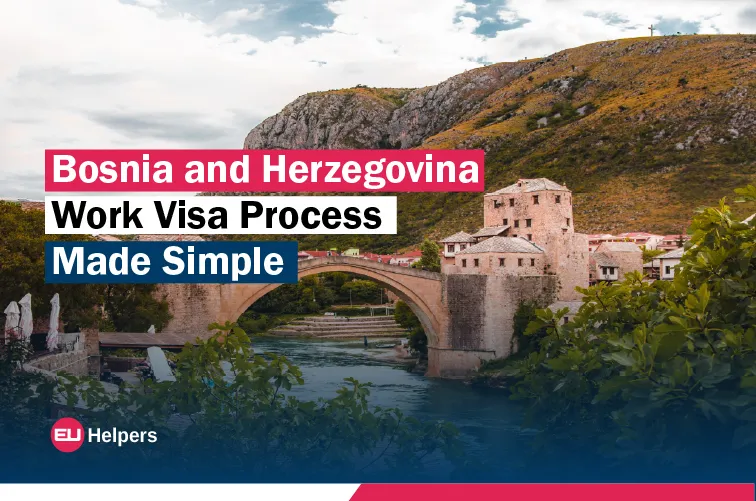

Bosnia and Herzegovina Work Visa Process Made Simple
Bosnia and Herzegovina's work visa process for international professionals operates through distinctive constitutional structure resulting from the 1995 Dayton Peace Agreement with entity-level authorities (Federation of Bosnia and Herzegovina, Republika Srpska, Brčko District) handling work permits and state-level Service for Foreigners' Affairs handling residence permits coordinated with Bosnian embassies for D visa arrangements. Understanding the essential flow makes navigation clear despite Bosnia's constitutional complexity. This EU Helpers guide simplifies the Bosnia and Herzegovina work visa process for international professionals with clear stage-by-stage explanation — international candidates can explore Bosnian opportunities through EU Helpers at https://euhelpers.com/jobseeker. Bosnia and Herzegovina is an EU candidate (since December 2022), NATO Membership Action Plan participant (since December 2018), and Council of Europe member (since 2002), but NOT an EU, Schengen, or eurozone member (uses convertible mark — BAM, pegged to euro).
The Simple Overview
The Bosnia and Herzegovina work visa process operates through essential stages that follow logical flow once entity is determined.
| Stage | What Happens | Approximate Duration |
|---|---|---|
| 1. Entity determination | Identify which entity handles application | Days |
| 2. Job offer | Secure Bosnian employer offer | Variable |
| 3. Documentation | Prepare comprehensive documents with translations | 4-6 weeks |
| 4. Work permit application | Submit to entity employment authority | 1-2 weeks preparation |
| 5. Entity authority processing | Federal, Republika Srpska, or Brčko | 1-2 months typical |
| 6. D visa arrangement | Bosnian embassy for visa-required nationals | 15-30 days |
| 7. Travel and residence application | Enter Bosnia and apply to SPS | 1-2 months |
| 8. Residence permit issuance | Service for Foreigners' Affairs | Within processing |
Total timeline typically spans 3-5 months from initial preparation to fully settled Bosnian arrival.
Stage 1: Entity Determination
Bosnia and Herzegovina's constitutional structure requires determining which entity handles the application based on employment location.
Federation of Bosnia and Herzegovina (FBiH): Employment in Federation cities including Sarajevo (state capital), Tuzla, Zenica, Mostar (with iconic UNESCO Old Bridge — Stari Most), Bihać, and other Federation locations. Application through Federal Employment Institute and cantonal employment services covering 10 cantons. Bosnian and Croatian are official languages.
Republika Srpska (RS): Employment in Republika Srpska cities including Banja Luka (largest RS city and de facto RS capital), Bijeljina, Prijedor, Trebinje, and other RS locations. Application through Republika Srpska Employment Bureau (Завод за запошљавање Републике Српске). Serbian is the official language with option of Cyrillic or Latin script.
Brčko District: Employment in Brčko District. Application through Brčko District's own administrative arrangements as special self-governing unit.
Simple checkpoint: Entity determination fundamentally shapes application procedures and language requirements.
Stage 2: Job Offer Confirmation
Applicants secure qualifying Bosnian employer job offer.
Job offer requirements include Bosnian employer legally registered and authorized to hire foreign workers, position genuinely requiring the applicant's qualifications, salary meeting Bosnian entity standards, employment contract confirming terms including position, salary, and duration, and appropriate route classification (Standard, Highly Qualified, ICT if intra-corporate transfer, or other).
Growing Bosnian sectors welcoming foreign workers include manufacturing (metalworking, wood processing, textile), IT and business services particularly in Sarajevo and Banja Luka, tourism particularly around Sarajevo (cultural tourism, 1984 Olympics heritage) and Mostar (UNESCO Old Bridge), energy (hydropower), and international organizations related to post-conflict reconstruction and EU accession activities.
Stage 3: Document Preparation
Comprehensive documentation preparation typically takes 4-6 weeks.
| Documentation | Purpose |
|---|---|
| Valid passport | Identity with sufficient validity |
| Employment contract | Confirming Bosnian employment terms |
| Employer supporting documents | Business need justification |
| Educational qualifications | Diplomas with certified translations |
| Professional experience | CV and reference letters |
| Health insurance | Coverage valid in Bosnia |
| Criminal record certificate | From country of previous residence |
| Certified translations | Into Bosnian, Croatian, or Serbian per entity |
| Apostille certification | Where required by country |
| Photographs | Recent biometric photos |
| Proof of accommodation | Bosnian address |
Certified translations must be into official language of the relevant entity (Bosnian or Croatian for Federation of BiH depending on canton, Serbian for Republika Srpska) by authorized court translators (sudski tumači / судски тумачи). Apostille certification or diplomatic legalization validates foreign documents.
Simple checkpoint: Start documentation early — 4-6 weeks preparation is realistic given multiple parallel processes plus entity language considerations.
Stage 4: Work Permit Application to Entity Authority
Applications are submitted through the relevant entity employment authority.
Application submission includes complete application documentation, employer supporting documentation demonstrating business need, applicant supporting documents including translated and apostilled documents, applicable fees, and required supporting materials. Entity authority evaluates labor market considerations and application quality.
Simple checkpoint: Entity authority determines specific submission procedures and requirements.
Stage 5: Entity Authority Processing
Entity employment authority handles work permit evaluation and decision.
Processing typically takes 1-2 months for Standard Work Permit at entity authority. Entity authority evaluates whether position requires foreign worker (labor market considerations), whether qualifications match position requirements, whether salary meets Bosnian standards, whether employer justification is adequate, and overall application quality.
Simple checkpoint: Entity-specific processing means variations between Federation, Republika Srpska, and Brčko District procedures.
Stage 6: D Visa Arrangement
For visa-required nationals, D visa arrangement at Bosnian embassy in country of residence follows work permit approval.
Applicants from visa-required countries book appointment at Bosnian embassy, submit D visa application with work permit approval documentation, provide supporting documentation, pay applicable visa fees, and provide biometric information. D visa processing typically takes 15-30 days after work permit approval.
Note that Bosnia and Herzegovina has visa liberalization agreements with many countries meaning nationals of visa-exempt countries can travel to Bosnia directly after work permit approval without D visa arrangement.
Stage 7: Travel to Bosnia and Herzegovina
With approvals in place, applicants travel to Bosnia and Herzegovina.
Travelers arrive at Sarajevo International Airport (Aerodrom Sarajevo) as main international gateway, Banja Luka International Airport providing secondary access particularly for Republika Srpska destinations, Tuzla International Airport, or Mostar International Airport for Herzegovina access. Land borders with Croatia (western and southern), Serbia (eastern), Montenegro (southeastern), and short Adriatic coastline around Neum provide additional entry options.
Coordination with the sponsoring Bosnian employer for practical support upon arrival helps including temporary accommodation and initial orientation.
Stage 8: Residence Permit at Service for Foreigners' Affairs
After Bosnian arrival, applicants apply for residence permit at Service for Foreigners' Affairs (Služba za poslove sa strancima — SPS).
Residence permit application at state-level SPS under Ministry of Security includes valid passport, work permit approval, D visa (where applicable), employment contract, health insurance valid in Bosnia and Herzegovina, proof of accommodation, applicable fees, and other required documents. Processing typically takes 1-2 months.
Simple checkpoint: SPS coordinates residence aspects with entity-level work permit approval providing state-level oversight of foreign residents.
Simple Cost Overview
Bosnia and Herzegovina work visa costs are moderate reflecting Balkan cost standards. Application fees vary by entity and category. Certified translation costs vary by document quantity. Apostille costs vary by country. Health insurance ongoing costs apply.
Bosnia has relatively low cost of living compared to Western European averages though costs in Sarajevo and Banja Luka are higher than smaller Bosnian cities.
Simple Language Considerations
Bosnia and Herzegovina's linguistic character reflects entity structure with three official languages recognized nationally.
| Language | Role in Bosnia and Herzegovina |
|---|---|
| Bosnian (Bosanski) | Official in Federation |
| Croatian (Hrvatski) | Official in Federation (particularly Croat-majority cantons) |
| Serbian (Srpski) | Official in Republika Srpska |
| English | Widely used in international sectors particularly Sarajevo |
All three official languages are mutually intelligible variants of Serbo-Croatian with distinctive script preferences (Bosnian and Croatian use Latin script, Serbian uses both Cyrillic and Latin). Language requirements vary by entity and specific location.
Simple Route Selection Guidance
Different Bosnia routes suit different circumstances.
Standard Work Permit: Suits most employment-based applications through entity employment authority with employer sponsorship. Most common route for third-country nationals.
Highly Qualified Worker Permit: Suits specific highly qualified positions with streamlined procedures.
Seasonal Work Permit: Suits agriculture and tourism seasonal employment with shorter processing.
ICT Permit: Suits multinational intra-corporate transfers when applicant transfers from foreign entity to Bosnian entity within same corporate group.
Self-Employment: Suits business establishment with substantial economic contribution.
Simple checkpoint: Route selection determines specific requirements and procedures.
Simple Family Reunification
Family members can join through separate family reunification applications.
Family reunification requires valid relationship documentation with apostille and certified translations into relevant entity language, adequate financial resources to support family members, adequate Bosnian accommodation, and health insurance coverage. Processing typically 2-3 months. Family members typically have right to work in Bosnia during primary applicant's permit period.
Simple Setup After Arrival
Post-arrival setup involves essential arrangements for Bosnian life.
| Setup Priority | Purpose |
|---|---|
| Residence permit | Legal residence at Service for Foreigners' Affairs |
| Personal identification | Bosnian residence card |
| Tax registration | Bosnian tax obligations |
| Health insurance | Access to Bosnian healthcare |
| Bosnian bank account | Financial services |
| Housing arrangements | Permanent accommodation |
| Utilities setup | Essential services |
Sarajevo, Banja Luka, and other larger Bosnian cities have services for international workers including growing expat community and English-language services in international sectors.
Understanding Bosnia and Herzegovina's Simple Appeal
Bosnia and Herzegovina's appeal for those pursuing work visa reflects distinctive advantages.
Post-conflict recovery and EU trajectory: Bosnia's EU candidate status (December 2022) creates trajectory of continued modernization with growing international engagement supporting economic development.
Distinctive multicultural character: Bosnia's Bosniak (Bosnian Muslim), Croat (Catholic), and Serb (Orthodox) communities alongside Jewish heritage in Sarajevo create distinctive multicultural environment particularly notable in Sarajevo.
Rich cultural heritage: Ottoman heritage particularly visible in Sarajevo's Baščaršija old bazaar and Mostar's Old Bridge, Austro-Hungarian heritage in Sarajevo, Banja Luka, and other cities, and diverse religious and cultural traditions create rich cultural environment.
Historic cities: Sarajevo with Olympic heritage (1984 Winter Olympics), Ottoman and Austro-Hungarian architectural character; Mostar with iconic Old Bridge; Banja Luka as growing Republika Srpska city; and smaller historic cities like Trebinje, Jajce with Pliva Waterfall, and Blagaj with Ottoman-era dervish house at Buna River source.
Cost advantage: Lower cost of living compared to Western European averages creates favorable economics for international professionals particularly compared to salary levels.
Growing sectors: Manufacturing, IT and business services, tourism, energy, and international organizations create genuine career opportunities.
Regional access: Central Balkan location provides access to Croatia, Serbia, Montenegro, and broader region.
Final Guidance Made Simple
The Bosnia and Herzegovina work visa process, while involving constitutional structure complexity, follows a logical flow that simplifies with clear understanding. Key elements include entity determination based on employment location (Federation of BiH through Federal Employment Institute and cantonal employment services for cities like Sarajevo state capital, Tuzla, Zenica, Mostar with iconic UNESCO Old Bridge — Stari Most, Bihać, and other Federation locations; Republika Srpska through Republika Srpska Employment Bureau for cities like Banja Luka as largest RS city and de facto RS capital, Bijeljina, Prijedor, Trebinje; and Brčko District through its own administrative arrangements as special self-governing unit), job offer confirmation with Bosnian employer, comprehensive documentation preparation with certified translations by authorized court translators (sudski tumači / судски тумачи) into official language of relevant entity (Bosnian or Croatian for Federation of BiH depending on canton, Serbian for Republika Srpska with option of Cyrillic or Latin script) and apostille certification (4-6 weeks), work permit application submission through relevant entity employment authority, entity authority processing typically 1-2 months for Standard Work Permit evaluating labor market considerations and application quality, D visa arrangement at Bosnian embassy for visa-required nationals after work permit approval with processing 15-30 days (nationals of visa-exempt countries can travel directly given Bosnia's visa liberalization arrangements), travel to Bosnia and Herzegovina (Sarajevo International Airport as main international gateway plus Banja Luka International Airport particularly for Republika Srpska destinations, Tuzla International Airport, and Mostar International Airport for Herzegovina access with land borders providing additional options), applying for residence permit at state-level Service for Foreigners' Affairs (Služba za poslove sa strancima — SPS) under Ministry of Security with processing 1-2 months, residence permit issuance, and completing post-arrival setup including Bosnian bank account, tax registration, health insurance, and housing arrangements. Total timeline typically spans 3-5 months. Costs are moderate reflecting Balkan standards with lower cost of living compared to Western Europe. Language considerations vary by entity with all three official languages (Bosnian, Croatian, Serbian) mutually intelligible variants of Serbo-Croatian with distinctive script preferences and English widely used in international sectors particularly Sarajevo. International candidates evaluating Bosnian opportunities can start their exploration through EU Helpers at https://euhelpers.com/jobseeker. Bosnia and Herzegovina's status as EU candidate (since December 2022 with candidate status granted after long application process though accession negotiations have not yet formally opened), NATO Membership Action Plan participant (since December 2018 though membership not yet achieved), and Council of Europe member (since 2002), NOT an EU, Schengen, or eurozone member (uses convertible mark — BAM, pegged to euro through currency board arrangement), combined with the country's distinctive geography featuring mountainous terrain covering most of country with Dinaric Alps, Sava River valley in north, Neretva River valley, narrow Adriatic coastline around Neum, and diverse landscapes, historic cities including Sarajevo as capital combining Ottoman, Austro-Hungarian, Yugoslav, and modern elements with distinctive multicultural character (Bosniak, Croat, Serb, Jewish heritage) and 1984 Winter Olympics heritage plus Baščaršija old bazaar with iconic Sebilj fountain and Latin Bridge historically significant as site of Archduke Franz Ferdinand's assassination in 1914 triggering World War I, Mostar in Herzegovina featuring iconic Old Bridge (Stari Most as UNESCO World Heritage originally built 1566 during Ottoman period as engineering masterpiece of chief architect Mimar Hayruddin, destroyed 1993 during Bosnian War, and rebuilt 2004 with iconic bridge diving tradition), Banja Luka as largest city in Republika Srpska, Tuzla, Zenica, Bihać, and other significant cities, developing economy with sectors including manufacturing (metalworking, wood processing, textile), agriculture, energy (hydropower given mountainous geography and river resources), tourism (growing particularly around Sarajevo, Mostar, and mountain destinations Jahorina and Bjelašnica ski resorts near Sarajevo), and services, EU accession trajectory supporting continued modernization, and cultural richness with distinctive multicultural character makes Bosnia and Herzegovina a distinctive Southeast European destination. EU Helpers simplifies the Bosnia and Herzegovina work visa process with entity determination guidance identifying appropriate authority based on employment location (Federation of BiH through Federal Employment Institute and cantonal services, Republika Srpska through Republika Srpska Employment Bureau, or Brčko District through own arrangements), work permit application coordination through relevant entity authority, document preparation support including certified translations into Bosnian, Croatian, or Serbian depending on entity and apostille arrangements, application coordination between entity and state-level authorities, D visa arrangements at Bosnian embassies where required, residence permit process guidance at state-level Service for Foreigners' Affairs, and clarity on Bosnia's distinctive requirements.
FAQs
Bosnia and Herzegovina's work visa process simplifies into essential stages: Stage 1 involves entity determination based on employment location (Federation of BiH, Republika Srpska, or Brčko District). Stage 2 involves securing Bosnian employer job offer meeting entity standards. Stage 3 involves comprehensive documentation preparation with certified translations into relevant entity language (4-6 weeks). Stage 4 involves work permit application submission through relevant entity employment authority. Stage 5 involves entity authority processing (1-2 months typical). Stage 6 involves D visa arrangement at Bosnian embassy for visa-required nationals (or direct travel for visa-exempt nationals). Stage 7 involves travel and residence permit application at Service for Foreigners' Affairs. Stage 8 involves residence permit issuance (1-2 months).
Bosnia and Herzegovina's distinctive constitutional structure resulting from 1995 Dayton Peace Agreement requires determining which entity handles the application based on employment location. Federation of Bosnia and Herzegovina (FBiH) is handled through Federal Employment Institute and cantonal employment services covering 10 cantons for employment in cities including Sarajevo, Tuzla, Zenica, Mostar, and Bihać with Bosnian and Croatian as official languages. Republika Srpska (RS) is handled through Republika Srpska Employment Bureau (Завод за запошљавање Републике Српске) for employment in cities including Banja Luka, Bijeljina, Prijedor, and Trebinje with Serbian as official language. Brčko District has its own administrative arrangements.
Bosnia and Herzegovina's Service for Foreigners' Affairs (Služba za poslove sa strancima — SPS) is the state-level authority under Ministry of Security responsible for residence permits, immigration matters, and coordination with entity-level employment authorities for foreign workers. Following entity-level work permit approval, foreign workers apply for residence permit at SPS with processing typically 1-2 months. SPS also coordinates with Bosnian embassies handling D visa applications abroad for visa-required nationals. Service for Foreigners' Affairs maintains oversight of foreign residents in Bosnia and Herzegovina including address changes, renewals, and other administrative matters providing state-level coordination.
Bosnia and Herzegovina's D visa process applies to visa-required foreign nationals intending to reside in Bosnia for extended periods including work purposes. After entity-level work permit approval, visa-required applicants apply for D visa at Bosnian embassy in country of residence. Application involves booking embassy appointment, submitting D visa application with work permit approval documentation and supporting documents, paying applicable visa fees, and providing biometric information. D visa processing typically takes 15-30 days. Note that Bosnia has visa liberalization agreements with many countries meaning many nationalities can travel to Bosnia directly without D visa.
Bosnia and Herzegovina work visa documentation requires valid passport with sufficient validity, employment contract confirming Bosnian employment terms, employer application to relevant entity employment authority, educational qualifications with certified translations by authorized court translators (sudski tumači / судски тумачи), professional experience CV and reference letters, health insurance coverage valid in Bosnia, criminal record certificate from country of previous residence, certified translations into official language of relevant entity (Bosnian or Croatian for Federation of BiH depending on canton, Serbian for Republika Srpska), apostille certification (from countries party to Hague Apostille Convention) or diplomatic legalization where required, recent biometric photographs, and proof of accommodation in Bosnia.
Bosnia and Herzegovina's linguistic character reflects entity structure with three official languages recognized nationally. Bosnian (Bosanski) is official in Federation particularly Bosniak-majority areas. Croatian (Hrvatski) is official in Federation particularly Croat-majority cantons. Serbian (Srpski) is official in Republika Srpska with option of Cyrillic or Latin script. All three official languages are mutually intelligible variants of Serbo-Croatian with distinctive script preferences (Bosnian and Croatian use Latin script, Serbian uses both Cyrillic and Latin). Documentation requires certified translations into official language of relevant entity. English is widely used in international sectors particularly Sarajevo.
The Dayton Peace Agreement signed in Paris on December 14, 1995, following negotiations at Wright-Patterson Air Force Base near Dayton, Ohio, in November 1995, ended the 1992-1995 Bosnian War and established Bosnia and Herzegovina as sovereign state with two entities — the Federation of Bosnia and Herzegovina (roughly comprising Bosniak and Croat majority areas) and Republika Srpska (roughly comprising Serb majority areas) — plus the Brčko District as separate self-governing unit added later. This distinctive constitutional structure affects all aspects of Bosnian governance including employment authorities (entity-level) and immigration procedures (residence permits at state-level Service for Foreigners' Affairs).
Bosnia and Herzegovina is NOT an EU member (candidate since December 2022 with candidate status granted after long application process though accession negotiations have not yet formally opened), NOT a Schengen member (though visa liberalization allows visa-free Schengen travel for Bosnian citizens for short stays), and NOT in the eurozone (uses convertible mark — BAM — as currency though BAM is pegged to euro through currency board arrangement with fixed exchange rate). Bosnia and Herzegovina is NOT a NATO member (though NATO Membership Action Plan participant since December 2018) and Council of Europe member (since 2002).
Sarajevo is Bosnia and Herzegovina's capital and largest city with approximately 275,000 residents combining Ottoman, Austro-Hungarian, Yugoslav, and modern architectural elements creating distinctive multicultural character. Sarajevo features Ottoman heritage in Baščaršija old bazaar with iconic Sebilj fountain, Austro-Hungarian architecture in city center including City Hall (Vijećnica) rebuilt after wartime destruction, Latin Bridge historically significant as site of Archduke Franz Ferdinand's assassination in 1914 triggering World War I, and modern developments. Sarajevo hosted 1984 Winter Olympics providing distinctive Olympic heritage. Sarajevo serves as Bosnia's economic, political, and cultural center with government institutions, universities, businesses, and growing tourism sector.
EU Helpers simplifies the Bosnia and Herzegovina work visa journey with entity determination guidance identifying appropriate authority based on employment location (Federation of BiH through Federal Employment Institute and cantonal services covering 10 cantons for cities like Sarajevo, Tuzla, Zenica, Mostar; Republika Srpska through Republika Srpska Employment Bureau for cities like Banja Luka, Bijeljina, Trebinje; or Brčko District through its own arrangements), work permit application coordination through relevant entity authority, document preparation support including certified translations into Bosnian, Croatian, or Serbian by authorized court translators (sudski tumači / судски тумачи) and apostille arrangements, application coordination between entity and state-level authorities, D visa arrangements at Bosnian embassies where required, residence permit process guidance at state-level Service for Foreigners' Affairs (Služba za poslove sa strancima), and clarity on Bosnia's distinctive requirements.
Still have questions? Get in touch
Ready to work in Bosnia and Herzegovina?
EU Helpers simplifies Bosnia and Herzegovina's distinctive entity-based work visa system. From entity determination to residence permit, we make your Bosnian path clear