
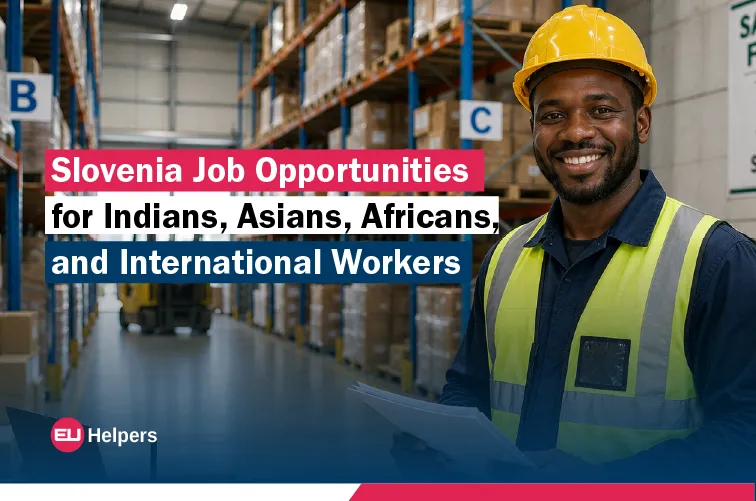

Slovenia Job Opportunities for Indians, Asians, Africans, and International Workers: An EU Helpers Guide
Slovenia has become an increasingly attractive destination for international workers, drawing talent from India, across Asia, and Africa to its prosperous, green economy between the Alps and the Adriatic. With genuine labour shortages in construction, manufacturing, transport, IT, and healthcare, an EU and Schengen location, and a clear route to settlement, Slovenia job opportunities for Indians, Asians, Africans, and international workers are real and growing.
At EU Helpers, we highlight what makes Slovenia accessible: a Single Work and Residence Permit covering all skill levels, the EU Blue Card for skilled professionals, and above all the official shortage list that waives or expedites the labour market test for in-demand roles. This EU Helpers guide explains where opportunities lie and what applicants from India, Asia, Africa, and beyond should prepare. Rules are revised periodically, so confirm the current position before acting.
The Routes That Shape Every Application
| Route | Best for | Note |
|---|---|---|
| Single Work and Residence Permit | Most roles and skill levels | Standard; test waived for shortage roles |
| EU Blue Card | Highly qualified professionals | Degree + €44,304/year; EU mobility |
For international workers, the message is clear: check the shortage list, target the EU Blue Card if you have a degree and higher salary, and use the Single Permit otherwise.
Where International Workers Genuinely Succeed
| Sector | Roles in demand | Notes |
|---|---|---|
| Construction | Trades and site workers | Deep shortage |
| Manufacturing | Production, assembly, technicians | Industrial base |
| IT and technology | Developers, specialists | Blue Card; often English-speaking |
| Transport and logistics | Drivers, warehouse, supply chain | Deep shortage |
| Healthcare | Doctors, nurses | Recognition + Slovenian |
| Tourism and hospitality | Hotel, restaurant, seasonal staff | Seasonal demand |
Notes for Indian Applicants
Indian professionals are well suited to Slovenia's strongest sectors: IT, engineering, and healthcare, along with skilled trades and transport. India's deep pools of developers, engineers, and healthcare professionals align with Slovenian demand, and Indian English fluency is an asset in IT and international companies.
Indian degree-holders should target the EU Blue Card (degree + €44,304/year), while engineers, technicians, skilled tradespeople, and drivers use the Single Permit — smoothest where the role is on the shortage list. Practical points: prepare translated, recognised qualifications and a recent criminal-record certificate, confirm your occupation's shortage-list status, meet the proof-of-funds requirement, and register your address within eight days of arrival.
Notes for Other Asian and African Applicants
The same logic holds: your skills, route, and shortage-list status matter more than your nationality. Skilled professionals across Asia and Africa should target IT, engineering, and healthcare via the Blue Card or Single Permit; practical workers find genuine demand in construction, manufacturing, and transport through the Single Permit.
For practical and trade workers especially, Slovenia's shortages in construction and transport open genuine routes that much of Western Europe does not. Be realistic that Slovenian is often needed for practical roles, document requirements differ by country, so confirm your recognition and translation route early, and stay alert to fraud.
If you would like structured, trustworthy help identifying legitimate roles and preparing a strong application, you can explore job seeker support from EU Helpers.
Process and Documents
| Stage | What happens |
|---|---|
| 1. Job offer | Secure a binding offer from a Slovenian employer |
| 2. Labour market test | ZRSZ checks the vacancy (waived for shortage roles) |
| 3. Application | Employer applies for the Single Permit / Blue Card |
| 4. Decision | Around 30–60 days |
| 5. Arrival | Register your address within 8 days |
| 6. Health insurance | Register with ZZZS after arrival |
| Document | Key point |
|---|---|
| Passport | Valid 3+ months beyond the permit |
| Employment contract | Binding, at least 1 year |
| Qualifications | Diplomas translated and recognised |
| Criminal record | Issued within the last 3 months |
| Proof of funds | Around €550/month minimum |
| Proof of accommodation | In Slovenia |
Rights, Language, and the Long Term
Slovenia applies EU-aligned protections. Blue Card holders gain EU mobility, easier family reunification, and a faster path to permanent residence. Single Permit holders can change employer if the new role meets labour market requirements. The path to settlement is clear: permanent residence after five years of continuous legal residence. Slovenia offers a high quality of life.
On language, Slovenian is the official language and helps with daily life and most roles, though IT and international companies often use English, giving skilled professionals real options. Slovenia's growing international communities also ease settling in.
Important Legal Notes
This EU Helpers guide is general information, not legal advice. Slovenian rules are set by the authorities and revised periodically, including salary thresholds, shortage lists, and procedures. What applies to you depends on your nationality, employer, occupation, and route. Confirm current requirements through official Slovenian sources such as the Employment Service (ZRSZ) and the Administrative Unit, or a qualified professional. Be alert to fraudulent offers.
Final Guidance and Next Steps
For workers from India, Asia, Africa, and beyond, Slovenia offers genuine, growing opportunity across the skill spectrum, thanks to its labour shortages and the official shortage list. Skilled professionals in IT and healthcare have the clearest path through the EU Blue Card, and Indian tech and healthcare talent in particular is well placed. Practical workers find genuine demand in construction, manufacturing, and transport through the Single Permit.
Remember the essentials: check the shortage list, secure a genuine employer sponsor, prepare recognised and translated documents plus a recent criminal-record certificate, register your address within eight days, and stay alert to fraud. If you would like trustworthy help finding real opportunities and preparing a competitive application, you can explore job seeker support from EU Helpers. EU Helpers is here to help workers from India, Asia, Africa, and around the world take that step with confidence.
FAQs
Yes, and Indian professionals are well suited to Slovenia's strongest sectors: IT, engineering, and healthcare, along with skilled trades and transport. India's deep pools of developers, engineers, and healthcare professionals align with Slovenian demand, and Indian English fluency is an asset in IT and international companies. Indian degree-holders should target the EU Blue Card, while engineers, technicians, tradespeople, and drivers use the Single Permit, which is smoothest where the role is on Slovenia's shortage list.
Construction, manufacturing, and transport generate the strongest practical demand, being among Slovenia's deepest shortages, followed by IT and healthcare, which offer skilled routes often via the EU Blue Card. Tourism provides seasonal demand. Many of these occupations appear on the official shortage list, which waives or expedites the labour market test. IT roles frequently operate in English, making Slovenia genuinely accessible to international candidates across both practical and skilled levels.
Because it removes the biggest obstacle in the process. For roles on Slovenia's official shortage list, the labour market test is waived or expedited, making applications significantly faster. Since Slovenia's shortages concentrate in construction, manufacturing, transport, healthcare, and IT, many roles that international workers target benefit. Confirming your occupation's shortage-list status before applying significantly improves and speeds your prospects, so it should be one of your very first steps.
Yes. Slovenia's construction, manufacturing, and transport sectors are among its deepest shortages, generating strong, ongoing demand for practical and trade workers, and many roles feature on the official shortage list, which eases the process. Qualified welders, electricians, technicians, and drivers find genuine, legal routes through the Single Permit, a real contrast to much of Western Europe. Note that Slovenian is often needed for practical and on-site roles, so some language ability strengthens your position.
It depends on the sector. Slovenian is the official language and helps considerably with daily life and most practical roles, particularly in construction, manufacturing, and customer-facing work. However, IT and international companies often operate in English, giving skilled professionals genuine options. For technology roles, English is often sufficient to begin, though learning Slovenian supports integration. Slovenian is a South Slavic language, so speakers of related regional languages may find it more accessible.
Yes. After five years of continuous legal residence, you can apply for permanent residence in Slovenia. The EU Blue Card offers a faster path to permanent residence eligibility, along with EU mobility and easier family reunification, making it particularly attractive for skilled professionals planning long-term. Single Permit holders also build toward settlement through continuous residence. These clear pathways reward stable, lawful employment and residence, giving international workers genuine long-term prospects in an EU and Schengen country.
EU Helpers helps candidates from India, Asia, Africa, and elsewhere check whether their occupation is on Slovenia's shortage list, which eases the process, and choose between the Single Permit and EU Blue Card. We help you target genuine demand in construction, manufacturing, transport, IT, and healthcare, prepare recognised and translated documents, understand the registration steps, and avoid fraud. Final decisions rest with the Slovenian authorities, but EU Helpers keeps you informed and organised.
Still have questions? Get in touch
Ready to work in Slovenia?
EU Helpers connects international job seekers with Slovenian employers offering Single Permit and EU Blue Card sponsorship. From construction and manufacturing to IT and healthcare, we help you secure the right role.