
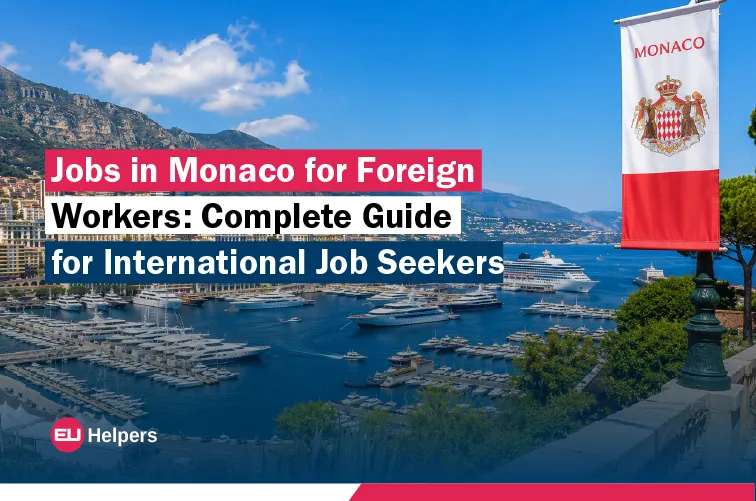

Jobs in Monaco for Foreign Workers: A Complete EU Helpers Guide for International Job Seekers
Monaco is one of the wealthiest and most glamorous places on Earth — a sovereign city-state on the French Riviera, home to a booming finance sector, luxury tourism, real estate, yachting, and world-famous events like the Formula 1 Grand Prix. With no income tax for most residents and some of the highest salaries in the world, it holds obvious appeal. For job seekers from Asia, Africa, Latin America, and beyond, jobs in Monaco for foreign workers are genuinely attractive — but honesty matters here, because Monaco runs one of the most controlled labour markets in Europe.
At EU Helpers, we always give you the accurate picture. Every non-Monégasque needs a work permit (Autorisation de Travail), hiring follows a strict national-preference priority order, and over 70% of Monaco's workforce commutes daily from France and Italy. Understanding this reality is essential before investing hope. Monaco is not in the EU but is closely tied to France and the Schengen area, so rules interact with French immigration. Confirm the current position before acting.
The Reality: A Strictly Controlled Market
Monaco's labour market is unlike almost anywhere else. It operates a national-preference system, meaning employers must offer roles in a fixed priority order before hiring a third-country national.
| Hiring priority order | Who comes first |
|---|---|
| 1. Monégasque nationals | Absolute priority |
| 2. Monaco residents | Long-term residents next |
| 3. French border-region / priority market | Frontalier and priority candidates |
| 4. Other foreign nationals | Only if no priority candidate is available |
When a vacancy arises, the employer must notify the Service de l'Emploi, which has a few days to find a suitable candidate from Monaco or the surrounding area. Only if no priority candidate is found can the employer hire a foreign national — so you must offer something the local and cross-border market cannot.
The Cross-Border Reality
Crucially, most people who work in Monaco do not live there. Over 70% of the workforce commutes daily from neighbouring France (Nice, Menton) and Italy (Ventimiglia), because living in Monaco is extraordinarily expensive.
This shapes strategy profoundly: for many overseas candidates, the realistic long-term route into Monaco's job market is to establish residence in the French or Italian border region first, then work in Monaco as a frontalier (cross-border) worker — a far more practical path than securing scarce Monaco residence.
What Non-EU Nationals Face
For a third-country national, the path is demanding and sequential.
| Requirement | Detail |
|---|---|
| Job offer | From a Monaco-registered employer |
| Priority clearance | Employer proves no priority candidate available |
| French residence permit | Non-EU nationals generally need this first |
| Autorisation de Travail | Monaco work authorisation |
| Carte de Séjour | Monaco residence card (if living in Monaco) |
| Timeline | Often more than three months in total |
A key complication: non-EU candidates generally must first obtain a French residence permit authorising work before beginning the Monégasque procedure — which extends the total timeline considerably.
Where the Jobs Are
| Sector | Typical roles in demand |
|---|---|
| Finance and banking | Wealth management, private banking, compliance |
| Luxury hospitality | Hotels, fine dining, concierge |
| Real estate | Agents, management, specialists |
| Yachting and maritime | Crew, management, specialist services |
| Events and tourism | Event management, luxury services |
| Domestic and personal services | High-end household and personal staff |
Monaco's economy centres on finance, luxury tourism, real estate, and yachting, and it is in these high-value sectors — especially where you offer scarce, specialist skills — that foreign hires are most feasible.
If you are searching for genuine openings and want structured, trustworthy help assessing whether Monaco is realistic for you, you can explore job seeker support from EU Helpers.
The Process and Your Documents
| Stage | What happens |
|---|---|
| 1. Job offer | Secure an offer from a Monaco-registered employer |
| 2. Vacancy declaration | Employer notifies the Service de l'Emploi |
| 3. Priority check | Employer proves no priority candidate available |
| 4. French residence permit | Non-EU nationals generally obtain this first |
| 5. Work authorisation | Direction du Travail issues the Autorisation de Travail |
| 6. Residence card | Apply for your Carte de Séjour if living in Monaco |
| Document | Key point |
|---|---|
| Passport | Sufficient validity |
| Employment contract | From a Monaco-registered employer |
| Qualifications | Proof of the skills the role requires |
| French residence permit | Generally required first for non-EU nationals |
| Clean record and health | Standard requirements |
A crucial rule: you cannot begin work before the permit is formally issued — doing so breaches Monégasque law and can lead to refusal and removal.
Rights, Language, and the Long Term
Monaco offers exceptional salaries and no income tax for most residents, along with strong safety and quality of life. Workers can generally bring immediate family, subject to the equivalent processes. Frontalier workers are largely subject to French social security rules.
On language, French is the official language and is important for most roles and daily life, though English is widely used in finance, yachting, and international luxury services. French ability is a strong asset and often expected. Permanent residence is possible over time, at the authorities' discretion, subject to stable means and a clean record.
Important Legal Notes
This EU Helpers guide is general information, not legal advice. Monaco's rules are set by the authorities and interact with French immigration law, including the priority hiring order, work authorisation, and residence procedures. What applies to you depends heavily on your nationality, employer, qualifications, and where you reside. Confirm current requirements through official Monégasque sources such as the Direction du Travail and moi.mc, or a qualified professional.
Final Guidance and Next Steps
Monaco offers extraordinary rewards, but its labour market is realistically accessible only to those who can offer something the local and cross-border market cannot. The strict national-preference order, the dominance of frontalier commuters, and the requirement for non-EU nationals to secure a French residence permit first all make direct entry demanding.
Your best strategy is to target high-value, specialist roles in finance, luxury hospitality, yachting, or real estate, and to seriously consider the cross-border route — establishing residence in the French or Italian border region and working in Monaco as a frontalier, which is how the majority of Monaco's workforce operates. Prepare a strong, specialist profile, plan for a timeline beyond three months, and never start work before your permit is issued. If you would like honest help assessing whether Monaco is realistic for you, you can explore job seeker support from EU Helpers. EU Helpers is here to help you take that step with clear, honest guidance.
FAQs
Yes. Every non-Monégasque, including French citizens, needs a work permit (Autorisation de Travail) before beginning any job in Monaco, and a new one if they change employer or role. The process is employer-driven, requiring a job offer from a Monaco-registered company. Non-EU and non-Swiss nationals also need a residence card if living in Monaco, and generally must first obtain a French residence permit authorising work. You cannot start work before the permit is formally issued.
Monaco operates a national-preference system, meaning employers must offer roles in a fixed priority order: first Monégasque nationals, then Monaco residents, then French border-region and priority-market candidates, and only last, other foreign nationals. When a vacancy arises, the employer notifies the Service de l'Emploi, which has a few days to find a suitable priority candidate. Only if none is available can the employer hire a third-country national, so you must offer scarce, specialist skills.
Because living in Monaco is extraordinarily expensive, over 70% of its workforce commutes daily from neighbouring France, such as Nice and Menton, and Italy, such as Ventimiglia, as frontalier or cross-border workers. This shapes strategy for overseas candidates: rather than securing scarce and costly Monaco residence, a realistic route is to establish residence in the French or Italian border region first, then work in Monaco as a cross-border worker, as most of its employees do.
Finance and banking, luxury hospitality, real estate, yachting and maritime services, and events and tourism dominate Monaco's economy, alongside high-end domestic and personal services. It is in these high-value sectors, particularly where you offer scarce, specialist skills that the local and cross-border market cannot supply, that foreign hires are most feasible. Wealth management, private banking, luxury hospitality, and specialist yachting roles are among the strongest routes for qualified international candidates.
Non-EU and non-Swiss nationals generally must first obtain a French residence permit authorising them to work before beginning the Monégasque work-permit procedure. This is because Monaco is closely integrated with France and the Schengen area, and it significantly extends the total timeline, often to more than three months. Planning for this two-country, sequential process from the outset is essential to avoid delays and disappointment when pursuing a Monaco role.
French is the official language and is important for most roles and daily life, so ability in it is a strong asset and often expected. However, English is widely used in finance, yachting, and international luxury services, giving English-speaking specialists genuine options in those sectors. Given how competitive and controlled Monaco's labour market is, French ability meaningfully strengthens your position and broadens the roles realistically open to you.
EU Helpers helps international job seekers understand Monaco's highly controlled labour market honestly, so you focus effort where it can realistically succeed. We help you assess whether your profile offers the scarce, specialist skills Monaco's priority system requires, target genuine demand in finance, luxury hospitality, and yachting, and understand the practical cross-border route through France or Italy. Final decisions rest with the Monégasque and French authorities, but EU Helpers helps you approach the market with clear, honest expectations.
Still have questions? Get in touch
Ready to work in Monaco?
EU Helpers connects international job seekers with Monaco employers offering work permit and residence sponsorship. From finance and luxury hospitality to yachting and specialist roles, we help you find and secure the right role.