
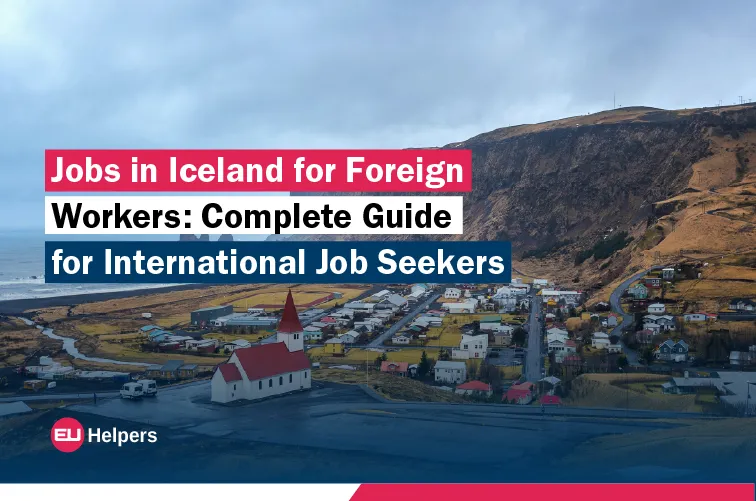

Jobs in Iceland for Foreign Workers: A Complete EU Helpers Guide for International Job Seekers
Iceland — a prosperous, safe, and strikingly beautiful island nation — has one of the highest standards of living in the world, powered by fisheries, tourism, energy, and construction. It sits outside the European Union but inside the EEA and Schengen, giving it European-style labour rules. For job seekers from Asia, Africa, Latin America, and beyond, jobs in Iceland for foreign workers offer a genuine, high-quality opportunity in a small economy with real labour shortages.
At EU Helpers, we explain Iceland through its track-based permit system. Because Iceland gives priority to Icelandic and EEA/EFTA workers, non-EEA nationals must fit one of a few specific tracks — most importantly expert knowledge or shortage of labour. Understanding which track fits you is the whole game. Thresholds and rules are set by the Icelandic authorities and revised periodically, so confirm the current position before acting.
How Iceland's System Works
Non-EEA/EFTA nationals need both a work permit and a residence permit, processed by two authorities working in parallel: the Directorate of Immigration (Útlendingastofnun) decides residence, and the Directorate of Labour (Vinnumálastofnun) decides the work permit. The process is employer-initiated, and the permit is tied to one employer and one occupation, especially in the first year.
| Feature | Detail |
|---|---|
| Who applies | The employer initiates; you file the residence application |
| Two authorities | Immigration (residence) + Labour (work permit) |
| Tied to | One specific employer and role, especially year one |
| EEA priority | Icelandic and EEA/EFTA workers come first |
| Decision time | Generally within about two months |
Critically, you cannot enter as a tourist and start work — both permits must be granted first.
The Main Tracks for Foreign Workers
| Track | Who it suits | Labour market test |
|---|---|---|
| Expert knowledge / specialist | University-educated professionals | Not required |
| Shortage of labour | Standard roles where no local/EEA worker is available | Required (EEA search) |
| Seasonal | Agriculture, tourism, fish processing (up to ~6 months) | Applies |
| Athletes, artists, specialised, exchange | Specific categories | Varies |
The key distinction: the expert/specialist permit requires no labour market test (its whole basis is that the skill is scarce), while the shortage-of-labour permit does require the employer to show no Icelandic or EEA candidate was available.
The Expert Knowledge Permit: The Smoothest Route
For qualified professionals, the expert knowledge permit is the best route. It requires university-level education or recognised specialist training, and because it is built on scarce expertise, it skips the labour market test.
It carries a further advantage: specialist permits can lead to an unrestricted work permit over time, and Iceland offers a notable tax incentive — only 75% of a foreign expert's income is taxed for the first three years, subject to conditions. For skilled candidates, this is a genuinely attractive package.
Where the Jobs Are
| Sector | Typical roles in demand |
|---|---|
| Tourism and hospitality | Hotel, restaurant, guide, resort staff |
| Fisheries and fish processing | Processing and production workers |
| Construction | Trades and site workers |
| Healthcare | Doctors, nurses, specialists |
| IT and specialist roles | Developers, engineers, experts |
| Energy and engineering | Technical and specialist staff |
Iceland's economy leans heavily on tourism and fisheries, both major sources of demand, while its shortage of skilled labour opens doors in construction, healthcare, and technology.
If you are searching for genuine openings and want structured, trustworthy help preparing your application, you can explore job seeker support from EU Helpers.
The Process and Your Documents
| Stage | What happens |
|---|---|
| 1. Job offer | Secure a concrete offer from an Icelandic employer |
| 2. Employer initiates | Files the work permit with the Directorate of Labour |
| 3. Labour market check | Required for shortage-of-labour (EEA search); skipped for experts |
| 4. Residence permit | You apply to the Directorate of Immigration |
| 5. Parallel decision | Both authorities decide, generally within two months |
| 6. Arrival | Register with Registers Iceland; obtain a national ID (kennitala) |
| Document | Key point |
|---|---|
| Passport | Sufficient validity |
| Employment contract | Must meet Icelandic collective-agreement pay and conditions |
| Qualifications | University education / recognised training for expert route |
| Criminal record | Clean or acceptable record |
| Health insurance | Required as part of the process |
A crucial point: your pay and conditions must meet Icelandic collective agreements — a strong protection, and a requirement employers must satisfy.
Rights, Language, and the Long Term
Iceland enforces its collective agreements for all workers, giving foreign employees strong pay and condition protections. Specialist permit holders benefit from the three-year tax incentive, and specialist permits can become the basis for an unrestricted work permit, a genuine path to stability.
On language, English is very widely spoken in Iceland, particularly in tourism, IT, and among younger Icelanders, making it accessible to non-Icelandic speakers in those sectors. Icelandic matters for long-term integration and some roles, but is rarely a barrier to entry in the main hiring industries.
Important Legal Notes
This EU Helpers guide is general information, not legal advice. Icelandic rules are set by the authorities and revised periodically, including permit tracks, thresholds, and procedures. What applies to you depends on your nationality, employer, occupation, and track. Confirm current requirements through official Icelandic sources such as the Directorate of Labour and Directorate of Immigration, or a qualified professional.
Final Guidance and Next Steps
Iceland is a small but rewarding destination, and your route depends entirely on your track. If you are university-educated or have recognised specialist training, target the expert knowledge permit — it skips the labour market test, can lead to an unrestricted permit, and comes with a valuable three-year tax break. If not, the shortage-of-labour permit covers standard roles where no Icelandic or EEA worker is available, and seasonal permits open tourism, fisheries, and agriculture for up to around six months.
Whatever your track, remember that your employer must initiate the process, both permits must be granted before you start, your pay must meet Icelandic collective agreements, and you cannot work on a tourist entry. If you would like trustworthy help finding legitimate opportunities and preparing a competitive application, you can explore job seeker support from EU Helpers. EU Helpers is here to help you take that step with clarity and confidence.
FAQs
Yes. Non-EEA and EFTA nationals need both a work permit and a residence permit, processed in parallel by two authorities: the Directorate of Immigration decides residence, and the Directorate of Labour decides the work permit. The process is employer-initiated, and the permit is tied to one specific employer and role, especially in the first year. You cannot enter as a tourist and begin working, as both permits must be granted first.
It is Iceland's route for university-educated professionals or those with recognised specialist training, and it is the smoothest option for skilled candidates. Because it is based on scarce expertise, it does not require a labour market test, unlike the shortage-of-labour permit. It also offers real advantages: it can become the basis for an unrestricted work permit over time, and foreign experts benefit from a tax incentive where only 75% of income is taxed for the first three years.
It is the route for standard roles where no suitable worker can be found on the Icelandic labour market or within the EEA and EFTA. Under this track, the employer must generally advertise the position and demonstrate, through a labour market search, that no local or EEA candidate was available before hiring you. It covers many practical roles, but because of this test it is more involved than the expert permit for qualified professionals.
Tourism and hospitality and fisheries, including fish processing, lead by a wide margin, reflecting the structure of Iceland's economy, followed by construction, healthcare, IT, and energy and engineering. Iceland's small population and genuine labour shortages create real demand across both practical and skilled roles. Tourism and fisheries offer the most seasonal and practical openings, while healthcare, technology, and engineering suit the expert knowledge route.
Not usually for the main hiring sectors. English is very widely spoken in Iceland, particularly in tourism, IT, and among younger Icelanders, making many roles accessible without Icelandic. Icelandic is valuable for long-term integration and for certain local or customer-facing roles, but it is rarely a barrier to entry in tourism, technology, or specialist work. Learning some Icelandic helps with daily life and broadens your longer-term options.
Iceland offers a notable tax benefit for qualifying foreign experts: only 75% of your income is taxed for the first three years of work in Iceland, provided certain conditions are met. This effectively reduces your income tax during that period, making the expert knowledge route more financially attractive. Applications for the incentive must be submitted within three months of starting work, through the designated Icelandic authority, so act promptly after arrival.
EU Helpers helps international job seekers understand Iceland's track-based system and identify which route fits them, whether the expert knowledge permit for qualified professionals or the shortage-of-labour permit for standard roles. We help you target genuine demand in tourism, fisheries, construction, and specialist sectors, verify that pay meets Icelandic collective agreements, and prepare documents. Final decisions rest with the Icelandic authorities, but EU Helpers helps you approach the process informed and organised.
Still have questions? Get in touch
Ready to work in Iceland?
EU Helpers connects international job seekers with Icelandic employers offering work and residence permit sponsorship. From tourism and fisheries to construction and specialist roles, we help you find and secure the right role.