
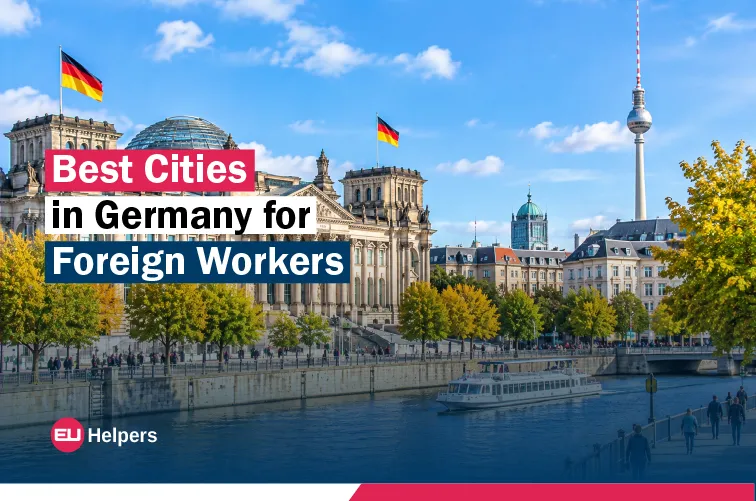

Best Cities in Germany for Foreign Workers
Germany (Bundesrepublik Deutschland — Federal Republic of Germany) is Europe's largest economy and has no single dominant city: its labour market is spread across strong regional centres, each with its own industrial identity. Berlin leads for tech and research; Munich and Stuttgart for automotive and engineering; Hamburg for port, logistics and aviation; Frankfurt for banking; Cologne and Düsseldorf for media, insurance and telecoms; Leipzig for eastern manufacturing and logistics; and Nuremberg for medical technology and sportswear. This EU Helpers guide compares the best German cities for foreign workers across sector mix, salary, cost of living and quality of life — international candidates can explore German opportunities through EU Helpers. Germany is a founding member of the European Union (as West Germany, a founding member of the European Economic Community from 1958), a founding signatory of the Schengen Agreement in 1985 (implemented 1995), a eurozone member since 1999 (euro cash since 2002), a NATO member since 1955, and a Council of Europe member since 1951.
Essential Context: How German Cities Compare
Germany's eight most relevant cities and regions for foreign workers break down roughly as follows.
| City | Population (approx.) | Lead sectors | Cost of living |
|---|---|---|---|
| Berlin | ~3,800,000 | Tech, start-ups, research, public sector, creative industries | High (tight rental market) |
| Munich (München) | ~1,500,000 | Automotive, engineering, insurance, big tech | Highest in Germany |
| Hamburg | ~1,900,000 | Port, logistics, aviation, media, consumer goods | High |
| Frankfurt am Main | ~775,000 | Banking, fintech, aviation, consulting | High |
| Stuttgart | ~630,000 | Automotive, mechanical engineering, automation | High |
| Cologne (Köln) & Düsseldorf | ~1,100,000 & ~630,000 | Media, insurance, telecoms, chemicals, retail | Moderate to high |
| Leipzig | ~620,000 | Automotive plants, logistics, energy, healthcare | Moderate (lowest of the major cities) |
| Nuremberg (Nürnberg) | ~530,000 | Medical technology, sportswear, software, public agencies | Moderate |
Germany's statutory minimum wage (Mindestlohn) is €13.90 per hour, roughly €2,400 gross per month for a full-time job, and average full-time gross earnings are approximately €4,700 per month. Munich, Frankfurt, Stuttgart and Hamburg typically pay 10–25% above that national average, while salaries in the eastern states — including Leipzig — typically sit below it. Salaries are quoted gross; income tax and the employee share of social contributions (roughly 20%) are deducted at source, so net pay is typically around 60–65% of gross for a single person.
Berlin — The Capital
Berlin is Germany's largest city, its political capital and the country's best-known destination for international professionals.
Lead sectors: Tech and start-ups (Zalando, Delivery Hero, N26, Trade Republic and hundreds of scale-ups), research (Charité, Fraunhofer and Max Planck institutes, Humboldt University), federal government, transport (Deutsche Bahn headquarters), creative industries and tourism.
Salary context: Berlin pays close to the national average overall, with tech roles above it. Senior software engineers commonly earn approximately €70,000–95,000+ gross annually; mid-level developers and product managers €55,000–70,000; graduate and junior roles start around €45,000–52,000.
Cost of living: High and rising, driven by one of Germany's tightest rental markets. Central one-bedroom rents typically run €1,000–1,500/month in districts such as Mitte, Prenzlauer Berg, Friedrichshain and Kreuzberg.
Who it fits: Software engineers, data scientists, product managers, researchers, creative professionals, and anyone who wants to work in English within Germany's largest international community.
Permit route: EU Blue Card (Blaue Karte EU) or skilled-worker residence permit, filed with Berlin's State Office for Immigration (Landesamt für Einwanderung — LEA) (Berlin's Ausländerbehörde), with Federal Employment Agency (Bundesagentur für Arbeit) approval where required.
Munich — Engineering and Big Tech
Munich (München), capital of Bavaria (Bayern), is Germany's richest major city and its highest-paying labour market.
Lead sectors: Automotive (BMW headquarters and research centre), engineering and electronics (Siemens, Infineon in nearby Neubiberg, Rohde & Schwarz), insurance and finance (Allianz, Munich Re), big tech engineering hubs (Google, Microsoft, Apple, Amazon), aerospace (Airbus Defence and Space), biotech and tourism.
Salary context: Munich typically pays 15–25% above the national average. Senior engineers and software developers commonly earn approximately €75,000–110,000+ gross annually; experienced mechanical and electrical engineers €60,000–80,000; graduate engineers start around €50,000–58,000.
Cost of living: Highest in Germany. Central one-bedroom rents typically €1,300–1,900/month; many workers live in S-Bahn suburbs to save money.
Who it fits: Automotive, mechanical and electrical engineers, embedded and software developers, semiconductor specialists, insurance professionals and researchers who value Alpine access and safety.
Hamburg — Germany's Gateway to the World
Hamburg is Germany's second-largest city and home to its largest seaport, one of Europe's busiest.
Lead sectors: Port and logistics (Port of Hamburg, HHLA, Hapag-Lloyd), aviation (Airbus Finkenwerder and Lufthansa Technik), media and publishing (Der Spiegel, Die Zeit), consumer goods (Beiersdorf, Otto Group), German offices of Google and Meta, offshore wind energy.
Salary context: Hamburg typically pays 10–20% above the national average. Aircraft engineers and technicians commonly earn approximately €50,000–75,000 gross annually; logistics managers €55,000–75,000; experienced software developers €65,000–90,000.
Cost of living: High but slightly below Munich and Frankfurt. Central one-bedroom rents typically €1,000–1,500/month; Altona, Eimsbüttel and Winterhude are popular with expats.
Who it fits: Logistics and supply-chain professionals, maritime specialists, aircraft engineers, media staff and renewable-energy engineers.
Frankfurt — Europe's Banking Capital
Frankfurt am Main is Germany's financial centre and one of its most international cities.
Lead sectors: Banking and supervision (European Central Bank, Bundesbank, Deutsche Bank, Commerzbank), stock exchange and fintech (Deutsche Börse), aviation (Frankfurt Airport, operated by Fraport, and Lufthansa's main hub), consulting and audit, data centres, chemicals and pharma in the Rhine-Main region.
Salary context: Frankfurt typically pays 15–25% above the national average and has some of the highest professional salaries in the country. Experienced finance and risk professionals commonly earn approximately €75,000–120,000+ gross annually plus bonuses; IT and cloud engineers €65,000–95,000; airport ground staff and logistics workers roughly €2,600–3,500 gross monthly.
Cost of living: High. Central one-bedroom rents typically €1,100–1,600/month; Sachsenhausen, Nordend and Bornheim are expat favourites, while Offenbach and towns along the S-Bahn are cheaper.
Who it fits: Bankers, risk and compliance specialists, cloud and data-centre engineers, consultants and aviation staff.
Stuttgart — The Automotive Heartland
Stuttgart, capital of Baden-Württemberg, sits at the centre of one of Europe's most productive industrial regions.
Lead sectors: Automotive (Mercedes-Benz and Porsche headquarters and plants), automotive suppliers (Bosch headquarters in nearby Gerlingen, Mahle), mechanical engineering and automation (Festo, Trumpf, Kärcher and many Mittelstand firms), vehicle software, university and Fraunhofer research.
Salary context: Stuttgart typically pays 15–25% above the national average, driven by strong metal and electrical industry collective agreements. Development engineers commonly earn approximately €65,000–90,000 gross annually; skilled production workers, mechatronics technicians and electricians roughly €3,500–4,800 gross monthly with shift premiums and annual bonuses on top.
Cost of living: High. Central one-bedroom rents typically €1,000–1,500/month; Esslingen, Ludwigsburg and Böblingen offer somewhat lower rents within commuting distance.
Who it fits: Automotive and mechanical engineers, embedded software and electric-vehicle specialists, mechatronics and automation technicians, skilled metal trades and families seeking a quieter lifestyle.
Cologne and Düsseldorf — The Rhineland Duo
Cologne (Köln) and Düsseldorf sit about 40 km apart on the Rhine in North Rhine-Westphalia (Nordrhein-Westfalen), Germany's most populous state, and function as one large labour market.
Lead sectors: In Cologne, media (WDR, RTL), insurance (AXA, Gothaer), automotive (Ford Germany) and retail (REWE Group). In Düsseldorf, telecoms (Vodafone Germany), consumer goods (Henkel), wholesale (Metro), defence (Rheinmetall), advertising and law firms, plus Germany's largest Japanese business community.
Salary context: Close to or slightly above the national average. Marketing, media and insurance professionals commonly earn approximately €50,000–75,000 gross annually; experienced IT specialists €60,000–85,000; skilled trades and logistics workers roughly €2,800–3,800 gross monthly.
Cost of living: Moderate to high and generally below Munich, Frankfurt and Hamburg. Central one-bedroom rents typically €900–1,350/month; the wider Ruhr area (Essen, Dortmund, Duisburg) is markedly cheaper and well connected by regional trains.
Who it fits: Media, marketing, insurance and telecoms professionals, chemical engineers, and anyone wanting big-city life at lower cost than southern Germany.
Leipzig — Eastern Germany's Boomtown
Leipzig in Saxony (Sachsen) is one of Germany's fastest-growing cities and the economic centre of the former East.
Lead sectors: Automotive (BMW and Porsche plants), air cargo and logistics (DHL's European hub at Leipzig/Halle Airport, Amazon), energy trading (European Energy Exchange), healthcare and a growing start-up scene.
Salary context: Below the national average, in line with the eastern states, although the gap is narrowing. Engineers and IT specialists commonly earn approximately €50,000–70,000 gross annually; production and logistics workers roughly €2,500–3,300 gross monthly, with night and weekend premiums common at the airport hub.
Cost of living: The lowest of Germany's major cities. Central one-bedroom rents typically €550–850/month.
Who it fits: Production and logistics workers, automotive technicians, IT professionals and creatives prioritising low living costs. Dresden, 100 km away, offers a similar profile with a strong semiconductor cluster (Infineon, Bosch, GlobalFoundries).
Nuremberg — Medtech, Sportswear and Software
Nuremberg (Nürnberg), Bavaria's second-largest city, forms a metropolitan region with Erlangen and Fürth.
Lead sectors: Medical technology (Siemens Healthineers in nearby Erlangen), sportswear (adidas and Puma headquarters in Herzogenaurach), automotive and industrial suppliers (Schaeffler, Bosch plants), software (DATEV), market research (GfK), and federal agencies (the Federal Employment Agency and the Federal Office for Migration and Refugees are headquartered here).
Salary context: Around or slightly above the national average. Engineers and software developers commonly earn approximately €55,000–80,000 gross annually; skilled industrial workers roughly €3,000–4,000 gross monthly.
Cost of living: Moderate — noticeably cheaper than Munich while still in high-paying Bavaria. Central one-bedroom rents typically €800–1,150/month.
Who it fits: Medtech engineers, sportswear professionals, software developers and anyone wanting Bavarian salaries without Munich rents.
Choosing the Right City for Your Profile
A quick match guide:
- Software, start-ups, data, UX → Berlin first, Munich and Hamburg close behind.
- Banking, finance, risk, compliance → Frankfurt (very few alternatives), Munich for insurance.
- Automotive and mechanical engineering → Stuttgart, Munich, then Leipzig, Ingolstadt and Wolfsburg.
- Port, logistics, maritime → Hamburg first, Bremen and the Leipzig air hub second.
- Aviation and aerospace → Hamburg, Munich, Frankfurt.
- Media, marketing, advertising → Cologne, Düsseldorf, Hamburg, Berlin.
- Medical technology and life sciences → Nuremberg–Erlangen, Berlin, Munich.
- Semiconductors and electronics → Munich, Dresden.
- Research and academia → Berlin, Munich, Heidelberg, Karlsruhe, Göttingen.
- Lowest cost of living with a job → Leipzig, Dresden, the Ruhr cities.
Other cities worth considering include Hanover (insurance, Volkswagen Commercial Vehicles, trade fairs), Bremen (aerospace and shipping), Karlsruhe (IT and research), Mannheim (chemicals and machinery) and Bonn (UN agencies and federal ministries).
Permit Route Across German Cities
The immigration framework is national, set by the Residence Act (Aufenthaltsgesetz) and expanded by the Skilled Immigration Act (Fachkräfteeinwanderungsgesetz), but applications are handled locally. After registering your address (Anmeldung) at the local residents' office, you apply to the Ausländerbehörde responsible for your city or district, which consults the Federal Employment Agency where required. The main routes are the EU Blue Card for graduates meeting an annually adjusted salary threshold (lower for shortage occupations and recent graduates), the skilled-worker residence permit for recognised vocational or academic qualifications, the Opportunity Card (Chancenkarte) for a points-based job search of up to one year, and intra-company transfer permits. Employers can shorten processing via the accelerated skilled-worker procedure (beschleunigtes Fachkräfteverfahren). Typical timelines from signed offer to arrival run 6–12 weeks, though busy Ausländerbehörden can add waiting time after arrival.
Quality of Life Beyond Work
Each city has a distinct lifestyle: Berlin for culture, nightlife and diversity; Munich for safety and weekends in the Alps; Hamburg for waterfront living; Frankfurt for a compact international city with a major airport; Stuttgart for vineyards and the Black Forest; Cologne and Düsseldorf for Rhineland friendliness and carnival; Leipzig for affordable space and an arts scene; Nuremberg for old-town charm and Franconian cuisine. The ICE high-speed network links most of these cities in 1–5 hours, and the nationwide Deutschlandticket covers local and regional transport for a flat monthly fee.
Final Guidance
The best city in Germany for a foreign worker depends almost entirely on your sector and lifestyle preferences, not on which city is objectively "best." Berlin leads for tech, start-ups and research but has a very tight rental market; Munich and Stuttgart offer the strongest engineering salaries at the highest living costs; Hamburg combines port, logistics and aviation; Frankfurt dominates finance; Cologne and Düsseldorf deliver media, insurance and telecoms at moderate costs; Leipzig and Nuremberg trade lower salaries for much lower rents. Across all eight cities the same national framework applies — EU Blue Card, skilled-worker permit and Opportunity Card under the Skilled Immigration Act — processed by the local Ausländerbehörde, typically 6–12 weeks from signed offer to arrival. As a founding EU member in Schengen and the eurozone, NATO member since 1955 and a country with strong demand for skilled workers, Germany offers real choice between very different city labour markets. International candidates can explore German opportunities through EU Helpers. EU Helpers supports foreign workers with Germany city-sector matching, offer-letter review, EU Blue Card and skilled-worker permit coordination, Berlin / Munich / Hamburg / Frankfurt / Stuttgart relocation planning, and clarity on the current official requirements from German immigration authorities.
FAQs
There is no single best city: Berlin suits tech and start-up workers seeking an English-friendly international scene, while Munich and Stuttgart suit engineers, Frankfurt suits finance professionals and Hamburg suits logistics and aviation specialists. EU Helpers matches your sector and lifestyle preferences to the right city.
Munich, Frankfurt and Stuttgart typically pay the highest salaries, around 15–25% above the national average gross of approximately €4,700 per month, with Hamburg typically 10–20% above. Frankfurt leads for finance, Munich for tech and engineering, and Stuttgart for automotive roles, though higher rents absorb much of the premium.
Among the major cities, Leipzig has the lowest cost of living, with central one-bedroom rents typically €550–850/month. Dresden, the Ruhr cities (Essen, Dortmund, Duisburg) and other eastern cities are similarly affordable, while Nuremberg and Cologne offer moderate costs compared with Munich, Frankfurt and Hamburg.
Many Munich workers save on rent by living in suburbs along the S-Bahn such as Freising, Dachau or Fürstenfeldbruck, while Frankfurt workers often choose Offenbach, Bad Homburg or Darmstadt. Commutes of 30–45 minutes are common, and EU Helpers can help identify commuting-friendly neighbourhoods.
Stuttgart and Munich are Germany's top engineering cities, home to Mercedes-Benz, Porsche, Bosch, BMW, Siemens and Infineon, with development engineers typically earning €65,000–110,000 gross annually depending on experience. Nuremberg–Erlangen leads in medical technology, Hamburg in aerospace and Dresden in semiconductors.
Berlin has Germany's largest start-up ecosystem, with companies such as Zalando, Delivery Hero, N26 and Trade Republic and many teams working in English. Munich pays more through big tech engineering hubs, and Hamburg, Cologne and Leipzig have growing tech scenes.
Yes, especially for automotive, logistics and IT workers who prioritise affordability. Salaries are below the national average, but rents are often half of Munich levels, and BMW, Porsche, DHL and Amazon are major employers. Fast ICE trains reach Berlin in about 75 minutes.
The same national rules apply everywhere: an EU Blue Card, a skilled-worker residence permit or an Opportunity Card under the Skilled Immigration Act. You apply through a German embassy and then the local Ausländerbehörde after registering your address, with the Federal Employment Agency approving employment where required.
Berlin has by far the largest English-speaking expat community, with international start-ups, co-working spaces and countless meetup groups. Frankfurt and Munich have large professional expat populations and international schools, Düsseldorf has Germany's main Japanese community, and Hamburg has a sizeable international business scene.
EU Helpers matches foreign workers to the right German city by sector and lifestyle, pre-vets roles, reviews offers for gross-versus-net clarity, coordinates EU Blue Card and skilled-worker permit steps with the Ausländerbehörde, and supports relocation including Anmeldung, housing searches and health insurance registration.
Still have questions? Get in touch
Ready to work in Germany?
EU Helpers guides non-EU workers through Germany’s work authorisation. From Federal Employment Agency coordination to Skilled Immigration Act, Opportunity Card and EU Blue Card routes, we make your Germany move smooth, with distinctive skilled-workforce positioning.