

Best Cities in Bosnia and Herzegovina for Foreign Workers
Bosnia and Herzegovina (Bosna i Hercegovina / Босна и Херцеговина — BiH) is compact, but its cities differ sharply in industry, salary and even administration, because the country is divided into two entities — the Federation of Bosnia and Herzegovina (Federacija Bosne i Hercegovine — FBiH) and Republika Srpska (RS) — plus the self-governing Brčko District. Sarajevo dominates for IT, banking, international organisations and tourism; Banja Luka is the administrative and business centre of Republika Srpska; Mostar leads Herzegovina's tourism and energy economy; Tuzla and Zenica carry chemicals, steel and metalworking; and Bihać, Bijeljina and Brčko offer wood, agriculture and river-port logistics at very low cost. This EU Helpers guide compares the best Bosnian cities for foreign workers across sector, entity, salary and cost of living — international candidates can explore Bosnian opportunities through EU Helpers. Bosnia and Herzegovina is NOT an EU member but has been an EU candidate country since December 2022, is NOT a Schengen member (Bosnian nationals have had visa-free Schengen travel since December 2010), is NOT in the eurozone (it uses the convertible mark, BAM / KM, pegged to the euro at approximately 1.95583 KM per euro), is NOT a NATO member, and has been a Council of Europe member since 2002.
Essential Context: How Bosnian Cities Compare
The eight most relevant cities break down roughly as follows. The entity matters because work permits, income tax rates and minimum wages are set at entity (and in the Federation, partly cantonal) level.
| City | Entity | Population (approx.) | Lead sectors | Cost of living |
|---|---|---|---|---|
| Sarajevo | Federation of BiH (Sarajevo Canton) | ~275,000 city (~410,000 canton) | IT, banking, international organisations, tourism | Highest in BiH |
| Banja Luka | Republika Srpska | ~185,000 | IT, telecoms, banking, public administration | Moderate–high |
| Mostar | Federation of BiH (Herzegovina-Neretva Canton) | ~105,000 | Tourism, energy, wine, services | Moderate (seasonal spike) |
| Tuzla | Federation of BiH (Tuzla Canton) | ~110,000 | Chemicals, salt, energy, healthcare | Low–moderate |
| Zenica | Federation of BiH (Zenica-Doboj Canton) | ~110,000 | Steel, metalworking, manufacturing | Low |
| Bihać | Federation of BiH (Una-Sana Canton) | ~55,000 | Wood processing, metalworking, nature tourism | Low |
| Bijeljina | Republika Srpska | ~105,000 | Agriculture, food processing, trade | Low |
| Brčko | Brčko District | ~85,000 | River port, food industry, logistics | Low |
Salaries in Bosnia and Herzegovina are usually quoted as net monthly amounts in convertible marks. The national average net salary is typically around 1,600–1,700 KM, while the net minimum wage is approximately 1,027 KM in the Federation and 1,000 KM in Republika Srpska.
Sarajevo — The Capital
Sarajevo is the capital of Bosnia and Herzegovina and of the Federation, and the default first choice for most skilled foreign workers.
Lead sectors: IT and software development (Symphony, Atlantbh, Ministry of Programming and a growing outsourcing scene), banking and insurance (UniCredit Bank, Raiffeisen Bank BiH, ASA Banka), telecoms (BH Telecom), international organisations (EU Delegation and EU Special Representative, OSCE Mission to BiH, Office of the High Representative, UN agencies, embassies), automotive components (Volkswagen Sarajevo) and city and ski tourism (Bjelašnica, Jahorina).
Salary context: Sarajevo Canton typically records the highest average salaries in the country. Senior software engineers commonly earn 3,500–6,000+ KM net monthly; mid-level developers and banking specialists 2,000–3,500 KM; junior professionals start around 1,300–1,800 KM.
Cost of living: Highest in BiH. Central one-bedroom rents typically 800–1,300 KM/month. Groceries roughly 400–600 KM/month.
Who it fits: IT professionals, finance and audit specialists, NGO and international-organisation staff, English teachers, hospitality professionals and anyone seeking the largest expat community.
Permit route: Work permit (radna dozvola) issued by the Employment Service of Sarajevo Canton (Služba za zapošljavanje Kantona Sarajevo) on the employer's application, followed by temporary residence (privremeni boravak) through the Service for Foreigners' Affairs (Služba za poslove sa strancima — SPS).
Banja Luka — Republika Srpska's Business Centre
Banja Luka is the second-largest city in the country and the administrative, financial and university centre of Republika Srpska.
Lead sectors: IT and software services (a dense cluster of outsourcing and product companies, including Lanaco), telecoms (m:tel — Telekom Srpske, headquartered in the city), banking (NLB Banka, UniCredit Bank Banja Luka, Nova banka), entity institutions, manufacturing and construction.
Salary context: Typically slightly below Sarajevo for comparable roles but above the national average in IT and finance. Experienced developers commonly earn 2,500–5,000 KM net; banking and telecoms professionals 1,800–3,000 KM; skilled trades 1,200–2,000 KM. Republika Srpska's income tax is 8%, versus 10% elsewhere.
Cost of living: Moderate. Central rents typically 550–900 KM/month; everyday costs noticeably lower than in Sarajevo.
Who it fits: IT engineers, telecoms specialists, finance professionals, construction and manufacturing specialists and candidates wanting a green, walkable mid-sized city.
Mostar — Herzegovina's Tourism and Energy Hub
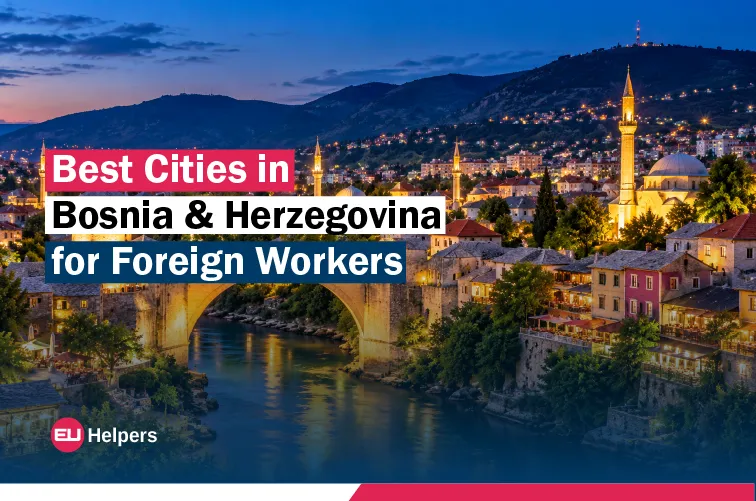
Mostar is the main city of Herzegovina, famous for its Old Bridge (Stari Most).
Lead sectors: Tourism and hospitality (Old Town, Kravice waterfalls, Blagaj and pilgrimage tourism in nearby Međugorje), electricity generation and utilities (Elektroprivreda HZ HB is headquartered in Mostar, with hydropower plants on the Neretva), wine and food production (Žilavka and Blatina vineyards), aluminium and metal processing heritage
Salary context: Close to the national average. Hospitality staff typically earn 1,100–1,600 KM net plus tips, with experienced chefs and hotel managers reaching 2,000–3,000 KM; engineers in energy and utilities 1,800–3,000 KM.
Cost of living: Moderate; short-term rents rise during the April–October tourist season. Long-term central rents typically 500–800 KM/month.
Who it fits: Hospitality and tourism professionals, chefs, tour guides with language skills, energy and electrical engineers, wine and agri-food specialists and candidates who prefer a Mediterranean climate.
Tuzla — Chemicals, Salt and Energy
Tuzla is north-eastern Bosnia's regional capital, built on salt deposits.
Lead sectors: Chemical industry (Şişecam Soda Lukavac in neighbouring Lukavac), salt production (Solana Tuzla), coal mining and thermal power (Tuzla Thermal Power Plant, part of Elektroprivreda BiH) and healthcare (University Clinical Centre Tuzla).
Salary context: Industrial and technical roles typically pay 1,300–2,500 KM net; engineers and specialist technicians 2,000–3,200 KM; general factory operators close to the national minimum to average range.
Cost of living: Low to moderate. Central rents typically 400–700 KM/month.
Who it fits: Chemical and process engineers, energy and mining technicians, healthcare professionals, furniture and wood-industry specialists and candidates who value low-cost flights from Tuzla International Airport.
Zenica — The Steel City
Zenica, about 70 km north of Sarajevo, is the country's historic steel centre.
Lead sectors: Steel and metallurgy (the Zenica steelworks, formerly ArcelorMittal Zenica and sold to Pavgord Group), metalworking and machine building and construction materials.
Salary context: Industrial wages typically above the local average for skilled manual roles. Welders, fitters and CNC operators commonly earn 1,300–2,200 KM net; metallurgical and mechanical engineers 1,800–3,000 KM; general operators close to the minimum wage. Heavy industry here has faced restructuring, so check contract terms carefully.
Cost of living: Low. Central rents typically 350–600 KM/month.
Who it fits: Welders and metalworkers, metallurgical and industrial engineers, maintenance technicians and heavy-industry profiles.
Bihać — Una Valley Industry and Nature
Bihać is the centre of the Una-Sana Canton in the far north-west, close to the Croatian border and the EU.
Lead sectors: Wood processing and furniture, metalworking and component manufacturing for EU buyers and nature tourism around Una National Park (rafting, the Štrbački buk waterfall).
Salary context: Below the national average outside skilled trades. Factory and wood-industry operators typically earn 1,000–1,500 KM net; skilled trades and technicians 1,300–2,000 KM; seasonal tourism and adventure-sport staff 1,100–1,600 KM, sometimes with accommodation.
Cost of living: Low. Central rents typically 350–600 KM/month.
Who it fits: Woodworkers and furniture specialists, CNC and metal trades, rafting and outdoor guides and candidates prioritising nature and low costs over salary.
Bijeljina — The Semberija Agricultural Centre
Bijeljina is Republika Srpska's second-largest city, set in the fertile Semberija plain near the borders with Serbia and Croatia.
Lead sectors: Agriculture (grain, fruit, vegetables), food processing and meat industry, cross-border trade with Serbia, construction, and transport and logistics.
Salary context: Below the national average. Agricultural and food-processing workers typically earn 1,000–1,500 KM net; drivers and logistics staff 1,200–2,000 KM; agronomists and food technologists 1,500–2,500 KM.
Cost of living: Low. Central rents typically 350–550 KM/month.
Who it fits: Agricultural and food-industry specialists, drivers and logistics staff, construction trades
Brčko — District on the Sava
Brčko District (Brčko distrikt) is a self-governing unit belonging to both entities, located on the Sava river at the border with Croatia.
Lead sectors: River port and logistics (Port of Brčko on the Sava), food industry (Bimal edible oils), agriculture, metal and wood processing, cross-border trade with Croatia and the EU, and district public administration.
Salary context: Close to the national average, with district public-sector salaries comparatively strong. Port, warehouse and production staff typically earn 1,100–1,800 KM net; engineers and technical specialists 1,800–2,800 KM.
Cost of living: Low. Central rents typically 350–550 KM/month.
Who it fits: Logistics and port specialists, food-industry technicians, agricultural specialists
Choosing the Right City for Your Profile
A quick match guide:
- IT, software, data, finance → Sarajevo first, Banja Luka second.
- International organisations and NGOs → Sarajevo (very few alternatives).
- Telecoms and Republika Srpska business → Banja Luka.
- Tourism and hospitality → Sarajevo and the Olympic mountains, Mostar, Trebinje, Bihać.
- Steel, metalworking and heavy industry → Zenica, with Tuzla second.
- Chemicals, salt and energy → Tuzla.
- Hydropower and electricity utilities → Mostar (Federation) and Trebinje (Republika Srpska, home of Elektroprivreda Republike Srpske).
- Wood processing and furniture → Bihać, Tuzla Canton.
- Agriculture and food processing → Bijeljina, Brčko, Herzegovina vineyards around Mostar.
- Lowest cost of living with a job → Zenica, Bihać, Bijeljina, Brčko.
Permit Route Across Bosnian Cities
In Bosnia and Herzegovina the work-permit step depends on where your employer is registered. In the Federation, work permits (radna dozvola) are issued by the cantonal employment services under the Federal Employment Institute (Federalni zavod za zapošljavanje); in Republika Srpska by the Employment Service of Republika Srpska (Zavod za zapošljavanje Republike Srpske); and in Brčko District by the district's own employment service. Permits are generally issued within an annual quota set by the Council of Ministers, though some categories, such as highly educated specialists and key personnel, typically fall outside it. Once the work permit is issued, temporary residence (privremeni boravak) is granted nationally by the Service for Foreigners' Affairs (Služba za poslove sa strancima), usually for up to one year and renewable. Typical timelines from offer to arrival run approximately 6–12 weeks.
Quality of Life Beyond Work
Each city has a distinct lifestyle: Sarajevo for café culture, Ottoman and Austro-Hungarian heritage and ski slopes 30 minutes away; Banja Luka for the Vrbas river and a relaxed pace; Mostar for Mediterranean sunshine and the Neretva; Tuzla for its city-centre salt lakes; Zenica for cheap living near the capital; Bihać for the Una river; Bijeljina for a market-town feel; and Brčko for the Sava next to the EU border. Most cities are two to four hours apart by road, so weekend travel is easy.
Final Guidance
The best city in Bosnia and Herzegovina for a foreign worker depends on your sector, preferred lifestyle and, unusually, on which entity your employer sits in. Sarajevo leads for IT, banking and international-organisation careers at the country's highest salaries and highest costs; Banja Luka offers a strong IT, telecoms and finance alternative in Republika Srpska with a lower 8% income tax; Mostar blends tourism and energy; Tuzla and Zenica anchor chemicals and steel; and Bihać, Bijeljina and Brčko trade narrower choice for very low costs. Work permits (radna dozvola) come from the cantonal, Republika Srpska or Brčko District employment service, while temporary residence (privremeni boravak) is handled nationally by the Service for Foreigners' Affairs. Combined with EU candidate status since December 2022, visa-free Schengen travel for Bosnian nationals since 2010, a euro-pegged convertible mark and low living costs, Bosnia and Herzegovina gives skilled foreign workers real city-level choice. International candidates can explore Bosnian opportunities through EU Helpers. EU Helpers supports foreign workers with city-sector matching, offer-letter review, permit coordination, relocation planning and clarity on the latest official requirements from Bosnian immigration authorities.
FAQs
For most skilled foreign workers, Sarajevo is the default best choice because it concentrates IT, banking, international organisations and the largest expat community at the country's highest salaries. However, "best" depends on your sector — telecoms and IT professionals also do well in Banja Luka, metalworkers in Zenica, chemical and energy specialists in Tuzla, and hospitality staff in Mostar. EU Helpers matches your profile to the right city.
Sarajevo Canton typically records the highest average net salaries, driven by IT, banking, telecoms and international organisations, with senior developers commonly earning 3,500–6,000+ KM net per month. Banja Luka follows for IT and finance roles, helped by Republika Srpska's lower 8% income tax.
Zenica, Bihać, Bijeljina and Brčko have the lowest cost of living among the larger cities, with central one-bedroom rents commonly around 350–600 KM per month and groceries and dining well below Sarajevo prices. Tuzla sits close behind.
Most Sarajevo office workers live in Centar, Stari Grad or Novo Sarajevo. Those wanting lower rents often choose Novi Grad or Ilidža. EU Helpers can help identify commuting-friendly neighbourhoods.
Zenica and Tuzla. Zenica is the historic steel and metalworking centre, with the steelworks formerly owned by ArcelorMittal and a network of metal and component suppliers, while Tuzla combines chemicals, salt, coal and thermal power. Skilled welders, fitters and process technicians typically earn 1,300–2,500 KM net, with engineers higher.
Sarajevo offers the most year-round hospitality work, adding winter demand at the Bjelašnica and Jahorina ski resorts. Mostar and nearby Međugorje, Blagaj and Kravice are the busiest summer destinations, while Trebinje and Bihać's Una valley serve growing wine, river and adventure tourism.
Yes, especially for IT, telecoms, banking and construction professionals. Banja Luka has a strong software-services scene, hosts m:tel and several banks, and offers rents and living costs noticeably below the capital. Republika Srpska's 8% personal income tax also slightly improves take-home pay, although the work permit comes from the Republika Srpska employment service rather than a Federation canton.
Every city requires a work permit (radna dozvola) followed by temporary residence (privremeni boravak), but the issuing employment office depends on location: cantonal services in the Federation, the Employment Service of Republika Srpska, or the Brčko District employment service. Temporary residence is granted nationally by the Service for Foreigners' Affairs. Permits usually run up to one year and are renewable.
Sarajevo has by far the strongest expat community, with international organisations, embassies, international schools, English-speaking co-working spaces and active expat groups. Banja Luka and Mostar have smaller but growing international populations linked to IT, tourism and remote work. Smaller cities have few expats, so some local-language skill helps.
EU Helpers matches foreign workers to the right city in Bosnia and Herzegovina based on sector, profile and lifestyle across Sarajevo, Banja Luka, Mostar, Tuzla, Zenica, Bihać, Bijeljina and Brčko, explains entity tax and wage differences, and reviews offer letters. We coordinate work permit (radna dozvola) applications through cantonal, Republika Srpska or Brčko District employment services, prepare temporary residence (privremeni boravak) files for the Service for Foreigners' Affairs, arrange translations and apostilles and support relocation and residence registration.
Still have questions? Get in touch
Ready to work in Bosnia and Herzegovina?
EU Helpers guides non-EU workers through Bosnia and Herzegovina’s work authorization. From Service for Foreigners’ Affairs coordination to Temporary Residence and Work Permit, we make your Bosnia and Herzegovina move seamless with distinctive Western Balkans EU candidate positioning.