
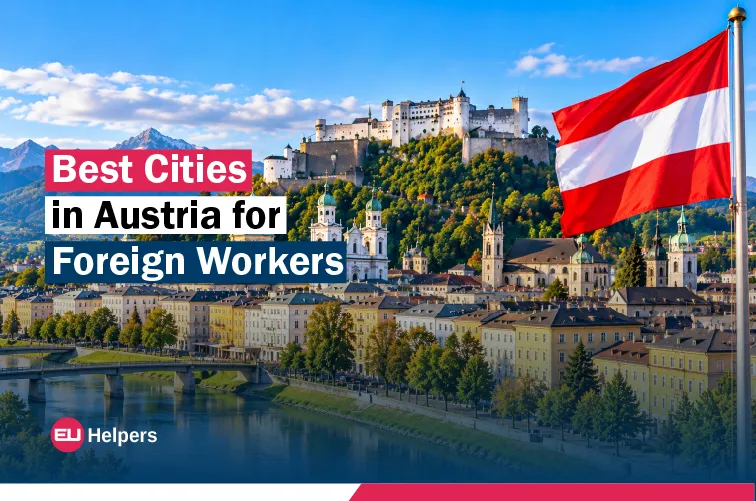

Best Cities in Austria for Foreign Workers
Austria (Republik Österreich — Republic of Austria) packs a surprising range of labour markets into a compact Alpine country, and the city you choose shapes your career and lifestyle more than many newcomers expect. Vienna dominates for IT, finance, life sciences and international organisations; Graz and Linz are the engineering and heavy-industry heartlands; Salzburg and Innsbruck lead Alpine tourism; the Vorarlberg Rhine Valley around Bregenz runs on export manufacturing; and Klagenfurt and Villach in Carinthia anchor a fast-growing semiconductor cluster. This EU Helpers guide compares the best Austrian cities for foreign workers across sector mix, salary, cost of living and quality of life — international candidates can explore Austrian opportunities through EU Helpers. Austria has been an EU member since 1995, a Schengen member since 1997, a eurozone member since 1999 (euro cash since 2002), and is NOT a NATO member — the country has been constitutionally neutral since 1955, and a Council of Europe member since 1956.
Essential Context: How Austrian Cities Compare
Austria's eight most relevant cities and regions for foreign workers break down roughly as follows.
| City | Population (approx.) | Lead sectors | Cost of living |
|---|---|---|---|
| Vienna (Wien) | ~2,000,000 | IT, finance, international organisations, life sciences | Highest overall, but regulated housing helps |
| Graz | ~300,000 | Automotive, engineering, microelectronics, universities | Moderate |
| Linz | ~210,000 | Steel, chemicals, machinery, software | Moderate |
| Salzburg | ~155,000 | Tourism, retail, food & beverage, culture | High |
| Innsbruck | ~130,000 | Alpine tourism, medtech, universities | High (tight housing market) |
| Bregenz & Rhine Valley | ~30,000 (Rhine Valley ~260,000) | Export manufacturing, ropeways, packaging | High |
| Klagenfurt | ~105,000 | Lakeside tourism, IT, public administration | Moderate to low |
| Villach | ~65,000 | Semiconductors, electronics, logistics | Moderate to low |
Austrian salaries are quoted gross and typically paid 14 times per year (12 monthly salaries plus holiday and Christmas bonuses), and there is no statutory national minimum wage — instead, collective agreements (Kollektivverträge) set sector minimums that cover the vast majority of employees. Pay floors are therefore similar nationwide, so housing costs often decide where salaries stretch furthest.
Vienna — The Capital
Vienna (Wien) is Austria's economic engine, home to roughly a quarter of the population and the default choice for most skilled foreign workers.
Lead sectors: IT and software (Bitpanda, Dynatrace's Vienna engineering hub, A1 Telekom Austria, a large start-up scene), banking and insurance (Erste Group, Raiffeisen Bank International, UniqaGroup, Vienna Insurance Group), energy (OMV headquarters), life sciences (Boehringer Ingelheim, Takeda, the Vienna BioCenter), international organisations (UN Office at Vienna, IAEA, UNIDO, OSCE, OPEC), hospitality.
Salary context: Vienna typically pays at the top of Austrian ranges for professional roles. Senior software engineers commonly earn approximately €60,000–85,000+ gross annually; mid-level professionals around €45,000–60,000; graduate and junior roles start around €38,000–45,000. Hospitality and care roles follow the collective agreements, typically from roughly €2,000–2,500 gross monthly.
Cost of living: Highest overall in Austria, yet still moderate for a European capital thanks to Vienna's large municipal and cooperative housing stock. Private one-bedroom rents typically run €800–1,200/month; districts such as Neubau, Josefstadt and Wieden sit at the top of that range.
Who it fits: IT and data professionals, finance and consulting staff, researchers and life-sciences specialists, staff of international organisations, nurses and care workers.
Permit route: Red-White-Red Card (Rot-Weiß-Rot – Karte) or EU Blue Card (Blaue Karte EU), filed with the Vienna immigration office (Magistratsabteilung 35 — MA 35), which consults the Public Employment Service (Arbeitsmarktservice — AMS) on labour-market criteria.
Graz — Austria's Engineering Capital
Graz, capital of Styria (Steiermark), is Austria's second-largest city and a major university and engineering centre.
Lead sectors: Automotive (Magna Steyr vehicle assembly, AVL List powertrain and testing), microelectronics (Infineon and NXP development sites, AT&S in nearby Leoben), green tech, research at TU Graz and the University of Graz, healthcare and a growing start-up scene.
Salary context: Engineering salaries track close to Vienna. Development engineers typically earn €50,000–75,000 gross annually; skilled production workers and technicians roughly €2,800–3,800 gross monthly under the metal-industry collective agreement.
Cost of living: Around 15–25% below Vienna for housing. One-bedroom rents typically €600–850/month, with a large student population keeping smaller flats in demand.
Who it fits: Automotive, mechanical and electrical engineers, embedded software developers, researchers and PhD candidates, skilled production technicians.
Linz — Industry Meets Digital
Linz, capital of Upper Austria (Oberösterreich), sits on the Danube and is the heart of Austria's most industrialised region.
Lead sectors: Steel and metals (voestalpine headquarters), chemicals and plastics (Borealis, Linz Chemical Park), machinery and plant engineering in the surrounding region (Engel, Rosenbauer, TGW Logistics, Fronius), software (Dynatrace's founding home), mechatronics and AI research at Johannes Kepler University, logistics on the Danube.
Salary context: Industrial wages are among the strongest in Austria. Process and metallurgical engineers typically earn €50,000–75,000 gross annually; welders, CNC machinists and electricians roughly €2,800–4,000 gross monthly with shift premiums on top.
Cost of living: Moderate. One-bedroom rents typically €600–850/month; nearby towns such as Wels (~63,000 people) and Leonding are cheaper still.
Who it fits: Metallurgists, process and chemical engineers, mechatronics and automation specialists, skilled metal trades, software developers.
Salzburg — Tourism, Trade and Culture
Salzburg sits on the German border at the edge of the Alps and combines city tourism with a strong commercial base.
Lead sectors: Tourism and hospitality (the Salzburg Festival, Old Town hotels, ski regions in Pongau and Pinzgau), retail and automotive trade (Porsche Holding, Spar Austria headquarters), food & beverage (Red Bull in nearby Fuschl am See, Stiegl brewery), culture and events.
Salary context: Hotel and restaurant roles follow the hospitality collective agreement — trained chefs typically earn roughly €2,300–3,200 gross monthly, often with staff accommodation and meals in resort areas. Commercial, marketing and IT roles at headquarters typically pay €45,000–65,000 gross annually.
Cost of living: High. One-bedroom rents typically €850–1,200/month, though resort employers commonly include housing.
Who it fits: Chefs, service staff and hotel managers, seasonal ski-resort workers, retail and trade professionals, event and culture specialists. The seasonal-worker quota (Saisonkontingent) is relevant for winter and summer tourism.
Innsbruck — Alpine Capital of Tyrol
Innsbruck, capital of Tyrol (Tirol), is surrounded by mountains and serves as a hub for Austria's biggest ski region.
Lead sectors: Alpine tourism (Nordkette, Stubai, Zillertal, Ötztal and Arlberg resorts within driving distance), medtech (MED-EL hearing implants), crystal and design (Swarovski in nearby Wattens), pharmaceuticals (Sandoz in Kundl), universities and the Medical University of Innsbruck, healthcare.
Salary context: Highly seasonal in tourism, with winter season (December–April) the peak. Ski instructors, chefs and hotel staff are paid under collective agreements with accommodation commonly included. Medtech engineers and researchers typically earn €48,000–70,000 gross annually.
Cost of living: High. Innsbruck has one of Austria's tightest rental markets; one-bedroom rents typically €850–1,200/month.
Who it fits: Hospitality and ski-resort staff, mountain-sports professionals, medtech engineers, doctors and nurses, researchers.
Bregenz and the Vorarlberg Rhine Valley
Bregenz, on Lake Constance (Bodensee), is the capital of Vorarlberg, Austria's westernmost state bordering Germany, Switzerland and Liechtenstein. Most jobs sit in the Rhine Valley corridor through Dornbirn, Hard and Feldkirch.
Lead sectors: Export manufacturing (Doppelmayr ropeways, Blum furniture fittings, Alpla packaging, Zumtobel lighting, Liebherr in Nenzing), tourism on the lake and in the Arlberg and Montafon, logistics.
Salary context: Vorarlberg industrial wages are among the highest in Austria. Engineers typically earn €52,000–78,000 gross annually; skilled trades roughly €3,000–4,200 gross monthly.
Cost of living: High, with rents typically €850–1,150/month. Note that an Austrian permit does not by itself authorise work in Switzerland or Liechtenstein.
Who it fits: Mechanical and electrical engineers, toolmakers, plastics technicians, industrial maintenance specialists.
Klagenfurt — Carinthia's Lakeside Capital
Klagenfurt am Wörthersee, capital of Carinthia (Kärnten), sits on the eastern shore of the Wörthersee near the Slovenian and Italian borders.
Lead sectors: Summer lake tourism (Wörthersee, Velden, Pörtschach), IT and research at the Lakeside Science & Technology Park and the University of Klagenfurt, energy (Kelag), public administration, healthcare.
Salary context: Slightly below the Austrian average outside technology. IT and engineering roles typically pay €45,000–65,000 gross annually; hospitality staff follow the collective agreement, often with summer-season accommodation.
Cost of living: Moderate to low. One-bedroom rents typically €550–800/month, among the most affordable of Austria's state capitals.
Who it fits: Software developers, researchers, hospitality staff for the May–September lake season, candidates prioritising lifestyle, sunshine and lower living costs.
Villach — Austria's Silicon Valley
Villach sits 40 km west of Klagenfurt at a crossroads of motorways and rail lines towards Italy and Slovenia.
Lead sectors: Semiconductors (Infineon Technologies Austria headquarters and its 300-millimetre power-chip fab), electronics and the wider "Silicon Alps" cluster, logistics, tourism around Lake Ossiach and Faaker See.
Salary context: Microelectronics pays well above regional averages. Process, test and design engineers typically earn €50,000–75,000 gross annually; cleanroom technicians and operators roughly €2,600–3,500 gross monthly with shift allowances.
Cost of living: Moderate to low. One-bedroom rents typically €550–750/month.
Who it fits: Semiconductor process engineers, chip designers, physicists, cleanroom technicians, electronics specialists.
Choosing the Right City for Your Profile
A quick match guide:
- IT, software, data, finance → Vienna first, Linz and Graz growing.
- International organisations & diplomacy → Vienna (very few alternatives).
- Automotive & mechanical engineering → Graz, Upper Austria around Linz and Steyr.
- Steel, chemicals, heavy industry → Linz.
- Semiconductors & microelectronics → Villach, Graz.
- Export manufacturing & machinery → Vorarlberg Rhine Valley, Upper Austria.
- Hotel & restaurant careers → Salzburg, Innsbruck, Vienna.
- Seasonal ski and lake tourism → Tyrol and Salzburg (winter), Carinthia (summer).
- Life sciences & medtech → Vienna, Innsbruck.
- Lowest cost of living with a job → Klagenfurt, Villach, Linz area.
Permit Route Across Austrian Cities
The work-permit framework is national, but processing is regional. Every city uses the same Red-White-Red Card (Rot-Weiß-Rot – Karte) categories — Very Highly Qualified Workers, Skilled Workers in Shortage Occupations (Fachkräfte in Mangelberufen), Other Key Workers (Sonstige Schlüsselkräfte), Graduates of Austrian universities and Start-up Founders — plus the EU Blue Card (Blaue Karte EU) and seasonal permits. Applications go to the competent residence authority (Niederlassungs- und Aufenthaltsbehörde) — MA 35 in Vienna, the district authority (Bezirkshauptmannschaft) or city magistrate elsewhere — while the regional AMS office checks salary and labour-market criteria. The one city-level difference is the regional shortage list (regionale Mangelberufe), which adds occupations in specific federal states. After arrival, everyone registers their address (Meldezettel) within three days and receives a social insurance number (Sozialversicherungsnummer) and e-card. Typical timeline from signed offer to arrival is 8–12 weeks.
Quality of Life Beyond Work
Each city has a distinct lifestyle: Vienna for coffee-house culture, superb public transport and the largest expat community; Graz for an affordable, sunny student city with Mediterranean influences; Linz for compact living, Danube cycling and a digital-arts scene; Salzburg for baroque beauty, music and mountains on the doorstep; Innsbruck for skiing before work and true Alpine living; Bregenz for lakeside summers and the Bregenz Festival; Klagenfurt for warm lake summers and an easygoing pace; Villach for a tech community with Italy and Slovenia an hour away. The ÖBB rail network and national KlimaTicket make travel between all eight cities easy.
Final Guidance
The best city in Austria for a foreign worker depends far more on your sector and lifestyle than on any single ranking. Vienna leads for IT, finance, life sciences and international-organisation careers; Graz and Linz are the engineering and industrial heartlands; Villach and Graz anchor microelectronics; Salzburg and Innsbruck dominate hotel careers and seasonal Alpine tourism; the Vorarlberg Rhine Valley pays some of the country's strongest industrial wages; and Klagenfurt offers lake living at lower cost. Across all eight cities the national Red-White-Red Card and EU Blue Card frameworks apply through the regional residence authorities, MA 35 in Vienna and the AMS, with typical timelines of 8–12 weeks from signed offer to arrival. Combined with Austria's EU membership since 1995, Schengen membership since 1997, the euro, neutrality and 14 salary payments a year, Austria offers skilled foreign workers real city-level choice in the heart of Europe. International candidates can explore Austrian opportunities through EU Helpers. EU Helpers supports foreign workers with Austria city-sector matching, offer-letter review, Red-White-Red Card and EU Blue Card coordination, Vienna / Graz / Linz / Salzburg / Innsbruck relocation planning, and clarity on the latest official requirements from Austrian immigration authorities.
FAQs
For most skilled foreign workers, Vienna is the default best choice because it concentrates IT, finance, life sciences, international organisations and the largest expat community at Austria's top professional salaries. However, "best" depends on your sector — engineers often do better in Graz or Linz, semiconductor specialists in Villach, and hospitality staff in Salzburg or Innsbruck. EU Helpers matches your profile to the right city.
Vienna pays the highest salaries overall for professional, finance and tech roles, and its international organisations offer tax-advantaged packages of their own. Industrial wages in the Vorarlberg Rhine Valley and Upper Austria around Linz can match or exceed Vienna for engineers and skilled trades. Because collective agreements (Kollektivverträge) set sector minimums nationwide, pay floors for hospitality and trades are broadly similar across cities.
Klagenfurt and Villach in Carinthia have the lowest housing costs among Austria's main job centres, with one-bedroom rents commonly €550–800/month. Graz and Linz follow at roughly €600–850/month, while Salzburg, Innsbruck and Vorarlberg are the most expensive.
Most Vienna workers live within the city itself — districts such as Neubau, Josefstadt, Leopoldstadt and Favoriten are popular, depending on budget. Some choose St. Pölten or towns in Lower Austria and commute by train, with St. Pölten roughly 25–30 minutes from Vienna by fast rail. EU Helpers can help identify commuting-friendly neighbourhoods and municipal-housing options.
Graz and Linz. Graz leads in automotive and powertrain engineering around Magna Steyr and AVL List, plus microelectronics and research at TU Graz. Linz and Upper Austria combine steel, chemicals, plant engineering and software, and Vorarlberg adds high-paying export manufacturing — typically €50,000–78,000 gross annually for experienced engineers.
Tyrol around Innsbruck and the Salzburg region lead for winter tourism, with resorts in the Zillertal, Ötztal, Arlberg, Pongau and Pinzgau hiring heavily for December–April. Carinthia's lakes around Klagenfurt and Villach peak in summer, while Vienna and Salzburg offer year-round city-hotel careers. Trained chefs and hotel staff often receive accommodation and meals alongside collective-agreement pay.
Yes, especially for automotive, mechanical and electrical engineers, embedded software developers and researchers. Graz offers lower rents, a large student community and a relaxed lifestyle, while engineering salaries stay close to Vienna levels.
The same national framework applies everywhere: a Red-White-Red Card (Rot-Weiß-Rot – Karte) in the relevant category or an EU Blue Card (Blaue Karte EU), filed with the regional residence authority — MA 35 in Vienna, the district authority or city magistrate elsewhere. The AMS checks salary and labour-market criteria, and regional shortage lists can add occupations in specific federal states. After arrival you register your address and receive a social insurance number.
Vienna has by far the strongest expat community — thousands of international-organisation staff, multinational employers, international schools, English-speaking networks and co-working spaces. Graz and Linz have growing communities around universities and tech employers, and Innsbruck and Salzburg attract seasonal workers each winter. Klagenfurt, Villach and Vorarlberg have smaller but active international populations tied to tech and industry.
EU Helpers matches foreign workers to the right Austrian city based on sector, profile and lifestyle across Vienna, Graz, Linz, Salzburg, Innsbruck, Bregenz, Klagenfurt and Villach, pre-vets roles with Austrian employers, reviews offer letters for gross-versus-net clarity and the 14-salary structure, coordinates Red-White-Red Card or EU Blue Card applications with the residence authority, MA 35 and the AMS, prepares documentation with German translations and apostille arrangements, assists with Meldezettel registration, social insurance and e-card setup, housing and arrival, and provides clarity on the latest official requirements from Austrian immigration authorities.
Still have questions? Get in touch
Ready to work in Austria?
EU Helpers guides non-EU workers through Austria’s work authorization. From AMS and Ausländerbehörde coordination to Red-White-Red Card, EU Blue Card and Skilled Worker routes, we make your Austria move seamless with distinctive Central European EU member positioning.