
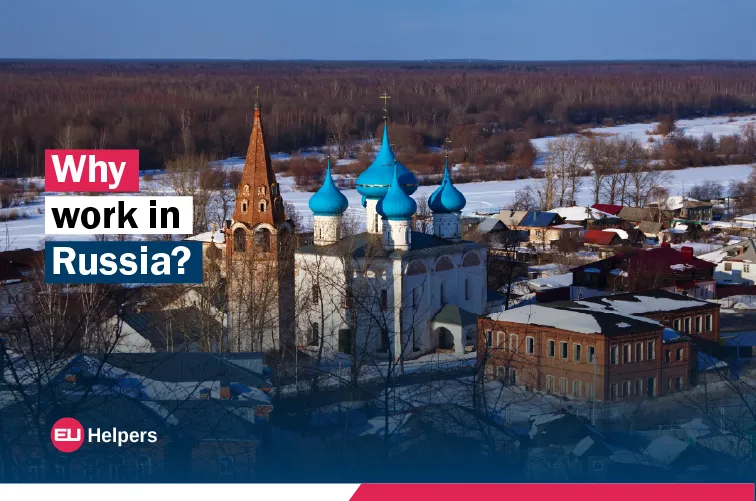

Why Work in Russia? A Complete EU Helpers Guide for International Professionals
Russia, the world's largest country by land area spanning Eastern Europe and Northern Asia across eleven time zones, has historically been a significant economic and cultural power with rich heritage spanning the Kievan Rus' foundations, the Tsarist Russian Empire (one of history's largest empires), the Soviet Union (one of the 20th century's superpowers), and modern post-1991 Russia. The country has historically offered a complex mix of opportunities and challenges for international professionals, with major economic centers including Moscow (the historic capital with iconic Red Square, the Kremlin, Saint Basil's Cathedral, the Bolshoi Theatre, and the city as Russia's dominant economic center), Saint Petersburg (the former imperial capital founded by Peter the Great in 1703, with stunning Imperial-era architecture, the world-renowned Hermitage Museum housed in the Winter Palace, the Peter and Paul Fortress, and the famous "Venice of the North" canal system), Novosibirsk (the largest city in Siberia and home to Akademgorodok — the famous Soviet-era scientific research city), Yekaterinburg (a major industrial city in the Ural Mountains, the dividing line between European and Asian Russia), Kazan (the historic Tatar capital with significant Volga Tatar heritage), Nizhny Novgorod (a major industrial and cultural city), Sochi (the Black Sea resort and 2014 Winter Olympics host), and Vladivostok (in the Russian Far East with Pacific Ocean access). Russia has rich cultural heritage including world-renowned literature (Tolstoy, Dostoevsky, Pushkin, Chekhov, Gogol, Turgenev, Pasternak, Solzhenitsyn, and many others), classical music (Tchaikovsky, Rachmaninoff, Mussorgsky, Rimsky-Korsakov, Stravinsky, Prokofiev, Shostakovich, and many others), ballet (the world-famous Bolshoi Ballet in Moscow and Mariinsky Ballet in Saint Petersburg), visual arts, film, scientific tradition (including 11 Nobel Prizes in scientific fields by Soviet and Russian scientists), space exploration heritage (Yuri Gagarin's first human spaceflight in 1961, Sputnik in 1957, the Mir space station, and continued participation in the International Space Station), Olympic sports excellence, distinctive cuisine and traditions, and the Russian Orthodox Christianity heritage. However, the question "Why work in Russia?" must today be answered within fundamentally changed current context that profoundly affects practical realities for international professionals.
Critical Current Context That Fundamentally Affects This Question
Before exploring any historical reasons to consider Russia, EU Helpers must provide essential context that fundamentally affects the practical answer to this question. Following Russia's full-scale invasion of Ukraine in February 2022, the international situation has fundamentally changed in ways that profoundly affect anyone considering Russia as a work or residence destination:
Unprecedented International Sanctions
Russia has been subject to unprecedented Western sanctions imposed by the European Union, the United States, the United Kingdom, Canada, Australia, Japan, Switzerland, Norway, and many other countries. These sanctions affect banking (with major Russian banks disconnected from SWIFT), trade, technology transfers, energy exports, travel, business operations, and many other dimensions. Sanctions continue to expand and intensify with successive packages.
Significant Western Company Departures
Many Western companies have departed Russia or significantly reduced operations since 2022. These include McDonald's, IKEA, H&M, Apple, Microsoft (reduced operations), Google (reduced operations), most major car manufacturers (Renault sold its Russian operations, Ford, Volkswagen, Mercedes-Benz, BMW, Toyota, and others departed), major consulting firms (McKinsey, BCG, Bain, Deloitte, PwC, EY, KPMG all departed), major financial institutions (many Western banks departed or sold operations), many tech companies (numerous SaaS companies suspended services), and many other Western multinationals. The departure of these companies has dramatically reduced opportunities at Western multinationals in Russia.
Significant Brain Drain From Russia
Significant brain drain has occurred from Russia, with hundreds of thousands of Russian professionals (estimates range from 500,000 to over 1 million Russians, particularly tech workers but also professionals across many sectors) having left Russia since 2022. Major destinations have included Georgia, Armenia, Kazakhstan, Turkey, the UAE, Serbia, Israel, Cyprus, Montenegro, and various EU countries.
Banking and Financial Restrictions
Major Russian banks have been disconnected from SWIFT and Western payment systems. Western credit cards (Visa, Mastercard, American Express) generally don't work in Russia for international transactions. Sending money to or from Russia internationally has become extremely difficult.
Travel and Mobility Restrictions
Direct flights between Russia and many Western countries (EU member states, the US, UK, Canada, and others) have been suspended or significantly reduced. EU airspace has been closed to Russian airlines and vice versa. Visa issuance for Russians has been significantly restricted by many Western countries, and Russia has imposed various restrictions.
Military Mobilization and Security Concerns
Russia has conducted partial mobilization (announced September 2022) and continues to have conscription provisions. While foreign nationals are generally exempt from Russian military service, this creates broader context. Security considerations for foreign nationals in Russia have intensified.
Political and Legal Environment Changes
Russia's political and legal environment has changed significantly since 2022 with new restrictive laws affecting various aspects of public life, freedom of expression, civil society, foreign agents designations, and international engagement.
Council of Europe Expulsion
Russia was expelled from the Council of Europe in 2022 following the invasion of Ukraine, ending Russian membership in the European Convention on Human Rights system.
For most international professionals from Western countries (particularly EU member states, the US, UK, Canada, Australia, Japan, and similar), Russia is currently NOT a recommended work destination given these dramatically changed circumstances. Anyone seriously considering Russia should consult current legal, financial, and security guidance from qualified professionals understanding the current situation thoroughly.
This complete EU Helpers guide provides structural information about historical reasons some considered Russia, while emphasizing that the broader context fundamentally affects practical realities. For most EU Helpers clients exploring European or international destinations, EU member states and other established democratic destinations (extensively covered in our other comprehensive guides) represent far more accessible and recommended alternatives.
Historical Reasons Some Considered Russia (With Important Current Context)
The following represents historical reasons some international professionals considered Russia, with essential current context affecting each reason.
Historical Significance as a Major Economy
Russia has historically been one of the world's significant economies, with major sectors in energy, mining, manufacturing, agriculture, IT, and others. However, current sanctions, departure of Western companies, and broader economic isolation have dramatically affected the Russian economy's integration with the global economy.
Rich Cultural Heritage
Russia has extraordinary cultural heritage including world-renowned literature (Tolstoy, Dostoevsky, Pushkin), classical music (Tchaikovsky, Rachmaninoff, Stravinsky), ballet (Bolshoi, Mariinsky), visual arts, scientific tradition, and distinctive culture. This heritage remains historically significant, though current circumstances affect practical engagement.
Major Cities — Moscow and Saint Petersburg
Moscow has historically been one of Europe's major capitals with significant business activity, world-class cultural institutions (Bolshoi Theatre, Tretyakov Gallery, Moscow Conservatory), iconic landmarks (Red Square, Kremlin, Saint Basil's Cathedral), and dynamic urban environment. Saint Petersburg, founded by Peter the Great in 1703, is one of the world's most beautiful cities with stunning Imperial-era architecture, the Hermitage Museum (one of the world's greatest art museums), and distinctive canal system. These cities retain their historical and cultural significance, but practical realities for foreign residents have changed.
Historical IT Sector
Russia has historically had a strong IT sector with companies including Yandex (often called "Russia's Google" with search engine, taxi service, food delivery, and other services), VK (formerly Mail.ru Group with social networks and digital services), Kaspersky Lab (the global cybersecurity company founded in 1997), and others. However, significant brain drain since 2022 has dramatically affected the Russian IT sector.
Energy Sector Heritage
Russia has historically been one of the world's largest oil and natural gas producers and exporters, with major companies including Gazprom, Rosneft, Lukoil, Novatek, and others. However, Western sanctions on Russian energy exports (EU has banned most Russian oil and gas imports, oil price caps imposed, equipment sanctions) and departure of Western energy companies have significantly affected this sector.
Cost of Living Considerations
Russian cost of living, particularly outside Moscow and Saint Petersburg, has historically been relatively accessible by Western European standards. However, current ruble volatility and banking realities significantly affect practical financial planning.
Strategic Geographic Position
Russia's enormous geographic extent across Eastern Europe and Northern Asia has historically provided strategic positioning. However, current geopolitical isolation affects practical implications.
Educational Heritage
Russia has historical educational and scientific tradition with notable universities including Moscow State University (MGU — founded in 1755), Saint Petersburg State University, Bauman Moscow State Technical University, the Higher School of Economics (HSE), MIPT (Moscow Institute of Physics and Technology), and others.
Russian Language as a Major World Language
Russian is spoken by approximately 250 million people worldwide as a first or second language, with significant presence across former Soviet states and various other countries.
Current Practical Considerations That Override Historical Reasons
Beyond historical considerations, current practical realities significantly affect any consideration of Russia.
Sanctions Compliance for Western Nationals
For nationals of sanctioning countries (EU, US, UK, Canada, Australia, Japan, and others), working in Russia may have implications for sanctions compliance depending on the specific role, sector, and circumstances. Some sectors and roles may be effectively prohibited or significantly restricted.
Banking and Financial Operational Difficulties
Practical banking and financial operations for foreign residents in Russia have become extremely complex due to Russian banks being disconnected from SWIFT, Western payment system restrictions, and broader financial isolation.
Travel and Mobility Practical Issues
Practical travel to and from Russia has become significantly more complex due to flight restrictions, with most international travel requiring transit through Turkey, UAE, or specific other hubs.
Security and Safety Considerations
Security considerations for foreign nationals in Russia have intensified given the broader environment and political dynamics.
Long-Term Career Mobility Implications
For Western professionals, working in Russia during the current period may have implications for future career opportunities with Western employers, depending on sector and circumstances.
Limited Western Community
Significant reduction in Western expatriate communities in Russia means reduced support networks, social opportunities, and integration resources that previously existed.
Russian Immigration Framework Structural Information
Russia structurally offers immigration pathways including the HQS (Highly Qualified Specialist) visa, standard work permits, the patent system (for visa-free post-Soviet nationals), EAEU mobility (for Belarus, Kazakhstan, Kyrgyzstan, Armenia nationals), the RVP (temporary residence permit) and Vid na zhitelstvo (permanent residence permit), investor routes, family reunification, and other categories. Structural pathways exist, though current circumstances affect practical implementation.
Healthcare, Education, and Social Benefits
Russia has historical healthcare and educational systems, though practical access for foreign nationals depends on registration and specific circumstances. Quality varies significantly between major cities (where private healthcare options exist) and other regions.
Practical Tips for International Professionals Considering Russia in Current Context
EU Helpers strongly recommends comprehensive current professional guidance.
Realistic Assessment Strategies
Thoroughly research current sanctions implications for your specific nationality and circumstances. Research current banking and financial realities. Research current travel and mobility realities. Research the current security and legal environment. Carefully evaluate whether alternative destinations (particularly EU member states extensively covered in EU Helpers other guides) better serve your goals. For most Western foreign professionals exploring international career destinations, alternative destinations are strongly recommended over Russia in current circumstances. Always rely on the latest qualified professional advice given rapidly evolving circumstances.
Final Guidance
The honest answer to "Why work in Russia?" must today acknowledge that the broader context since February 2022 fundamentally affects practical realities for most international professionals. While Russia historically had significant historical reasons some considered the country — including significant economy, rich cultural heritage (world-renowned literature, classical music, ballet, scientific tradition, space exploration heritage), major cities (Moscow and Saint Petersburg with their iconic landmarks and cultural institutions), historical IT sector (Yandex, VK, Kaspersky Lab), energy sector significance, accessible cost of living, and Russian language as a major world language — the current circumstances since Russia's invasion of Ukraine in February 2022 have created circumstances making Russia a fundamentally different proposition than before. Unprecedented Western sanctions, significant departure of Western companies (with most major Western multinationals having departed or substantially reduced operations), dramatic brain drain (hundreds of thousands of Russian professionals having left Russia), banking and financial restrictions (Russian banks disconnected from SWIFT, Western credit cards generally not working), travel limitations (suspended direct flights to most Western countries), security concerns, and political environment changes have created a fundamentally different practical reality. For most international professionals from Western countries exploring European or international career destinations, EU Helpers strongly and clearly recommends evaluating alternative destinations — particularly EU member states extensively covered in our other comprehensive guides — rather than Russia in current circumstances. Where Russia remains potentially relevant — typically for those with strong family ties to Russia, Russian/Soviet heritage with specific qualifying circumstances, nationals of countries with continued normal relations with Russia, or specific specialized situations — current comprehensive professional legal, financial, and security guidance specifically addressing the post-2022 situation is absolutely essential. EU Helpers can provide structural information about Russia, but emphasizes that for the vast majority of clients exploring European or international career destinations, alternative destinations provide accessible, stable, and welcoming alternatives with predictable legal frameworks, functional banking and travel, full EU integration benefits, and democratic institutions. If you are exploring European work or residence destinations, EU Helpers' comprehensive guides on EU member states (Germany, France, Netherlands, Czech Republic, Poland, Portugal, Spain, Italy, Estonia, Denmark, Sweden, Ireland, Finland, Austria, Belgium, and many others) provide detailed, accessible, and recommended alternatives.
FAQs
For most international professionals from Western countries, Russia is currently NOT recommended as a work destination given dramatically changed circumstances since February 2022. EU Helpers strongly recommends consulting current comprehensive professional guidance and evaluating alternative destinations covered in our other comprehensive guides.
Since Russia's invasion of Ukraine in February 2022, unprecedented Western sanctions, significant departure of Western companies, dramatic brain drain (hundreds of thousands of Russian professionals leaving), banking restrictions (Russian banks disconnected from SWIFT), travel limitations, security concerns, and political environment changes have fundamentally affected practical realities for foreign professionals.
Many Western companies have departed Russia or significantly reduced operations since 2022, including McDonald's, IKEA, H&M, Apple, most major car manufacturers (Renault, Ford, Volkswagen, Mercedes-Benz, BMW, Toyota), major consulting firms (McKinsey, BCG, Bain, Deloitte, PwC, EY, KPMG), many tech companies, major financial institutions, and many other multinationals.
Significant brain drain has occurred from Russia since 2022, with estimates of 500,000 to over 1 million Russian professionals (particularly tech workers but across many sectors) having left. Major destinations include Georgia, Armenia, Kazakhstan, Turkey, UAE, Serbia, Israel, Cyprus, and various EU countries.
Russia has extraordinary cultural heritage including world-renowned literature (Tolstoy, Dostoevsky, Pushkin, Chekhov, Gogol, Solzhenitsyn), classical music (Tchaikovsky, Rachmaninoff, Stravinsky, Prokofiev, Shostakovich), ballet (Bolshoi, Mariinsky), visual arts, scientific tradition, space exploration heritage (Yuri Gagarin, Sputnik), and distinctive culture.
Moscow is Russia's historic capital with iconic Red Square, the Kremlin, Saint Basil's Cathedral, the Bolshoi Theatre, and many cultural institutions. Saint Petersburg, founded by Peter the Great in 1703, is one of the world's most beautiful cities with stunning Imperial-era architecture, the Hermitage Museum (one of the world's greatest art museums), and the "Venice of the North" canal system.
No. Russia is not a member of the European Union, the European Economic Area, the Schengen Area, or NATO. Russia was a member of the Council of Europe but was expelled in 2022 following the invasion of Ukraine.
Russia uses the Russian ruble (RUB) as its currency. Since 2022, the ruble has experienced significant volatility, and many Western payment systems no longer operate normally with Russia. This creates practical challenges for foreign residents.
Western sanctions affect banking access (Russian banks disconnected from SWIFT), salary payments, ability to send money internationally, business operations, travel, and many other dimensions. Effects depend on specific nationality, profession, and sector. Some sectors and roles may face effective prohibitions or significant restrictions.
Banking for foreign nationals in Russia has become significantly more complex since 2022. Major Russian banks have been disconnected from SWIFT and Western payment systems. Western credit cards generally don't work in Russia for international purposes. Practical banking realities should be researched with current professional guidance.
Direct flights between Russia and many Western countries (EU member states, the US, UK, Canada, and others) have been suspended or significantly reduced since 2022. Most international travel from Russia requires transit through Turkey, UAE, or specific other hubs.
Russia has historically had a strong IT sector with companies like Yandex, VK, and Kaspersky Lab. However, significant brain drain since 2022 has dramatically affected the sector — hundreds of thousands of Russian IT professionals have left Russia. While workforce gaps exist, these reflect departure of Russian professionals rather than attractive opportunities for most Western professionals.
Russia has historically been a major oil and gas producer with companies like Gazprom, Rosneft, Lukoil, and Novatek. However, Western sanctions on Russian energy exports (EU has banned most Russian oil and gas imports, oil price caps, equipment sanctions) and departure of Western energy companies have significantly affected this sector.
The HQS (Highly Qualified Specialist) visa is Russia's framework for highly qualified specialists with high-salary employment from Russian employers. It provides advantages including streamlined processing and quota exemption, though practical implementation is affected by current circumstances.
Russia's political and legal environment since 2022 includes new restrictive laws affecting various aspects of public life, freedom of expression, civil society, foreign agents designations, and international engagement. Security considerations for foreign nationals have intensified.
Russia was expelled from the Council of Europe in March 2022 following the invasion of Ukraine, ending Russian membership in the European Convention on Human Rights system. This was a significant institutional break that reflected broader changes in Russia's international position.
Russian (an East Slavic language using Cyrillic script) is the official language. Russian is spoken by approximately 250 million people worldwide. English use has been growing among younger generations and in major cities, though less universal than in some European countries.
For international professionals exploring European or international career destinations, EU Helpers strongly recommends evaluating EU member states extensively covered in our other comprehensive guides, including Germany, France, Netherlands, Czech Republic, Poland, Portugal, Spain, Italy, Estonia, Denmark, Sweden, Ireland, Finland, Austria, Belgium, and many others.
EU member states offer stable democratic institutions, full EU integration benefits, predictable legal frameworks, accessible banking and travel, functional Schengen mobility, sophisticated immigration frameworks supporting foreign professionals, welcoming international communities, and absence of the sanctions, banking restrictions, travel limitations, and political environment challenges currently affecting Russia.
EU Helpers can provide structural information about Russia, but strongly recommends evaluating alternative European destinations covered in our other comprehensive guides — these provide stable, accessible, and welcoming alternatives with full EU integration benefits. For Russia specifically, current comprehensive professional legal, financial, and security guidance is absolutely essential.