
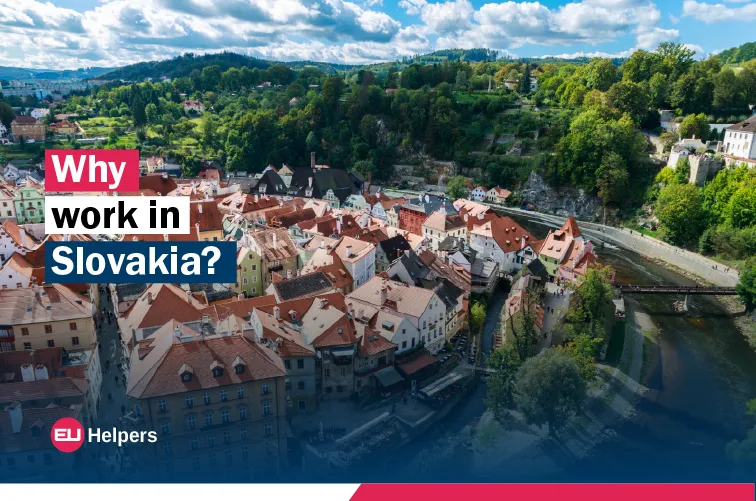
Why Work in Slovakia? A Complete EU Helpers Guide for International Professionals
Slovakia, the dynamic Central European nation bordering the Czech Republic to the west, Poland to the north, Ukraine to the east, Hungary to the south, and Austria to the southwest, occupies an attractive position in Central Europe for those seeking the combination of full EU and eurozone integration (Slovakia joined the EU in 2004, Schengen in 2007, the eurozone in 2009 — making Slovakia the only V4 — Visegrád Four — country in the eurozone, and NATO in 2004, plus the Council of Europe), significant automotive industry (Slovakia produces over 1 million vehicles annually — one of the world's highest car production per capita ratios, with major plants from Volkswagen in Bratislava, Kia Motors in Žilina, PSA Stellantis in Trnava, and Jaguar Land Rover in Nitra — making Slovakia one of Europe's most significant automotive hubs), growing IT sector (Bratislava and Košice have developed notable tech ecosystems, with ESET — the global cybersecurity company headquartered in Bratislava — being one of Slovakia's most successful tech exports), accessible cost of living (significantly lower than Western European EU averages, providing exceptional purchasing power), distinctive Slovak culture and language (Slovak is a West Slavic language closely related to Czech, with Slovaks and Czechs broadly understanding each other — a heritage from the shared Czechoslovak period from 1918 to 1992), exceptional natural beauty (with the spectacular High Tatras — the smallest high alpine mountain range in the world but with stunning peaks including Gerlach — Slovakia's highest peak at 2,655 meters, the Low Tatras, the Slovak Paradise National Park with its dramatic gorges and waterfalls, and over 6,000 caves making Slovakia one of Europe's most cave-rich countries), rich cultural heritage including notable UNESCO World Heritage Sites (Spiš Castle and associated cultural monuments — one of the largest castle complexes in Central Europe, Vlkolínec — a traditional Slovak village preserved in its 19th century form, the Historic Town of Bardejov, the wooden churches of the Slovak Carpathians — several distinctive wooden churches in eastern Slovakia, the Historic Town of Banská Štiavnica and the technical monuments in its surroundings — historic mining heritage, and the Caves of Aggtelek Karst and Slovak Karst shared with Hungary — one of the world's most significant cave systems), the historical heritage of having been part of various states throughout history including the Kingdom of Hungary (for nearly 1,000 years until 1918), the Habsburg Empire, Czechoslovakia (1918-1992 — with Slovaks playing a significant role including Slovak national leader Andrej Hlinka and the Slovak National Uprising of 1944), and modern independent Slovakia since the peaceful Velvet Divorce on January 1, 1993 (when Czechoslovakia peacefully split into the Czech Republic and Slovakia — one of history's most peaceful state separations), distinctive Slovak hospitality, exceptional folk culture tradition (with notable folk music — particularly the distinctive Slovak folk music with the famous fujara — the largest wooden pipe instrument in the world, recognized by UNESCO), distinctive cuisine and food tradition (with the famous bryndzové halušky — sheep cheese gnocchi being Slovakia's national dish), Slivovica (Slovak plum brandy), and significant Slovak diaspora connections (with substantial Slovak communities in the Czech Republic, the United States — particularly in Pennsylvania, Ohio, and other industrial states with significant Slovak-American heritage, Canada, Hungary, Serbia, and many other countries). With a population of approximately 5.4 million and covering about 49,035 square kilometers, Slovakia has firmly established itself as one of the most attractive smaller Central European EU destinations. The capital Bratislava (the vibrant historic capital and main business, IT, and cultural hub, uniquely positioned at the confluence of the Morava and Danube rivers near the borders with Austria and Hungary — Bratislava is the only national capital in the world bordering two other countries, with iconic landmarks including Bratislava Castle — historically the seat of Hungarian kings during the Ottoman occupation of Buda from 1536 to 1783 when Bratislava — then called Pozsony in Hungarian and Pressburg in German — served as the capital of the Kingdom of Hungary, St. Martin's Cathedral — where 11 Hungarian kings and 8 queens were crowned including Maria Theresa, the Old Town with its charming medieval streets and Hlavné námestie main square, the UFO Bridge — the iconic Most SNP with its UFO-shaped observation deck, the modern Eurovea complex on the Danube, the Devín Castle ruins at the Slovak-Austrian border, the Blue Church — Church of Saint Elisabeth famous for its distinctive blue Art Nouveau design, and exceptional cafés and dining), along with Košice (Slovakia's second-largest city in eastern Slovakia, with the largest historical city center in Slovakia, the famous St. Elisabeth Cathedral — Slovakia's largest church and one of Europe's easternmost Gothic cathedrals, the historic Main Street — Hlavná ulica with charming architecture, the Old Town, and European Capital of Culture 2013), Prešov (in eastern Slovakia), Žilina (in northwestern Slovakia with significant Kia Motors automotive plant and gateway to the Malá Fatra mountains), Nitra (in southwestern Slovakia with notable historical heritage as one of the oldest Slovak cities), Banská Bystrica (in central Slovakia with the famous Slovak National Uprising Museum), Trnava (in western Slovakia, often called the "Little Rome" for its many churches), Trenčín (in western Slovakia with notable castle heritage), Poprad (gateway to the High Tatras), and Banská Štiavnica (UNESCO World Heritage Site with historic mining heritage), host major Slovak and multinational companies, technology hubs, financial institutions, automotive operations, and innovative start-ups. For applicants from anywhere considering Slovakia, the country offers structured immigration pathways including the single permit (jednotné povolenie), EU Blue Card, D visa, distinctive živnosť (trade license — popular framework for self-employed professionals including IT freelancers), Slovak heritage permit (Slovak Living Abroad — for ethnic Slovaks), researcher route, family reunification provisions, and a clear long-term route toward Slovak permanent residence and eventually Slovak citizenship with full EU citizenship benefits. At EU Helpers, candidates regularly ask the fundamental question: why should I consider Slovakia specifically?
This complete EU Helpers guide answers that question in depth and walks you through the genuine, practical, and long-term reasons that make Slovakia one of Central Europe's most attractive destinations.
Why Slovakia Is Genuinely Distinctive Among European Destinations
Slovakia occupies a distinctive position in Central Europe — full EU and eurozone integrated (only V4 country in the eurozone), with significant automotive industry, growing IT sector, beautiful natural landscapes, distinctive culture, and accessible cost of living.
Full EU, Schengen, and Eurozone Integration
Slovakia is the only V4 (Visegrád Four — Slovakia, Czech Republic, Poland, Hungary) country in the eurozone, having adopted the euro in 2009. This creates favorable conditions for European business and personal matters that differentiate Slovakia from other V4 countries.
Significant Automotive Industry
Slovakia produces over 1 million vehicles annually — one of the world's highest car production per capita ratios. Major plants from Volkswagen (in Bratislava), Kia Motors (in Žilina), PSA Stellantis (in Trnava), and Jaguar Land Rover (in Nitra) make Slovakia one of Europe's most significant automotive hubs.
Growing IT Sector Anchored by ESET
Slovakia has a growing IT sector. ESET, the global cybersecurity company headquartered in Bratislava, is one of Slovakia's most successful tech exports. Combined with broader Bratislava and Košice tech ecosystems, IT has become a major Slovak growth sector.
Distinctive Živnosť Framework for Self-Employed
The Slovak živnosť (trade license) framework is one of Slovakia's distinctive features for self-employed foreign professionals, particularly IT freelancers and consultants seeking accessible EU and eurozone residence.
Distinctive Slovak Heritage Permit
Slovakia offers a distinctive Slovak heritage permit (Slovak Living Abroad — Slovák žijúci v zahraničí) for ethnic Slovaks, providing facilitated procedures. This is particularly relevant given substantial Slovak diaspora communities worldwide (particularly in the Czech Republic, US, Canada, Hungary, and many other countries).
Bratislava — Uniquely Positioned Capital
Bratislava is the only national capital in the world bordering two other countries (Austria and Hungary). Uniquely positioned at the confluence of the Morava and Danube rivers, Bratislava offers immediate access to Austria (Vienna is just 60 km away) and Hungary (Budapest is about 200 km away).
Beautiful High Tatras and Natural Heritage
Slovakia's exceptional natural beauty includes the High Tatras (the smallest high alpine mountain range in the world but with stunning peaks including Gerlach at 2,655 meters), the Low Tatras, the Slovak Paradise National Park with its dramatic gorges and waterfalls, and over 6,000 caves making Slovakia one of Europe's most cave-rich countries.
Rich Cultural Heritage with UNESCO Sites
Slovakia has multiple UNESCO World Heritage Sites including Spiš Castle (one of the largest castle complexes in Central Europe), Vlkolínec (a traditional Slovak village), the Historic Town of Bardejov, the wooden churches of the Slovak Carpathians, the Historic Town of Banská Štiavnica with its mining heritage, and the Caves of Aggtelek Karst and Slovak Karst.
Velvet Divorce Heritage
Slovakia gained independence through the peaceful Velvet Divorce on January 1, 1993, when Czechoslovakia peacefully split into the Czech Republic and Slovakia. This is one of history's most peaceful state separations and a notable model of peaceful political transition.
Accessible Cost of Living
Slovakia has accessible cost of living, significantly lower than Western European EU averages. Combined with full EU/eurozone benefits, this provides exceptional purchasing power for foreign professionals.
Distinctive Slovak Cultural Heritage
Slovakia has rich cultural heritage spanning the Kingdom of Hungary period (for nearly 1,000 years until 1918), the Habsburg Empire, Czechoslovakia (1918-1992), and modern independent Slovakia. Slovak folk culture, music (with the famous fujara recognized by UNESCO), and traditions remain distinctive.
Top Financial Reasons to Consider Slovakia
The financial rationale for working in Slovakia centers around accessible cost of living combined with full EU/eurozone benefits and rising salary levels in key sectors.
Accessible Cost of Living with Eurozone Benefits
Slovakia has accessible cost of living, significantly lower than Western European EU averages, particularly outside central Bratislava. Combined with full EU/eurozone benefits, this provides exceptional purchasing power.
Rising Salary Levels in Key Sectors
Slovak salaries have been rising notably in IT (where IT salaries in Bratislava and Košice are competitive within Central Europe), automotive (with EV-related premiums), senior professional roles, and specialized positions.
Eurozone Currency Convenience
Slovakia uses the euro (adopted in 2009 — making Slovakia the only V4 country in the eurozone), providing currency stability and convenience for European business and personal matters.
Strong Worker Protections
Slovakia has labor laws providing paid vacation, public holidays, parental leave, and other worker protections within EU frameworks.
Comprehensive Healthcare
Slovakia has a healthcare system providing coverage for residents through statutory health insurance.
Favorable for Self-Employed Through Živnosť
The živnosť framework offers favorable arrangements for qualifying self-employed professionals, making Slovakia particularly attractive for IT freelancers and consultants.
Lifestyle and Quality-of-Life Benefits
Beyond money, Slovakia offers a distinctive lifestyle combining Central European character, beautiful nature, rich cultural heritage, and warm Slovak hospitality.
Vibrant Capital Bratislava
Bratislava combines historical heritage (Bratislava Castle, St. Martin's Cathedral where 11 Hungarian kings and 8 queens were crowned, the Old Town with charming medieval streets, the historic Main Square — Hlavné námestie), modern character (the iconic UFO Bridge with its observation deck, the modern Eurovea complex), distinctive sites (the famous Blue Church — Church of Saint Elisabeth with its distinctive blue Art Nouveau design, the Devín Castle ruins at the Slovak-Austrian border), exceptional café culture, vibrant nightlife reputation, and growing international atmosphere. Bratislava's unique position bordering Austria and Hungary creates exceptional regional access (Vienna is just 60 km away).
Charming Košice
Košice, Slovakia's second-largest city, was European Capital of Culture 2013. The city has the largest historical city center in Slovakia, the famous St. Elisabeth Cathedral (Slovakia's largest church and one of Europe's easternmost Gothic cathedrals), the historic Main Street — Hlavná ulica with charming architecture, and growing tech ecosystem.
Other Distinctive Slovak Cities
Žilina (gateway to the Malá Fatra mountains with significant Kia Motors automotive plant). Nitra (one of the oldest Slovak cities with notable historical heritage). Banská Bystrica (with the famous Slovak National Uprising Museum). Trnava (often called the "Little Rome" for its many churches). Trenčín (with notable castle heritage). Poprad (gateway to the High Tatras). Banská Štiavnica (UNESCO World Heritage Site with historic mining heritage). Spišská Nová Ves (gateway to Slovak Paradise). Each city offers distinctive character.
Spectacular High Tatras
The High Tatras (Vysoké Tatry) — the smallest high alpine mountain range in the world but with stunning peaks including Gerlach (Slovakia's highest at 2,655 meters), Lomnický štít, and many others — offer world-class hiking, skiing in winter at resorts like Štrbské Pleso and Tatranská Lomnica, beautiful alpine lakes including the famous Štrbské Pleso, and dramatic alpine scenery. The High Tatras are one of Slovakia's most beloved destinations.
Other Beautiful Natural Areas
The Low Tatras (Nízke Tatry) offer extensive hiking and skiing. The Slovak Paradise National Park (Slovenský raj) features dramatic gorges, waterfalls, and ladder trails. The Malá Fatra and Veľká Fatra mountains offer additional beautiful landscapes. The Pieniny Mountains with the Dunajec River gorge are stunning. Slovakia has over 6,000 caves, making it one of Europe's most cave-rich countries — with notable sites including the Demänovská Cave System and others.
Rich Cultural Heritage
Slovakia has rich cultural heritage including the Spiš Castle (one of the largest castle complexes in Central Europe — UNESCO listed), Vlkolínec (a traditional Slovak village — UNESCO listed), Bardejov (historic town — UNESCO listed), the wooden churches of the Slovak Carpathians (UNESCO listed), Banská Štiavnica historic mining town (UNESCO listed), and many distinctive castles including Bojnice Castle (one of Slovakia's most beautiful with its fairytale appearance) and Orava Castle.
Distinctive Slovak Cuisine
Slovak cuisine combines Central European influences with distinctive specialties including bryndzové halušky (sheep cheese gnocchi — Slovakia's national dish), kapustnica (cabbage soup — traditional Christmas dish), pirohy (filled dumplings), trdelník (cinnamon roll pastry), Slovenský guláš (Slovak goulash), Slovak cheese varieties (including the distinctive bryndza sheep cheese, oštiepok smoked cheese, parenica string cheese), Slovak wines from various wine regions (including the Tokaj region which Slovakia shares with Hungary), and exceptional pastry tradition.
Famous Slovak Slivovica Tradition
Slovakia has notable spirits tradition with Slivovica (Slovak plum brandy) being particularly significant. Distinctive Slovak rakija and other fruit brandies are also significant.
Distinctive Folk Music Tradition
Slovakia has rich folk music tradition with the famous fujara (the largest wooden pipe instrument in the world, distinctively Slovak, recognized by UNESCO as Intangible Cultural Heritage), distinctive Slovak folk music with various regional traditions, and the famous Východná Folk Festival (one of the largest folk festivals in Central Europe).
Warm Continental Climate
Slovakia has a continental climate with four distinct seasons — warm summers (with average highs around 25-28°C in July in Bratislava and lower in mountain areas), beautiful colorful autumns, cold winters with snow (particularly excellent for skiing in the High Tatras and other mountains), and pleasant springs.
Generally Safe
Slovakia has overall reasonable safety levels, with the country generally considered safe for foreign residents, particularly in major cities. Stable political conditions support reasonable safety.
Distinctive Slovak Hospitality
Slovaks are known for their warm hospitality and welcoming attitude toward foreigners, particularly in rural areas and smaller cities.
Strong Christmas Tradition
Slovakia has strong Christmas tradition with distinctive Slovak customs including the traditional Christmas Eve dinner (with kapustnica cabbage soup, fish, and many distinctive dishes), Christmas markets (particularly the famous Bratislava Christmas Market and the markets in Košice and other cities), and rich folk traditions.
Growing International Community
Slovakia's automotive industry presence, growing IT sector, BPO operations, and accessible immigration framework have created international communities, particularly in Bratislava and Košice.
Family-Friendly Society
Slovakia has family-oriented culture with public education, family allowances, parental leave, and family-friendly workplace policies.
Strategic Travel Position
Slovakia's central European location with Bratislava bordering Austria and Hungary provides access to Vienna (just 60 km away — one of the most distinctive cross-border opportunities in Europe), Budapest (about 200 km away), and broader Central European destinations.
Career Growth and Professional Opportunities
Slovakia's career environment is improving, with particularly strong opportunities in growing sectors.
Exceptional Career Pathways in Automotive
For automotive professionals, Slovakia's status as one of the world's most significant automotive producers per capita (with Volkswagen, Kia Motors, PSA Stellantis, and Jaguar Land Rover operations) creates exceptional opportunities, particularly through the electric vehicle transition.
Strong Career Pathways in Technology
For IT and tech professionals, Slovakia offers expanding opportunities through Bratislava's tech ecosystem (anchored by ESET — the global cybersecurity company) and Košice's growing tech presence supported by the Košice IT Valley initiative.
BPO and Shared Services Opportunities
For multilingual professionals, Slovakia hosts notable BPO and shared services operations supporting multinational companies.
Opportunities for Self-Employed Professionals
Slovakia offers attractive routes for self-employed foreign professionals through the distinctive živnosť framework.
Opportunities for Ethnic Slovaks
The distinctive Slovak heritage permit (Slovak Living Abroad) supports return migration of ethnic Slovaks.
Strong Foundation for European Careers
As an EU, Schengen, and eurozone member with strategic Central European positioning, Slovakia provides a strong foundation for European careers.
Residency, Work Permit, and Legal Benefits
Working legally in Slovakia comes with structured immigration pathways and strong legal protections within the EU framework.
Structured Permit System
Foreign workers obtain residence through dedicated schemes including the single permit (jednotné povolenie), EU Blue Card, D visa, distinctive živnosť (trade license), Slovak heritage permit (Slovak Living Abroad), researcher route, family reunification provisions, and other pathways.
Distinctive Živnosť for Self-Employed Professionals
The živnosť framework is one of Europe's distinctive accessible pathways for self-employed foreign professionals.
Distinctive Slovak Heritage Permit
The Slovak heritage permit (Slovak Living Abroad) supports ethnic Slovaks with facilitated procedures.
Family Reunification
Slovakia allows qualifying workers and residents to bring close family members.
Pathway to Slovak Citizenship and EU Benefits
After qualifying continuous residence in Slovakia and meeting other requirements (including Slovak language and integration criteria), foreign nationals may become eligible for Slovak citizenship by naturalization. Slovak citizenship grants full EU citizenship benefits.
Healthcare, Education, and Social Benefits
Slovak public services provide coverage for residents.
Healthcare System
Slovakia has a healthcare system providing coverage for residents through statutory health insurance.
Educational System
Slovakia offers a public education system, with international schools available in Bratislava and Košice serving the foreign community. Major Slovak universities include Comenius University in Bratislava (founded in 1919 — Slovakia's largest), the Slovak University of Technology, Pavol Jozef Šafárik University in Košice, and others.
Social Protections
Registered workers benefit from contributions toward pensions, healthcare, and other social protections.
Practical Considerations for Working in Slovakia
While Slovakia offers compelling benefits, applicants should also understand some practical considerations.
Slovak Language Importance
Slovak is essential for most professional and daily life contexts in Slovakia, though English use is growing in IT and international business contexts. Czech is broadly mutually intelligible with Slovak given the historical relationship.
Demographic Challenges
Slovakia faces demographic challenges with population aging and emigration of skilled workers to other EU member states (particularly the Czech Republic, Germany, and Austria).
Bureaucratic Considerations
Slovak bureaucracy can sometimes be challenging compared to some other EU countries, though improvements are ongoing.
Cultural Adjustments
Slovak culture has distinctive features including more reserved interpersonal style than some other European cultures, appreciation for family traditions, distinctive folk culture significance, and rich seasonal celebrations.
Required Documents and Step-by-Step Overview
While exact requirements depend on the specific permit and applicant profile, the general route involves coordination with the Foreign Police (Cudzinecká polícia) under the Ministry of Interior, Slovak embassies and consulates abroad, the Labour Office for some work authorization aspects, and other authorities depending on the specific route.
Practical Tips for International Applicants Considering Slovakia
Tips From EU Helpers for Considering Slovakia
Carefully evaluate which permit category fits your profile — single permit (jednotné povolenie), EU Blue Card, živnosť (trade license), Slovak heritage permit, or others. For self-employed professionals (particularly IT freelancers and consultants), evaluate the živnosť route carefully. For ethnic Slovaks with documented heritage, evaluate the Slovak heritage permit. Target Slovak employers in growing sectors — automotive (Volkswagen, Kia, Stellantis, Jaguar Land Rover), IT (ESET and broader Bratislava/Košice tech ecosystem), BPO operations, and major Slovak companies. Take advantage of Slovakia's full EU/eurozone integration and accessible cost of living. Plan housing carefully — Slovakia offers different lifestyle options at significantly lower prices than Western European capitals. Strengthen your Slovak language skills for daily life and integration, while leveraging English (widely used in IT and international business). Embrace Slovak culture — distinctive folk traditions, exceptional natural beauty (High Tatras), and warm hospitality. Always rely on the latest official guidance.
Final Guidance
Why work in Slovakia? Because few countries in Central Europe combine such a unique mix of full EU, Schengen, and eurozone integration (Slovakia is the only V4 country in the eurozone, having adopted the euro in 2009), significant automotive industry (Slovakia produces over 1 million vehicles annually with major plants from Volkswagen, Kia Motors, PSA Stellantis, and Jaguar Land Rover making Slovakia one of the world's most significant automotive producers per capita), growing IT sector (anchored by ESET — the global cybersecurity company headquartered in Bratislava — and broader Bratislava and Košice tech ecosystems), distinctive živnosť (trade license) framework for self-employed professionals (particularly attractive for IT freelancers and consultants), distinctive Slovak heritage permit for ethnic Slovaks, beautiful natural landscapes (with the spectacular High Tatras being the smallest high alpine mountain range in the world but with stunning peaks, the Low Tatras, the Slovak Paradise National Park, and over 6,000 caves), rich cultural heritage with multiple UNESCO World Heritage Sites (Spiš Castle, Vlkolínec traditional village, Bardejov historic town, the wooden churches of the Slovak Carpathians, Banská Štiavnica historic mining town, and the Caves of Aggtelek Karst and Slovak Karst), distinctive Slovak culture (with the famous fujara — the largest wooden pipe instrument in the world recognized by UNESCO, distinctive folk music tradition, and rich seasonal celebrations), distinctive Slovak cuisine (with bryndzové halušky — sheep cheese gnocchi being Slovakia's national dish, Slivovica plum brandy, and distinctive cheese tradition including bryndza sheep cheese), distinctive Slovak hospitality, the historical heritage of having been part of various states throughout history with peaceful Velvet Divorce of January 1, 1993 creating modern independent Slovakia (one of history's most peaceful state separations), accessible cost of living relative to Western European EU averages, exceptional regional positioning with Bratislava being the only national capital bordering two other countries (Austria and Hungary, with Vienna just 60 km away), and a clear pathway to Slovak citizenship with full EU benefits. For international automotive professionals attracted to Slovakia's significant automotive industry (with EV transitions creating substantial opportunities at Volkswagen, Kia Motors, PSA Stellantis, and Jaguar Land Rover), IT and tech professionals drawn to Bratislava and Košice's growing tech ecosystems (anchored by ESET), self-employed professionals using the distinctive živnosť framework (particularly IT freelancers and consultants), ethnic Slovaks using the distinctive Slovak heritage permit, lifestyle migrants attracted to Slovakia's beautiful nature (particularly the High Tatras and the over 6,000 caves), or those interested in Central European character with full EU and eurozone membership, Slovakia stands out as one of Central Europe's most attractive destinations. EU Helpers supports international applicants at every stage — from evaluating eligibility and selecting the right permit route (single permit, EU Blue Card, živnosť, Slovak heritage permit, researcher route, family-based residence, or others) to preparing documents, employer coordination, embassy navigation, Foreign Police timeline planning, and planning a smooth transition. If Slovakia is on your radar as a future work destination, EU Helpers can help you move forward with clarity, confidence, and the latest accurate information.
FAQs
Slovakia offers a unique combination of full EU/Schengen/eurozone integration (only V4 country in the eurozone), significant automotive industry (over 1 million vehicles annually with Volkswagen, Kia, Stellantis, Jaguar Land Rover), growing IT sector anchored by ESET, distinctive živnosť framework for self-employed professionals, distinctive Slovak heritage permit for ethnic Slovaks, beautiful High Tatras nature, accessible cost of living, and a clear pathway to Slovak citizenship with full EU benefits.
Yes. Slovakia is an EU member (since 2004), Schengen member (since 2007), eurozone member (adopted euro in 2009 — making Slovakia the only V4 country in the eurozone), NATO member (since 2004), and Council of Europe member.
Slovakia uses the euro as its currency, having adopted it in 2009. Slovakia is the only V4 (Visegrád Four — Slovakia, Czech Republic, Poland, Hungary) country in the eurozone.
Slovakia produces over 1 million vehicles annually with major plants from Volkswagen (in Bratislava), Kia Motors (in Žilina), PSA Stellantis (in Trnava), and Jaguar Land Rover (in Nitra). This makes Slovakia one of the world's most significant automotive producers per capita.
ESET is a global cybersecurity company headquartered in Bratislava, Slovakia. ESET is one of Slovakia's most successful tech exports and a major Slovak tech employer with global operations.
Slovakia's živnosť (trade license) is Slovakia's distinctive framework for self-employed persons. The živnosť is particularly popular for IT freelancers and other self-employed professionals seeking accessible EU and eurozone residence.
Slovakia offers a distinctive heritage permit for ethnic Slovaks (Slovak Living Abroad — Slovák žijúci v zahraničí) — providing facilitated procedures for those with Slovak heritage seeking residence in Slovakia.
Bratislava is the only national capital in the world bordering two other countries (Austria and Hungary). Uniquely positioned at the confluence of the Morava and Danube rivers, Bratislava is just 60 km from Vienna. The city has historic significance as the former capital of the Kingdom of Hungary (1536-1783).
The Velvet Divorce refers to the peaceful separation of Czechoslovakia into the Czech Republic and Slovakia on January 1, 1993. This is one of history's most peaceful state separations and a notable model of peaceful political transition.
The High Tatras (Vysoké Tatry) are the smallest high alpine mountain range in the world but feature stunning peaks including Gerlach (Slovakia's highest at 2,655 meters), Lomnický štít, and many others. The High Tatras offer world-class hiking, skiing, and beautiful alpine lakes — one of Slovakia's most beloved destinations.
Slovak (a West Slavic language closely related to Czech) is the official language. Slovak and Czech are broadly mutually intelligible. English use is growing in IT and international business contexts. Hungarian is also spoken by the Hungarian minority in southern Slovakia.
Yes, generally. Slovakia has overall reasonable safety levels and is considered generally safe for foreign residents, particularly in major cities. Stable political conditions support reasonable safety.
Slovakia has a continental climate with four distinct seasons — warm summers (average highs around 25-28°C in July in Bratislava, lower in mountain areas), beautiful colorful autumns, cold winters with snow (excellent for skiing in the High Tatras), and pleasant transitional seasons.
Slovakia has multiple UNESCO World Heritage Sites including Spiš Castle (one of the largest castle complexes in Central Europe), Vlkolínec (traditional Slovak village), Historic Town of Bardejov, the wooden churches of the Slovak Carpathians, Historic Town of Banská Štiavnica (mining heritage), and the Caves of Aggtelek Karst and Slovak Karst.
Bryndzové halušky is Slovakia's national dish — small potato gnocchi with bryndza sheep cheese, often topped with bacon. It is one of the most distinctive Slovak dishes and a foundational part of Slovak culinary identity.
The fujara is the largest wooden pipe instrument in the world, distinctively Slovak. The fujara is recognized by UNESCO as Intangible Cultural Heritage and represents one of Slovakia's most distinctive folk traditions.
Slovakia's cost of living is significantly lower than Western European EU averages, particularly outside central Bratislava. This is attractive for foreign professionals, providing exceptional purchasing power with full EU/eurozone benefits.
Yes. Slovakia is attractive for foreign IT freelancers due to its full EU and eurozone integration, accessible cost of living, growing IT sector in Bratislava and Košice (anchored by ESET), and the distinctive živnosť (trade license) framework for self-employed professionals.
The Visegrád Four (V4) is a regional alliance of four Central European countries: Slovakia, Czech Republic, Poland, and Hungary. Founded in 1991, the V4 focuses on regional cooperation. Slovakia is the only V4 country in the eurozone.
Yes. Qualifying workers and residents can usually apply for family reunification for spouses, registered partners, and dependent children. EU Blue Card holders benefit from particularly favorable family reunification provisions.
After qualifying continuous residence in Slovakia (typically several years and meeting other requirements including Slovak language and integration), foreign nationals may become eligible for Slovak citizenship by naturalization. Slovak citizenship grants full EU citizenship benefits.
EU Helpers supports international applicants with eligibility assessment, permit category selection (including živnosť for self-employed professionals and Slovak heritage permit for ethnic Slovaks), document preparation, employer or sponsor coordination, embassy navigation, Foreign Police timeline planning, and clarity on the latest official requirements tailored to your career goals.