
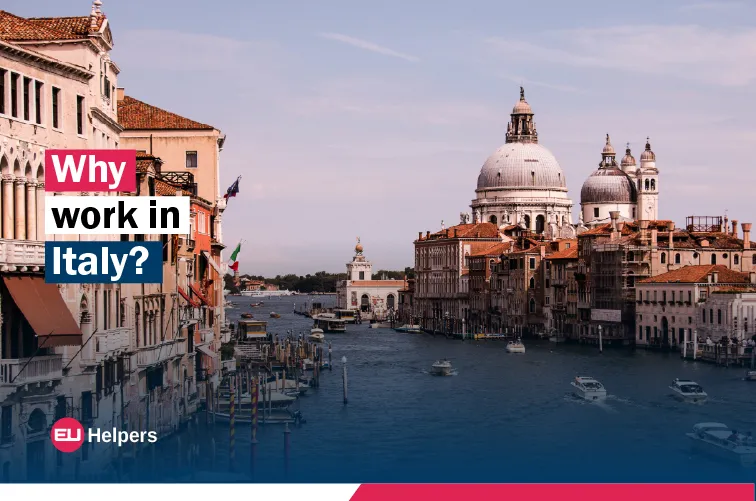

Why Work in Italy? A Complete EU Helpers Guide for International Professionals
Italy, the dynamic Southern European nation bordering France to the northwest, Switzerland and Austria to the north, Slovenia to the northeast, and surrounded by the Mediterranean Sea with distinctive coastlines along the Adriatic Sea, Ionian Sea, and Tyrrhenian Sea, occupies an exceptionally attractive position in Europe and the world for those seeking the rare combination of being an EU founding member and one of the world's most significant economies (Italy joined the European Communities in 1957 as one of the six original founding members of the European Economic Community — the ECSC/EEC that evolved into the modern EU, alongside France, Germany, Belgium, the Netherlands, and Luxembourg through the historic Treaties of Rome signed in Italy's capital, signed Schengen in 1990 with practical implementation since 1997, the eurozone founding in 1999/2002, NATO founding in 1949 as one of NATO's twelve original members, and the Council of Europe founding in 1949, plus being one of the G7 group of major world economies), status as one of the world's most historically significant civilizations (Italy hosts the vast heritage of the ancient Roman Empire that shaped Western civilization, was the birthplace of the Renaissance that fundamentally transformed Western art and culture from the 14th to 17th centuries, and hosts Vatican City — the sovereign city-state within Rome that is the spiritual and administrative capital of the Roman Catholic Church home to over 1.3 billion Catholics worldwide with the Pope residing there), exceptional cultural heritage with the most UNESCO World Heritage Sites in the world (Italy has 59 UNESCO sites — the most of any country in the world reflecting Italy's exceptional cultural, artistic, and historical heritage — more than any other nation including sites like the Historic Centre of Rome — with the Colosseum, Roman Forum, and Pantheon plus Vatican City extraterritorial properties, the Historic Centre of Florence — the birthplace of the Renaissance with the Duomo, the Uffizi Gallery housing masterpieces by Botticelli, Michelangelo, Raphael, the Ponte Vecchio, and the Accademia housing Michelangelo's David, Venice and its Lagoon — the iconic city built on 118 small islands connected by over 400 bridges with the Grand Canal, St. Mark's Basilica, the Doge's Palace, and gondolas, the Amalfi Coast — the spectacular Mediterranean coastline in Campania region, Pompeii and Herculaneum — the ancient Roman cities preserved by the Vesuvius eruption in 79 AD providing extraordinary insight into ancient Roman daily life, the Historic Centre of Naples, Cinque Terre — the five picturesque coastal villages in Liguria, the Costiera Amalfitana, the Trulli of Alberobello — the distinctive whitewashed conical houses of Puglia, Val d'Orcia — the iconic Tuscan landscape, the Historic Centre of Siena, San Gimignano — the medieval town famous for its towers, the Sassi and Rock-Hewn Churches of Matera — the ancient cave dwellings, the Isole Eolie — the Aeolian Islands, Mount Etna in Sicily — one of the world's most active volcanoes, the Palazzo Palladio and Palladian Villas in the Veneto — the works of Andrea Palladio one of history's most influential architects, the Assisi frescoes by Giotto and other masters, the Milan Duomo, the historic Modena Cathedral and Ghirlandina, Verona, the Val Camonica Rock Drawings, the Aquileia Basilica, the Padua Botanical Garden — one of the world's oldest botanical gardens, the Genoa historic port area, and many others), distinctive Italian language and cultural influence (Italian is one of the world's most beautiful and musical languages spoken by about 65 million people globally as a first language plus taught worldwide as one of the most popular foreign languages, being the official language of Italy, San Marino, Vatican City, and having official status in Switzerland — where it's spoken in Ticino canton, plus historically important in parts of Croatia, Slovenia, and other Mediterranean regions, and with the exceptional Italian language regulation through the Accademia della Crusca — the Italian language academy founded in 1583 making it the oldest linguistic academy in the world), exceptional Italian cuisine (widely considered by many culinary experts as the world's most influential and beloved culinary tradition, with distinctive Italian food including pasta — Italy having hundreds of pasta shapes each with distinctive regional origins and specific sauce pairings including spaghetti, penne, rigatoni, fusilli, farfalle, orecchiette, ravioli, tortellini, gnocchi, tagliatelle, pappardelle, lasagna, cannelloni, and many others, pizza — invented in Naples with the traditional Margherita pizza celebrating the Italian flag colors created in 1889 by Raffaele Esposito in honor of Queen Margherita of Savoy featuring tomato red, mozzarella white, and basil green — UNESCO recognized the traditional Neapolitan pizzaiolo art as Intangible Cultural Heritage of Humanity, exceptional Italian coffee culture — with espresso being one of Italy's most iconic contributions to global culture, cappuccino traditionally consumed only in the morning per Italian custom, and the distinctive Italian coffee bar culture where coffee is typically enjoyed standing at the bar, famous Italian cheeses including Parmigiano Reggiano — the "King of Cheeses" produced in Emilia-Romagna and Lombardy, Mozzarella di Bufala Campana — buffalo mozzarella from Campania, Gorgonzola, Pecorino Romano, Grana Padano, Provolone, Ricotta, and many others, Italian cured meats and salumi including prosciutto di Parma — the famous Parma ham, prosciutto di San Daniele, bresaola, salami, mortadella, culatello, and many others, distinctive Italian wines from over 20 wine regions each with distinctive character — with Italy being one of the world's largest wine producers with iconic wines including Chianti and Brunello di Montalcino from Tuscany, Barolo and Barbaresco from Piedmont, Prosecco from Veneto, Amarone della Valpolicella from Veneto, Franciacorta sparkling wine from Lombardy, Nero d'Avola from Sicily, and many others plus the famous Italian aperitivo tradition with Aperol Spritz, Negroni, and Campari Spritz becoming global favorites, exceptional Italian desserts including gelato — the artisanal Italian ice cream superior to standard ice cream due to distinctive production methods, tiramisu — the famous coffee-flavored dessert originating from Veneto or Friuli-Venezia Giulia, panna cotta, cannoli — the Sicilian specialty, panettone — the famous Milanese Christmas cake, and many others, and the founding of the Slow Food movement in Italy in 1986 as a global counter-movement to fast food culture emphasizing traditional, local, seasonal, and sustainable food), major Italian design tradition (with Italian design being globally recognized across multiple disciplines including fashion with Milan as one of the world's four global fashion capitals hosting famous Italian brands including Armani — founded by Giorgio Armani, Prada — founded by Miuccia Prada, Gucci, Versace — the iconic Italian luxury brand, Dolce & Gabbana, Valentino, Bulgari — the Roman jewelry house, Fendi, Bottega Veneta, Salvatore Ferragamo, Missoni, Roberto Cavalli, Trussardi, Moncler, Furla, Tod's, Ermenegildo Zegna, and many others; industrial design with famous Italian designers including Gio Ponti, Ettore Sottsass — founder of the Memphis Group, Giorgetto Giugiaro — one of history's most famous car designers, Giovanni Michelotti, Sergio Pininfarina, Achille Castiglioni, and Alessi products; automotive design with iconic Italian designers shaping many of the world's most beautiful cars; and furniture design), major Italian automotive heritage (with famous Italian automotive brands including Ferrari — often called "the prancing horse" and considered the world's most iconic luxury sports car brand founded by Enzo Ferrari in 1939 with headquarters in Maranello and the Ferrari Museum drawing global visitors, Lamborghini — the iconic supercar manufacturer founded by Ferruccio Lamborghini in 1963 with headquarters in Sant'Agata Bolognese, Maserati — the luxury sports car brand founded 1914, Fiat — Italy's largest automaker forming part of Stellantis after mergers and famous for iconic models including the Fiat 500 designed by Dante Giacosa, Alfa Romeo — the iconic Italian sporting brand founded 1910, Ducati motorcycles — the famous Italian motorcycle brand, Aprilia motorcycles, plus Pagani — the modern hypercar manufacturer, and many others — the Italian automotive industry being concentrated in the Emilia-Romagna region with the famous "Motor Valley" including Ferrari, Lamborghini, Maserati, Pagani, Ducati, and other manufacturers making this region one of the world's most concentrated automotive luxury hubs), exceptional Italian art and architecture heritage (with Italy being the birthplace of the Renaissance which fundamentally transformed Western art and culture from the 14th to 17th centuries, featuring iconic Renaissance masters including Leonardo da Vinci — the ultimate Renaissance polymath painter of the Mona Lisa and The Last Supper plus scientific and engineering genius, Michelangelo — sculptor of David, painter of the Sistine Chapel ceiling and Last Judgment, and architect of St. Peter's Basilica, Raphael — the master of harmonious composition, Sandro Botticelli — painter of The Birth of Venus and Primavera, Donatello — the pioneering Renaissance sculptor, Brunelleschi — engineer of the Florence Duomo dome, Filippo Lippi, Fra Angelico, Piero della Francesca, Andrea Mantegna, Titian, Tintoretto, Veronese, and many others; ancient Roman heritage with the vast archaeological and architectural heritage of the Roman Empire that shaped Western civilization; Baroque masters including Caravaggio — the revolutionary Baroque painter, Bernini — the ultimate Baroque sculptor and architect, and many others; plus later Italian masters including Modigliani, De Chirico, Boccioni, and many contemporary artists), major Italian scientific heritage (with famous Italian scientists including Galileo Galilei — the father of modern science who revolutionized astronomy and physics in the 17th century using the telescope to observe the moons of Jupiter and support the Copernican heliocentric model, Leonardo da Vinci — the Renaissance polymath who was both an artistic and scientific genius exploring anatomy, engineering, and many fields, Alessandro Volta — inventor of the electric battery whose name gave us the "volt" unit, Guglielmo Marconi — inventor of long-distance radio transmission earning the 1909 Nobel Prize in Physics, Enrico Fermi — Nobel physicist who developed the first nuclear reactor, Rita Levi-Montalcini — Nobel physiologist, and many others plus Italy having produced over 20 Nobel laureates), exceptional Italian music and film heritage (with Italian opera being one of the world's most significant musical traditions — Italy being the birthplace of opera as an art form emerging in the late 16th century with famous Italian composers including Giuseppe Verdi — the master of Italian Romantic opera with masterpieces including Aida, La Traviata, Rigoletto, Otello, and Nabucco whose "Va, pensiero" became an unofficial Italian national anthem, Giacomo Puccini — creator of some of the world's most beloved operas including La Bohème, Tosca, Madama Butterfly, and Turandot, Gioachino Rossini — the master of comic opera with The Barber of Seville, Gaetano Donizetti, Vincenzo Bellini, and many others; the world's most famous opera houses including La Scala in Milan — inaugurated 1778 and one of the world's most prestigious opera venues, Teatro dell'Opera in Rome, Teatro San Carlo in Naples — Europe's oldest continuously active opera house founded 1737, Arena di Verona — the ancient Roman amphitheater hosting one of the world's most famous opera seasons, and Teatro La Fenice in Venice; Italian classical music heritage with the violin invented in Italy in the 16th century with famous Italian violin makers Antonio Stradivari and Giuseppe Guarneri "del Gesù" whose instruments remain the most valuable and sought-after in the world; famous Italian singers including Luciano Pavarotti — one of the greatest tenors of the 20th century, Andrea Bocelli — the internationally beloved contemporary tenor, Enrico Caruso — the legendary early 20th-century tenor, and many others; famous Italian films including the neorealist masterpieces of Vittorio De Sica — Bicycle Thieves, Roberto Rossellini — Rome Open City, and Luchino Visconti after WWII that transformed world cinema, plus later Italian cinema masters Federico Fellini — creator of La Dolce Vita and 8½, Michelangelo Antonioni, Pier Paolo Pasolini, Bernardo Bertolucci — Oscar winner for The Last Emperor, Sergio Leone — creator of the Spaghetti Western with the Man with No Name Trilogy and Once Upon a Time in the West, Nanni Moretti, Roberto Benigni — Oscar winner for Life Is Beautiful, and contemporary masters like Paolo Sorrentino — Oscar winner for The Great Beauty, plus famous Italian film music composers including Ennio Morricone — creator of some of cinema's most iconic music including for the Sergio Leone films), rich Italian regional diversity (Italy is composed of 20 regions each with distinctive cultural, linguistic, culinary, and historical character — from Lombardy in the north with its fashion and business capital Milan, to Tuscany in central Italy with its Renaissance heritage and rolling hills, to Sicily in the south with its Mediterranean character and Greek and Arab heritage, plus Piedmont known for wine and cars, Veneto with Venice, Emilia-Romagna with Bologna Modena Parma and the Motor Valley automotive hub, Liguria with the Cinque Terre and Portofino, Campania with Naples the Amalfi Coast and Pompeii, Lazio with Rome as the capital, Puglia with its beautiful coasts and trulli, Sardinia with its distinctive island heritage, Calabria, Abruzzo, Marche, Umbria — the "green heart of Italy", Trentino-Alto Adige with strong Austrian influence, Friuli-Venezia Giulia bordering Slovenia, Molise, Basilicata, and Valle d'Aosta bordering France with the highest Alps), exceptional Italian nature (with the Italian Alps in the north including Mont Blanc — Europe's highest peak at 4,809 meters shared with France, the Dolomites — UNESCO listed mountain range with distinctive limestone peaks, Lake Como, Lake Garda, Lake Maggiore, and other beautiful Alpine lakes; the Apennine Mountains running the length of the Italian peninsula; the beautiful Mediterranean coasts along the Adriatic, Ionian, and Tyrrhenian seas with iconic destinations including the Amalfi Coast, Cinque Terre, the Italian Riviera, the Amalfi Coast, the beautiful island of Capri, Ischia, and the vast Italian coastline; Mount Vesuvius near Naples — the famous active volcano that destroyed Pompeii; Mount Etna in Sicily — one of the world's most active volcanoes; Stromboli — the constantly erupting volcanic island; and the beautiful Italian countryside with the famous rolling hills of Tuscany, the vineyards throughout Italy, and diverse landscapes), significant Italian sports tradition (with Italian football being one of the world's most successful with the Italian national team — the Azzurri — winning the FIFA World Cup four times — 1934, 1938, 1982, and 2006 — making Italy tied with Germany as the second-most-successful national team behind Brazil, plus winning the UEFA European Championship in 1968 and 2020; iconic Italian football clubs including AC Milan, Inter Milan, Juventus, AS Roma, Lazio, Napoli, and Fiorentina; the exceptional Italian passion for football; plus notable Italian tradition in cycling with the Giro d'Italia — one of the three Grand Tours of professional cycling, motorsport with the Ferrari Formula 1 team being the oldest and most successful in F1 history and the historic Italian circuits including Monza — one of F1's most legendary tracks, and other sports), significant Italian diaspora connections (with about 80 million people of Italian descent globally making Italian diaspora one of the world's largest — particularly in the United States with about 17 million Italian Americans concentrated in cities like New York, Boston, Philadelphia, and Chicago, Argentina with about 20 million Italian Argentines making Argentina having the largest Italian-descended population outside Italy and Italian influence being pervasive in Argentine culture and cuisine, Brazil with about 32 million Italian Brazilians particularly in the south — São Paulo has the largest Italian population outside Italy in the world, plus substantial Italian communities in Uruguay, Venezuela, Canada, Australia — with about 1 million Italian Australians, France, Germany, Switzerland — where Italian is an official language, Belgium, and many other countries), and famous Italian style and lifestyle (with the concept of "la dolce vita" — the sweet life — captured in Fellini's famous film, and "bella figura" — the art of making a good impression valuing appearance, style, and dignity in daily life; exceptional Italian focus on family and food; the famous Italian passion for life expressed through animated conversation and expressiveness; and the appreciation of beauty in daily life). With a population of approximately 59 million and covering about 301,340 square kilometers (making Italy one of Europe's larger countries by both population and area), Italy has firmly established itself as one of the world's most attractive destinations. The capital Rome (the vibrant historic capital and main political and cultural hub, one of the world's most historically significant cities as the capital of the ancient Roman Empire, home to about 4.3 million people in the metropolitan area, with iconic landmarks including the Colosseum, Vatican City, Trevi Fountain, Spanish Steps, Piazza Navona, and Villa Borghese), along with Milan (Italy's economic and financial hub — one of the world's fashion capitals), Naples (Italy's third-largest city with the famous Naples pizza), Turin (with automotive heritage), Palermo (Sicily's capital), Genoa (birthplace of Christopher Columbus), Bologna (with the world's oldest university founded 1088), Florence (Firenze — birthplace of the Renaissance), Bari, Catania, Venice (Venezia — UNESCO listed), and Verona (Romeo and Juliet setting), host major Italian and multinational companies, technology hubs, financial institutions, fashion houses, automotive operations, and innovative start-ups. For applicants from anywhere considering Italy, the country offers structured immigration pathways including the Decreto Flussi work permit, the EU Blue Card, the ICT permit, the Digital Nomad Visa (launched 2024), the elective residence visa, the investor visa (Italian golden visa), the self-employment residence permit, the researcher permit, family reunification provisions, the distinctive Italian citizenship by descent (jure sanguinis) route, and a clear long-term route toward Italian permanent residence and eventually Italian citizenship with full EU citizenship benefits. At EU Helpers, candidates regularly ask the fundamental question: why should I consider Italy specifically?
This complete EU Helpers guide answers that question in depth and walks you through the genuine, practical, and long-term reasons that make Italy one of the world's most uniquely attractive destinations.
Why Italy Is Genuinely Unique Among European Destinations
Italy occupies an exceptionally distinctive position in Europe and the world — EU founding member, one of the world's most historically significant civilizations, most UNESCO sites globally, world-leading tourism, distinctive Italian culture, exceptional cuisine, major fashion and design tradition, major automotive heritage, and famous la dolce vita.
EU Founding Member and G7 Country
Italy is an EU founding member (since 1957), Schengen member (since 1997), eurozone founding member (adopted euro in 1999/2002), NATO founding member (since 1949), Council of Europe founding member (since 1949), and one of the G7 group of major world economies.
Most UNESCO Sites in the World
Italy has 59 UNESCO World Heritage Sites — the most of any country in the world, reflecting Italy's exceptional cultural, artistic, and historical heritage. Sites include the Historic Centre of Rome, Vatican City, Florence, Venice, Amalfi Coast, Pompeii and Herculaneum, Cinque Terre, and many others.
World-Leading Tourism Industry
Italy is consistently among the world's most visited countries with iconic attractions including Rome (Colosseum, Vatican City), Florence, Venice, the Amalfi Coast, Cinque Terre, Tuscan countryside, Sicily, and many others.
Ancient Roman and Renaissance Heritage
Italy hosts the vast heritage of the ancient Roman Empire that shaped Western civilization, and was the birthplace of the Renaissance that fundamentally transformed Western art and culture. Features Renaissance masters including Leonardo da Vinci, Michelangelo, Raphael, Botticelli, and Donatello.
Vatican City
Vatican City is the sovereign city-state within Rome that is the spiritual and administrative capital of the Roman Catholic Church home to over 1.3 billion Catholics worldwide, where the Pope resides.
Distinctive Italian Language
Italian is one of the world's most beautiful and musical languages spoken by about 65 million people globally, being the official language of Italy, San Marino, Vatican City, and having official status in Switzerland.
Exceptional Italian Cuisine
Italian cuisine is widely considered by many culinary experts as the world's most influential culinary tradition. Distinctive Italian food includes pasta with hundreds of shapes, pizza (invented in Naples — UNESCO recognized as Intangible Cultural Heritage), exceptional Italian coffee culture (espresso, cappuccino), famous Italian cheeses (Parmigiano Reggiano, Mozzarella di Bufala Campana), cured meats (prosciutto di Parma), Italian wines from over 20 wine regions, and desserts (gelato, tiramisu).
Major Fashion and Luxury Industry
Milan is one of the world's four global fashion capitals hosting famous Italian brands including Armani, Prada, Gucci, Versace, Dolce & Gabbana, Valentino, Bulgari, Fendi, Bottega Veneta, and many others, plus Milan Fashion Week.
Major Automotive Heritage
Italy has famous automotive brands including Ferrari (the iconic luxury sports car brand), Lamborghini (the iconic supercar manufacturer), Maserati, Fiat/Stellantis, Alfa Romeo, and Ducati motorcycles, concentrated in the Emilia-Romagna "Motor Valley."
Exceptional Italian Art and Design Tradition
Italy has exceptional design tradition extending across fashion, industrial design, automotive design, and furniture design — with Italian design being globally recognized.
Nobel Laureates and Scientific Heritage
Italy has produced over 20 Nobel laureates plus famous Italian scientists including Galileo Galilei, Leonardo da Vinci, Alessandro Volta, Guglielmo Marconi, and Enrico Fermi.
Exceptional Music and Opera Heritage
Italy is the birthplace of opera with famous composers including Verdi, Puccini, Rossini, Donizetti, and Bellini. La Scala in Milan is one of the world's most prestigious opera venues.
Distinctive Immigration Frameworks
Italy has distinctive immigration frameworks including the Digital Nomad Visa (launched 2024), elective residence visa for retirees, investor visa for wealthy investors, and Italian citizenship by descent (jure sanguinis) for those with Italian ancestry.
Famous Italian Style — La Dolce Vita
The concept of "la dolce vita" (the sweet life) captured in Fellini's famous film and "bella figura" (the art of making a good impression) reflect the distinctive Italian appreciation for beauty, style, and joy in daily life.
Top Financial Reasons to Consider Italy
The financial rationale for working in Italy centers around moderate cost of living with full EU/eurozone benefits and competitive salaries in specialized sectors.
Moderate Cost of Living
Italy's cost of living is moderate compared to Northern European and some other Western European EU averages, with significant regional variation. Milan and Rome are relatively expensive, while southern Italy and smaller cities are more affordable.
Competitive Salaries in Specialized Sectors
Fashion, luxury goods, and design roles in Italy often offer competitive compensation given Italy's global leadership in these sectors.
Eurozone Currency Convenience
Italy uses the euro (founding eurozone member adopting in 1999/2002), providing currency stability and convenience.
Worker Protections
Italy has strong labor laws providing comprehensive paid vacation, parental leave, and other worker protections within EU frameworks.
Universal Healthcare
Italy has universal healthcare through the Servizio Sanitario Nazionale (SSN — National Health Service) providing comprehensive coverage.
Public Educational System
Italy offers public education through university level, with historic universities including the University of Bologna (founded 1088 — the world's oldest university) and many others.
Lifestyle and Quality-of-Life Benefits
Beyond money, Italy offers an exceptional lifestyle combining Mediterranean character, exceptional cultural heritage, distinctive Italian style, and famous Italian hospitality.
Vibrant Capital Rome
Rome combines extraordinary historical heritage (the Colosseum from 80 AD — one of the world's most iconic ancient monuments, the Roman Forum, the Pantheon with the world's largest unreinforced concrete dome from 126 AD, Vatican City with St. Peter's Basilica and the Sistine Chapel with Michelangelo's ceiling, the Trevi Fountain, Spanish Steps, Piazza Navona, Villa Borghese with masterpieces by Bernini and Caravaggio, historic Trastevere), exceptional modern character, exceptional Italian café and dining culture, and rich cultural life.
Fashionable Milan and Other Italian Cities
Milan (Italy's economic hub and one of the world's four global fashion capitals with the iconic Duomo di Milano — Milan's magnificent Gothic cathedral, historic Galleria Vittorio Emanuele II, La Scala opera house, Santa Maria delle Grazie housing Leonardo's The Last Supper). Florence (Firenze — birthplace of the Renaissance with the Duomo with Brunelleschi's dome, Uffizi Gallery, Ponte Vecchio, and Accademia housing Michelangelo's David). Venice (Venezia — the iconic city built on 118 islands with the Grand Canal, St. Mark's Basilica, Doge's Palace, and gondolas). Naples (Italy's third-largest city with famous Naples pizza and Vesuvius nearby). Turin (with automotive heritage). Bologna (with the world's oldest university and Motor Valley nearby). Each city offers distinctive character.
Iconic Colosseum and Ancient Roman Heritage
The Colosseum, completed in 80 AD, is one of the world's most iconic ancient monuments and Italy's most famous landmark. Combined with the Roman Forum, Pantheon, Pompeii and Herculaneum, and vast other ancient Roman heritage.
Vatican City
Vatican City is the sovereign city-state within Rome home to St. Peter's Basilica designed by Renaissance masters, the Sistine Chapel with Michelangelo's famous ceiling and Last Judgment frescoes, and the Vatican Museums housing one of the world's greatest art collections.
Renaissance Florence and Art Heritage
Florence (Firenze) is the birthplace of the Renaissance with iconic landmarks including the Duomo with Brunelleschi's dome, the Uffizi Gallery housing masterpieces by Botticelli (The Birth of Venus, Primavera), Michelangelo, Raphael, and others, the Ponte Vecchio, and the Accademia housing Michelangelo's David.
Iconic Venice
Venice (Venezia) is the iconic city built on 118 small islands connected by over 400 bridges featuring the Grand Canal, St. Mark's Basilica, the Doge's Palace, gondolas, and unique Venetian character — UNESCO listed.
Amalfi Coast and Mediterranean Coasts
The Amalfi Coast is the spectacular Mediterranean coastline in Campania region — UNESCO listed. Combined with the beautiful Italian Riviera, Cinque Terre, Puglia coasts, and many others.
Italian Lakes
Northern Italy features beautiful Alpine lakes including Lake Como (famous international destination), Lake Garda, Lake Maggiore, Lake Lugano (shared with Switzerland), and others.
Italian Alps and Dolomites
The Italian Alps in the north include Mont Blanc (Europe's highest peak — shared with France), the Dolomites (UNESCO listed mountain range with distinctive limestone peaks), and provide exceptional skiing and mountaineering.
Tuscan Countryside
The famous rolling hills of Tuscany with vineyards, cypress trees, historic hill towns, and Renaissance heritage represent one of the world's most iconic landscapes.
Exceptional Italian Cuisine
Italian cuisine features distinctive specialties including pasta (with hundreds of shapes), pizza (invented in Naples — UNESCO recognized), Italian coffee culture (espresso, cappuccino), famous Italian cheeses (Parmigiano Reggiano, Mozzarella di Bufala Campana, Gorgonzola, Pecorino Romano), cured meats (prosciutto di Parma, prosciutto di San Daniele, bresaola, salami, mortadella, culatello), Italian wines from over 20 wine regions, aperitivo tradition (Aperol Spritz, Negroni, Campari), and desserts (gelato, tiramisu, panna cotta, cannoli, panettone).
Famous Italian Wine Tradition
Italy has exceptional wine tradition with famous wines including Chianti and Brunello di Montalcino from Tuscany, Barolo and Barbaresco from Piedmont, Prosecco and Amarone della Valpolicella from Veneto, Franciacorta from Lombardy, and Nero d'Avola from Sicily.
Famous Italian Coffee Culture
Italian coffee culture is one of the world's most iconic — espresso being one of Italy's most famous global contributions. Cappuccino is traditionally consumed only in the morning per Italian custom, and the distinctive Italian coffee bar culture where coffee is enjoyed standing at the bar is culturally significant.
Slow Food Movement
The Slow Food movement was founded in Italy in 1986 as a global counter-movement to fast food culture emphasizing traditional, local, seasonal, and sustainable food.
Distinctive Italian Opera and Music
Italy is the birthplace of opera with famous composers including Giuseppe Verdi (Aida, La Traviata, Rigoletto), Giacomo Puccini (La Bohème, Tosca, Madama Butterfly, Turandot), and Gioachino Rossini (The Barber of Seville). Famous opera houses include La Scala in Milan and Teatro San Carlo in Naples (Europe's oldest continuously active opera house).
Distinctive Italian Cinema
Italian cinema features masters including Federico Fellini (La Dolce Vita, 8½), Vittorio De Sica (Bicycle Thieves), Sergio Leone (Spaghetti Westerns), and contemporary Oscar winners like Paolo Sorrentino (The Great Beauty) and Roberto Benigni (Life Is Beautiful). Plus famous film music composer Ennio Morricone.
Distinctive Italian Fashion and Design
Milan Fashion Week is one of the world's most important fashion events. Italian design extends across fashion, industrial design (with legendary designers like Gio Ponti and Ettore Sottsass), automotive design (with iconic Italian car designers), and furniture design.
Mediterranean Climate
Italy has diverse climates including Mediterranean (along most coasts with warm dry summers and mild winters), continental (in the Po Valley including Milan with hot summers and cool winters), and Alpine (in northern mountain regions). The Mediterranean climate supports outdoor lifestyle throughout much of the year.
Generally Safe
Italy has overall reasonable safety levels, though like any major country with tourism experiences some petty crime particularly in tourist areas.
Famous Italian Hospitality
Italians are known for warm hospitality, generous treatment of guests, sociable culture, and the famous Italian appreciation of life expressed through animated conversation and expressiveness.
La Dolce Vita and Bella Figura
The concept of "la dolce vita" (the sweet life) and "bella figura" (the art of making a good impression) reflect the distinctive Italian appreciation for beauty, style, and joy in daily life.
Growing International Community
Italy's Digital Nomad Visa (launched 2024), elective residence visa, and investor visa have created growing international communities.
Family-Friendly Society
Italian family-oriented culture creates family-friendly society with strong emphasis on family relationships and family gatherings.
Universal Healthcare
Italy has universal healthcare through the SSN (Servizio Sanitario Nazionale).
Career Growth and Professional Opportunities
Italy's career environment offers exceptional opportunities across multiple sectors.
Strong Career Pathways in Fashion and Luxury
For fashion and design professionals, Milan offers exceptional opportunities through Italian fashion houses and Milan Fashion Week.
Career Pathways in Tourism
For tourism professionals, Italy's world-leading tourism creates substantial opportunities.
Career Pathways in Automotive
For automotive professionals, Italian automotive brands (Ferrari, Lamborghini, Maserati, Fiat/Stellantis, Alfa Romeo, Ducati) create opportunities particularly in the Motor Valley (Emilia-Romagna).
Career Pathways in IT and Design
For IT professionals, Milan's growing tech ecosystem creates opportunities. For designers, Italy's exceptional design tradition creates opportunities.
Career Pathways in Healthcare
For healthcare professionals, Italy's demographic-driven demand creates opportunities.
Opportunities Through Distinctive Immigration Frameworks
The distinctive Italian immigration frameworks (Digital Nomad Visa launched 2024, elective residence visa for retirees, investor visa for wealthy investors, and Italian citizenship by descent for those with Italian ancestry) make Italy particularly accessible for various foreign professional and lifestyle profiles.
Residency, Work Permit, and Legal Benefits
Working legally in Italy comes with structured immigration pathways.
Structured Permit System
Foreign workers obtain residence through dedicated schemes including the Decreto Flussi work permit, EU Blue Card, ICT permit, Digital Nomad Visa, elective residence visa, investor visa, self-employment routes, researcher route, family reunification provisions, and other pathways.
Italian Citizenship by Descent (Jure Sanguinis)
Italy notably offers citizenship by descent (jure sanguinis) for those able to demonstrate unbroken Italian ancestry, making Italy particularly relevant for the substantial Italian diaspora globally (about 80 million people of Italian descent). This provides a powerful pathway for those with Italian ancestry to obtain Italian and EU citizenship.
Family Reunification
Italy allows qualifying workers and residents to bring close family members.
Pathway to Italian Citizenship and EU Benefits
After qualifying continuous residence in Italy (typically 10 years for most nationalities, reduced to 4 years for EU citizens, 5 years for refugees, and 3 years for descendants of Italian citizens meeting specific criteria) and meeting other requirements, foreign nationals may obtain Italian citizenship by naturalization. Italian citizenship grants full EU citizenship benefits.
Healthcare, Education, and Social Benefits
Italian public services provide comprehensive coverage.
Universal Healthcare
Italy has universal healthcare through the SSN (Servizio Sanitario Nazionale — National Health Service) providing comprehensive coverage for residents.
Public Educational System
Italy offers public education through university level, with historic universities including the University of Bologna (founded 1088 — the world's oldest university), the University of Padua, Sapienza University of Rome, University of Milan, and many others.
Social Protections
Registered workers benefit from comprehensive contributions through the INPS (Istituto Nazionale della Previdenza Sociale) including pensions, healthcare, and other benefits.
Practical Considerations for Working in Italy
While Italy offers compelling benefits, applicants should also understand some practical considerations.
Italian Language Importance
Italian is essential for most professional and daily life contexts. While English use is growing in international business, tech, fashion, and tourism, Italian skills are important for broader integration.
Complex Italian Bureaucracy
Italian bureaucracy is notably complex, requiring careful attention to procedural detail and multiple authority coordination.
Regional Economic Disparities
Italy has notable regional economic disparities with northern Italy (Milan, Turin, Bologna) generally being more prosperous than southern Italy.
Moderate Salaries
Italian salaries are generally moderate compared to Northern European averages, though competitive in specialized sectors like fashion, luxury, and design.
Cultural Adjustments
Italian culture has distinctive features including warm interpersonal style, expressive communication, family orientation, appreciation of beauty and style (bella figura), and famous Italian passion for life.
Required Documents and Step-by-Step Overview
While exact requirements depend on the specific permit and applicant profile, the general route involves coordination with Italian embassies and consulates abroad, the Sportello Unico per l'Immigrazione at prefecture level, the Questura for permesso di soggiorno after arrival, and other authorities.
Practical Tips for International Applicants Considering Italy
Tips From EU Helpers for Considering Italy
Carefully evaluate which permit category fits your profile. For remote workers, evaluate the Digital Nomad Visa (launched 2024). For retirees, evaluate the elective residence visa. For wealthy investors, evaluate the investor visa. For those with Italian ancestry, explore Italian citizenship by descent (jure sanguinis) — a powerful long-term option. Target Italian employers in strong sectors — fashion (Milan), automotive (Motor Valley), tourism, IT (Milan). Take advantage of Italy's exceptional cultural heritage, cuisine, art, and Mediterranean lifestyle. Plan housing carefully — different Italian cities offer different lifestyles at different price points. Develop Italian language skills. Embrace Italian culture — la dolce vita, bella figura, exceptional cuisine and coffee, distinctive art and design heritage. Always rely on the latest official guidance.
Final Guidance
Why work in Italy? Because few countries in Europe — or in the world — combine such a unique mix of being an EU founding member (since 1957), Schengen member (since 1997), eurozone founding member (adopted euro in 1999/2002), NATO founding member (since 1949), Council of Europe founding member (since 1949), one of the G7 group of major world economies, EU's third-largest economy, one of the world's most historically significant civilizations (hosting the ancient Roman Empire heritage that shaped Western civilization, being the birthplace of the Renaissance that fundamentally transformed Western art and culture, and hosting Vatican City — the spiritual capital of Roman Catholicism), exceptional cultural heritage with the most UNESCO World Heritage Sites in the world (59 sites — the most globally including Rome's Historic Centre with the Colosseum and Vatican City, Florence, Venice, the Amalfi Coast, Pompeii and Herculaneum, Cinque Terre, and many others), world-leading tourism industry, distinctive Italian language (one of the world's most beautiful languages spoken by about 65 million people globally), exceptional Italian cuisine (widely considered the world's most influential culinary tradition with pasta, pizza invented in Naples — UNESCO recognized, exceptional coffee culture, famous cheeses including Parmigiano Reggiano and Mozzarella di Bufala Campana, cured meats including prosciutto di Parma, Italian wines from over 20 wine regions with iconic wines including Chianti, Brunello, Barolo, Prosecco, and Amarone, aperitivo tradition, and exceptional desserts including gelato and tiramisu — plus the Slow Food movement founded in Italy in 1986), major fashion and luxury industry (Milan being one of the world's four global fashion capitals with famous brands including Armani, Prada, Gucci, Versace, Dolce & Gabbana, Valentino, Bulgari, Fendi, Bottega Veneta), major automotive heritage (Ferrari — the iconic prancing horse, Lamborghini, Maserati, Fiat/Stellantis, Alfa Romeo, Ducati concentrated in Emilia-Romagna's Motor Valley), exceptional Italian design tradition (extending across fashion, industrial design, automotive design, and furniture design — globally recognized), exceptional Italian art and architecture heritage (Renaissance masters — Leonardo da Vinci with the Mona Lisa and The Last Supper, Michelangelo with David and the Sistine Chapel, Raphael, Botticelli with The Birth of Venus and Primavera, Donatello; ancient Roman heritage; Baroque masters — Caravaggio and Bernini), exceptional music and opera heritage (Italy being the birthplace of opera with Verdi, Puccini, Rossini, plus La Scala Milan and Teatro San Carlo Naples — Europe's oldest continuously active opera house from 1737, famous Italian violin makers Stradivarius and Guarneri, plus Pavarotti and Andrea Bocelli), exceptional Italian cinema heritage (Fellini, De Sica with Bicycle Thieves, Sergio Leone with Spaghetti Westerns, plus Oscar winners Sorrentino and Benigni, and iconic film composer Ennio Morricone), rich Italian regional diversity (20 distinctive regions each with unique cultural, linguistic, culinary, and historical character), exceptional Italian nature (Italian Alps and Dolomites, Amalfi Coast and Mediterranean coasts, Italian lakes including Como and Garda, Tuscan countryside), significant Italian scientific heritage (Galileo Galilei — father of modern science, Leonardo da Vinci as scientific genius, Volta, Marconi, Fermi, plus over 20 Italian Nobel laureates), significant Italian sports tradition (Italy having won the FIFA World Cup four times — 1934, 1938, 1982, 2006, plus iconic Italian football clubs and Ferrari F1 dominance), significant Italian diaspora connections (about 80 million people of Italian descent globally — one of the world's largest diasporas, particularly in the United States with 17 million Italian Americans, Argentina with 20 million Italian Argentines making Argentina having the largest Italian-descended population outside Italy, and Brazil with 32 million Italian Brazilians), distinctive immigration frameworks (Digital Nomad Visa launched 2024, elective residence visa for retirees, investor visa for wealthy investors, and Italian citizenship by descent — jure sanguinis — for those with Italian ancestry making Italy particularly relevant for the substantial Italian diaspora), famous Italian style and lifestyle (la dolce vita and bella figura), universal healthcare, and a clear pathway to Italian citizenship with full EU benefits. For international fashion and design professionals drawn to Milan's fashion capital status, automotive professionals attracted to Italy's automotive heritage (Ferrari, Lamborghini, and others), tourism and hospitality professionals attracted to Italy's world-leading tourism, IT professionals drawn to Milan's growing tech ecosystem, healthcare professionals attracted to demographic-driven demand, retirees using the elective residence visa for exceptional Mediterranean retirement lifestyle, remote workers using the Digital Nomad Visa, wealthy investors using the investor visa, those with Italian ancestry pursuing Italian citizenship by descent, or lifestyle migrants attracted to Italy's exceptional cultural heritage, exceptional cuisine, art heritage, Mediterranean lifestyle, and famous la dolce vita, Italy stands out as one of Europe's — and the world's — most uniquely attractive destinations. EU Helpers supports international applicants at every stage — from evaluating eligibility and selecting the right permit route (Decreto Flussi work permit, EU Blue Card, ICT permit, Digital Nomad Visa, elective residence visa, investor visa, self-employment routes, researcher route, family-based residence, or Italian citizenship by descent) to preparing documents, certified Italian translation guidance, employer coordination, embassy navigation, Sportello Unico and Questura procedures, and planning a smooth transition. If Italy is on your radar as a future work destination, EU Helpers can help you move forward with clarity, confidence, and the latest accurate information.
FAQs
Italy offers a unique combination of EU founding membership (since 1957), one of the world's most historically significant civilizations (ancient Roman heritage, birthplace of the Renaissance, Vatican City), most UNESCO sites globally (59 — the most of any country), world-leading tourism, exceptional Italian cuisine (widely considered the world's most influential culinary tradition), major fashion and luxury industry (Milan being one of the world's fashion capitals), major automotive heritage (Ferrari, Lamborghini), exceptional art and design tradition, distinctive Digital Nomad Visa (launched 2024), elective residence visa for retirees, Italian citizenship by descent for those with Italian ancestry, and famous la dolce vita.
Yes. Italy is an EU founding member (since 1957), Schengen member (since 1997), eurozone founding member (adopted euro in 1999/2002), NATO founding member (since 1949), and Council of Europe founding member.
Italy uses the euro as its currency, having been a founding eurozone member that adopted the euro in 1999 for accounting purposes and in 2002 in physical form.
Italy has 59 UNESCO World Heritage Sites — the most of any country in the world — reflecting Italy's exceptional cultural, artistic, and historical heritage from ancient Roman, Renaissance, and later periods. Sites include the Historic Centre of Rome, Vatican City, Florence, Venice, Amalfi Coast, Pompeii and Herculaneum, Cinque Terre, and many others.
Vatican City is the sovereign city-state within Rome that is the spiritual and administrative capital of the Roman Catholic Church home to over 1.3 billion Catholics worldwide. Home to St. Peter's Basilica designed by Renaissance masters including Michelangelo, the Sistine Chapel with Michelangelo's famous ceiling and Last Judgment frescoes, and the Vatican Museums. The Pope resides there.
Italian cuisine is widely considered by many culinary experts as the world's most influential and beloved culinary tradition. Distinctive Italian food includes pasta (with hundreds of shapes), pizza (invented in Naples — UNESCO recognized as Intangible Cultural Heritage), exceptional Italian coffee culture, famous cheeses (Parmigiano Reggiano, Mozzarella di Bufala Campana), cured meats (prosciutto di Parma), Italian wines from over 20 wine regions, and exceptional desserts (gelato, tiramisu).
Milan is one of the world's four global fashion capitals (along with Paris, New York, and London), hosting famous Italian fashion brands including Armani, Prada, Gucci, Versace, Dolce & Gabbana, Valentino, Bulgari, Fendi, Bottega Veneta, and many others, plus the internationally famous Milan Fashion Week held twice yearly.
Italy has famous automotive brands including Ferrari (the iconic prancing horse — the world's most famous luxury sports car brand), Lamborghini (the iconic supercar manufacturer), Maserati, Fiat (part of Stellantis after mergers), Alfa Romeo, and Ducati motorcycles. The Italian automotive industry is concentrated in Emilia-Romagna's "Motor Valley."
The Renaissance was the cultural, artistic, and intellectual movement that emerged in Italy in the 14th century and spread through Europe by the 17th century, fundamentally transforming Western art and culture. Italy was the birthplace with Florence being the center. Renaissance masters included Leonardo da Vinci, Michelangelo, Raphael, Botticelli, and Donatello.
Leonardo da Vinci (1452-1519) was the ultimate Renaissance polymath, painter of the Mona Lisa and The Last Supper, plus a scientific and engineering genius exploring anatomy, engineering, aviation, and many fields. He is considered one of history's greatest geniuses.
Michelangelo (1475-1564) was the Renaissance master who created the sculpture David, painted the Sistine Chapel ceiling and The Last Judgment, and served as architect of St. Peter's Basilica. He is considered one of the greatest artists in Western history.
The Colosseum is the ancient Roman amphitheater completed in 80 AD in Rome — one of the world's most iconic ancient monuments. It hosted gladiatorial combats and public spectacles for centuries during the Roman Empire.
Italy launched its Digital Nomad Visa in 2024 as its dedicated framework for foreign nationals working remotely for non-Italian employers or freelancing for non-Italian clients while residing in Italy. Requirements include qualifying remote work, income thresholds, health insurance, higher education qualifications or professional experience, and other criteria.
The elective residence visa is Italy's framework for financially independent applicants (particularly retirees) with substantial passive income seeking residence in Italy without employment. Note it does not permit working in Italy.
Italy notably offers citizenship by descent (jure sanguinis) for those able to demonstrate unbroken Italian ancestry, making Italy particularly relevant for the substantial Italian diaspora globally (about 80 million people of Italian descent). This provides a powerful pathway for those with Italian ancestry to obtain Italian and EU citizenship.
"La dolce vita" (the sweet life) is a distinctive Italian concept captured in Federico Fellini's famous 1960 film. It reflects the Italian appreciation for beauty, joy, style, food, family, and pleasure in daily life.
"Bella figura" (the beautiful figure, literally) is the Italian concept of making a good impression, valuing appearance, style, dignity, and behavior in social settings. It's central to Italian cultural identity.
Italy is the birthplace of opera as an art form emerging in the late 16th century. Famous Italian composers include Giuseppe Verdi (Aida, La Traviata, Rigoletto), Giacomo Puccini (La Bohème, Tosca, Madama Butterfly, Turandot), Gioachino Rossini (The Barber of Seville), Gaetano Donizetti, and Vincenzo Bellini. Famous opera houses include La Scala Milan and Teatro San Carlo Naples.
Italian is the official language, spoken by about 65 million people globally. Italy has significant regional linguistic diversity with distinctive regional languages and dialects including Sicilian, Neapolitan, Venetian, Piedmontese, Lombard, Sardinian, Friulian, and Ladin. Italian is regulated by the Accademia della Crusca founded in 1583.
Italy has overall reasonable safety levels, though like any major country with tourism experiences some petty crime particularly in tourist areas. Generally considered safe for foreign residents and tourists.
Italy has diverse climates including Mediterranean (along most coasts with warm dry summers and mild winters), continental (in the Po Valley including Milan with hot summers and cool winters), and Alpine (in northern mountain regions). The Mediterranean climate supports outdoor lifestyle throughout much of the year.
Italy has a moderate cost of living with significant variation by region and city. Milan and Rome are relatively expensive, while southern Italy and smaller cities are more affordable. Overall cost of living is generally moderate compared to Northern European EU averages.
Italy is attractive for retirees through the elective residence visa framework combined with exceptional Mediterranean climate, cultural heritage (with the most UNESCO sites globally), exceptional cuisine, art heritage, distinctive Italian lifestyle — la dolce vita, and accessible cost of living relative to Northern Europe.
Yes. Qualifying workers and residents can usually apply for family reunification for spouses, registered partners, and dependent children.
After qualifying continuous residence in Italy (typically 10 years for most nationalities, reduced to 4 years for EU citizens, and other reductions for specific circumstances) and meeting other requirements, foreign nationals may obtain Italian citizenship by naturalization. Italian citizenship grants full EU citizenship benefits. Additionally, Italy offers citizenship by descent (jure sanguinis) for those with Italian ancestry.
EU Helpers supports international applicants with eligibility assessment, permit category selection (including Digital Nomad Visa for remote workers, elective residence visa for retirees, investor visa for wealthy investors, and Italian citizenship by descent for those with Italian ancestry), document preparation, certified Italian translation guidance, employer coordination, embassy navigation, Sportello Unico and Questura procedures, and clarity on the latest official requirements tailored to your career goals.