
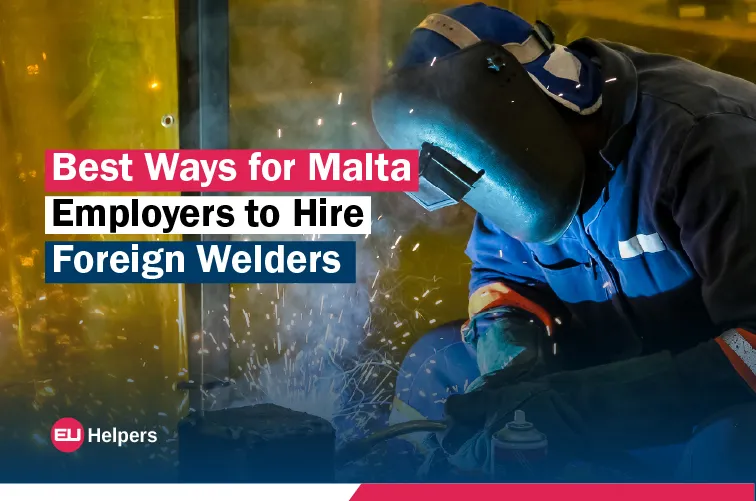

Best Ways for Malta Employers to Hire Foreign Welders — The Complete EU Helpers Employer Guide
Malta has a distinctive small-island industrial economy that creates substantial welding demand despite the country's small size — a full EU/Schengen/Eurozone member of approximately 540,000-550,000 population with manufacturing concentrated in selected industrial areas (including electronics and pharmaceutical manufacturing at Bulebel, Mosta, and other industrial estates), substantial construction sector (driven by Malta's recent strong economic growth requiring construction welding for structural steel, building services, and infrastructure), maritime services (Malta has significant maritime industry given its strategic Mediterranean location and one of the world's largest ship registries, with ship repair operations at Malta drydocks creating specialised maritime welding demand), industrial maintenance (servicing Malta's manufacturing and operational infrastructure), and broader fabrication. Welders play a critical role across this industrial landscape. The construction sector creates significant welding demand for structural steel work supporting Malta's rapid construction growth in residential, commercial, hospitality, and infrastructure projects. The ship repair sector at Malta drydocks creates specialised maritime welding demand with classification society certifications. The electronics and pharmaceutical manufacturing sectors create demand for precision welding for equipment and infrastructure. Industrial maintenance creates ongoing demand. Yet Malta is facing a welder shortage, exacerbated by Malta's small population of approximately 540,000-550,000 limiting the local workforce, Maltese workers increasingly preferring office careers in iGaming/financial services/IT over industrial trades, the rapidly growing Maltese economy creating substantial construction and industrial demand, and limited domestic vocational welding training relative to demand. As a result, more and more Maltese employers are now looking abroad to fill welding positions.
This in-depth EU Helpers guide is built for Maltese manufacturers (electronics and pharmaceutical manufacturing concentrated at Bulebel/Mosta/other industrial estates), Malta drydocks ship repair operators, heavy industrial maintenance specialists, construction firms (with significant demand given Malta's recent growth), metal fabrication workshops, and HR professionals who want to understand the best ways to hire foreign welders for Malta. At EU Helpers, we work directly with Maltese employers to source qualified welders from abroad, manage Single Permit applications, coordinate documentation, and ensure full compliance with Maltese immigration, labour, and minimum wage rules. In the sections below, you will learn where to find welders, which authorisation routes apply, what certifications matter most, how long the process really takes, how much it costs, what mistakes to avoid, and how factors like nationality, welding specialisation, and project type can shape your hiring strategy.
Why Maltese Employers Are Hiring Welders from Abroad
The Maltese industrial economy depends on welding capacity across several key sectors. Construction welding (driven by Malta's rapid recent growth in residential development supporting population growth from rapid immigration, commercial development serving Malta's iGaming/financial services/tourism economy, hotel and tourism infrastructure construction, and various infrastructure projects) creates significant welding demand for structural steel, building services, and broader construction welding. Malta drydocks ship repair operations create specialised maritime welding demand with classification society requirements (Malta's strategic Mediterranean location making it a natural ship repair hub plus Malta's substantial ship registry generating repair demand). Electronics and pharmaceutical manufacturing at Bulebel and other industrial estates create demand for precision welding. Industrial maintenance creates ongoing demand across various sectors.
At the same time, the supply of qualified welders inside Malta has been limited. Malta's small population of approximately 540,000-550,000 cannot supply unlimited workforce, and Maltese workers increasingly prefer office careers in iGaming/financial services/IT/tourism over industrial trades like welding. Younger Maltese workers often choose university and office careers rather than trade qualifications. The rapidly growing Maltese economy creates substantial demand. For employers, hiring foreign welders is becoming a structural part of how Maltese industry delivers construction, manufacturing, ship repair, and industrial maintenance. The Maltese government provides routes for foreign welder recruitment, primarily through the Single Permit. But hiring foreign welders also comes with serious legal responsibilities, monitored by Identità (handling immigration and residence permits), Jobsplus (handling labour market verification), the Commissioner for Revenue (handling personal income tax), the Social Security Department (handling social security contributions), the Department for Industrial and Employment Relations (DIER), and other competent authorities. Understanding the rules from the start is the foundation of a successful international recruitment programme.
Where Welding Demand Is Strongest in Malta
Welding demand in Malta is concentrated in several key sectors and locations. Construction welding demand is distributed across Malta wherever construction is occurring — particularly in Sliema, St Julian's, Valletta surroundings, Birkirkara, and other growing areas. Malta drydocks ship repair operations create specialised welding demand. Electronics and pharmaceutical manufacturing at Bulebel (Malta's main industrial estate hosting significant electronics and pharmaceutical manufacturing) and other industrial locations create demand. Industrial maintenance welding is distributed across various operational sites. Each segment has its own welding profile, certification needs, and salary expectations, and EU Helpers adapts the recruitment strategy to match.
Why Local Welders Alone Cannot Meet Demand
Malta has vocational training capacity through MCAST (Malta College of Arts, Science and Technology) and other programmes, but the small population of approximately 540,000-550,000 combined with Maltese workers preferring office careers means domestic recruitment cannot meet demand. Bringing in foreign welders from countries with strong welding traditions and structured certification systems has become the most practical solution for many Maltese employers.
Understanding the Legal Framework Before You Recruit
Before sourcing the first candidate, Maltese employers need to understand the legal categories that govern hiring foreign workers — and specifically foreign welders — in Malta. Malta is a full member of the EU, Schengen, and Eurozone.
EU/EEA and Swiss Welders
Welders from EU member states, EEA countries, and Switzerland enjoy freedom of movement and do not need a work permit in Malta. They can be employed on the same terms as Maltese welders. The employer's main obligations are correct registration with the Commissioner for Revenue (handling personal income tax), the Social Security Department (handling social security contributions), compliance with Maltese employment law, and compliance with the Maltese statutory minimum wage. EU citizens staying longer than three months should register with Identità. Many Maltese employers therefore start their search for foreign welders in Italy (given proximity — Sicily approximately 80km from Malta — and significant Italian community in Malta), plus broader EU countries including Romania, Bulgaria, Poland, Slovakia, Hungary, Croatia, and other EU countries.
Non-EU (Third-Country) Welders
For welders from outside the EU/EEA and Switzerland, Maltese law sets out a structured set of permit routes.
Single Permit
For most non-EU welders, Malta uses the Single Permit — a combined work and residence permit covering both the right to work and the right to reside in Malta. The Single Permit application is handled through Identità with Jobsplus verifying the labour market position.
Key Employee Initiative
For highly skilled non-EU welders meeting Maltese government criteria (typically senior welding engineers, welding technologists, or welding specialists with specific qualifications and experience), the Key Employee Initiative provides a streamlined faster procedure.
EU Blue Card
The EU Blue Card is particularly relevant for welding engineers (IWE — International Welding Engineer), welding technologists (IWT), welding inspectors, and senior welding specialists with recognised higher education and salaries meeting the threshold.
Intra-Corporate Transfer (ICT)
Multinational industrial groups can transfer welding engineers and senior specialists from non-EU group companies to Maltese entities through the ICT route.
Path to Long-Term Residence and Citizenship
Workers may apply for long-term EU resident status after typically five years of legal stay, and eventually for Maltese citizenship under various paths.
Welder-Specific Legal and Professional Requirements
Beyond immigration, Maltese and EU law sets strict welder-specific requirements:
- Recognised welder qualification (e.g., EN ISO 9606 series)
- Valid welding procedure qualification documents where the role requires them
- Occupational health and safety training in line with Maltese occupational safety law
- Compliance with EU Pressure Equipment Directive (PED) for pressure vessels
- Classification society certifications for Malta drydocks ship repair work
These requirements apply to all professional welders working in Malta, regardless of nationality.
The exact rules, eligible nationalities, salary thresholds, processing times, and document requirements can change based on government decisions and EU regulations. EU Helpers always checks the most up-to-date official requirements before starting any case.
Welding Certifications and Qualification Requirements
For welder roles, hiring is not only about immigration — the candidate must also be technically qualified to perform the welding work that the Maltese employer needs.
Required Welding Processes
Different projects require different welding processes, and the candidate's certification must match. The most common processes employers in Malta look for include MIG/MAG (Gas Metal Arc Welding), TIG (Gas Tungsten Arc Welding), MMA / SMAW (Shielded Metal Arc Welding / stick welding), and Flux-Cored Arc Welding (FCAW). For specialised work — Malta drydocks ship repair welding with classification society requirements, pressure vessel welding, electronics/pharmaceutical manufacturing equipment welding, and construction structural welding — additional certifications and process knowledge are required.
International Welding Certifications
Welders bring certifications from various international standards. Maltese employers are particularly familiar with European standards: EN ISO 9606 series, EN ISO 14732 for welding operators, and welding procedure qualifications under EN ISO 15614. These standards are widely recognised across the EU and Malta. The EWF (European Welding Federation) qualification framework provides the European welder qualification hierarchy: IWS (International Welding Specialist), IWT (International Welding Technologist), IWE (International Welding Engineer), and IWP (International Welding Practitioner). For ship repair work at Malta drydocks, classification society certifications are required. For pressure equipment, PED-aligned certifications apply.
Practical Experience and Specialisations
Beyond certificates, real-world experience is critical. Welders may specialise in ship welding (essential for Malta drydocks), pressure vessel welding, structural steel welding (for construction), precision welding (for electronics/pharmaceutical equipment), industrial maintenance welding, or general fabrication. A welder with extensive ship welding experience brings significant value to Malta drydocks operations but may not be the right fit for precision electronics work. During shortlisting, employers should clearly define which specialisations are essential and verify them through references and practical tests on arrival.
Safety, Health, and Equipment Standards
Welders work with high temperatures, hazardous fumes, electrical risks, and heavy materials. Maltese employers must ensure that foreign welders are physically fit, properly trained in safety procedures, and equipped with appropriate personal protective equipment (PPE). Maltese occupational safety law sets comprehensive requirements.
Where to Find Foreign Welders for Malta
Once the legal and certification framework is clear, the next question is where the welders actually come from. Successful Maltese employers usually combine several channels rather than relying on one.
EU/EEA Recruitment First, with Italian Proximity Priority
Because EU/EEA welders do not need a work permit, many Maltese employers start their search in Italy (with significant proximity — Sicily approximately 80km from Malta — plus historical cultural ties and Italian community in Malta), plus broader EU countries (Romania, Bulgaria, Poland, Slovakia with strong welding heritage, Hungary, Croatia, Czech Republic, and others). These markets offer strong supplies of EN ISO–certified welders trained to European standards.
India (Major Source — English-Language Compatibility)
India has become a major non-EU source country for Maltese welder employers given Malta's English-language environment, India's strong welding tradition, and large Indian welder workforce. Indian welders benefit from significant linguistic compatibility with Malta.
Philippines
The Philippines provides another major non-EU source, with Filipino welders benefiting from English-language skills aligning with Malta's English environment.
Pakistan
Pakistan provides welders with English language skills.
Nepal
Nepal has become a significant source.
Western Balkans
Serbia, Albania, North Macedonia, and other Western Balkan countries provide growing welder workforces.
North African Countries
Given Malta's Mediterranean proximity to North Africa, countries including Tunisia, Morocco, and Egypt provide workforce sources.
Licensed Recruitment Agencies and Partners
Most Maltese employers prefer to work with a licensed recruitment partner that already has sourcing networks in multiple source countries, handles candidate screening, manages documentation, and coordinates with Identità, Jobsplus, Commissioner for Revenue, Social Security Department, and Maltese consulates. This is exactly the kind of end-to-end support that EU Helpers provides — combining cross-border sourcing with full Maltese legal compliance, so employers receive ready-to-deploy welders rather than half-finished cases. For Maltese businesses that want a structured, compliant, and fully managed welder recruitment pipeline, you can learn more about employer sponsorship and hiring support from EU Helpers.
Online Job Portals and Specialised Welding Communities
Specialised welding job boards, LinkedIn, Jobsplus.gov.mt (the official Maltese employment portal), Jobsinmalta.com, KeepMePosted, Indeed Malta, regional Facebook groups (Italian, Indian, Filipino communities), and country-specific platforms can be used to advertise welder vacancies. Malta's English-language environment means most job ads can be in English, with multilingual ads in Italian, Hindi, and other languages adding reach to specific source markets.
Referrals from Existing Foreign Welders
Welders who are already happy working with a Maltese employer often refer friends, former colleagues, and family members from their home country. The Indian, Filipino, Italian, and other immigrant communities in Maltese industrial sectors are particularly close-knit and effective for referrals.
Vocational Schools and Training Centres
Some employers build relationships with vocational welding schools and training centres in source countries.
Government and Institutional Channels
Jobsplus, EURES, and Maltese embassies abroad support employers and candidates.
Step-by-Step Process to Hire a Foreign Welder in Malta
The typical workflow EU Helpers uses with Maltese employers follows a clear sequence.
Step 1: Define the Welder Profile and Project Needs
Start by defining the exact role — Malta drydocks ship repair welding (with classification society requirements), electronics/pharmaceutical manufacturing precision welding, construction structural welding, industrial maintenance welding, or general fabrication — and the required welding processes, certifications (EN ISO and classification society for shipbuilding), and experience level. Clarify project location, working hours, salary aligned with Maltese statutory minimum wage and any applicable standards, accommodation, and travel between sites if applicable. A clear brief produces better candidates and fewer surprises later.
Step 2: Choose the Correct Legal Route
Based on the candidate's nationality and the role's duration, decide whether to recruit from the EU/EEA (no work permit), via the standard Single Permit (for non-EU/EEA welders), the Key Employee Initiative (for highly skilled non-EU welders), the EU Blue Card (for welding engineers IWE meeting threshold), or ICT (particularly for multinational industrial transfers).
Step 3: Jobsplus Labour Market Verification
For most non-EU Single Permit applications, the employer must verify that the role cannot be filled by Maltese, EU/EEA, or Swiss workers through Jobsplus.
Step 4: Apply for the Single Permit at Identità
The employer applies for the Single Permit at Identità.
Step 5: Source and Shortlist Candidates
Run a structured recruitment campaign through agencies, portals, referrals, or welding schools. Interview candidates by video, check references with previous employers, and verify documents — passport validity, welding certificates, training records, medical fitness, and previous project experience. Where possible, request video evidence of welding work or arrange a practical test on arrival.
Step 6: Sign the Employment Contract
Once a candidate is selected, sign a clear employment contract that clearly states the role, welding processes involved, salary in line with Maltese statutory minimum wage, working schedule, accommodation arrangements, probation period, notice periods, and start date.
Step 7: Visa Application and Consulate Procedures (if Applicable)
For visa-required nationalities, the worker applies for a Maltese D-visa at the Maltese embassy, consulate, or visa centre.
Step 8: Arrival, Identità Registration, and Onboarding
After arrival, the worker must obtain the Single Permit physical residence card from Identità. The employer registers the worker with the Commissioner for Revenue and Social Security Department. The worker signs the formal employment contract, sets up a Maltese bank account, arranges accommodation, registers for Maltese healthcare access, completes mandatory safety training, and undergoes role-specific onboarding.
Step 9: Certification Verification and Practical Testing
Even if a welder holds EN ISO certificates, many Maltese employers run an internal practical test on arrival to confirm the candidate's real skills. For specialised projects (Malta drydocks ship repair with classification society requirements), additional employer-specific or client-specific certifications may be required.
Step 10: Long-Term Stay, Renewals, and Career Path
For welders who plan to stay long term, the employer should track residence permit expiry dates, certification validity, and any required medical renewals.
Documents Maltese Employers Typically Need
The exact list depends on the permit route and the latest official requirements, but Maltese employers should generally be ready to provide:
- Malta Business Registry (MBR) registration
- Commissioner for Revenue tax good-standing confirmation
- Social Security Department contribution good-standing confirmation
- Jobsplus vacancy registration and labour market verification evidence (where required)
- Detailed job description and welding processes involved
- Proposed salary aligned with Maltese statutory minimum wage (or EU Blue Card threshold for engineers)
- Proof of available work and operational capacity
- Identification documents of the person signing on behalf of the company
- Power of attorney where EU Helpers or another representative is filing on the employer's behalf
Welders will separately provide their passport, welding certificates (with apostilles or legalisations and certified translations into English where needed), CV with detailed employment history, English language certificates where required, medical fitness certificate, photos, police clearance certificates, and any other personal documents required.
Fees, Costs, and Timelines
Hiring a foreign welder is an investment, and Maltese employers should plan the full cost rather than focusing only on the headline residence permit fee.
Direct Costs
Direct costs include Identità fees for Single Permits, Maltese consulate D-visa fees, certified translations and notarisations, medical examinations, and any recruitment agency or consultancy fees. Some specialised certifications or additional welding tests may also carry costs.
Indirect and Operational Costs
Indirect costs often include flights or transport to Malta, initial accommodation (Maltese housing has been rapidly rising in cost particularly in Sliema/St Julian's/Valletta areas), welding-specific PPE, mobile communication, and induction training. Malta's English language environment generally reduces language training costs.
Realistic Timelines
Timelines depend on the route, the welder's nationality, consulate workload, and document readiness. EU hires can be quick. EU Blue Card and Key Employee Initiative cases for welding engineers can move faster than standard Single Permit cases. Standard third-country cases typically take several weeks to a few months. EU Helpers always provides realistic timelines based on the latest processing experience.
Hidden Costs Employers Often Overlook
Beyond the headline permit fees, several smaller costs can add up. Certified translations of welding certificates carry per-page fees. Apostilles or legalisations in the source country involve fees. Medical examinations are not optional. Opening a Maltese bank account and setting up Maltese services are administrative steps. If accommodation is provided, deposits, utilities, internet, basic furniture, and rapidly rising rental costs in Malta add monthly expenses. Finally, employers should budget for occasional setbacks.
Rights and Obligations Once the Welder Arrives
A successful hire does not end at the airport. Maltese law sets clear standards for how foreign employees, including welders, must be treated.
Employment Contract and Working Conditions
The welder must be employed under the same terms promised in the Single Permit application. The Maltese employment contract must comply with Maltese employment law and working time rules.
Salary, Taxes, and Social Contributions
The welder is registered with the Commissioner for Revenue and Social Security Department, with salary, personal income tax, social security contributions, and other contributions paid according to Maltese law. The agreed salary cannot fall below the Maltese statutory minimum wage or the salary stated in the work permit.
Health, Safety, and PPE
Welders face significant occupational risks — burns, eye damage, fume exposure, electrical hazards, and noise. Employers must provide proper PPE, ventilation, fire safety equipment, and ongoing training in line with Maltese occupational safety law. Periodic medical examinations are essential.
Identità Registration and Reporting Obligations
The welder must obtain proper Identità registration shortly after arrival. Failure to register can result in fines. EU Helpers helps employers stay on top of these obligations from day one.
Accommodation and Living Conditions
While accommodation is not always legally required to be provided by the employer, where it is provided it must meet decent standards. Maltese housing has been rapidly rising in cost particularly in Sliema/St Julian's/Valletta areas.
Family, Long-Term Stay, and Mobility
Workers on long-term routes can, depending on their status, bring family members through family reunification under Maltese rules. EU Blue Card and Key Employee Initiative holders have particularly streamlined family reunification with EU mobility rights (for EU Blue Card). Within their permit limits, foreign workers in Malta benefit from a clear long-term plan, including possible progression to long-term EU resident status (after typically five years) and eventual Maltese citizenship under various paths.
How Nationality, Embassy, and Permit Category Change the Process
One of the most common mistakes is assuming the process is identical for everyone. Several factors significantly change the timeline and approach.
Nationality
EU/EEA and Swiss welders do not need a work permit. Third-country welders follow the standard Single Permit, Key Employee Initiative, EU Blue Card (for engineers), or ICT routes. Visa-required nationalities also need a Maltese D-visa.
Consulate Workload
A Maltese consulate in one country might issue visas faster than in another.
Certification and Specialisation Profile
Welders from countries with EN ISO–aligned training and recognised certification systems usually integrate faster. Welding engineers (IWE) qualify for the EU Blue Card.
Sector and Project Type
Shipyard welders for Malta drydocks with classification society certifications, pressure vessel welders, and precision welders may justify stronger cases for authorisation.
Employer History
Companies with a clean compliance record, valid Commissioner for Revenue and Social Security Department contributions, and a track record of successful foreign hires usually find their files reviewed more smoothly.
Common Mistakes Maltese Employers Make When Hiring Foreign Welders
Over the years, EU Helpers has seen the same mistakes repeat themselves. Most are completely avoidable with planning.
Starting Too Late
Many employers begin recruiting only when project deadlines are already at risk. By that point, work permits cannot realistically be issued in time. Planning recruitment several months ahead transforms outcomes.
Choosing the Wrong Welder Profile
Hiring welders with the wrong process certification or insufficient experience for the project type leads to rework, quality issues, and lost time. Matching the welder profile to the actual project — including classification society certifications for Malta drydocks ship repair work, PED for pressure vessels — is more important than filling the seat quickly.
Underestimating Wage Compliance
Malta has a statutory minimum wage that must be met. Offering salaries below this level leads to Single Permit refusals.
Poor Document Preparation
Missing apostilles, uncertified translations, expired passports, expired welding certificates, or inconsistent job descriptions cause delays and refusals.
Weak Onboarding
Bringing welders to Malta with no clear accommodation, no introduction to the workshop, no help with Identità, Commissioner for Revenue, Social Security Department, banking, or orientation in their language leads to early resignations.
Ignoring Compliance After Arrival
Failing to ensure proper Identità registration, missing tax registration, paying below permit-specified salary, ignoring safety rules, or letting permits expire without renewal can result in fines.
Different Welder Profiles and How to Approach Them
Foreign welders are not a single group, and the most effective recruitment strategy treats each profile differently.
Construction Welders
Malta's significant construction sector (driven by Malta's rapid recent growth) creates substantial demand for construction welders including structural steel welders, building services welders, and infrastructure welders.
Malta Drydocks Ship Repair Welders
Malta drydocks ship repair operations create demand for ship welders with classification society certifications. Malta's strategic Mediterranean location and one of the world's largest ship registries generate ship repair demand.
Electronics and Pharmaceutical Manufacturing Welders
Malta's manufacturing concentrated at Bulebel and other industrial estates (including electronics and pharmaceutical manufacturing) creates demand for precision welders for manufacturing equipment.
Pressure Vessel Welders
Industrial equipment creates demand for PED-aligned pressure vessel welders.
Industrial Maintenance Welders
Industrial maintenance across various Maltese operations creates ongoing demand.
Welding Engineers (IWE)
Senior welding engineers with EWF qualifications (IWE) often qualify for the EU Blue Card or Key Employee Initiative.
Welders from English-Speaking Backgrounds
Welders from India, Philippines, Pakistan, and other English-speaking backgrounds integrate particularly well given Malta's English-language environment.
Welders Already in Malta or EU Countries
Some welders are already in Malta on existing permits or are working in nearby EU countries (Italy) and willing to relocate. EU Helpers always reviews the existing documentation before issuing an offer.
Reasons for Delays, Refusals, and Rejected Permits
Even well-prepared cases can face obstacles. Common reasons include incomplete or inconsistent documentation; unclear or unrealistic job descriptions; salary below Maltese statutory minimum wage; insufficient Jobsplus labour market verification; employer compliance issues; previous immigration violations; security or background concerns at the consulate; problems with welding certificates; and errors in the company's MBR data. Strong preparation, honest declarations, and professional representation reduce these risks dramatically.
Practical Tips for Maltese Employers
To turn international welder recruitment into a sustainable strategy rather than a one-off project, consider these EU Helpers recommendations:
- Build a recruitment calendar that aligns with your project pipeline and construction milestones
- Always check Italian sources first given proximity and existing community
- Check broader EU markets (Romania, Bulgaria, Slovakia with strong welding heritage)
- Leverage Indian and Filipino welders given English-language compatibility with Malta
- Explore the EU Blue Card route for welding engineers (IWE)
- Consider Key Employee Initiative for highly skilled non-EU welders
- Use ICT routes for multinational industrial transfers
- Diversify source countries to reduce dependency on a single nationality
- For Malta drydocks ship repair welding, ensure classification society certifications
- For electronics/pharmaceutical manufacturing, ensure precision welding expertise
- Offer transparent contracts that fully comply with Maltese statutory minimum wage
- Plan Identità registration as the first priority after arrival
- Provide clear paths for progression — welders who see a future stay much longer
- Track every permit, certificate, and medical expiry in a central system
- Treat compliance with Maltese employment law and minimum wage requirements as a competitive advantage
- Help newcomers with Identità, Commissioner for Revenue, Social Security Department, Maltese bank account
- Maintain modern, well-equipped workshops and quality PPE
- Plan accommodation well in advance given Malta's tight and rapidly rising housing market
- Partner with a specialised consultancy like EU Helpers to avoid reinventing the wheel for every new hire
Practical Tips for International Welders Considering Malta
Many welders reading employer-side content are also evaluating their own options. From a welder's perspective, Malta offers an EU/Schengen/Eurozone member state economy, English as official language (along with Maltese) making integration straightforward, Mediterranean climate and lifestyle, beautiful islands with Valletta's UNESCO World Heritage Old Town, opportunities in growing construction sector and Malta drydocks ship repair, and a clear long-term path to long-term EU resident status and Maltese citizenship under various paths providing full EU citizenship benefits and Schengen mobility. Welders should always verify the employer's legitimacy, request a written employment contract with clear salary breakdown aligned with Maltese statutory minimum wage, understand the tax and social security deductions, confirm accommodation arrangements, check that their certifications match the planned work, prepare for Identità registration after arrival, and recognise Malta's small geographic size. Working with a reputable partner such as EU Helpers, on either the employer or welder side, reduces the risk of misunderstandings and ensures the process follows Maltese law from start to finish.
Important Legal Notes
Maltese immigration, labour, and sector rules are detailed and updated periodically. Permit categories, eligible nationalities, salary thresholds, processing times, document requirements, and certification recognition procedures can change based on government decisions and EU regulations. The information in this article is general guidance and does not replace official advice for a specific case. Every hiring scenario should be reviewed against the latest official requirements before submission, and EU Helpers always confirms current rules with the relevant offices before filing.
Final Guidance from EU Helpers
The best ways for Maltese employers to hire foreign welders all share the same foundation — treat international recruitment as a structured, repeatable process rather than an emergency reaction. That means understanding the permit landscape (including EU/EEA freedom of movement, the Single Permit as the standard route for non-EU welders with Jobsplus labour market verification, Key Employee Initiative for highly skilled non-EU welders, EU Blue Card for welding engineers IWE, ICT for multinational industrial transfers, and Malta's full EU/Schengen/Eurozone membership with English-language advantage), choosing the right source countries (leveraging Italian proximity, Indian welders given English-language compatibility, Filipino welders given English compatibility, plus broader EU and other non-EU sources), verifying welding certifications (with EN ISO, EWF, classification society certifications for shipbuilding, and PED for pressure equipment being particularly relevant), preparing documentation properly, planning realistic timelines, complying with the Maltese statutory minimum wage, planning Identità registration as the first priority after arrival, and supporting welders from the first interview through to long-term integration in Malta.
The companies that get the best results think beyond the first hire. They build relationships with reliable agencies in two or three source countries, design accommodation systems that work given Malta's tight housing market, and create renewal calendars so no permit or certificate ever lapses by accident. They view foreign welders not as temporary project staff, but as long-term team members.
If you are a Maltese employer looking to build or expand a foreign welder workforce, EU Helpers can guide you through every step — from sourcing candidates in multiple EU and non-EU countries, to handling Single Permit, EU Blue Card, Key Employee Initiative, ICT, and other applications via Identità and Jobsplus, to coordinating D-visas at the Maltese embassy for visa-required nationals, to ensuring full compliance with Maltese employment law, Commissioner for Revenue, Social Security Department, and Maltese statutory minimum wage requirements once the welder is in your workshop. With the right partner and the right process, hiring foreign welders in Malta becomes not just possible but predictable. Reach out to EU Helpers when you are ready to turn your welder shortage into a stable, legal, long-term solution, and explore our dedicated employer hiring services for Malta to see how we can support your business directly.
FAQs
Generally, any legally registered Maltese employer — whether a Limited Company, partnership, sole trader, or other recognised entity — can hire foreign welders, provided the business complies with Maltese employment law, has valid Malta Business Registry (MBR) registration, and has no serious compliance issues with the Commissioner for Revenue or Social Security Department. The exact route depends on the welder's nationality and the role, and EU Helpers helps employers confirm eligibility before starting.
EU/EEA and Swiss welders do not need a work permit in Malta. Most other third-country welders need a Single Permit (combined work and residence permit). EU Helpers reviews each case individually to confirm the correct route.
Yes. Malta is a full member of the European Union (since 2004), the Schengen Area (since 2007), and the Eurozone (since 2008, using the Euro as currency). Malta also has English as one of its two official languages (along with Maltese), providing significant advantage for international recruitment.
Malta has substantial maritime industry given its strategic Mediterranean location and one of the world's largest ship registries. Malta drydocks ship repair operations create specialised maritime welding demand. Ship welding at Malta drydocks requires classification society certifications.
The Single Permit is Malta's combined work and residence permit for third-country nationals, covering both the right to work and the right to reside in Malta. The Single Permit is the standard route for most non-EU foreign welders in Malta, applied for through Identità with Jobsplus verifying the labour market position.
The Key Employee Initiative is a streamlined faster procedure for highly skilled non-EU workers (typically managerial, professional, and technical roles requiring qualifications and experience). For welders, this is particularly relevant for senior welding engineers (IWE), welding technologists (IWT), and welding inspectors.
Timelines vary based on the welder's nationality, consulate workload, document readiness, and the route used. EU hires can be quick. EU Blue Card and Key Employee Initiative cases for welding engineers can move faster than standard Single Permit cases. Standard third-country cases typically take several weeks to a few months. EU Helpers provides realistic timelines based on current processing experience.
Within the EU/EEA, common source countries include Italy (proximity given Sicily approximately 80km from Malta), Romania, Bulgaria, Poland, Slovakia (with strong welding heritage), Hungary, Croatia, Czech Republic. From non-EU countries, the most important sources are India (English-language compatibility plus strong welding tradition), Philippines (English-language compatibility), Pakistan (English language), Nepal, Western Balkans (Serbia, Albania), and North African countries (Tunisia, Morocco, Egypt given Mediterranean proximity).
Certifications aligned with EN ISO 9606 series, EN ISO 14732, and EN ISO 15614 are widely recognised in Malta. The EWF qualification hierarchy includes IWS, IWT, IWE, and IWP. For ship repair work at Malta drydocks, classification society certifications are required. For pressure equipment, PED-aligned certifications apply.
Yes, Malta has a statutory minimum wage set by law and reviewed periodically. All foreign welders must be paid at least the statutory minimum wage. EU Blue Card has higher salary requirements.
Malta has both Maltese and English as official languages, with English widely used as the primary business language. English is typically sufficient for welder roles in Malta. This English-language environment provides Malta with a major advantage for international recruitment.
Employers usually need to provide their Malta Business Registry (MBR) registration, Commissioner for Revenue tax good-standing confirmation, Social Security Department contribution good-standing confirmation, Jobsplus vacancy registration and labour market verification evidence, a detailed job description, salary information aligned with Maltese statutory minimum wage, the signed employment contract, and signatory identification. Additional documents may be required depending on the case.
Costs include Identità fees, Maltese consulate D-visa fees (for visa-required nationals), certified translations, recruitment or consultancy fees, possible travel and accommodation support, medical examinations, induction training, and assistance with Identità/Commissioner for Revenue/Social Security Department setup. The total depends on the route and the level of recruitment support chosen.
In many cases, yes — particularly for welders on EU Blue Card (with streamlined family reunification and EU mobility rights), Key Employee Initiative, and other long-term routes. Family reunification has its own requirements regarding accommodation, income, and documentation under Maltese rules.
Refusals usually have a specific legal reason, such as incomplete documents, salary below Maltese statutory minimum wage, insufficient Jobsplus labour market verification, employer non-compliance, suspicion of fictitious employment, or security concerns. In many cases, the issue can be corrected and resubmitted, or an appeal can be filed. EU Helpers analyses refusals and recommends the best next step.
Yes. Foreign welders employed under a Maltese contract have the same core rights as Maltese employees, including Maltese employment law protection, working time protections, paid annual leave, health and safety, and access to the Maltese healthcare system. Their employment must match the conditions stated in the work permit.
EU Helpers supports Maltese employers across the entire hiring journey — from analysing welder needs and identifying source countries (including Italian sources plus Indian/Filipino welders given English-language compatibility), to candidate sourcing, certification verification (EN ISO, EWF, classification society), document preparation, Single Permit, EU Blue Card, Key Employee Initiative, ICT, and other applications via Identità and Jobsplus, consulate coordination for visa-required nationals, arrival logistics, Identità registration, Commissioner for Revenue and Social Security Department setup, certification recognition support, and long-term compliance with Maltese employment law and Maltese occupational safety rules. The goal is to make international welder recruitment predictable, compliant, and scalable for Maltese businesses of any size.