
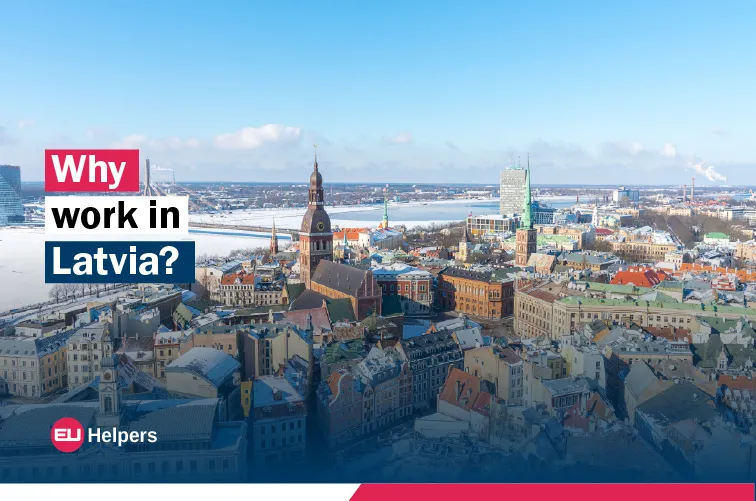

Why Work in Latvia? A Complete EU Helpers Guide for International Professionals
Latvia, the dynamic Baltic nation bordering Estonia to the north, Lithuania to the south, Russia to the east, Belarus to the southeast, and facing the Baltic Sea to the west with a substantial coastline including the Gulf of Riga, occupies an exceptionally attractive position in the Baltic region for those seeking the rare combination of full EU integration (Latvia joined the EU in 2004 as part of the historic Fifth Enlargement of the EU that brought 10 countries including all three Baltic states — Estonia, Latvia, and Lithuania — into the EU, joined Schengen in 2007, joined NATO in 2004, joined the eurozone in 2014 as the 18th country to join the eurozone, and joined the Council of Europe in 1995 — making Latvia one of the most fully EU-integrated Baltic states), distinctive Baltic character (Latvia is one of three Baltic states along with Estonia and Lithuania with shared Baltic history, culture, and geographic position — with distinctive Baltic solidarity demonstrated most powerfully in the 1989 Baltic Way when approximately 2 million people formed a 675-kilometer human chain across Estonia, Latvia, and Lithuania on August 23, 1989, marking the 50th anniversary of the Molotov-Ribbentrop Pact and being one of history's most powerful peaceful demonstrations for independence which contributed to the eventual restoration of Baltic independence in 1991), exceptional Latvian culture with rich cultural heritage (Latvia has extraordinarily distinctive cultural traditions including the Latvian language — one of two surviving Baltic languages alongside Lithuanian — one of the world's oldest Indo-European languages with distinctive character preserved through centuries of Latvian resistance to Russification and Germanization, being spoken by about 1.5 million people primarily in Latvia making it one of Europe's less-spoken official languages though of exceptional linguistic significance, the exceptional Latvian folk song tradition — dainas — the traditional four-line folk songs with over 1 million recorded dainas making it one of the world's most extensive folk song traditions, UNESCO recognized reflecting exceptional Latvian oral heritage, the exceptional Latvian Song and Dance Festival tradition — Vispārējie latviešu Dziesmu un Deju svētki — held every five years and UNESCO recognized as Masterpiece of the Oral and Intangible Heritage of Humanity in 2003, gathering tens of thousands of singers and dancers in Riga in one of the world's largest folk music celebrations reflecting centuries of Latvian cultural tradition dating back to the first festival in 1873, and the distinctive Latvian folk arts including detailed Latvian symbols and patterns), UNESCO World Heritage Sites (Latvia has 2 UNESCO sites including Riga Historic Centre — recognized in 1997 for exceptional Art Nouveau architecture with Riga having one of the world's most concentrated Art Nouveau collections with over 800 Art Nouveau buildings making Riga's historic center distinctively beautiful and one of Europe's most notable Art Nouveau destinations along with Vienna and Barcelona, plus the historic medieval and Hanseatic character reflecting Riga's status as one of the Hanseatic League's important trading centers from the 13th century, and the Struve Geodetic Arc shared with multiple countries — the 19th-century scientific survey chain running from Norway to the Black Sea through 10 countries), distinctive Baltic geography (with beautiful Baltic Sea coastline including the beloved beach destination of Jūrmala — the seaside resort town near Riga famous for its distinctive wooden architecture, mineral spa tradition, and beautiful beaches, Latvia's substantial forests covering approximately half the country making Latvia one of Europe's most forested nations, over 12,500 rivers including the substantial Daugava river running through Riga, over 3,000 lakes including beautiful Latvian lakes, and diverse landscapes including the beautiful Gauja National Park — Latvia's oldest and largest national park, and the distinctive Latvian countryside), rich Latvian historical heritage (with Latvia's complex history spanning ancient Baltic tribes including the Latgalians who gave Latvia its name, Livonian Order and German Baltic influence from the 13th century, Polish-Lithuanian and Swedish periods, Russian Empire rule from the 18th century, Latvian independence declared in 1918 following WWI and the Latvian War of Independence, Soviet occupation from 1940 under the Molotov-Ribbentrop Pact, Nazi occupation during WWII, restored Soviet occupation, the exceptional Baltic Way demonstration in 1989, and finally restored Latvian independence in 1991 following the collapse of the Soviet Union — with Latvia's exceptional resilience through decades of foreign occupation being a source of profound national pride), significant Latvian diaspora connections (with substantial Latvian communities particularly in the United States — with the substantial Latvian American community reflecting refugee flight during Soviet occupation, Canada, Australia, and other countries with substantial Latvian heritage), and Latvia's growing IT sector and Startup Visa framework (Latvia introduced its Startup Visa in 2017 as one of Europe's early startup visa frameworks supporting foreign entrepreneurs). With a population of approximately 1.8 million and covering about 64,589 square kilometers, Latvia has firmly established itself as one of the Baltic region's most attractive destinations. The capital Riga (the vibrant capital and main business, IT, and cultural hub, the largest city in the Baltic states with about 600,000 residents in the city and about 1 million in the metropolitan area representing over half of Latvia's total population, one of Europe's most beautiful capitals with the UNESCO-listed historic center featuring exceptional Art Nouveau architecture — with over 800 Art Nouveau buildings making Riga one of the world's most concentrated Art Nouveau collections and one of Europe's most notable Art Nouveau destinations, the historic Old Town — Vecrīga — with medieval and Hanseatic character reflecting Riga's Hanseatic League membership from the 13th century with narrow cobblestone streets and distinctive medieval buildings, iconic landmarks including the Freedom Monument — Brīvības piemineklis — inaugurated in 1935 as the symbolic monument to Latvian independence dedicated to soldiers killed during the Latvian War of Independence and being the sacred center of Latvian national identity, the House of the Blackheads — Melngalvju nams — the reconstructed Baltic German merchant guild building originally built in 1334 and famously destroyed in WWII then reconstructed in the 1990s, Riga Cathedral — Rīgas Doms — one of the largest Lutheran cathedrals in the Baltic states originally consecrated in 1211, St. Peter's Church — Sv. Pētera baznīca — with its distinctive tower providing views of Riga, the Three Brothers — Trīs brāļi — the historic residential complex being the oldest medieval dwellings in Riga, the Riga Central Market — Rīgas Centrāltirgus — one of Europe's largest markets housed in former Zeppelin hangars from WWI and UNESCO listed as part of the Riga Historic Centre, the Corner House — Stūra māja — the former KGB headquarters now serving as a museum of Soviet-era repression, the Museum of the Occupation of Latvia documenting Latvia's WWII and Soviet occupation experiences, the National Library of Latvia — the Castle of Light — the distinctive modern building designed by Latvian-American architect Gunnar Birkerts, the historic Riga Castle — the seat of the Latvian President, the Riga Art Nouveau Centre in Alberta Street — the concentrated Art Nouveau district, and Riga's growing reputation as one of Northern Europe's emerging business and tech hubs), along with Daugavpils (Latvia's second-largest city in eastern Latvia in the Latgale region with distinctive multicultural character including substantial Russian-speaking population and the historic Daugavpils Fortress — one of Europe's largest 19th-century fortifications), Liepāja (major port city on the Baltic Sea coast in western Latvia with distinctive maritime heritage), Jelgava (historic city near Riga formerly the capital of the Duchy of Courland and Semigallia), Jūrmala (the beloved beach resort town near Riga famous for its distinctive wooden architecture and mineral spa tradition), Ventspils (major port city with growing economic significance), Rēzekne (in eastern Latvia — Latgale region with distinctive Latgalian character and language variations), Valmiera, and Ogre, host Latvian and multinational companies, technology hubs, financial institutions, and innovative start-ups. For applicants from anywhere considering Latvia, the country offers structured immigration pathways including the standard work permit (through employer sponsorship), the EU Blue Card (for highly qualified professionals), the ICT permit (intra-corporate transferee), the Startup Visa (introduced 2017 for innovative entrepreneurs), the D visa (long-stay visa), self-employment residence permits, the researcher permit, family reunification provisions, and a clear long-term route toward Latvian permanent residence and eventually Latvian citizenship with full EU citizenship benefits. At EU Helpers, candidates regularly ask the fundamental question: why should I consider Latvia specifically?
This complete EU Helpers guide answers that question in depth and walks you through the genuine, practical, and long-term reasons that make Latvia one of the Baltic region's most uniquely attractive destinations.
Why Latvia Is Genuinely Distinctive Among European Destinations
Latvia occupies an exceptionally distinctive position in Europe — full EU/Schengen/eurozone/NATO integration, distinctive Baltic character, exceptional Latvian culture, UNESCO-listed Art Nouveau heritage, and distinctive Startup Visa framework.
Full EU, Schengen, Eurozone, and NATO Integration
Latvia is an EU member (since 2004), Schengen member (since 2007), eurozone member (since 2014), NATO member (since 2004), and Council of Europe member (since 1995), providing comprehensive European integration benefits.
Distinctive Baltic Character
Latvia is one of three Baltic states along with Estonia and Lithuania with shared Baltic history, culture, and geographic position. The distinctive Baltic solidarity was demonstrated most powerfully in the 1989 Baltic Way when approximately 2 million people formed a 675-kilometer human chain across the three countries — one of history's most powerful peaceful demonstrations for independence.
Exceptional Latvian Language
Latvian is one of two surviving Baltic languages alongside Lithuanian — one of the world's oldest Indo-European languages with distinctive character preserved through centuries of Latvian resistance to Russification and Germanization.
Exceptional Folk Song Tradition — Dainas
Latvia has the exceptional folk song tradition — dainas — traditional four-line folk songs with over 1 million recorded dainas making it one of the world's most extensive folk song traditions, UNESCO recognized.
UNESCO-Recognized Song and Dance Festival
The Latvian Song and Dance Festival is held every five years and is UNESCO recognized as Masterpiece of the Oral and Intangible Heritage of Humanity (2003). It gathers tens of thousands of singers and dancers in one of the world's largest folk music celebrations, dating back to 1873.
UNESCO Riga Historic Centre — Art Nouveau Capital
Riga Historic Centre is UNESCO recognized for exceptional Art Nouveau architecture. Riga has one of the world's most concentrated Art Nouveau collections with over 800 Art Nouveau buildings, making Riga one of Europe's most notable Art Nouveau destinations along with Vienna and Barcelona.
Distinctive Baltic Geography
Latvia has beautiful Baltic Sea coastline including Jūrmala (the beloved beach resort town), substantial forests covering approximately half the country making Latvia one of Europe's most forested nations, over 12,500 rivers including the Daugava, over 3,000 lakes, and diverse landscapes.
Rich Latvian Historical Heritage
Latvia has complex history spanning ancient Baltic tribes, Livonian Order and German Baltic influence, Polish-Lithuanian and Swedish periods, Russian Empire rule, Latvian independence in 1918, Soviet and Nazi occupations, the exceptional 1989 Baltic Way, and restored independence in 1991.
Startup Visa Framework
Latvia introduced its Startup Visa in 2017 as one of Europe's early startup visa frameworks, supporting foreign entrepreneurs establishing innovative startups in Latvia.
Growing IT Sector
Latvia has developed as one of the Baltic states' growing tech hubs alongside Estonia and Lithuania, with Riga emerging as an important Baltic tech destination.
Accessible Cost of Living
Latvia has moderate cost of living compared to Western European EU countries, with Riga being relatively affordable compared to many European capitals.
Top Financial Reasons to Consider Latvia
The financial rationale for working in Latvia centers around competitive salaries in growth sectors combined with accessible cost of living.
Rising Salary Levels in Growth Sectors
Latvian salaries have been rising notably in IT, senior management, healthcare, and specialized professional roles.
Moderate Cost of Living
Latvia's cost of living is moderate compared to Western European EU averages, with Riga being relatively affordable compared to many European capitals. This provides attractive purchasing power.
Eurozone Currency Convenience
Latvia uses the euro (since 2014), providing currency stability and convenience.
Strong Worker Protections
Latvia has strong labor laws providing paid vacation, parental leave, and other worker protections within EU frameworks.
Universal Healthcare
Latvia has universal healthcare providing coverage for residents.
Public Educational System
Latvia offers public education through university level, with universities including the University of Latvia (founded 1919), Riga Technical University, and others.
Lifestyle and Quality-of-Life Benefits
Beyond money, Latvia offers a distinctive lifestyle combining Baltic character, exceptional cultural heritage, and beautiful nature.
Vibrant Capital Riga
Riga combines extraordinary historical heritage (UNESCO-listed historic center with the historic Old Town Vecrīga featuring medieval and Hanseatic character, exceptional Art Nouveau architecture with over 800 Art Nouveau buildings, the Freedom Monument, House of the Blackheads reconstructed after WWII destruction, Riga Cathedral, St. Peter's Church, the Three Brothers, Riga Central Market in former Zeppelin hangars, the Corner House former KGB headquarters now museum), exceptional modern character (growing tech ecosystem, café culture, dining scene), and rich cultural life. Riga is the largest city in the Baltic states.
Beautiful Jūrmala and Latvian Coast
Jūrmala is the beloved beach resort town near Riga famous for its distinctive wooden architecture and mineral spa tradition. Latvia has beautiful Baltic Sea coastline throughout.
Latvian Countryside and Nature
Latvia's substantial forests covering approximately half the country, over 12,500 rivers, over 3,000 lakes, and diverse landscapes including Gauja National Park (Latvia's oldest and largest national park) create exceptional nature access.
Distinctive Historic Cities
Daugavpils (with the historic Daugavpils Fortress — one of Europe's largest 19th-century fortifications). Liepāja (Baltic Sea port with maritime heritage). Jelgava (formerly the capital of the Duchy of Courland and Semigallia). Ventspils (growing economic significance). Rēzekne (in Latgale region with distinctive Latgalian character). Each city offers distinctive character.
Exceptional Latvian Culture
Latvia has exceptional cultural traditions including the Latvian language, the daina folk song tradition (over 1 million recorded — UNESCO recognized), the UNESCO-recognized Song and Dance Festival (held every five years), and distinctive Latvian folk arts.
Distinctive Latvian Cuisine
Latvian cuisine features distinctive specialties including rye bread (rupjmaize — traditional Latvian black bread), grey peas with bacon (pelēkie zirņi ar speķi — a traditional Latvian dish), Latvian smoked fish (particularly sprats from the Baltic Sea), beetroot soup (aukstā zupa — cold summer variant, and traditional warm variants), sauerkraut, potato dishes, and traditional Latvian pastries. Latvia has notable beer tradition and distinctive Riga Black Balsam — the traditional Latvian herbal liqueur dating back to the 18th century.
Rich Cultural Heritage
Latvia has rich cultural heritage spanning ancient Baltic tribes, Livonian Order and Hanseatic League heritage, historical periods under various powers, Latvian independence in 1918, occupations, and modern independent Latvia.
Generally Safe
Latvia has overall reasonable safety levels, with the country generally considered safe for foreign residents.
Distinctive Baltic Character
Latvians are known for reserved character (typical of Nordic-Baltic peoples), strong environmental consciousness, love of nature, exceptional cultural traditions, and characteristic Baltic resilience.
Latvian Character
Latvian character reflects centuries of Baltic history including exceptional resilience through foreign occupations, strong national identity, love of nature and forests, appreciation of song and dance culture, and characteristic Baltic reserved warmth.
Baltic Sea Coast
Latvia's substantial Baltic Sea coastline provides beach access, maritime heritage, and distinctive coastal character.
Growing International Community
Latvia's Startup Visa framework, growing IT sector, and EU integration have created growing international communities, particularly in Riga.
Family-Friendly Society
Latvian society has family-friendly features with family allowances and family-oriented culture.
Career Growth and Professional Opportunities
Latvia's career environment offers opportunities in growing sectors.
Career Pathways in Technology
For IT professionals, Latvia offers opportunities through Riga's growing tech ecosystem.
Career Pathways in Banking and Financial Services
Latvia's banking and financial services sector creates opportunities.
Career Pathways in Logistics
Latvia's Baltic position creates logistics opportunities.
Career Pathways in Healthcare
Latvia's demographic-driven healthcare demand creates opportunities.
Startup Ecosystem Opportunities
The Startup Visa framework and growing startup ecosystem create entrepreneur opportunities.
Strong Foundation for Baltic and European Careers
As an EU/Schengen/eurozone/NATO member with strong Baltic connections, Latvia provides a foundation for Baltic and European careers.
Residency, Work Permit, and Legal Benefits
Working legally in Latvia comes with structured immigration pathways.
Structured Permit System
Foreign workers obtain residence through dedicated schemes including the standard work permit, EU Blue Card, ICT permit, Startup Visa, D visa, self-employment routes, researcher route, family reunification provisions, and other pathways.
Family Reunification
Latvia allows qualifying workers and residents to bring close family members.
Pathway to Latvian Citizenship and EU Benefits
After qualifying continuous residence in Latvia (typically 5 years for most nationalities) and meeting other requirements including Latvian language and integration criteria, foreign nationals may obtain Latvian citizenship. Latvian citizenship grants full EU citizenship benefits.
Healthcare, Education, and Social Benefits
Latvian public services provide EU-standard coverage.
Universal Healthcare
Latvia has universal healthcare providing coverage for residents.
Educational System
Latvia offers public education through university level, with universities including the University of Latvia (founded 1919), Riga Technical University, Rīga Stradiņš University, and others.
Social Protections
Registered workers benefit from contributions toward pensions, healthcare, and other social protections.
Practical Considerations for Working in Latvia
While Latvia offers compelling benefits, applicants should also understand practical considerations.
Latvian Language Importance
Latvian is essential for broader integration and citizenship. While English and Russian are widely spoken in Latvia, Latvian skills are important for full integration.
Small Market
Latvia's population of approximately 1.8 million creates a smaller labor market compared to larger EU countries.
Weather Considerations
Latvia's Baltic climate creates cold winters and pleasant summers. Winter darkness during December can be significant for some people.
Cultural Adjustments
Latvian culture has distinctive features including reserved interpersonal style, deep appreciation of Latvian traditions, and characteristic Baltic character.
Required Documents and Step-by-Step Overview
While exact requirements depend on the specific permit and applicant profile, the general route involves coordination with the Office of Citizenship and Migration Affairs (OCMA/PMLP), Latvian embassies and consulates abroad, and other authorities.
Practical Tips for International Applicants Considering Latvia
Tips From EU Helpers for Considering Latvia
Carefully evaluate which permit category fits your profile. For innovative entrepreneurs, evaluate the Startup Visa (introduced 2017). Target Latvian employers in strong sectors — IT (Riga tech ecosystem), banking and financial services, logistics, and healthcare. Take advantage of Latvia's distinctive Baltic character, accessible cost of living, and exceptional cultural heritage. Plan for cold Baltic winters. Develop Latvian language skills for broader integration while leveraging English and Russian (widely spoken). Embrace Latvian culture — daina folk songs, Song and Dance Festival tradition, exceptional Art Nouveau heritage in Riga, distinctive Baltic character. Always rely on the latest official guidance.
Final Guidance
Why work in Latvia? Because few countries in Europe combine such a distinctive mix of full EU/Schengen/eurozone/NATO integration (EU member since 2004, Schengen since 2007, eurozone since 2014, NATO since 2004), distinctive Baltic character (with distinctive Baltic solidarity demonstrated in the 1989 Baltic Way when approximately 2 million people formed a 675-kilometer human chain across Estonia, Latvia, and Lithuania — one of history's most powerful peaceful demonstrations for independence), exceptional Latvian culture (with the Latvian language being one of two surviving Baltic languages — one of the world's oldest Indo-European languages, the exceptional Latvian folk song tradition dainas with over 1 million recorded traditional four-line folk songs — UNESCO recognized as one of the world's most extensive folk song traditions, the UNESCO-recognized Latvian Song and Dance Festival held every five years gathering tens of thousands of singers and dancers in one of the world's largest folk music celebrations dating back to 1873), UNESCO World Heritage Sites (Riga Historic Centre — recognized for exceptional Art Nouveau architecture with over 800 Art Nouveau buildings making Riga one of the world's most concentrated Art Nouveau collections and one of Europe's most notable Art Nouveau destinations along with Vienna and Barcelona, plus the historic medieval and Hanseatic character reflecting Riga's Hanseatic League membership from the 13th century, and the Struve Geodetic Arc shared with multiple countries), distinctive Baltic geography (with beautiful Baltic Sea coastline including Jūrmala — the beloved beach resort town, substantial forests covering approximately half the country making Latvia one of Europe's most forested nations, over 12,500 rivers, over 3,000 lakes, and diverse landscapes including Gauja National Park — Latvia's oldest and largest national park), rich Latvian historical heritage (spanning ancient Baltic tribes, Livonian Order and German Baltic influence, various historical periods, Latvian independence in 1918, Soviet and Nazi occupations, the exceptional 1989 Baltic Way demonstration, and restored independence in 1991 — reflecting Latvia's exceptional resilience through decades of foreign occupation), Startup Visa framework (introduced 2017 as one of Europe's early startup visa frameworks supporting foreign entrepreneurs), growing IT sector (with Riga emerging as an important Baltic tech destination alongside Tallinn and Vilnius), accessible cost of living (Latvia having moderate cost of living compared to Western European EU averages with Riga being relatively affordable compared to many European capitals), significant Latvian diaspora connections (with substantial Latvian communities particularly in the United States, Canada, and Australia reflecting refugee flight during Soviet occupation), universal healthcare, and a clear pathway to Latvian citizenship with full EU benefits. For international IT professionals drawn to Riga's growing tech ecosystem, banking and financial services professionals attracted to Latvia's financial sector, entrepreneurs using the distinctive Startup Visa framework (introduced 2017), logistics professionals attracted to Latvia's Baltic position, healthcare professionals attracted to demographic-driven demand, cultural enthusiasts drawn to Latvia's exceptional Art Nouveau heritage in Riga (one of the world's most concentrated Art Nouveau collections), the exceptional Latvian folk song tradition dainas and UNESCO-recognized Song and Dance Festival, or lifestyle migrants attracted to Latvia's distinctive Baltic character, exceptional natural beauty, and accessible cost of living, Latvia stands out as one of the Baltic region's most uniquely attractive destinations. EU Helpers supports international applicants at every stage — from evaluating eligibility and selecting the right permit route (standard work permit, EU Blue Card, ICT permit, Startup Visa, self-employment routes, researcher route, family-based residence, or others) to preparing documents, employer coordination, embassy navigation, OCMA/PMLP procedures, and planning a smooth transition. If Latvia is on your radar as a future work destination, EU Helpers can help you move forward with clarity, confidence, and the latest accurate information.
FAQs
Latvia offers a unique combination of EU/Schengen/eurozone/NATO membership, distinctive Baltic character (with the exceptional 1989 Baltic Way demonstration for independence), exceptional Latvian culture (with folk song dainas tradition and UNESCO-recognized Song and Dance Festival), UNESCO Riga Historic Centre with exceptional Art Nouveau heritage (one of the world's most concentrated Art Nouveau collections), Startup Visa framework (introduced 2017), growing IT sector, accessible cost of living, and a clear pathway to Latvian citizenship with full EU benefits.
Yes. Latvia is an EU member (since 2004), Schengen member (since 2007), eurozone member (since 2014), NATO member (since 2004), and Council of Europe member (since 1995).
Latvia uses the euro as its currency, having adopted the euro in 2014 as the 18th country to join the eurozone.
Riga has one of the world's most concentrated Art Nouveau architectural collections with over 800 Art Nouveau buildings, recognized within the UNESCO-listed Riga Historic Centre. This makes Riga one of Europe's most notable Art Nouveau destinations along with Vienna and Barcelona.
Latvian dainas are traditional four-line folk songs with over 1 million recorded, making the Latvian daina tradition one of the world's most extensive folk song traditions and UNESCO recognized. Dainas reflect centuries of Latvian oral heritage.
The Latvian Song and Dance Festival (Vispārējie latviešu Dziesmu un Deju svētki) is held every five years and is UNESCO recognized as Masterpiece of the Oral and Intangible Heritage of Humanity (2003). It gathers tens of thousands of singers and dancers in Riga in one of the world's largest folk music celebrations, dating back to the first festival in 1873.
The Baltic Way (Baltic Chain) was a peaceful demonstration on August 23, 1989, when approximately 2 million people formed a 675-kilometer human chain across Estonia, Latvia, and Lithuania on the 50th anniversary of the Molotov-Ribbentrop Pact — one of history's most powerful peaceful demonstrations for independence from Soviet occupation. It contributed to the eventual restoration of Baltic independence in 1991.
Latvia introduced its Startup Visa in 2017 as one of Europe's early startup visa frameworks. The Startup Visa supports foreign entrepreneurs establishing innovative startups in Latvia with qualifying business plans and endorsements.
Latvian (Latviešu valoda) is one of two surviving Baltic languages alongside Lithuanian — one of the world's oldest Indo-European languages with distinctive character preserved through centuries of Latvian resistance to Russification and Germanization. Latvian is spoken by about 1.5 million people primarily in Latvia.
Jūrmala is the beloved beach resort town near Riga on the Baltic Sea, famous for its distinctive wooden architecture, mineral spa tradition dating back centuries, and beautiful beaches. Jūrmala is one of the most popular Latvian tourist destinations.
Riga Historic Centre is UNESCO listed since 1997 for exceptional Art Nouveau architecture and the historic medieval and Hanseatic character. Iconic landmarks include the Freedom Monument, House of the Blackheads (reconstructed after WWII destruction), Riga Cathedral, St. Peter's Church, the Three Brothers medieval residential complex, and Riga Central Market housed in former Zeppelin hangars from WWI.
The Three Brothers (Trīs brāļi) is the historic residential complex in Riga being the oldest medieval dwellings in Riga — three connected medieval buildings that survived centuries and are UNESCO listed within the Riga Historic Centre.
The Freedom Monument (Brīvības piemineklis) in Riga was inaugurated in 1935 as the symbolic monument to Latvian independence, dedicated to soldiers killed during the Latvian War of Independence. It is the sacred center of Latvian national identity.
Latvian cuisine features distinctive specialties including rye bread (rupjmaize — traditional Latvian black bread), grey peas with bacon (pelēkie zirņi ar speķi), Latvian smoked fish (particularly Baltic Sea sprats), beetroot soup, sauerkraut, potato dishes, traditional Latvian pastries, notable beer tradition, and distinctive Riga Black Balsam (traditional herbal liqueur since the 18th century).
Latvian is the official language. English and Russian are widely spoken, particularly in Riga and business contexts. Russian remains widely spoken due to Latvia's Soviet-era history and substantial Russian-speaking minority population.
Yes, generally. Latvia has overall reasonable safety levels and is considered safe for foreign residents. Stable political conditions support reasonable safety.
Latvia has a Baltic climate with cold winters (temperatures often below freezing December-February with snow) and pleasant summers (typically 20-25°C June-August). Winter darkness during December can be significant.
Latvia has a moderate cost of living compared to Western European EU countries, with Riga being relatively affordable compared to many European capitals. This provides attractive value for foreign professionals.
Latvia is one of three Baltic states (with Estonia and Lithuania) with distinctive shared Baltic history, culture, and geographic position. The distinctive Baltic solidarity was demonstrated most powerfully in the 1989 Baltic Way. Latvia has distinctive Latvian language (one of two surviving Baltic languages), exceptional folk traditions, and characteristic Baltic character.
Yes. Qualifying workers and residents can usually apply for family reunification for spouses, registered partners, and dependent children.
After qualifying continuous residence in Latvia (typically 5 years for most nationalities) and meeting other requirements including Latvian language and integration criteria, foreign nationals may obtain Latvian citizenship by naturalization. Latvian citizenship grants full EU citizenship benefits.
EU Helpers supports international applicants with eligibility assessment, permit category selection (including Startup Visa for innovative entrepreneurs), document preparation, employer or sponsor coordination, embassy navigation, OCMA/PMLP procedures, and clarity on the latest official requirements tailored to your career goals.