
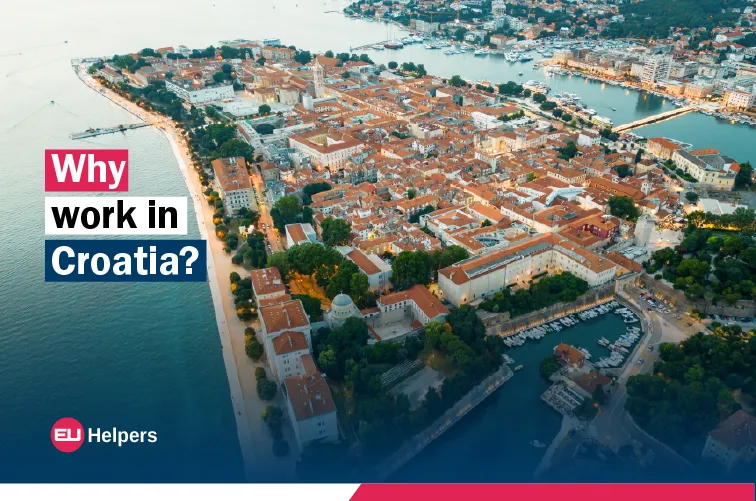

Why Work in Croatia? A Complete EU Helpers Guide for International Professionals
Croatia, the dynamic Southeast European nation on the Adriatic Sea bordering Slovenia, Hungary, Serbia, Bosnia and Herzegovina, and Montenegro, occupies an increasingly attractive position in Europe for those seeking the rare combination of full EU integration (Croatia is an EU member since 2013, joined Schengen in January 2023, and adopted the euro in January 2023, making it one of the most recently fully-integrated EU member states), stunning Mediterranean coastline (with over 1,200 islands along the famous Adriatic), exceptional climate, rich cultural and historical heritage (with multiple UNESCO World Heritage Sites), distinctive digital nomad permit framework (Croatia was one of the first EU countries to introduce comprehensive digital nomad provisions), accessible cost of living compared to Western European EU countries, and Mediterranean lifestyle. With a population of approximately 3.8 million and covering about 56,594 square kilometers, Croatia has firmly established itself as one of the most attractive Mediterranean EU destinations for international professionals, IT and tech specialists, tourism and hospitality professionals, maritime and yachting experts, founders, entrepreneurs, digital nomads, retirees, and lifestyle migrants. As an EU and Schengen member state, a eurozone member, a NATO member, and a Council of Europe member, with stunning natural beauty (including the famous Plitvice Lakes National Park and Krka National Park, both UNESCO sites, and the breathtaking islands of Hvar, Brač, Korčula, Pag, and Mljet), exceptional historical heritage (including UNESCO sites at Dubrovnik's Old Town, Diocletian's Palace in Split, the historic city of Trogir, the Plitvice Lakes, the cathedral of St James in Šibenik, Stari Grad Plain on Hvar, the Episcopal Complex of the Euphrasian Basilica in Poreč, the Stećci Medieval Tombstones, and the Venetian Works of Defence), vibrant coastal lifestyle, distinctive Croatian cuisine, and exceptional Mediterranean climate (with over 2,600 sunny hours per year in coastal areas), Croatia consistently ranks among the most desirable Mediterranean countries in the EU to live and work. The capital Zagreb (the vibrant capital with Austro-Hungarian-era architecture and Croatia's main business and IT hub), along with Split (the historic Dalmatian coast hub with Diocletian's Palace), Dubrovnik (the famous "Pearl of the Adriatic" and UNESCO World Heritage Site), Rijeka (the major port city and 2020 European Capital of Culture), Zadar (a historic Adriatic coast city), Pula (with the famous Roman amphitheater, one of the best preserved Roman amphitheaters in the world), and Osijek (in the Slavonia region), hosts businesses across various sectors. For applicants from anywhere considering Croatia, the country offers structured immigration pathways including the residence and work permit, EU Blue Card, the distinctive digital nomad permit, self-employment route, and other routes, along with a clear long-term route toward Croatian permanent residence and eventually Croatian citizenship (with full EU citizenship benefits).
This complete EU Helpers guide answers the fundamental question of why Croatia deserves consideration. Whether you are considering a salaried role under the residence and work permit, the EU Blue Card, the distinctive digital nomad permit (particularly attractive for remote workers and freelancers), self-employment routes, or family-based residence, this article walks you through everything you need to know.
Why Croatia Is Genuinely Unique Among European Destinations
Croatia occupies an unusually attractive position in Europe — fully EU-integrated with recent Schengen and eurozone membership, blessed with stunning Adriatic coastline, rich with historical heritage, and pioneering in digital nomad provisions.
Recent Full EU Core Integration
Croatia is one of the most recently fully-integrated EU member states. EU membership since 2013, Schengen membership since January 2023, and eurozone membership since January 2023 give Croatia full EU core benefits, making it a particularly distinctive emerging destination.
Stunning Adriatic Coastline
Croatia's Adriatic coastline (over 6,000 km when including the islands) features over 1,200 islands, islets, and reefs (with 48 permanently inhabited), creating one of Europe's most beautiful coastlines.
Multiple UNESCO World Heritage Sites
Croatia has multiple UNESCO World Heritage Sites including Dubrovnik's Old Town (the "Pearl of the Adriatic" and famous "Game of Thrones" filming location for King's Landing), Diocletian's Palace in Split (one of the world's best preserved Roman buildings, still actively inhabited), the historic city of Trogir, the Plitvice Lakes National Park, the cathedral of St James in Šibenik, Stari Grad Plain on Hvar, the Episcopal Complex of the Euphrasian Basilica in Poreč, the Stećci Medieval Tombstones (shared with neighboring countries), and the Venetian Works of Defence (shared with Italy and Montenegro).
Distinctive Digital Nomad Permit
Croatia was one of the first EU countries to introduce a comprehensive digital nomad permit framework (introduced in 2021), making it a notable destination for remote workers seeking to live in an EU/Schengen/eurozone member state with Mediterranean lifestyle.
Exceptional Mediterranean Climate
Croatia's coastal areas enjoy exceptional Mediterranean climate with over 2,600 sunny hours per year, particularly notable in Hvar (often called "Europe's sunniest island"), Dubrovnik, and the Dalmatian coast generally.
Accessible Cost of Living
Croatia has a lower cost of living than Western European EU countries, particularly attractive given full Schengen and eurozone integration.
Top Financial Reasons to Consider Croatia
The financial rationale for working in Croatia centers around accessible cost of living combined with full EU benefits.
Accessible Cost of Living
Croatia has a lower cost of living than Western European EU countries, with housing (particularly outside prime coastal areas during peak summer), food, services, and transportation all significantly less expensive.
Growing Salary Levels
Croatian salaries are rising and competitive for the region, particularly in IT, senior management, tourism leadership, and specialized professional roles.
Eurozone Currency Convenience
Croatia uses the euro (adopted in January 2023), providing currency stability and convenience.
EU Membership Benefits
EU membership provides labor mobility for Croatian citizens (achievable through naturalization), EU funds for development, and other integration benefits.
Schengen Convenience
Schengen membership provides freedom of movement throughout the Schengen Area.
Lifestyle and Quality-of-Life Benefits
Beyond financial considerations, Croatia offers an exceptional Mediterranean lifestyle.
Stunning Adriatic Islands and Coastline
Croatia's coast features stunning destinations including Hvar (the sunny lavender island), Brač (with Zlatni Rat — the Golden Horn beach), Korčula (the birthplace of Marco Polo, reportedly), Mljet (with its national park), Pag (famous for cheese and beaches), Vis (with its remote charm), and many others.
UNESCO-Listed Dubrovnik
Dubrovnik is one of Europe's most beautiful walled cities, with its UNESCO-listed Old Town, famous medieval walls, the Stradun (the main street), and breathtaking setting.
Historic Split with Diocletian's Palace
Split is built around Diocletian's Palace (one of the world's best preserved Roman buildings, built between 295-305 AD), still actively inhabited with residences and shops within Roman walls.
Vibrant Zagreb
Zagreb, Croatia's capital, has Austro-Hungarian-era architecture, the historic Upper Town (Gornji Grad), the funicular (one of the world's shortest), Cathedral of Zagreb, vibrant café culture, and growing dining scene.
Beautiful Natural Heritage
Plitvice Lakes National Park (Croatia's most famous national park with 16 cascading lakes connected by waterfalls, UNESCO listed), Krka National Park (with stunning waterfalls), Brijuni National Park, Mljet National Park, Kornati National Park, Risnjak National Park, and Paklenica National Park offer exceptional natural beauty.
Distinctive Croatian Cuisine
Croatian cuisine combines Mediterranean, Central European, Balkan, and Italian influences with distinctive specialties including seafood (particularly along the coast), peka (slow-cooked meat under a bell), Pag cheese (from Pag island), Slavonian kulen (paprika-flavored sausage), truffles (Istria is famous for truffles), wines (Croatia has notable wine tradition particularly in Dalmatia and Istria), and Adriatic specialties.
Notable Wine and Olive Oil Tradition
Croatia has notable wine tradition with distinctive grape varieties including Plavac Mali, Pošip, Malvazija Istarska, and others. Croatian wines are gaining international recognition. Olive oil production, particularly in Istria, is also notable.
Exceptional Mediterranean Climate
Croatia has exceptional Mediterranean climate along the coast (warm sunny summers, mild winters with abundant sunshine) and continental climate in the interior.
Generally Safe
Croatia is generally safe with relatively low crime rates.
Growing Tourism and Hospitality
Tourism creates a vibrant atmosphere particularly along the coast, with significant international visitor activity supporting hospitality, dining, and cultural scenes.
Affordable Lifestyle Possibilities
Croatia makes lifestyle options accessible — apartments in Zagreb, coastal properties (particularly outside prime tourist areas), dining at quality restaurants, and a generally relaxed Mediterranean lifestyle are accessible.
Career Growth and Professional Opportunities
Croatia's career environment is growing in many sectors.
Strong Career Pathways in Tourism
For tourism professionals, Croatia offers substantial opportunities given its position as one of the Mediterranean's significant tourism destinations.
Growing Opportunities in IT
For IT professionals, Croatia's growing IT sector, particularly around Zagreb, offers expanding opportunities. Companies like Infobip, Rimac (the electric supercar manufacturer), and many others alongside major IT outsourcing operations create vibrant career ecosystems.
Maritime and Yachting Opportunities
For maritime and yachting professionals, the Adriatic coast and Croatian yachting sector create specialized opportunities.
Opportunities for Digital Nomads
For remote workers and freelancers, Croatia's distinctive digital nomad permit makes it particularly accessible.
Opportunities in Healthcare
For healthcare professionals, demographic factors and emigration of medical professionals create growing demand.
Strong Foundation for European Careers
As an EU, Schengen, and eurozone member with central European positioning between Western Europe and the Balkans, Croatia provides a strong foundation for European careers.
Residency, Work Permit, and Legal Benefits
Working legally in Croatia comes with structured immigration pathways.
Structured Permit System
Most foreign workers obtain residence through dedicated schemes including the residence and work permit, EU Blue Card, ICT permit, digital nomad permit, self-employment routes, investor routes, researcher permit, family reunification provisions, and other pathways.
Distinctive Digital Nomad Permit
This pathway makes Croatia particularly accessible for remote workers and freelancers.
Family Reunification
Croatia allows qualifying workers and residents to bring close family members.
Pathway to Croatian Citizenship and EU Benefits
After qualifying continuous residence and work in Croatia, foreign nationals may become eligible for Croatian citizenship by naturalization, granting full EU citizenship benefits.
Healthcare, Education, and Social Benefits
Croatian public services provide coverage for residents.
Healthcare System
Croatia has a healthcare system providing coverage for residents.
Educational System
Croatia offers high-quality public and private education, with international schools available in Zagreb and other major cities.
Social Protections
Registered workers benefit from contributions toward pensions, healthcare, and other social protections.
Practical Considerations for Working in Croatia
While Croatia offers compelling benefits, applicants should also understand some practical considerations.
Demographic Challenges
Croatia faces demographic challenges with significant emigration of skilled workers to other EU member states.
Tourism Seasonality
The coastal economy is highly seasonal, with substantial summer activity and much quieter winter periods.
Language Considerations
Croatian is the official language. English is widely used in tourism and IT, but Croatian language skills enhance integration.
Bureaucratic Considerations
Croatian bureaucracy can sometimes be challenging compared to longer-standing Western European EU members, though this is improving.
Required Documents and Step-by-Step Overview
While exact requirements depend on the specific permit, the general route involves coordination with the Ministry of Interior of Croatia, the Croatian embassy or consulate for D visas where required, and local authorities for registration.
Practical Tips for International Applicants Considering Croatia
Tips From EU Helpers for Considering Croatia
Carefully evaluate which permit category fits your profile, with particular attention to the digital nomad permit for qualifying remote workers. Identify Croatian employers experienced with hiring foreign workers, particularly in IT (Zagreb), tourism (coastal areas), and growing sectors. For self-employment, prepare credible business plans. Take advantage of Croatia's accessible cost of living and full EU/Schengen/eurozone benefits. Plan housing carefully — Zagreb and coastal areas (particularly Dubrovnik) have different markets and considerations. Strengthen your Croatian language skills for daily life and integration. Always rely on the latest official guidance.
Final Guidance
Why work in Croatia? Because few EU member states offer such a unique mix of recent full EU core integration (EU member since 2013, Schengen and eurozone member since January 2023), stunning Adriatic coastline with over 1,200 islands, multiple UNESCO World Heritage Sites (including Dubrovnik's Old Town, Diocletian's Palace in Split, Trogir, Plitvice Lakes, and others), distinctive digital nomad permit framework (one of the EU's first comprehensive digital nomad pathways), accessible cost of living compared to Western European EU countries, exceptional Mediterranean climate (with over 2,600 sunny hours per year in coastal areas), rich cultural heritage spanning Roman, Venetian, Habsburg, and modern Croatian periods, exceptional Croatian cuisine and wine tradition, growing IT sector (anchored by companies like Infobip and Rimac), notable tourism economy, accessible immigration pathways, and a clear path to Croatian citizenship with full EU benefits. For international professionals seeking Mediterranean EU lifestyle with full EU/Schengen/eurozone benefits, tourism and hospitality professionals drawn to one of the Mediterranean's significant destinations, IT professionals seeking growing tech opportunities, digital nomads using the distinctive permit framework, lifestyle migrants and retirees seeking accessible Mediterranean residence, or those drawn to Croatia's stunning natural beauty and rich heritage, Croatia stands out as one of Europe's most uniquely attractive destinations. EU Helpers supports international applicants at every stage — from evaluating eligibility and selecting the right permit route to preparing documents, comparing residence and work permit, EU Blue Card, ICT, the distinctive digital nomad permit, self-employment, investor routes, and family-based residence, and planning a smooth transition. If Croatia is on your radar as a future work or residence destination, EU Helpers can help you move forward with clarity, confidence, and the latest accurate information.
FAQs
Croatia offers a unique combination of recent full EU core integration (EU/Schengen/eurozone member), stunning Adriatic coastline with over 1,200 islands, multiple UNESCO sites, distinctive digital nomad permit, accessible cost of living, exceptional Mediterranean climate, rich cultural heritage, and a clear path to Croatian citizenship with full EU benefits.
Yes. Croatia is an EU member (since 2013), Schengen member (since January 2023), eurozone member (since January 2023), and NATO member.
The euro, adopted in January 2023.
The Croatia digital nomad permit allows foreign nationals to reside in Croatia while working remotely for non-Croatian employers or freelancing for non-Croatian clients. Croatia was one of the first EU countries to introduce this framework.
Multiple sites including Dubrovnik's Old Town, Diocletian's Palace in Split, the historic city of Trogir, the Plitvice Lakes National Park, the cathedral of St James in Šibenik, Stari Grad Plain on Hvar, the Episcopal Complex of the Euphrasian Basilica in Poreč, the Stećci Medieval Tombstones (shared with neighboring countries), and the Venetian Works of Defence (shared with Italy and Montenegro).
Dubrovnik is famous as the "Pearl of the Adriatic" with its UNESCO-listed Old Town and famous medieval walls. It is also famous as a "Game of Thrones" filming location for King's Landing.
Diocletian's Palace is the Roman emperor Diocletian's palace built between 295-305 AD in Split. It is one of the world's best preserved Roman buildings and is still actively inhabited with residences and shops within the Roman walls.
Croatia has exceptional Mediterranean climate along the coast (warm sunny summers, mild winters with abundant sunshine — over 2,600 sunny hours per year in coastal areas) and continental climate in the interior.
Croatia has a lower cost of living than Western European EU countries, particularly attractive given full Schengen and eurozone integration.
Croatian is the official language. English is widely used in tourism and IT contexts.
Yes. Croatia is generally safe with relatively low crime rates.
Croatia has over 1,200 islands, islets, and reefs along its Adriatic coast, with 48 permanently inhabited.
Yes, very. Croatia was one of the first EU countries with a comprehensive digital nomad permit and remains one of the most attractive destinations for remote workers.
Yes, increasingly. Croatia's growing IT sector, particularly around Zagreb, with companies like Infobip and Rimac, offers expanding opportunities.
Zagreb is Croatia's capital with Austro-Hungarian-era architecture, the historic Upper Town (Gornji Grad), vibrant café culture, growing dining scene, and Croatia's main business and IT hub.
The Plitvice Lakes National Park is Croatia's most famous national park, with 16 cascading lakes connected by waterfalls. It is a UNESCO World Heritage Site and one of Europe's most beautiful natural attractions.
The residence and work permit (dozvola za boravak i rad) is Croatia's main framework for foreign workers in salaried employment, combining residence and work authorization.
Yes. Qualifying workers can usually apply for family reunification for spouses and dependent children.
After qualifying continuous residence and work in Croatia, foreign nationals may become eligible for Croatian citizenship by naturalization, granting full EU citizenship benefits.
Yes. Croatia is attractive for retirees seeking Mediterranean EU residence with accessible cost of living, beautiful coastline, exceptional climate, and full EU/Schengen/eurozone benefits.
EU Helpers supports international applicants with eligibility assessment, permit category selection (including the distinctive digital nomad permit), document preparation, employer coordination, and clarity on the latest official requirements tailored to your career goals.