
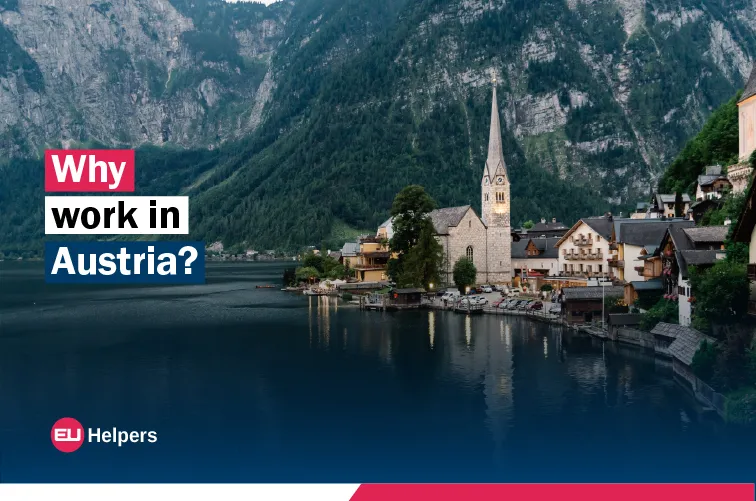

Why Work in Austria? A Complete EU Helpers Guide for International Professionals
Austria, the dynamic Central European nation in the heart of the Alps with one of the EU's most prosperous economies, occupies a uniquely attractive position in Europe for those seeking a combination of exceptional quality of life, strong economy, world-class healthcare and education, rich cultural heritage, stunning natural beauty, and central European location with easy access to surrounding countries. With a population of approximately 9 million and covering about 83,879 square kilometers between the Alps and the Danube River basin, Austria has firmly established itself as one of the most desirable, high-paying, and globally connected work destinations in the European Union for international professionals, IT and tech specialists, banking and finance specialists, engineering experts, healthcare workers, tourism and hospitality leaders, international civil servants (particularly at Vienna's UN, OPEC, and OSCE offices), business consultants, founders, and entrepreneurs. As an EU and Schengen member state, a eurozone member, and a member of multiple international organizations, with one of Europe's highest GDP per capita, world-class universities (including the University of Vienna founded in 1365), the iconic city of Vienna which repeatedly ranks as one of the world's most livable cities (often topping global livability rankings), exceptional Alpine natural beauty, and a rich cultural heritage spanning music (Vienna is the city of Mozart, Haydn, Beethoven, Schubert, and Strauss), arts, architecture, and history, Austria consistently ranks among the most desirable countries in Europe to live and work. Cities like Vienna (the vibrant historic capital and main business hub), Graz (Austria's second-largest city with a UNESCO-listed Old Town), Linz, Salzburg (Mozart's birthplace, also UNESCO-listed), and Innsbruck (the Alpine capital) host major Austrian and multinational companies, technology hubs, financial institutions, manufacturing leaders, international organizations, and innovative start-ups. For applicants from Asia, Africa, Latin America, the Americas, and Europe, Austria offers structured immigration pathways including the distinctive Red-White-Red Card system and the notable Jobseeker visa, EU-aligned legal protections, and a clear long-term route toward Austrian permanent residence and eventually Austrian citizenship. At EU Helpers, candidates regularly ask the fundamental question: why should I consider Austria specifically, compared to other major European destinations?
This complete EU Helpers guide answers that question in depth and walks you through the genuine, practical, and long-term reasons that make Austria one of Europe's most uniquely attractive destinations. Whether you are considering a salaried role under the Red-White-Red Card or its various categories (very highly qualified workers, skilled workers in shortage occupations, other key workers, self-employed key workers, start-up founders, graduates, or regular workers in shortage occupations), the Jobseeker visa for very highly qualified workers, the EU Blue Card, the ICT permit, self-employed key worker pathway, Startup founder route, researcher route, family-based residence, or other pathways, this article walks you through everything you need to know — from strong salaries and Vienna's exceptional livability to Alpine lifestyle, central European location, world-class healthcare, rich cultural heritage, and welcoming immigration framework. Keep in mind that immigration rules, salaries, and market conditions may vary by nationality, employer, permit category, sector, and the latest official requirements, so EU Helpers always recommends confirming your eligibility and offer based on your personal profile before making any move.
Why Austria Is Genuinely Unique Among European Destinations
Austria occupies an unusual position in Europe — small enough to feel manageable and intimate, yet powerful enough to host major international organizations (Vienna's UN offices are the third largest UN site globally after New York and Geneva, alongside OPEC headquarters and OSCE), one of Europe's most prosperous economies, world-class culture, and exceptional quality of life. Few countries in Europe combine such a unique mix of advantages.
One of the World's Most Livable Cities — Vienna
Vienna has repeatedly ranked as one of the world's most livable cities in major international rankings (often holding the top position), reflecting exceptional quality of life, public services, infrastructure, cultural offerings, safety, environment, and overall livability. This is one of Austria's most distinctive features.
Strong and Prosperous Economy
Austria has one of Europe's highest GDP per capita, with sophisticated industrial sectors (machinery, automotive components, electronics, specialty chemicals), strong services sectors, prosperous financial sector, and significant tourism. This prosperity translates into strong job markets, infrastructure, and quality of life.
Major International Organization Hub
Vienna hosts major international organizations including the UN (Vienna International Centre houses major UN offices and is the third largest UN site globally), OPEC headquarters, OSCE, IAEA (International Atomic Energy Agency), UNIDO, and many others. This creates exceptional opportunities for international affairs careers.
Strategic Central European Location
Austria's location in the heart of Europe, bordering Germany, Czech Republic, Slovakia, Hungary, Slovenia, Italy, Switzerland, and Liechtenstein, provides exceptional access to surrounding countries and central European business networks.
World-Class Cultural Heritage
Austria has an extraordinary cultural heritage, particularly in music (the home of Mozart, Haydn, Beethoven, Schubert, Strauss, and Mahler), arts, architecture, and intellectual history (Freud, Wittgenstein, and many others). Vienna and Salzburg are particularly renowned cultural centers, with multiple UNESCO World Heritage Sites.
Exceptional Alpine Natural Beauty
Austria offers some of Europe's most spectacular Alpine natural beauty, with the Austrian Alps covering much of the country, beautiful lakes (including the lake districts of Salzkammergut), the Danube River, and stunning natural landscapes.
Welcoming Immigration Framework for Qualified Workers
Austria has developed a structured points-based immigration system through the Red-White-Red Card, with categories specifically targeting various qualified worker profiles, plus the distinctive Jobseeker visa allowing very highly qualified workers to enter Austria to search for employment.
Top Financial Reasons to Consider Austria
The financial rationale for working in Austria centers around strong salaries, comprehensive social benefits, and access to one of Europe's most prosperous economies.
Strong Salaries in Key Sectors
Austrian salaries are among Europe's stronger, with particular strength in senior IT, engineering, healthcare specialists, banking, and senior management roles. Top sectors offer particularly competitive compensation, and Austrian compensation typically includes strong benefits packages.
Comprehensive Social Welfare System
Austria has a generous and comprehensive social welfare system, including extensive healthcare coverage, family allowances, pension contributions, unemployment insurance, parental leave, and other benefits. These significantly enhance the financial value of working in Austria.
Strong Worker Protections
Austria has strong labor laws and worker protections, with mandatory paid vacation (typically 5 weeks for most workers), public holidays, robust employment protections, and other features.
Generous Parental Leave
Austria offers generous parental leave provisions supporting work-life balance and family-oriented careers.
Eurozone Currency Convenience
Austria uses the euro, providing currency stability and convenience for European business and personal matters.
Generally Reasonable Cost of Living
Vienna and other Austrian cities have a relatively high cost of living, though typically lower than Switzerland or some Western European capitals. Salary levels generally provide good purchasing power.
Lifestyle and Quality-of-Life Benefits
Beyond money, Austria offers a lifestyle that genuinely tops global livability rankings, combining urban sophistication, Alpine beauty, cultural richness, and exceptional public services.
Vienna's Exceptional Livability
Vienna, Austria's vibrant and historic capital, consistently tops global livability rankings, combining imperial architectural heritage (the Hofburg Palace, Schönbrunn Palace, Belvedere Palace, Vienna State Opera, St. Stephen's Cathedral), world-class culture (Vienna is the city of Mozart, the Vienna Philharmonic Orchestra, and countless cultural institutions), exceptional public transport (the U-Bahn metro system), green spaces (the Vienna Woods and parks), thriving café culture (the Wiener Kaffeehaus tradition is UNESCO-listed Intangible Cultural Heritage), excellent restaurants, and an exceptional quality of life. Vienna's historic center is a UNESCO World Heritage Site.
Other Distinctive Cities
Salzburg, Mozart's birthplace and a UNESCO World Heritage Site renowned for its stunning Baroque architecture, the Hohensalzburg Fortress, and the Salzburg Festival. Graz, Austria's second-largest city with a UNESCO-listed Old Town and growing tech scene. Linz, an emerging cultural and industrial center. Innsbruck, the spectacular Alpine capital surrounded by mountains, hosting two Winter Olympics. Each Austrian city offers distinctive character.
Stunning Alpine Natural Landscapes
Austria offers spectacular natural beauty including the Austrian Alps (covering about two-thirds of the country), beautiful lakes (including the Salzkammergut lake district with destinations like Hallstatt — a UNESCO World Heritage Site), the Danube River valley with its dramatic Wachau (also UNESCO-listed), the Grossglockner (Austria's highest peak), and many other natural treasures.
World-Class Skiing and Mountain Sports
Austria is one of the world's premier skiing destinations, with iconic resorts including Kitzbühel, St. Anton, Mayrhofen, Saalbach, and many others. For those who value winter sports, Austria is genuinely exceptional. Summer mountain activities including hiking, mountaineering, cycling, and lake-based activities are equally distinctive.
Rich Musical and Cultural Heritage
Austria's cultural heritage is exceptional — the home of Mozart, Haydn, Beethoven, Schubert, Strauss (the Vienna Waltz), Mahler, and many other musical giants. Vienna's musical institutions including the Vienna Philharmonic, Vienna State Opera, Salzburg Festival, and countless others make Austria a global musical capital. UNESCO World Heritage Sites include the historic centers of Vienna and Salzburg, Schönbrunn Palace, the Wachau, Hallstatt, the Semmering Railway, and others.
Distinctive Austrian Cuisine
Austrian cuisine offers distinctive specialties including Wiener Schnitzel (the iconic Vienna schnitzel), Tafelspitz (boiled beef), Sachertorte (the famous chocolate cake from Hotel Sacher), Apfelstrudel, Vienna sausages, dumplings (Knödel), and excellent wines from the Wachau and Burgenland. Coffee culture is exceptionally important and recognized by UNESCO.
Pleasant Continental Climate
Austria has a continental climate with four distinct seasons, with warm summers (perfect for outdoor activities and lake visits), beautiful autumn, snowy winters (excellent for skiing), and pleasant spring. The seasons create distinctive year-round experiences.
Exceptional Safety
Austria is consistently ranked among the safer countries in the world, with very low crime rates and strong political stability.
Strong Work-Life Balance
Austria values work-life balance, with reasonable working hours, generous vacation entitlements (typically 5 weeks paid vacation), and a culture that values family time, leisure, and quality of life.
Family-Friendly Society
Austria has a family-oriented culture with high-quality public childcare, family allowances, generous parental leave, and family-friendly workplace policies.
World-Class Educational Options
Austria has world-class universities including the University of Vienna (founded in 1365, one of Europe's oldest), Vienna University of Technology, University of Innsbruck, Medical University of Vienna, and others. International schools in Vienna serve the substantial international community.
Excellent Public Transport
Austria has excellent public transport, including Vienna's renowned U-Bahn metro system, ÖBB national railways (with high-speed connections to neighboring countries), and efficient transport throughout the country.
Easy Access to Surrounding Countries
Austria's central European location means easy access to Germany, Czech Republic, Slovakia, Hungary, Slovenia, Italy, Switzerland, and beyond. Munich, Prague, Bratislava, Budapest, Ljubljana, Venice, and Zurich are all easily accessible.
Career Growth and Professional Opportunities
Austria's career environment is dynamic and offers strong opportunities across multiple sectors.
Career Pathways in Prosperous Economy
For finance professionals, Austria's strong banking sector (with major banks like Erste Group, Raiffeisen Bank International, and Bank Austria) offers substantial opportunities. For IT and tech professionals, growing tech ecosystem particularly in Vienna and Graz offers expanding opportunities. For engineering and industrial professionals, Austria's strong manufacturing tradition creates substantial opportunities. For healthcare professionals, significant demand driven by demographic aging creates opportunities (with German language and qualification recognition typically required).
International Organization Careers
Vienna's role as host of major international organizations including the UN, OPEC, OSCE, IAEA, and others creates distinctive opportunities for international affairs careers, including specialists in diplomacy, multilingual communication, security, and policy.
Opportunities for Entrepreneurs
Austria offers the Red-White-Red Card for self-employed key workers (Selbständige Schlüsselkräfte) and the start-up founder category for foreign entrepreneurs with credible projects creating significant economic value.
Strong Foundation for European Mobility
As an EU and Schengen member with central European location and excellent transport connections, Austria is an excellent base for European and international careers.
Residency, Work Permit, and Legal Benefits
Working legally in Austria comes with structured immigration pathways and strong legal protections within the EU framework.
Structured Permit System
Most foreign workers obtain a residence permit through dedicated schemes such as the Red-White-Red Card (with multiple categories), the Red-White-Red Card Plus, the EU Blue Card, the ICT permit, the Jobseeker visa, the self-employed key worker route, the Startup founder route, the researcher route, or family-based residence.
Red-White-Red Card Points-Based System
Austria's Red-White-Red Card uses a structured points-based system that provides clear criteria for qualifying as a very highly qualified worker, skilled worker in shortage occupations, or other categories.
Jobseeker Visa for Very Highly Qualified Workers
The Jobseeker visa allows very highly qualified third-country nationals to enter Austria for up to 6 months to search for employment — a distinctive Austrian feature.
EU Blue Card
Austria issues the EU Blue Card for highly qualified third-country professionals.
Family Reunification With Strong Provisions
Austria allows qualifying workers and residents to bring close family members, including spouses and dependent children, though Austria's family reunification framework has specific requirements and is sometimes subject to annual quotas.
Pathway to Long-Term Residency and Austrian Citizenship
After several continuous years of legal residence and work in Austria, foreign nationals may become eligible for permanent residence and eventually Austrian citizenship by naturalization, though Austrian citizenship typically requires meeting stringent criteria including significant residence periods, integration, German language proficiency, and other requirements. Austrian citizenship is valuable as it grants full EU citizenship benefits.
Healthcare, Education, and Social Benefits
Austria's public services are widely recognized for their quality.
World-Class Healthcare System
Austria has a world-class universal healthcare system with high-quality medical care, modern facilities, and excellent outcomes. The system is widely recognized as one of Europe's best.
Excellent Educational System
Austria offers a high-quality public educational system, alongside excellent private schools and international schools (particularly in Vienna serving the diplomatic and international business community). The University of Vienna and other Austrian universities have respected traditions.
Strong Social Protections for Workers
Registered workers benefit from comprehensive contributions toward pensions, healthcare, unemployment insurance, parental leave, and other social protections through the Austrian social security system.
Generous Family Benefits
Austria offers generous family benefits including family allowances, parental leave, childcare subsidies, and other family-supporting policies.
Practical Considerations for Working in Austria
While Austria offers compelling benefits, applicants should also understand some practical considerations.
German Language Importance
While English is widely used in international business, IT, academic settings, and multinational companies (particularly in Vienna), German is widely required in many roles and essential for daily life, integration, and the long-term path to permanent residence and citizenship. Investing in German language skills significantly enhances career prospects and quality of life.
Climate Considerations
Austria's continental climate with cold winters (often with snow) and warm summers may require adjustment for those from different climates, though the distinct seasons are appreciated by many.
Bureaucratic Considerations
Austrian bureaucracy can be detailed and structured, requiring careful attention to documentation and procedures.
Family Reunification Quotas
Austria's family reunification framework is sometimes subject to annual quotas that can affect timing and processing of family applications.
Required Documents and Step-by-Step Overview of Working in Austria
While exact requirements depend on the specific permit and applicant profile, the general route to legally working in Austria follows a predictable structure.
Typical Documents Needed
Applicants usually need a valid passport, police clearance certificates, medical certificates where required, proof of qualifications and experience (with degree recognition where applicable), a formal job offer or qualifying ground, employer or sponsor documentation, accommodation evidence, valid health insurance, and proof of financial means. Translations into German and apostille or legalization of foreign public documents are commonly required.
General Step-by-Step Process
The process typically starts with securing a job offer (for sponsored routes), or qualifying for the Jobseeker visa, self-employed key worker route, Startup founder route, or other qualifying ground. The application involves coordination with the AMS for labor market assessment (for many categories), the provincial immigration authority for the residence permit decision, the Austrian embassy or consulate for the D visa (for visa-required nationals), and post-arrival registration in Austria.
Common Mistakes and Reasons for Delays or Refusals
Incomplete documents, missing translations or legalizations, unverified employer sponsorship, salary or qualification shortfalls, points-based assessment shortfalls, the wrong permit category being selected, and unrealistic expectations are common reasons for delays or refusals.
Practical Tips for International Applicants Considering Austria
Moving to Austria is rewarding, but preparation makes the difference.
Tips From EU Helpers for Considering Austria
Carefully evaluate which permit category fits your profile, including specific Red-White-Red Card categories (shortage occupations, very highly qualified workers, self-employed key workers, start-up founders), Jobseeker visa, EU Blue Card, or others. Check Austria's official shortage occupation list, as roles in shortage occupations benefit from streamlined Red-White-Red Card processing. Identify Austrian employers experienced with hiring foreign workers, particularly multinational subsidiaries, major Austrian companies, and international organizations in Vienna. Strengthen your German language skills significantly — German is widely required and essential for the long-term integration path. For Jobseeker visa applicants, prepare comprehensive points-based documentation. For Startup founder applicants, focus on innovative business propositions. Consider Austrian qualification recognition processes carefully, particularly for healthcare and other regulated professions. Plan housing in Vienna or other relevant cities. Always rely on the latest official guidance.
Final Guidance
Why work in Austria? Because few countries in Europe combine such a unique mix of Vienna's exceptional livability (consistently topping global livability rankings), strong and prosperous economy with high salaries in key sectors, world-class healthcare and education, exceptional Alpine natural beauty, rich cultural heritage (the home of Mozart, Beethoven, and countless musical and artistic giants), major international organization hub status (Vienna hosts major UN offices, OPEC, OSCE, IAEA, and others), exceptional safety, strong family-oriented benefits, central European location with easy access to surrounding countries, world-class skiing and mountain sports, distinctive cuisine and coffee culture, comprehensive social welfare, and a clear pathway to Austrian citizenship with full EU benefits. For international professionals seeking exceptional quality of life combined with strong career opportunities in a culturally rich and naturally stunning country, Austria stands out as one of Europe's most uniquely attractive destinations. However, the process is structured, and outcomes depend heavily on personal circumstances, employer sponsorship (or alternative qualifying ground), nationality, sector, German language skills, and the specific permit category chosen. That is exactly where expert guidance matters. EU Helpers supports international applicants at every stage — from evaluating eligibility and selecting the right permit route to preparing documents, comparing Red-White-Red Card categories, Jobseeker visa, EU Blue Card, ICT, self-employed key worker, Startup founder, researcher route, family-based residence, and other pathways, and planning a smooth relocation. If Austria is on your radar as a future work destination, EU Helpers can help you move forward with clarity, confidence, and the latest accurate information.
Why should I work in Austria?
Austria offers a unique combination of Vienna's exceptional livability (consistently topping global livability rankings), strong and prosperous economy, world-class healthcare and education, exceptional Alpine natural beauty, rich cultural heritage, major international organization hub status, exceptional safety, strong family benefits, central European location, world-class skiing, distinctive cuisine, and a clear pathway to Austrian citizenship.
Why is Vienna so highly ranked for livability?
Vienna repeatedly ranks as one of the world's most livable cities, reflecting exceptional quality of life, public services, infrastructure, cultural offerings (the city of Mozart and countless cultural institutions), safety, environment, public transport, green spaces, café culture, and overall livability.
How do Austrian salaries compare to other European countries?
Austrian salaries are among Europe's stronger, with particular strength in senior IT, engineering, healthcare specialists, banking, and senior management roles. Top sectors offer particularly competitive compensation, and Austrian compensation typically includes strong benefits packages.
What international organizations are based in Austria?
Vienna hosts major international organizations including the UN (Vienna International Centre is the third largest UN site globally after New York and Geneva), OPEC headquarters, OSCE, IAEA (International Atomic Energy Agency), UNIDO, and many others. This creates exceptional opportunities for international affairs careers.
What is Austria's cultural heritage like?
Austria has an extraordinary cultural heritage, particularly in music (the home of Mozart, Haydn, Beethoven, Schubert, Strauss, and Mahler), arts, architecture, and intellectual history. Vienna and Salzburg are particularly renowned cultural centers with multiple UNESCO World Heritage Sites.
Is Austria a good destination for outdoor enthusiasts?
Yes. Austria offers some of Europe's most spectacular Alpine natural beauty and is one of the world's premier skiing destinations with iconic resorts including Kitzbühel, St. Anton, Mayrhofen, and Saalbach. Summer mountain activities including hiking, cycling, and lake-based activities are equally distinctive.
What is the Austrian Red-White-Red Card?
The Red-White-Red Card (Rot-Weiß-Rot Karte) is Austria's main work and residence permit for qualified third-country nationals, structured around a points-based system with multiple categories including very highly qualified workers, skilled workers in shortage occupations, other key workers, self-employed key workers, start-up founders, graduates of Austrian universities, and regular workers in shortage occupations.
What is the Austria Jobseeker visa?
The Jobseeker visa (Aufenthaltsbewilligung für Stellensuchende) allows very highly qualified third-country nationals to enter Austria for up to 6 months to search for employment locally. It is awarded based on a points-based assessment.
What is the Austrian EU Blue Card?
Austria issues the EU Blue Card for highly qualified third-country professionals with recognized higher education or equivalent qualifications and a qualifying job offer that meets the salary threshold.
Is Austria part of the EU and Schengen Area?
Yes. Austria is an EU member state, a Schengen Area member, and a eurozone member.
What currency does Austria use?
Austria uses the euro as its currency.
Is Austria safe?
Yes. Austria is consistently ranked among the safer countries in the world, with very low crime rates and strong political stability.
What is Austria's healthcare system like?
Austria has a world-class universal healthcare system with high-quality medical care, modern facilities, and excellent outcomes. The system is widely recognized as one of Europe's best.
Does Austria value work-life balance?
Yes. Austria values work-life balance, with reasonable working hours, generous vacation entitlements (typically 5 weeks paid vacation), and a culture that values family time, leisure, and quality of life.
How important is German for working in Austria?
German is widely required for many roles in Austria, particularly in healthcare, public administration, customer-facing roles, and traditional industries. English is widely used in international business, IT, academic settings, and multinational companies, particularly in Vienna. German language skills significantly enhance career prospects and the long-term integration path.
What is Austria's coffee culture?
Austria's coffee culture, particularly the Wiener Kaffeehaus (Vienna coffee house) tradition, is exceptionally important and recognized by UNESCO as Intangible Cultural Heritage. Vienna's historic coffee houses are cultural institutions.
Can I bring my family to live with me while working in Austria?
Qualifying workers can usually apply for family reunification for spouses and dependent children, though Austria's family reunification framework has specific requirements and is sometimes subject to annual quotas. EU Blue Card holders typically benefit from particularly favorable family reunification provisions.
Does working in Austria lead to long-term residency or citizenship?
After several continuous years of legal residence and work in Austria, foreign nationals may become eligible for permanent residence and eventually Austrian citizenship by naturalization, though citizenship typically requires meeting stringent criteria including significant residence periods, integration, and German language proficiency.
Are there opportunities for foreign doctors in Austria?
Yes, with significant demand driven by demographic aging. Healthcare in Austria offers opportunities for specialized doctors, surgeons, dentists, and senior medical professionals. Recognition of foreign qualifications and German language proficiency are typically required.
What are the main growth sectors in Austria?
The main growth sectors in Austria include IT and software development, healthcare (driven by demographic aging), engineering and industrial innovation, cybersecurity, AI and data science, renewable energy and green transition, skilled trades, tourism and hospitality, banking and financial services, manufacturing, and international organizations.
Is Austria good for international students?
Yes. Austria has world-class universities including the University of Vienna (founded in 1365), Vienna University of Technology, University of Innsbruck, Medical University of Vienna, and others, with English-language programs at many institutions and provisions for post-graduation work in Austria.
How can EU Helpers help me with working in Austria?
EU Helpers supports international applicants with eligibility assessment, permit category selection (including various Red-White-Red Card categories, Jobseeker visa, EU Blue Card, and others), document preparation, employer coordination, and clarity on the latest official requirements. The goal is to help you approach the Austrian work and residency process with accurate, up-to-date, and practical information tailored to your career goals.
FAQs
Why should I work in Austria?
Austria offers a unique combination of Vienna's exceptional livability (consistently topping global livability rankings), strong and prosperous economy, world-class healthcare and education, exceptional Alpine natural beauty, rich cultural heritage, major international organization hub status, exceptional safety, strong family benefits, central European location, world-class skiing, distinctive cuisine, and a clear pathway to Austrian citizenship.
Vienna repeatedly ranks as one of the world's most livable cities, reflecting exceptional quality of life, public services, infrastructure, cultural offerings (the city of Mozart and countless cultural institutions), safety, environment, public transport, green spaces, café culture, and overall livability.
Austrian salaries are among Europe's stronger, with particular strength in senior IT, engineering, healthcare specialists, banking, and senior management roles. Top sectors offer particularly competitive compensation, and Austrian compensation typically includes strong benefits packages.
Vienna hosts major international organizations including the UN (Vienna International Centre is the third largest UN site globally after New York and Geneva), OPEC headquarters, OSCE, IAEA (International Atomic Energy Agency), UNIDO, and many others. This creates exceptional opportunities for international affairs careers.
Austria has an extraordinary cultural heritage, particularly in music (the home of Mozart, Haydn, Beethoven, Schubert, Strauss, and Mahler), arts, architecture, and intellectual history. Vienna and Salzburg are particularly renowned cultural centers with multiple UNESCO World Heritage Sites.
Yes. Austria offers some of Europe's most spectacular Alpine natural beauty and is one of the world's premier skiing destinations with iconic resorts including Kitzbühel, St. Anton, Mayrhofen, and Saalbach. Summer mountain activities including hiking, cycling, and lake-based activities are equally distinctive.
The Red-White-Red Card (Rot-Weiß-Rot Karte) is Austria's main work and residence permit for qualified third-country nationals, structured around a points-based system with multiple categories including very highly qualified workers, skilled workers in shortage occupations, other key workers, self-employed key workers, start-up founders, graduates of Austrian universities, and regular workers in shortage occupations.
The Jobseeker visa (Aufenthaltsbewilligung für Stellensuchende) allows very highly qualified third-country nationals to enter Austria for up to 6 months to search for employment locally. It is awarded based on a points-based assessment.
Austria issues the EU Blue Card for highly qualified third-country professionals with recognized higher education or equivalent qualifications and a qualifying job offer that meets the salary threshold.
Yes. Austria is an EU member state, a Schengen Area member, and a eurozone member.
Austria uses the euro as its currency.
Yes. Austria is consistently ranked among the safer countries in the world, with very low crime rates and strong political stability.
Austria has a world-class universal healthcare system with high-quality medical care, modern facilities, and excellent outcomes. The system is widely recognized as one of Europe's best.
Yes. Austria values work-life balance, with reasonable working hours, generous vacation entitlements (typically 5 weeks paid vacation), and a culture that values family time, leisure, and quality of life.
German is widely required for many roles in Austria, particularly in healthcare, public administration, customer-facing roles, and traditional industries. English is widely used in international business, IT, academic settings, and multinational companies, particularly in Vienna. German language skills significantly enhance career prospects and the long-term integration path.
Austria's coffee culture, particularly the Wiener Kaffeehaus (Vienna coffee house) tradition, is exceptionally important and recognized by UNESCO as Intangible Cultural Heritage. Vienna's historic coffee houses are cultural institutions.
Qualifying workers can usually apply for family reunification for spouses and dependent children, though Austria's family reunification framework has specific requirements and is sometimes subject to annual quotas. EU Blue Card holders typically benefit from particularly favorable family reunification provisions.
After several continuous years of legal residence and work in Austria, foreign nationals may become eligible for permanent residence and eventually Austrian citizenship by naturalization, though citizenship typically requires meeting stringent criteria including significant residence periods, integration, and German language proficiency.
Yes, with significant demand driven by demographic aging. Healthcare in Austria offers opportunities for specialized doctors, surgeons, dentists, and senior medical professionals. Recognition of foreign qualifications and German language proficiency are typically required.
The main growth sectors in Austria include IT and software development, healthcare (driven by demographic aging), engineering and industrial innovation, cybersecurity, AI and data science, renewable energy and green transition, skilled trades, tourism and hospitality, banking and financial services, manufacturing, and international organizations.
Yes. Austria has world-class universities including the University of Vienna (founded in 1365), Vienna University of Technology, University of Innsbruck, Medical University of Vienna, and others, with English-language programs at many institutions and provisions for post-graduation work in Austria.
EU Helpers supports international applicants with eligibility assessment, permit category selection (including various Red-White-Red Card categories, Jobseeker visa, EU Blue Card, and others), document preparation, employer coordination, and clarity on the latest official requirements. The goal is to help you approach the Austrian work and residency process with accurate, up-to-date, and practical information tailored to your career goals.