
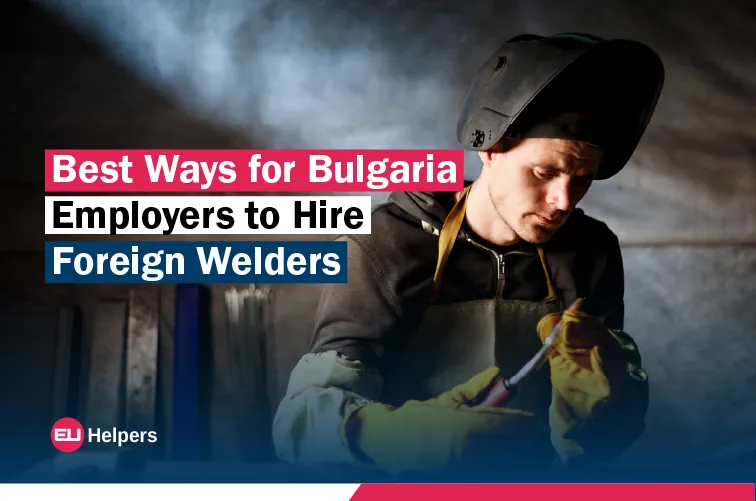

Best Ways for Bulgaria Employers to Hire Foreign Welders — The Complete EU Helpers Employer Guide
Bulgaria has emerged as one of the most strategically positioned industrial economies in Southeast Europe. From the automotive components and electronics manufacturing belts around Plovdiv, Stara Zagora, and Ruse, to the metallurgy and machinery industries in central Bulgaria, to the petrochemical and energy cluster around Burgas (Lukoil Neftochim, one of the largest refineries in the Balkans) and Devnya, to shipbuilding in Varna and Burgas, to defence and aerospace contractors, to construction across Sofia, Plovdiv, Varna, and the Black Sea tourism corridor, welders are at the centre of Bulgaria’s industrial and construction productivity. Yet the local supply of qualified welders is no longer sufficient. Welder roles consistently appear on Bulgarian shortage occupations lists, demographic decline is one of the steepest in Europe, and emigration to Germany, Spain, Italy, Greece, and the UK keeps pulling Bulgarian welders abroad. As a result, more and more Bulgarian employers are now turning to foreign recruitment to fill their welding positions.
This in-depth EU Helpers guide is built for Bulgarian construction companies, metal fabrication workshops, industrial contractors, automotive and electronics suppliers, shipbuilding firms, petrochemical and energy operators, defence contractors, and HR professionals who want to understand the best ways to hire foreign welders for Bulgaria. At EU Helpers, we work directly with Bulgarian employers to source qualified welders from abroad, manage single permit applications and residence cards, coordinate documentation, and ensure full compliance with Bulgarian immigration, labour, and collective agreement rules. In the sections below, you will learn where to find welders, which authorisation routes apply, what certifications matter most, how long the process really takes, how much it costs, what mistakes to avoid, and how factors like nationality, welding specialisation, and project type can shape your hiring strategy.
Why Bulgarian Employers Are Hiring Welders from Abroad
Bulgaria’s industrial economy depends on welding capacity across nearly every sector. Automotive components, electronics manufacturing, machinery production, defence equipment, energy and petrochemical facilities, shipbuilding, construction steelwork, food processing equipment, and metal fabrication for tourism infrastructure all require certified welders working to demanding standards. At the same time, the supply of qualified welders inside Bulgaria has been declining sharply. Bulgaria has one of the steepest demographic declines in the EU, with hundreds of thousands of working-age citizens having moved to Germany, Spain, Italy, Greece, the UK, the Netherlands, and other Western EU countries since EU accession. Industrial trades have been particularly affected. Younger Bulgarians often pursue IT, BPO, or service-sector careers rather than industrial work.
For employers, hiring foreign welders is no longer a backup plan — it is becoming a structural part of how Bulgarian businesses deliver projects, keep production lines running, and meet export commitments. Bringing in welders from abroad allows Bulgarian companies to keep workshops productive, meet contract deadlines, expand into more complex industrial jobs, and maintain quality standards on demanding metalwork. But hiring foreign welders also comes with serious legal responsibilities, monitored by the Employment Agency (Agentsiya po zaetostta), the Ministry of Labour and Social Policy, the Migration Directorate of the Ministry of Interior, the National Revenue Agency (NRA), the National Social Security Institute (NSSI / NOI), the General Labour Inspectorate (GIT), and other competent authorities. Understanding the rules from the start is the foundation of a successful international recruitment programme.
Where Welding Demand Is Strongest in Bulgaria
Welding demand in Bulgaria is visible across several regions and sectors. Plovdiv and the surrounding Trakia Economic Zone host one of the largest automotive components and industrial clusters in the Balkans, with strong demand for welders in automotive, electronics, and machinery. Stara Zagora adds machinery, energy, and heavy industry welding demand. Ruse combines shipbuilding (Danube river vessels), machinery, and metal industry. Burgas anchors petrochemical, energy, and shipbuilding welding around Lukoil Neftochim and the port. Devnya and Varna add chemical, energy, and shipbuilding demand. Sofia concentrates construction and industrial machinery welding. Veliko Tarnovo, Pleven, Vratsa, and other regional centres host machinery and metallurgy. Each region has its own welding profile, certification needs, and salary expectations, and EU Helpers adapts the recruitment strategy to match.
Why Local Welders Alone Cannot Meet Demand
Bulgaria has a strong welding tradition, supported by structured vocational training that traces back to the country’s industrial heritage. But the demographic reality is brutal — Bulgaria’s population has been declining for decades, and emigration of skilled industrial workers to Western EU markets has accelerated since EU accession. Combined with low birth rates and an ageing workforce, the result is a chronic shortage that local recruitment alone cannot solve. Bringing in foreign welders from countries with strong welding traditions and structured certification systems has become the most practical and sustainable solution for many Bulgarian employers.
Understanding the Legal Framework Before You Recruit
Before sourcing the first candidate, Bulgarian employers need to understand the legal categories that govern hiring foreign workers — and specifically foreign welders — in Bulgaria. The route you choose will affect timelines, costs, documentation, and how soon the welder can legally start working.
EU/EEA and Swiss Welders
Welders from EU member states, EEA countries, and Switzerland enjoy freedom of movement and do not need a work permit in Bulgaria. They can be employed on the same terms as Bulgarian welders. The employer’s main obligations are correct registration with NRA (tax), NSSI (social security), full compliance with any applicable collective agreement (kolektiven trudov dogovor), and Bulgarian labour, tax, and safety rules. Many Bulgarian employers therefore start their search for foreign welders in Romania, Greece, Hungary, Slovakia, the Czech Republic, Poland, Croatia, and Italy.
Non-EU (Third-Country) Welders
For welders from outside the EU/EEA and Switzerland, Bulgarian law sets out a structured set of permit routes. The right one depends on the welder’s qualifications, nationality, and the role.
Single Permit for Work and Residence
For employment longer than 90 days, Bulgaria offers a single permit that combines the work and residence authorisation into one document. The employer submits the application through the Employment Agency, which evaluates the labour market component, while the Migration Directorate handles the residence component. Welder roles are commonly recognised on shortage occupations lists, which often supports the labour market component of the single permit application.
EU Blue Card
For highly qualified welding specialists or welding engineers with recognised higher education and salaries meeting specific thresholds, the EU Blue Card is available. This is more common for welding engineers, quality controllers, and notified body inspectors than for hands-on welders.
Bulgarian-Origin Persons
Persons of Bulgarian origin (lica ot balgarski proizhod) from countries such as North Macedonia, Moldova, Ukraine, and others can benefit from specific simplified procedures that recognise their connection to Bulgaria. Many Bulgarian industrial employers actively recruit welders from these communities given the cultural and linguistic links.
Intra-Corporate Transfers (ICT)
Multinational groups can transfer welding engineers and supervisors from non-EU group companies to Bulgarian entities through the EU ICT Directive route.
Posted Workers and Cross-Border Service Provision
Posted welders from EU-based group companies and cross-border service providers follow specific EU rules.
Welder-Specific Legal and Professional Requirements
Beyond immigration, Bulgarian and EU law sets strict welder-specific requirements:
- Recognised welder qualification (e.g., EN ISO 9606 series)
- Valid welding procedure qualification documents where the role requires them
- Occupational health and safety training in line with Bulgarian Health and Safety at Work Act (Zakon za zdravoslovni i bezopasni usloviya na trud)
- Medical fitness for welding work
- Compliance with Bulgarian and EU Pressure Equipment Directive (PED) rules where relevant
- Specific shipyard certifications where the role involves marine welding
These requirements apply to all professional welders working in Bulgaria, regardless of nationality.
The exact rules, eligible nationalities, salary thresholds, shortage occupations lists, and document requirements can change based on government decisions and EU regulations. EU Helpers always checks the most up-to-date official requirements before starting any case.
Welding Certifications and Qualification Requirements
For welder roles, hiring is not only about immigration — the candidate must also be technically qualified to perform the welding work that the Bulgarian employer needs. This is where many employers underestimate the complexity.
Required Welding Processes
Different projects require different welding processes, and the candidate’s certification must match. The most common processes employers in Bulgaria look for include MIG/MAG (Gas Metal Arc Welding), TIG (Gas Tungsten Arc Welding), MMA / SMAW (Shielded Metal Arc Welding / stick welding), and Flux-Cored Arc Welding (FCAW). For specialised industries — petrochemical plants, refineries, pressure equipment, pipelines, shipbuilding, automotive structural components, defence equipment, electronics enclosures — additional certifications and process knowledge are often required, including sub-arc welding (SAW), orbital welding, and aluminium or stainless steel welding.
International Welding Certifications
Welders bring certifications from various international standards. Bulgarian employers are particularly familiar with European standards: EN ISO 9606 series (Qualification testing of welders), EN ISO 14732 for welding operators, and welding procedure qualifications under EN ISO 15614. These standards are widely recognised across the EU and Bulgaria, including by notified bodies and the petrochemical industry. For shipbuilding on the Danube and Black Sea, classification society certifications (DNV, Lloyd’s Register, Bureau Veritas, RINA, ABS) are important. AWS (American Welding Society) certifications can also be relevant depending on the project. EU Helpers helps employers verify which certifications a candidate holds and whether they match the project requirements.
Practical Experience and Specialisations
Beyond certificates, real-world experience is critical. Welders may specialise in structural steel, pressure vessels, pipework, shipbuilding, automotive, defence, aerospace, decorative metalwork, or maintenance. A welder with extensive experience in industrial pipework may not be the right fit for delicate automotive parts, and vice versa. During shortlisting, employers should clearly define which specialisations are essential and verify them through references and, where possible, practical tests on arrival.
Safety, Health, and Equipment Standards
Welders work with high temperatures, hazardous fumes, electrical risks, and heavy materials. Bulgarian employers must ensure that foreign welders are physically fit, properly trained in safety procedures, and equipped with appropriate personal protective equipment (PPE) in line with the Bulgarian Health and Safety at Work Act — helmets with proper filters, gloves, fire-resistant clothing, footwear, and respiratory protection where needed. Workshop ventilation, fire safety, and equipment maintenance are equally important parts of the compliance picture, with petrochemical and shipyard environments adding specific hot work permit and confined space requirements.
Where to Find Foreign Welders for Bulgaria
Once the legal and certification framework is clear, the next question is where the welders actually come from. Successful Bulgarian employers usually combine several channels rather than relying on one.
EU Recruitment First
Because EU welders do not need a work permit, many Bulgarian employers start their search in Romania, Greece, Hungary, Slovakia, the Czech Republic, Poland, Croatia, Italy, Spain, and Portugal. These markets offer strong supplies of EN ISO–certified welders trained to European standards, often with experience working in Western European projects. EURES, the European employment network, supports this kind of cross-border EU recruitment, which moves faster because no work permit is needed.
Direct Recruitment in Third-Country Markets
For third-country recruitment, common source markets for Bulgarian employers include Ukraine, Belarus, Moldova, Georgia, Serbia, North Macedonia, Bosnia and Herzegovina, Kosovo, Albania, Turkey, Uzbekistan, Kazakhstan, Tajikistan, Kyrgyzstan, India, Nepal, Pakistan, Bangladesh, the Philippines, Indonesia, Vietnam, and several other countries. Persons of Bulgarian origin from North Macedonia, Moldova, and Ukraine form a particularly important group given the simplified procedures and cultural closeness.
Direct recruitment also means dealing with local realities in each source country — different document formats, different ways of presenting qualifications, different cultural expectations around interviews, and different timeframes for issuing passports, police clearance certificates, and medical reports. Employers who adapt their process to each market consistently fill vacancies on time.
Licensed Recruitment Agencies and Partners
Most Bulgarian employers prefer to work with a licensed recruitment partner that already has sourcing networks in multiple source countries, handles candidate screening, manages documentation, and coordinates with the Employment Agency, Migration Directorate, and embassies. This is exactly the kind of end-to-end support that EU Helpers provides — combining cross-border sourcing with full Bulgarian legal compliance, so employers receive ready-to-deploy welders rather than half-finished cases. For Bulgarian businesses that want a structured, compliant, and fully managed welder recruitment pipeline, you can learn more about employer sponsorship and hiring support from EU Helpers.
Online Job Portals and Specialised Welding Communities
Specialised welding job boards, LinkedIn, regional Facebook and Telegram groups, the Employment Agency portal, and country-specific platforms can be used to advertise welder vacancies. Multilingual job ads — in Bulgarian, English, Russian, Romanian, Turkish, Macedonian, Ukrainian, Hindi, Tagalog, Spanish, or other languages depending on the target market — perform far better than ads written only in Bulgarian.
Referrals from Existing Foreign Welders
One of the most underrated channels is your own current workforce. Welders who are already happy working with a Bulgarian employer often refer friends, former colleagues, and family members from their home country. A transparent referral bonus scheme quickly builds a pipeline of pre-vetted candidates who already understand the company’s standards, schedule, and expectations.
Vocational Schools and Training Centres
Some employers build relationships with vocational welding schools and training centres in source countries, allowing them to recruit promising graduates with up-to-date certifications. This is particularly useful for employers willing to invest in onboarding and additional in-house training, and it creates a long-term pipeline of motivated younger welders.
Step-by-Step Process to Hire a Foreign Welder in Bulgaria
The typical workflow EU Helpers uses with Bulgarian employers follows a clear sequence, with some flexibility depending on nationality, project type, and certification profile.
Step 1: Define the Welder Profile and Project Needs
Start by defining the exact role — structural, pipework, fabrication, maintenance, automotive, shipbuilding, pressure vessel — and the required welding processes, certifications, and experience level. Clarify project location, working hours, salary aligned with the applicable collective agreement, accommodation, and any travel between sites. A clear brief produces better candidates and fewer surprises later.
Step 2: Choose the Correct Legal Route
Based on the candidate’s nationality and the role’s duration, decide whether to recruit from the EU (no work permit) or apply for the single permit, EU Blue Card, Bulgarian-origin procedure, or ICT route. For long-term hires, plan the full sequence including future renewals.
Step 3: Labour Market Check Where Required
For most single permit applications, the Employment Agency performs a labour market check to verify whether suitable EU candidates are available. For welder roles on the shortage occupations list, the procedure is often simpler. EU Helpers verifies the latest shortage occupations list before submitting.
Step 4: Source and Shortlist Candidates
Run a structured recruitment campaign through agencies, portals, referrals, or welding schools. Interview candidates by video, check references with previous employers, and verify documents — passport validity, welding certificates, training records, medical fitness, and previous project experience. Where possible, request video evidence of welding work or arrange a practical test on arrival.
Step 5: Sign a Preliminary Agreement
Once a candidate is selected, sign a preliminary employment offer that clearly states the role, welding processes involved, salary in line with the collective agreement, working schedule, accommodation arrangements, probation period, and start date. This document also supports the single permit and visa file.
Step 6: Apply for the Single Permit
The employer submits the single permit application to the Employment Agency, accompanied by company documents (commercial register extract, UIC/EIK, NRA and NSSI confirmations), the job description, the welder’s documents, and the preliminary agreement. The Employment Agency evaluates the labour market and qualification aspects, and coordinates with the Migration Directorate for the residence component.
Step 7: Visa Application Abroad (Visa D)
Once the single permit is approved, the welder applies for the Visa D at the Bulgarian embassy or consulate in their country of residence, presenting the permit, passport, photos, insurance, accommodation proof, and other required documents.
Step 8: Arrival, Residence Permit, and Onboarding
After visa approval, the welder travels to Bulgaria, where the employer registers the start of employment with NRA and NSSI, the welder collects the Bulgarian residence permit card at the Migration Directorate, registers their address, signs the formal Bulgarian employment contract, arranges accommodation, and runs role-specific onboarding — including safety training, equipment familiarisation, and introduction to project standards and quality expectations.
Step 9: Certification Verification and Practical Testing
Even if a welder holds EN ISO certificates, many Bulgarian employers run an internal practical test on arrival to confirm the candidate’s real skills on the company’s preferred materials and processes. For pressure equipment, PED-regulated work, shipbuilding under classification societies, and specialised projects, additional client-specific or notified body certifications may be required and arranged after arrival.
Step 10: Long-Term Stay, Renewals, and Career Path
For welders who plan to stay long term, the employer should track residence permit expiry dates, certification validity, and any required medical renewals. A central renewal calendar prevents accidental lapses that can ground a project. After typically five years, welders may progress to long-term EU residence and, eventually, Bulgarian nationality with its EU citizenship benefits.
Documents Bulgarian Employers Typically Need
The exact list depends on the permit route and the latest official requirements, but Bulgarian employers should generally be ready to provide:
- Commercial register extract (UIC / EIK) confirming legal existence
- Confirmation of good standing with NRA (tax authority)
- Confirmation of good standing with NSSI (social security)
- Detailed job description and welding processes involved
- Proposed salary in line with the applicable collective agreement and any minimum permit thresholds
- Proof of available work and operational capacity
- Identification documents of the person signing on behalf of the company
- Power of attorney where EU Helpers or another representative is filing on the employer’s behalf
Welders will separately provide their passport, welding certificates (with apostilles and certified translations as needed), CV with detailed employment history, language certificates where required, medical fitness certificate, photos, police clearance certificates, and any other personal documents required by Bulgarian authorities.
Fees, Costs, and Timelines
Hiring a foreign welder is an investment, and Bulgarian employers should plan the full cost rather than focusing only on the headline state fee.
Direct Costs
Direct costs include official state fees for the single permit, residence cards, and Visa D, certified translations and notarisations of foreign documents by sworn translators, medical examinations, and any recruitment agency or consultancy fees. Some specialised certifications or additional welding tests may also carry costs, particularly for pressure equipment and shipbuilding work.
Indirect and Operational Costs
Indirect costs often include flights or transport to Bulgaria, initial accommodation, welding-specific PPE, mobile communication, tool allowances, Bulgarian language courses, and induction training. For industrial projects in regions where accommodation supply is limited, employers often need to plan shared or company-arranged housing carefully to keep the offer attractive.
Realistic Timelines
Timelines depend on the route, the welder’s nationality, embassy workload, and document readiness. EU hires can be quick, while single permit cases typically take several weeks to a few months once a complete file is submitted, plus embassy time. Shortage occupations cases and Bulgarian-origin cases often move faster. EU Helpers always provides realistic timelines based on the latest processing experience rather than the best-case scenario.
Hidden Costs Employers Often Overlook
Beyond the headline state fees, several smaller costs can add up. Certified translations by sworn translators carry per-page fees. Apostilles or legalisations of foreign diplomas, welding certificates, and police clearance certificates often involve fees in the source country. Medical examinations are not optional. If accommodation is provided, deposits, utilities, internet, basic furniture, and cleaning add monthly expenses. Transport between accommodation and worksites in industrial regions can be a regular cost. Finally, employers should budget for occasional setbacks — a missed visa appointment, an expired document, or a delayed flight — and treat these as normal parts of international recruitment.
Rights and Obligations Once the Welder Arrives
A successful hire does not end at the airport. Bulgarian law sets clear standards for how foreign employees, including welders, must be treated, and there are serious consequences for non-compliance, including inspections by the General Labour Inspectorate.
Employment Contract and Working Conditions
The welder must be employed under the same terms promised in the single permit application — same role, same welding processes, same salary range, and same project type. The role and pay must comply with the applicable collective agreement (kolektiven trudov dogovor) where one exists. Any significant change typically requires updating the permit.
Salary, Taxes, and Social Contributions
The welder is registered with NRA (tax authority) and NSSI (social security), with salary, income tax, and social contributions paid according to Bulgarian law. The agreed salary cannot fall below the legal minimum wage, sector thresholds, or the level stated in the single permit. Underpayment is one of the most common reasons for serious penalties.
Health, Safety, and PPE
Welders face significant occupational risks — burns, eye damage, fume exposure, electrical hazards. Employers must provide proper PPE, ventilation, fire safety equipment, and ongoing training in line with the Bulgarian Health and Safety at Work Act. Periodic medical examinations are essential, and any concerns about respiratory or musculoskeletal health should be taken seriously and addressed quickly. Petrochemical and shipyard environments add specific hot work permit, confined space, and working-at-height requirements.
Address Registration and Reporting Obligations
Bulgarian rules require timely address registration of foreign workers and ongoing reporting obligations to the Migration Directorate. Failure to register or report can result in fines for both employer and worker. EU Helpers helps employers stay on top of these obligations from day one.
Accommodation and Living Conditions
While accommodation is not always legally required to be provided by the employer, where it is provided it must meet decent standards. Overcrowded, unsafe, or unsanitary accommodation for foreign welders is both a compliance risk and a fast track to high turnover.
Family, Long-Term Stay, and Mobility
Foreign welders on single permit, EU Blue Card, and similar long-term routes can, depending on their status, bring family members through family reunification. Within their permit limits, welders also benefit from a clear long-term path, including long-term EU residence after five years and, eventually, Bulgarian nationality with its EU citizenship benefits.
How Nationality, Embassy, and Permit Category Change the Process
One of the most common mistakes is assuming the process is identical for everyone. In reality, several factors significantly change the timeline and approach.
Nationality
EU/EEA and Swiss welders do not need a work permit, which dramatically simplifies and speeds up the process. Third-country welders follow the single permit route, each with its own criteria and timelines. Persons of Bulgarian origin benefit from specific simplified procedures.
Bulgarian-Origin Persons
Welders of Bulgarian origin from countries such as North Macedonia, Moldova, and Ukraine benefit from specific simplified procedures, which can significantly speed up hiring. This is a particularly important route for many Bulgarian industrial employers.
Embassy Workload
A Bulgarian embassy or consulate in one country might issue Visa D in a few weeks, while another might take significantly longer due to staffing, security checks, or seasonal peaks.
Certification and Specialisation Profile
Welders from countries with EN ISO–aligned training and recognised certification systems usually integrate faster than welders whose qualifications need extensive verification. This should be planned for, not discovered after arrival.
Sector and Project Type
Industrial, infrastructure, shipbuilding, pressure equipment, automotive, aerospace, defence, and specialised welding projects may justify stronger cases for authorisation than generic fabrication roles, because the difficulty of replacing such workers locally is clearly higher.
Employer History
Companies with a clean compliance record, properly maintained workshops, full collective agreement compliance, and a track record of successful foreign hires usually find their files reviewed more smoothly than companies with unresolved issues.
Common Mistakes Bulgarian Employers Make When Hiring Foreign Welders
Over the years, EU Helpers has seen the same mistakes repeat themselves. Most are completely avoidable with planning.
Starting Too Late
Many employers begin recruiting only when project deadlines are already at risk. By that point, single permits and visas cannot realistically be issued in time. Planning recruitment several months ahead, in line with project pipelines, transforms outcomes.
Choosing the Wrong Welder Profile
Hiring welders with the wrong process certification or insufficient experience for the project type leads to rework, quality issues, and lost time. Matching the welder profile to the actual project — including shipyard certifications for marine work or PED for pressure equipment — is more important than filling the seat quickly.
Underestimating Salaries Compared to Western EU Markets
Bulgaria competes for welders against Western EU markets, where wages are several times higher. Offering salaries that look attractive locally but are clearly low compared to EU alternatives causes welders to use Bulgaria as a stepping stone to other EU countries. A realistic, transparent package — combined with good accommodation and clear progression — retains welders far better than a slightly cheaper one.
Poor Document Preparation
Missing apostilles, uncertified translations, expired passports, expired welding certificates, or inconsistent job descriptions between the single permit file and contract cause delays and refusals. Detailed checklists prevent most of these issues.
Weak Onboarding
Bringing welders to Bulgaria with no clear accommodation, no introduction to the workshop, and no orientation in their language leads to early resignations and reputational damage in the source country.
Ignoring Compliance After Arrival
Failing to register address, missing NRA/NSSI registrations, paying below the permit salary, ignoring safety rules, or letting permits expire without renewal can result in fines, bans on future hiring, and serious problems with authorities.
Different Welder Profiles and How to Approach Them
Foreign welders are not a single group, and the most effective recruitment strategy treats each profile differently.
Structural and Construction Welders
These welders work on steel frames, reinforcements, columns, and load-bearing structures. They typically need solid MIG/MAG and MMA skills, the ability to work at heights, and familiarity with construction site safety. For Bulgaria’s active construction sector in Sofia, Plovdiv, Varna, and Black Sea resorts, this is one of the most in-demand profiles.
Petrochemical, Refinery, and Pressure Vessel Welders
Pipework and pressure equipment welders handle pressure-bearing pipes, tanks, and industrial installations, particularly around the Burgas Lukoil Neftochim refinery cluster and Devnya chemical facilities. They usually need strong TIG skills, pipe welding experience, and certifications aligned with EN ISO 9606 and EN ISO 15614 for relevant materials, with awareness of PED requirements. These are higher-value specialists with a salary expectation to match.
Automotive and Electronics Welders
Bulgaria’s rapidly growing automotive components and electronics manufacturing sectors — particularly in and around the Trakia Economic Zone in Plovdiv — need welders for vehicle components, body structures, electronics enclosures, and assembly. These hires often involve robotic welding operators alongside manual welders, and require precision, consistency, and familiarity with strict automotive quality standards.
Shipbuilding and Marine Welders
Shipbuilding in Varna and Burgas, and Danube river vessels in Ruse, needs welders familiar with hull construction, repair, and marine structures. These hires often require specific certifications and experience in shipyard environments.
Defence and Aerospace Welders
Bulgarian defence and aerospace contractors need welders for specialised equipment, often with strict quality requirements and clearance considerations.
Fabrication Workshop Welders
Workshop welders produce custom metalwork — railings, staircases, gates, frames, decorative pieces, and machinery components. They need versatility across processes, attention to detail, and good finishing skills.
Maintenance and Repair Welders
Maintenance welders work in factories, plants, and large facilities, handling repairs, modifications, and emergency work. They need broad skills across processes and materials, problem-solving ability, and the willingness to work flexible hours, including during industrial shutdown windows.
Specialised and High-Skill Welders
Aluminium, stainless steel, exotic alloy, orbital, and sub-arc welders form a high-value niche. They require advanced certifications and command higher salaries, but they are also harder to replace, which means investing in retention is essential from day one.
Welders of Bulgarian Origin
Welders from North Macedonia, Moldova, Ukraine, and other Bulgarian-origin communities form a culturally close segment, often with simplified procedures and easier integration thanks to language and cultural ties.
Welders Already in Bulgaria or Neighbouring Countries
Some welders are already in Bulgaria on existing permits or are working in nearby Romania, Greece, Serbia, or Turkey and willing to relocate. Hiring them can be faster, but legal checks on their existing status and any contractual obligations are essential. EU Helpers always reviews the existing documentation before issuing an offer.
Reasons for Delays, Refusals, and Rejected Permits
Even well-prepared cases can face obstacles. Common reasons include incomplete or inconsistent documentation; unclear or unrealistic job descriptions; salary below sectoral or permit thresholds; employer arrears with NRA or NSSI; previous immigration violations by the welder; security or background concerns at the embassy; high embassy workload and seasonal peaks; problems with welding certificates or expired documents; and errors in the company’s registration or sector activity data. Strong preparation, honest declarations, and professional representation reduce these risks dramatically.
Practical Tips for Bulgarian Employers
To turn international welder recruitment into a sustainable strategy rather than a one-off project, consider these EU Helpers recommendations:
- Build a recruitment calendar that aligns with your project pipeline and industrial shutdown windows
- Always check EU markets and Bulgarian-origin candidates first
- Diversify source countries to reduce dependency on a single nationality
- Invest in multilingual onboarding materials and basic Bulgarian language support
- Offer transparent contracts that fully comply with the applicable collective agreement
- Provide clear paths for progression — welders who see a future stay much longer
- Track every permit, certificate, and medical expiry in a central system
- Treat compliance with collective agreements and the Bulgarian Health and Safety at Work Act as a competitive advantage
- Maintain modern, well-equipped workshops and quality PPE; welders judge employers by their workshops
- Partner with a specialised consultancy like EU Helpers to avoid reinventing the wheel for every new hire
Practical Tips for International Welders Considering Bulgaria
Many welders reading employer-side content are also evaluating their own options. From a welder’s perspective, Bulgaria offers an EU member state economy, low cost of living, beautiful nature and Black Sea coast, modern industrial infrastructure, growing automotive and electronics sectors, and a clear long-term path to long-term EU residence and Bulgarian nationality (with its EU citizenship benefits). Welders should always verify the employer’s legitimacy, request a written offer with clear salary breakdown, understand accommodation and transport arrangements, and confirm that their certifications match the planned work. Working with a reputable partner such as EU Helpers, on either the employer or welder side, reduces the risk of misunderstandings and ensures the process follows Bulgarian law from start to finish.
Important Legal Notes
Bulgarian immigration, labour, and sector rules are detailed and updated periodically. Permit categories, eligible nationalities, salary thresholds, shortage occupations lists, processing times, document requirements, and certification recognition procedures can change based on government decisions and EU regulations. The information in this article is general guidance and does not replace official advice for a specific case. Every hiring scenario should be reviewed against the latest official requirements before submission, and EU Helpers always confirms current rules with the relevant offices before filing.
Final Guidance from EU Helpers
The best ways for Bulgaria employers to hire foreign welders all share the same foundation — treat international recruitment as a structured, repeatable process rather than an emergency reaction. That means understanding the permit landscape (including the single permit, Bulgarian-origin advantage, and shortage occupations), choosing the right source countries, verifying welding certifications and experience, preparing documentation properly, planning realistic timelines, complying with the collective agreement, and supporting welders from the first interview through to long-term integration in Bulgaria.
The companies that get the best results think beyond the first hire. They build relationships with reliable agencies in two or three source countries, design accommodation and transport systems that work for industrial regions, train Bulgarian supervisors in basic multilingual communication, and create renewal calendars so no permit or certificate ever lapses by accident. They view foreign welders not as temporary project staff, but as long-term team members, with the same access to training, promotion, and recognition as local welders. Companies that take this view consistently outperform competitors who treat international recruitment as a one-off emergency.
If you are a Bulgarian employer looking to build or expand a foreign welder workforce, EU Helpers can guide you through every step — from sourcing candidates in multiple EU and third countries, to handling single permit, EU Blue Card, and Bulgarian-origin applications, to coordinating Visa D at the embassy, to ensuring full compliance with collective agreements and Bulgarian safety rules once the welder is in your workshop. With the right partner and the right process, hiring foreign welders in Bulgaria becomes not just possible but predictable. Reach out to EU Helpers when you are ready to turn your welder shortage into a stable, legal, long-term solution, and explore our dedicated employer hiring services for Bulgaria to see how we can support your business directly.
FAQs
Generally, any legally registered Bulgarian employer — whether an OOD/EOOD, AD, sole trader, partnership, or other recognised entity — can hire foreign welders, provided the business complies with Bulgarian labour law, any applicable collective agreement, and has no serious arrears with NRA or NSSI. The exact route depends on the welder’s nationality and the role, and EU Helpers helps employers confirm eligibility before starting.
EU/EEA and Swiss welders do not need a work permit in Bulgaria. Most third-country welders do — usually through the single permit (combining work and residence), the EU Blue Card for highly qualified specialists, or the Bulgarian-origin procedure. Each case should be checked against the latest official requirements.
Welder roles, including various specialised welding professions, commonly appear on Bulgarian shortage occupations lists. Roles on these lists often benefit from simplified single permit procedures. The lists are reviewed periodically.
Timelines vary based on the welder’s nationality, embassy workload, and document readiness. EU hires and Bulgarian-origin cases can be quick, while standard single permit cases typically take several weeks to a few months. EU Helpers provides realistic timelines based on current processing experience.
Within the EU, common source countries include Romania, Greece, Hungary, Slovakia, the Czech Republic, Poland, Croatia, Italy, Spain, and Portugal. From third countries, common source markets include Ukraine, Belarus, Moldova, Georgia, Serbia, North Macedonia, Bosnia and Herzegovina, Kosovo, Albania, Turkey, Uzbekistan, Kazakhstan, India, Nepal, Pakistan, Bangladesh, the Philippines, Indonesia, Vietnam, and several other markets.
Certifications aligned with EN ISO 9606 series, EN ISO 14732, and EN ISO 15614 are widely recognised in Bulgaria. For shipbuilding, classification society certifications (DNV, Lloyd’s Register, Bureau Veritas, RINA, ABS) are important. AWS-based certifications can also be relevant depending on the project.
Welders of Bulgarian origin from countries such as North Macedonia, Moldova, and Ukraine can benefit from specific simplified procedures that recognise their cultural and ancestral connection to Bulgaria. This often allows for expedited residence and easier integration. EU Helpers verifies eligibility on a case-by-case basis.
The Employment Agency (Agentsiya po zaetostta) handles the labour market component of the single permit and other work-related authorisations, while the Migration Directorate of the Ministry of Interior handles the residence component, including residence cards and address registration.
Employers usually need to provide their commercial register extract (UIC/EIK), confirmation of good standing with NRA and NSSI, a detailed job description, salary information, and signatory identification. Additional documents may be required depending on the permit type and sector. EU Helpers prepares and reviews the full file before submission.
Costs include official state fees for the single permit, residence cards, and visas, certified translations and notarisations, recruitment or consultancy fees, possible travel and accommodation support, induction training, language courses, and medical examinations. The total depends on the route and the level of recruitment support chosen.
In many cases, yes — particularly for welders on single permit, EU Blue Card, or other long-term routes. Family reunification has its own requirements regarding accommodation, income, and documentation, and is usually pursued once the main worker is stable in Bulgaria.
Refusals usually have a specific legal reason, such as incomplete documents, salary below the threshold, employer non-compliance, suspicion of fictitious employment, or security concerns at the embassy. In many cases, the issue can be corrected and resubmitted, or an appeal can be filed. EU Helpers analyses refusals and recommends the best next step.
Yes. Foreign welders employed under a Bulgarian contract have the same core rights as local employees, including collective agreement protection where applicable, working time rules, leave, health and safety, and access to NSSI-based social security and healthcare. Their employment must match the conditions stated in the single permit.
It depends on the type of permit. The single permit is initially tied to a specific employer, while longer-term residence statuses and the EU Blue Card offer more flexibility under certain conditions. Changes typically require either an amended permit or a new application. EU Helpers advises both employers and welders on how to handle changes legally.
EU Helpers supports Bulgarian employers across the entire hiring journey — from analysing welder needs and identifying source countries, to candidate sourcing, certification verification, document preparation, single permit and Bulgarian-origin applications, embassy coordination, arrival logistics, and long-term compliance with collective agreements and Bulgarian safety rules. The goal is to make international welder recruitment predictable, compliant, and scalable for Bulgarian businesses of any size.