
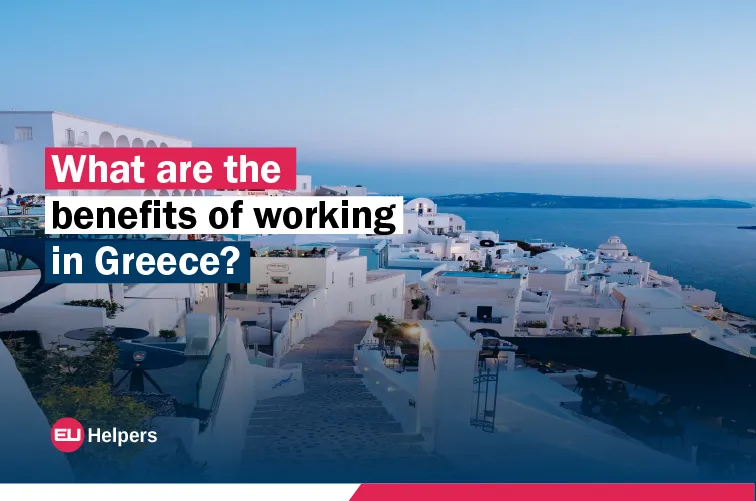

What Are the Benefits of Working in Greece? A Complete EU Helpers Guide
Greece, the historic Mediterranean nation at the crossroads of Europe, Asia, and Africa, has firmly established itself as an increasingly attractive and rapidly evolving work destination in the European Union for international professionals, IT and tech specialists, shipping and maritime experts, tourism and hospitality leaders, healthcare workers, finance and banking specialists, life sciences researchers, energy and renewables professionals, business consultants, digital nomads, founders, and entrepreneurs. As an EU and Schengen member state and a eurozone member, with one of the world's largest merchant fleets, a vibrant tourism industry, growing technology sector, exceptional cultural heritage, beautiful Mediterranean climate, and an attractive cost-to-quality-of-life ratio, Greece consistently ranks among the most desirable countries in Southern Europe to live and work. Cities like Athens, Thessaloniki, Patras, Heraklion, and the Greek islands host multinational companies, shipping companies, financial institutions, tourism leaders, technology hubs, research centers, and innovative start-ups that consistently recruit foreign talent. For applicants from Asia, Africa, Latin America, the Americas, and Europe, Greece offers structured immigration pathways, EU-aligned legal protections, and a clear long-term route toward EU long-term residence and eventually citizenship. At EU Helpers, candidates regularly ask which concrete benefits make Greece worth choosing as a work destination.
This complete EU Helpers guide explains the real, practical, and long-term benefits of working in Greece. Whether you are considering a salaried role under the residence permit for employment, an EU Blue Card position, a role in shipping and maritime, IT, tourism, healthcare, or finance, self-employment through Greek business structures, an investor route through the Golden Visa, a Digital Nomad Visa setup, the residence permit for financially independent persons, or a family-based residence, this article walks you through everything you need to know — from salaries, taxes, and tax provisions for foreign residents to lifestyle, healthcare, family options, and career growth. Keep in mind that immigration rules, salaries, and market conditions may vary by nationality, embassy, sponsor, employer, permit category, sector, region, and the latest official requirements, so EU Helpers always recommends confirming your eligibility and offer based on your personal profile before making any move.
Why Greece Is a Top Work Destination in Europe
Greece combines an attractive Mediterranean lifestyle, EU and Schengen access, eurozone integration, world-renowned shipping and tourism industries, exceptional cultural heritage, growing technology sector, and beautiful natural landscapes. For ambitious professionals seeking lifestyle-rich career opportunities in Europe, this combination is hard to match.
A Strategic Mediterranean Location
Greece's location at the crossroads of Europe, Asia, and Africa, with strong connections to the Balkans, the Eastern Mediterranean, and the Middle East, makes it a strategic base for international business spanning multiple regions. EU and Schengen membership combined with strong maritime infrastructure support exceptional career mobility.
A Diversified Economy With Globally Significant Sectors
Greece's economy combines globally significant shipping (with one of the world's largest merchant fleets), world-class tourism (one of the world's most visited destinations), a growing technology sector, traditional industries, energy and renewables, agriculture, and a recovering financial sector. International companies and Greek shipping giants support strong demand for skilled foreign professionals.
Exceptional Lifestyle and Quality of Life
Greece offers one of Europe's most attractive lifestyles, with mild Mediterranean climate, beautiful coastlines, more than 6,000 islands (about 200 inhabited), exceptional cuisine and wine, rich cultural heritage, and a relaxed pace of life. This is one of the country's most distinctive lifestyle advantages.
Strong Demand for Foreign Talent in Key Sectors
Greece actively recruits foreign talent through structured pathways such as the residence permit for employment, EU Blue Card, ICT permit, Golden Visa, Digital Nomad Visa, residence permit for financially independent persons, and self-employment routes. IT, shipping and maritime, tourism and hospitality, finance, healthcare, energy and renewables, and shortage occupations consistently feature in active recruitment.
Top Financial Benefits of Working in Greece
One of the biggest reasons professionals consider Greece is its favorable financial framework when combined with EU access, attractive tax provisions for foreign residents, and a significantly lower cost of living than most Western European countries.
Competitive Salaries in Key Sectors
Salaries in Greece are lower than in most Western European countries in absolute terms, but in top-paying sectors such as shipping and maritime, IT, finance, tourism leadership, life sciences, specialized healthcare, senior consulting, and renewable energy, compensation is significantly above the Greek average. Shipping roles in particular can command exceptionally high compensation by Greek standards.
Strong Purchasing Power Thanks to Lower Cost of Living
The cost of living in Greece is generally lower than in most Western European countries, particularly outside central Athens and the most popular tourist islands. This means that even moderate Greek salaries can offer a comfortable lifestyle, while higher-end sector salaries deliver strong purchasing power and excellent lifestyle quality.
Tax Provisions for Foreign Residents
Greece has introduced specific tax provisions for qualifying foreign residents and certain professional categories, including special tax regimes for foreign retirees, financial investors, qualifying professionals, and digital nomads. These provisions are designed to attract international talent and investment. Applicants should verify the current rules and conditions of available tax provisions directly with the Greek tax authorities.
Social Welfare Benefits
Beyond salary, Greece's social welfare system provides solid value, including public healthcare through the National Healthcare System (ESY), parental leave, unemployment insurance, pension contributions, and education access. These benefits are an integral part of the financial value of working in Greece.
Favorable Conditions for Remote Workers and Investors
For remote workers, founders, and investors based in Greece, the combination of EU and eurozone access, attractive tax provisions where applicable, moderate operating costs, and lower cost of living can deliver significant net advantages, provided the legal and tax setup is properly structured.
Lifestyle and Quality-of-Life Benefits
Beyond money, Greece offers a lifestyle that is genuinely world-renowned. Daily life is uniquely attractive for international professionals seeking a high-quality base in Europe with exceptional cultural, climatic, and culinary advantages.
Mediterranean Climate Year-Round
Greece enjoys a Mediterranean climate, with warm sunny summers and mild winters, particularly in the southern regions and islands. The country boasts more than 250 days of sunshine per year in many regions, supporting an outdoor lifestyle year-round.
Beautiful Mediterranean Coastline and Islands
Greece offers some of Europe's most beautiful coastlines, including the iconic Greek islands (Mykonos, Santorini, Crete, Rhodes, Corfu, and many more), Athens Riviera, Peloponnese coast, and Halkidiki. The country has more than 6,000 islands and exceptional beaches, supporting outdoor activities such as sailing, diving, swimming, hiking, and exploring historic regions.
Exceptional Cultural and Historic Heritage
Greece is the cradle of Western civilization, with deep cultural and historic heritage including UNESCO World Heritage sites (such as the Acropolis of Athens, Delphi, Olympia, Meteora, and many more), ancient ruins, Byzantine monuments, and a strong literary, philosophical, and artistic tradition that has shaped Western thought for millennia.
World-Renowned Cuisine and Wine
Greek cuisine, recognized by UNESCO as part of the Mediterranean diet (a cultural treasure), is internationally celebrated for its quality, freshness, and health benefits. The country's exceptional olive oil, wines (including Assyrtiko, Agiorgitiko, and other indigenous varieties), seafood, and traditional dishes are central to daily life.
Vibrant and Historic Cities
Athens, Greece's vibrant capital, combines ancient heritage with modern urban energy. Thessaloniki, the cosmopolitan northern city, offers a rich cultural scene. Patras, Heraklion (Crete), Rhodes, and other cities each offer distinctive experiences combining history, culture, and Mediterranean lifestyle.
Welcoming and Friendly Society
Greece is internationally recognized for its philoxenia (love of strangers), one of the country's most cherished cultural values. The Greek people are known for their warmth, hospitality, and openness to international visitors and residents, making integration significantly easier than in many other European countries.
Safety and Political Stability
Greece is consistently ranked among the safer countries in Europe, with relatively low crime rates and a peaceful society. This makes it particularly attractive for foreign professionals and families.
Strong Work-Life Balance
Greece values work-life balance, with a culture that prioritizes family time, leisure, social connections, and well-being. The Greek lifestyle emphasizes enjoying life, sharing long meals with family and friends, and appreciating cultural experiences and natural beauty.
English Widely Used in International Environments
Although Greek is the official language, English is widely used in IT, tech, shipping, tourism, multinational companies, finance, and international business environments, particularly in Athens, Thessaloniki, Piraeus, and tourist regions. This makes Greece accessible for foreign professionals.
Multicultural Community
Greece hosts a growing international population, particularly in Athens, Thessaloniki, and tourist regions, with foreign professionals and digital nomads from across Europe and beyond. This multicultural environment makes networking, friendships, and integration easier for international workers and their families.
Career Growth and Professional Opportunities
Greece's career environment is dynamic, welcoming, and rewarding for those who invest in their long-term development. The country offers diverse pathways for foreign professionals.
Strong Career Pathways in Growing Sectors
Shipping and maritime, IT and software development, tourism and hospitality, healthcare, banking and finance, energy and renewables, life sciences, real estate, logistics, marketing, legal services, education, and skilled trades all offer strong career pathways for foreign professionals. International experience, technical qualifications, and language skills are particularly valued.
Opportunities in Shipping, IT, and Innovation
For shipping, IT, and innovation-focused professionals, Greece offers exposure to globally leading shipping companies and a growing tech ecosystem in Athens and Thessaloniki. Senior shipping executives, maritime lawyers, software engineers, fintech specialists, product managers, and senior operators often build internationally relevant careers from a Greek base.
Opportunities for Entrepreneurs, Self-Employed, and Investors
Greece actively encourages foreign entrepreneurs through residence permits for self-employment and business activities, and through the Golden Visa for investors. Combined with Greece's EU access, growing economy, and Mediterranean lifestyle, this offers significant opportunities for serious founders, investors, and self-employed professionals.
Strong Foundation for International Mobility
As an EU and Schengen member state, eurozone member, and Mediterranean gateway with connections to the Balkans, the Eastern Mediterranean, and the Middle East, Greece is an excellent base for international careers. Long-term residents can access broader European opportunities.
Residency, Work Permit, and Legal Benefits
Working legally in Greece comes with structured immigration pathways and strong legal protections within the EU framework.
Structured Permit System Through Dedicated Schemes
Most foreign workers obtain a residence permit through dedicated schemes such as the residence permit for employment, EU Blue Card, ICT permit, residence permit for highly skilled employment, Golden Visa, Digital Nomad Visa, residence permit for financially independent persons (FIP), residence permit for self-employment and business activities, or family-based residence.
Residence Permit for Employment
Greece's residence permit for employment is the main pathway for non-EU workers in salaried roles with a Greek employer.
EU Blue Card and Highly Qualified Workers
Highly qualified third-country professionals with recognized higher education and a qualifying job offer above the salary threshold can apply through the EU Blue Card.
Greek Golden Visa
Greece's Golden Visa programme is one of Europe's most popular residence-by-investment schemes, offering residence permits to non-EU nationals who make qualifying investments in Greek real estate, businesses, or financial instruments under defined investment options.
Greek Digital Nomad Visa
Greece's Digital Nomad Visa allows non-EU remote workers to live in Greece while working remotely for foreign employers or clients.
Residence Permit for Financially Independent Persons (FIP)
Greece's residence permit for financially independent persons is dedicated to non-EU nationals with stable independent income who wish to live in Greece without engaging in local employment.
Residence Permit for Self-Employment and Business Activities
Greece offers residence permits for foreign nationals planning to operate as self-employed professionals or business owners.
Intra-Corporate Transferee (ICT) Permit
Multinational companies use the ICT permit to bring managers, specialists, and trainees from non-EU branches to Greek entities.
Family Reunification With Strong Provisions
Greece allows qualifying workers and residents to bring close family members, including spouses and dependent children, under family reunification rules.
Pathway to Long-Term Residency and Citizenship
After several continuous years of legal residence and work in Greece, foreign nationals may become eligible for permanent residence or EU long-term resident status, provided they meet integration, income, language, and legal requirements. Over a longer horizon, naturalization may also become possible under Greek nationality rules.
Healthcare, Education, and Social Benefits
Greece's public services provide solid support for workers and their families.
Public Healthcare Through the National Healthcare System (ESY)
Greece has a public healthcare system, the National Healthcare System (ESY). Once registered and employed in Greece, residents are typically integrated into the ESY under the applicable rules. Many residents also use private clinics, which often offer faster access and English-speaking staff in major cities.
Strong Educational System for Families
Greece offers a public educational system, alongside a growing network of private and international schools, including English-language and bilingual programs in Athens, Thessaloniki, and tourist regions. Higher education institutions, including the National and Kapodistrian University of Athens, Aristotle University of Thessaloniki, and other respected universities, offer programs in many subjects.
Social Protections for Workers
Registered workers benefit from contributions toward pensions, healthcare, unemployment insurance, parental leave, and other social protections through the Greek social security system (EFKA). These long-term benefits are an important part of the financial value of working in Greece.
Required Documents and Step-by-Step Overview of Working in Greece
While exact requirements depend on the specific permit and applicant profile, the general route to legally working in Greece follows a predictable structure. EU Helpers guides applicants through each step in detail.
Typical Documents Needed
Applicants usually need a valid passport, police clearance certificates, medical certificates where required, proof of qualifications and experience, a formal job offer or qualifying ground, employer or sponsor documentation, accommodation evidence, valid health insurance, and proof of financial means. Translations into Greek and apostille or legalization of foreign public documents are commonly required.
General Step-by-Step Process
The process typically starts with securing a job offer, internal assignment, business project, qualifying remote work, qualifying investment, qualifying passive income, or another qualifying ground. The applicant then applies for the appropriate visa at the Greek embassy or consulate, travels to Greece, and obtains the residence permit through the relevant Greek authorities.
Common Mistakes and Reasons for Delays or Refusals
Incomplete documents, missing translations or legalizations, unverified employer sponsorship, salary below thresholds, mismatched qualifications, weak business plans for self-employment applications, unclear remote work for Digital Nomad Visa applicants, weak investment documentation for Golden Visa applicants, and the wrong permit category being selected are common reasons for delays or refusals. Working with experienced advisors like EU Helpers helps minimize these risks.
Practical Tips for International Applicants
Moving to Greece is rewarding, but preparation makes the difference between a smooth transition and a stressful one.
Tips From EU Helpers for a Successful Move
Start by carefully evaluating which permit category fits your profile. Identify Greek employers experienced with hiring foreign workers in shipping, IT, tourism, healthcare, finance, and shortage occupations. For shipping roles, focus on Piraeus, one of the world's most important shipping centers. For Digital Nomad Visa applicants, organize your remote contracts and income evidence professionally. For Golden Visa applicants, work with experienced advisors to evaluate qualifying investment options. Strengthen your English fluency, which is widely used in international workplaces, and consider learning Greek for daily life and long-term integration. Plan housing carefully, particularly in central Athens and the popular tourist islands. Understand how your nationality, passport, country of residence, employer, embassy, and permit category may influence your timeline and documentation.
Final Guidance
Working in Greece offers a rare combination of EU and Schengen access, exceptional Mediterranean lifestyle, beautiful coastline and islands, mild climate, rich cultural heritage, welcoming society, world-class shipping industry, growing tech and tourism sectors, attractive tax provisions for foreign residents, and reasonable cost of living. For international professionals seeking a lifestyle-rich, welcoming, and rewarding base in Europe, Greece stands out as one of the most attractive destinations on the continent. However, the process is structured and detailed, and outcomes depend heavily on personal circumstances, employer sponsorship, nationality, sector, and the specific permit category chosen. That is exactly where expert guidance matters. EU Helpers supports international applicants at every stage — from evaluating eligibility and selecting the right permit route to preparing documents, comparing residence permit for employment, EU Blue Card, Golden Visa, Digital Nomad Visa, financially independent person permit, and other pathways, and planning a smooth relocation. If Greece is on your radar as a future work destination, EU Helpers can help you move forward with clarity, confidence, and the latest accurate information.
FAQs
Working in Greece offers exceptional Mediterranean lifestyle, mild climate, EU and Schengen membership, eurozone access, welcoming society, world-class shipping industry, growing tech and tourism sectors, attractive tax provisions for foreign residents, comprehensive social welfare, structured immigration pathways including the Golden Visa, Digital Nomad Visa, and financially independent person permit, and a clear long-term residence and citizenship outlook for foreign professionals.
The cost of living in Greece is generally lower than in most Western European countries, particularly outside central Athens and the most popular tourist islands. This means that even moderate Greek salaries can offer comfortable living, while higher salaries and foreign incomes often deliver strong purchasing power and savings potential.
Salaries in Greece are lower than in most Western European countries in absolute terms, but in top-paying sectors such as shipping and maritime, IT, finance, tourism leadership, life sciences, specialized healthcare, and senior consulting, compensation is competitive by Greek standards and especially attractive when combined with Greece's lower cost of living, mild climate, and exceptional lifestyle.
Greece has introduced specific tax provisions for qualifying foreign residents and certain professional categories, including special tax regimes for foreign retirees, financial investors, qualifying professionals, and digital nomads. These provisions are designed to attract international talent and investment. Applicants should verify the current rules and conditions of available tax provisions directly with the Greek tax authorities.
Yes. Greece is one of the world's most significant maritime powers, with Greek shipping companies controlling approximately 20% of the global merchant fleet by tonnage. Senior shipping executives, maritime lawyers, ship brokers, chartering managers, marine engineers, and naval architects are in particularly strong demand, especially in Piraeus.
Yes. Greece has emerged as a growing tech hub, with multinational companies like Microsoft, Pfizer, Cisco, and many others establishing significant operations in Athens and Thessaloniki. Software engineers, full-stack developers, DevOps specialists, cloud experts, data engineers, AI specialists, and cybersecurity professionals are in demand.
Greece's Golden Visa programme is one of Europe's most popular residence-by-investment schemes, offering residence permits to non-EU nationals who make qualifying investments in Greek real estate, businesses, or financial instruments under defined investment options.
Greece's Digital Nomad Visa allows non-EU remote workers to live in Greece while working remotely for foreign employers or clients. It does not require a Greek job offer but requires proof of qualifying remote work, sufficient income, accommodation, and valid health insurance.
Greece's residence permit for financially independent persons is dedicated to non-EU nationals with stable independent income (such as pensions, rental income, dividends, or other reliable income streams) who wish to live in Greece without engaging in local employment. It is particularly attractive for retirees and rentiers seeking a Mediterranean lifestyle.
Shipping and maritime, IT and software development, tourism and hospitality, healthcare, banking and finance, energy and renewables, life sciences, real estate, logistics, marketing, legal services, education, and skilled trades are among the strongest sectors for foreign professionals.
Yes. Greece is an EU member state, a Schengen Area member, and a eurozone member, which gives residents strong protections, EU-aligned legal frameworks, the right to travel within the Schengen Area, and the convenience of the euro.
Qualifying workers and residents can usually apply for family reunification for spouses and dependent children, subject to conditions regarding income, housing, and documentation.
After several continuous years of legal residence and work in Greece, foreign nationals may become eligible for permanent residence or EU long-term resident status, provided they meet integration, income, language, and legal requirements. Over a longer horizon, naturalization may also become possible under Greek nationality rules.
Greece has a public healthcare system, the National Healthcare System (ESY). Once registered and employed in Greece, residents are typically integrated into the ESY under the applicable rules. Many residents also use private clinics, which often offer faster access and English-speaking staff in major cities.
Greece enjoys a Mediterranean climate, with warm sunny summers and mild winters, particularly in the southern regions and islands. The country boasts more than 250 days of sunshine per year in many regions, supporting an outdoor lifestyle year-round.
Greek is the official language, but English is widely used in IT, tech, shipping, tourism, multinational companies, finance, and international business environments, particularly in Athens, Thessaloniki, Piraeus, and tourist regions. However, learning Greek helps significantly with daily life, integration, and long-term career growth. Some regulated professions, such as healthcare, require Greek language proficiency.
Yes. Greece welcomes foreign entrepreneurs through residence permits for self-employment and business activities, and through the Golden Visa for investors. Combined with Greece's EU access and growing economy, the country offers an attractive environment for serious applicants with credible projects.
Yes. Greece's international schools, language centers, and higher education institutions hire foreign teachers and academic staff, particularly for English, French, Spanish, German, and other languages, as well as for STEM and international curricula.
Common reasons include incomplete documentation, salary below thresholds, mismatched qualifications, weak business plans for self-employment applications, unclear remote work for Digital Nomad Visa applicants, weak investment documentation for Golden Visa applicants, and the wrong permit category. Proper preparation significantly reduces refusal risks.
EU Helpers supports international applicants with eligibility assessment, sector and salary insights, permit category selection, document preparation, employer and sponsor coordination, and clarity on the latest official requirements. The goal is to help you approach the Greek work and residency process with accurate, up-to-date, and practical information tailored to your career goals.