
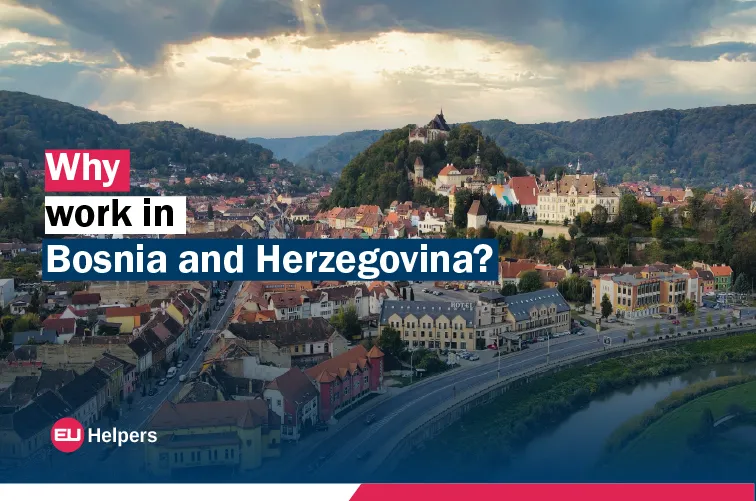

Why Work in Bosnia and Herzegovina? A Complete EU Helpers Guide for International Professionals
Bosnia and Herzegovina, the dynamic Southeast European nation in the heart of the Western Balkans bordering Croatia, Serbia, and Montenegro (with a small coastline on the Adriatic Sea at Neum), has been steadily emerging as one of Europe's most interesting emerging destinations for international professionals, IT and tech specialists, construction and infrastructure experts, tourism and hospitality professionals, founders, entrepreneurs, and lifestyle migrants seeking a combination of EU accession trajectory, rich cultural heritage, beautiful natural landscapes, and accessible cost of living. As an official European Union candidate country (granted candidate status in December 2022, with formal accession negotiations opened in March 2024), a Council of Europe member, and a country with a complex but functioning political structure following the 1995 Dayton Agreement (with two entities — the Federation of Bosnia and Herzegovina and Republika Srpska — plus the Brčko District), Bosnia offers a uniquely interesting combination of characteristics for international professionals. The capital Sarajevo (the vibrant historic capital with its famous Baščaršija Ottoman-era old town and unique position as a meeting point of Eastern and Western cultures — sometimes called the "Jerusalem of Europe" for its religious diversity), along with Banja Luka (the administrative center of Republika Srpska), Mostar (with the iconic UNESCO-listed Old Bridge), Trebinje (a charming Herzegovinian town and growing wine destination), Tuzla, Zenica, and Bihać, host businesses across various sectors. For applicants from anywhere considering Bosnia and Herzegovina, the country offers structured immigration pathways and a relatively accessible entry point to the broader Western Balkans context. At EU Helpers, candidates regularly ask the fundamental question: why should I consider Bosnia and Herzegovina specifically?
This complete EU Helpers guide answers that question in depth and walks you through the genuine, practical, and long-term reasons that make Bosnia and Herzegovina one of Europe's most interesting emerging destinations. Whether you are considering a salaried role under the standard work permit, self-employment routes, investor routes, family-based residence, or other pathways, this article walks you through everything you need to know — from low cost of living and rich cultural heritage to EU accession dynamics, beautiful natural landscapes, warm hospitality, and emerging opportunities.
Why Bosnia and Herzegovina Is Genuinely Worth Considering
Bosnia and Herzegovina occupies an unusual position in Europe — emerging but with distinctive characteristics, beautiful but still relatively undiscovered by mass tourism, affordable but offering genuine quality of life, and gradually modernizing as it pursues EU accession.
EU Accession Progress
Bosnia is an official EU candidate country with formal accession negotiations opened in March 2024. The country's EU integration trajectory is gradually transforming its economy and broader institutional environment.
Strategic Western Balkans Location
Bosnia's location at the heart of the Western Balkans provides access to the broader regional context, with Croatia (EU member) to the north, Serbia to the east, and Montenegro to the southeast.
Rich Cultural Heritage
Bosnia has an extraordinarily rich cultural heritage spanning Ottoman, Austro-Hungarian, Yugoslav, and modern Bosnian influences. The country is one of Europe's most religiously and culturally diverse, with Muslim, Orthodox Christian, Catholic Christian, and Jewish heritage all visible particularly in Sarajevo.
Genuinely Low Cost of Living
Bosnia has one of the lowest costs of living in Europe, with affordable housing, food, services, and transportation. This provides remarkable purchasing power for those earning competitive salaries or international incomes.
Beautiful and Varied Natural Landscapes
Bosnia offers stunning natural beauty including the Sutjeska National Park (home to one of Europe's last remaining primeval forests, Perućica), the Bjelašnica and Jahorina mountains (which hosted 1984 Winter Olympics events), the Neretva River canyon, the Una and Drina rivers, and many other natural treasures.
Warm Hospitality
Bosnians are known for their warm hospitality and welcoming attitude toward foreigners.
Top Financial Reasons to Consider Bosnia and Herzegovina
The financial rationale for working or residing in Bosnia centers around exceptional cost of living advantages and emerging opportunities.
Exceptionally Low Cost of Living
Bosnia has one of the lowest costs of living in Europe, with housing, food, dining, services, transportation, and entertainment all significantly less expensive than in Western European countries.
Growing Salary Levels in Key Sectors
While Bosnian salaries are generally lower than EU averages, they have been gradually rising and are competitive for the region, particularly in IT, senior professional roles, and international companies.
Favorable for International Income Earners
For digital nomads, remote workers, and others earning international incomes, Bosnia's combination of accessible arrangements and very low cost of living creates value.
Strong Wages in International Companies and IT
International companies operating in Bosnia, IT outsourcing operations, and growing Bosnian businesses serving international markets typically offer competitive compensation packages.
Convertible Mark Currency
Bosnia uses the convertible mark (BAM) which is pegged to the euro, providing currency stability.
Lifestyle and Quality-of-Life Benefits
Beyond financial considerations, Bosnia offers a lifestyle that appeals to those who value distinctive culture, natural beauty, warm hospitality, and emerging opportunity.
Sarajevo's Distinctive Character
Sarajevo, Bosnia's vibrant capital, is one of Europe's most distinctive cities, featuring the famous Baščaršija Ottoman-era old town, the historic Latin Bridge (where Franz Ferdinand was assassinated in 1914, triggering World War I), the City Hall (Vijećnica), the Sarajevo Cathedral, the Gazi Husrev-beg Mosque, the historic Old Synagogue, the Tunnel of Hope (from the 1990s siege), Sarajevo Film Festival, and a unique cultural atmosphere combining Eastern and Western influences.
Other Distinctive Cities
Mostar, famous for the iconic UNESCO-listed Old Bridge (Stari Most) crossing the Neretva River, with traditional Ottoman-era old town and beautiful Herzegovinian setting. Banja Luka, the modern administrative center of Republika Srpska with green parks and the Vrbas River. Trebinje, a charming Herzegovinian town with growing wine production and the impressive Tvrdoš Monastery nearby. Each Bosnian city offers distinctive character.
Rich Historical Heritage with UNESCO Sites
Bosnia has UNESCO World Heritage Sites including the Old Bridge Area of Mostar (Stari Most and the surrounding old town), the Mehmed Paša Sokolović Bridge in Višegrad, and the Stećci Medieval Tombstones Graveyards (medieval tombstones unique to Bosnia and surrounding regions).
Beautiful Natural Landscapes and National Parks
Beyond cities, Bosnia offers spectacular natural beauty including Sutjeska National Park (home to Perućica, one of Europe's last primeval forests), Una National Park (with the famous Strbacki Buk waterfalls), Kozara National Park, the Bjelašnica and Jahorina mountains (skiing destinations), the Neretva River canyon, and Vrelo Bune (the source of the Buna River in Blagaj, with a beautiful Dervish monastery built into the cliffs).
Distinctive Bosnian Cuisine
Bosnian cuisine combines Ottoman, Mediterranean, Central European, and broader Balkan influences with distinctive specialties including ćevapi (grilled minced meat), burek (savory pastries), sarma (stuffed cabbage rolls), bosanski lonac (Bosnian pot stew), excellent Bosnian coffee (served with rahat lokum), traditional bread, and emerging wine production particularly in Herzegovina.
Wine Tradition in Herzegovina
Herzegovina has a notable wine tradition, particularly around Trebinje, Mostar, and Čitluk, with distinctive Žilavka (white) and Blatina (red) grape varieties. Wine tourism is growing.
Continental and Mediterranean Climate
Bosnia has varied climate — continental in the north (Bosnia proper) with cold winters and warm summers, Mediterranean influences in Herzegovina (the south) with mild winters and hot summers, and alpine conditions in mountain areas.
Generally Safe
Bosnia has overall low crime rates and is generally safe for foreign residents.
Growing International Community
Bosnia's growing IT sector, increasing foreign investment, and emerging international visibility have created growing international communities, particularly in Sarajevo and Banja Luka.
Affordable Lifestyle Possibilities
Bosnia makes lifestyle options accessible that would be expensive elsewhere — apartments in Sarajevo, country properties in beautiful regions, dining at quality restaurants, and a generally relaxed quality of life are all genuinely affordable.
Career Growth and Professional Opportunities
Bosnia's career environment is emerging and offers opportunities particularly in growing sectors.
Opportunities in Growing IT Sector
For IT professionals, Bosnia's growing IT sector — supported by educated IT workforce, lower cost structure, and IT outsourcing to international clients — offers expanding opportunities.
Opportunities in Construction and Infrastructure
Bosnia's significant infrastructure development program, including the ongoing Corridor Vc highway project, creates substantial construction and engineering opportunities.
Opportunities in Tourism
Bosnia's growing tourism sector, particularly around Sarajevo, Mostar, Trebinje, and natural areas, creates hospitality and tourism opportunities.
Opportunities for Entrepreneurs
Bosnia offers accessible routes for entrepreneurs and self-employed professionals, with relatively low business establishment costs.
Limited but Distinctive Opportunity Set
Bosnia's job market remains smaller than larger European countries and concentrated in specific sectors. Bosnia is often more attractive for IT professionals, digital nomads, entrepreneurs, and lifestyle migrants than for those seeking conventional salaried employment.
Residency, Work Permit, and Legal Benefits
Working or residing legally in Bosnia comes with structured immigration pathways.
Structured Permit System
Bosnia offers structured immigration pathways including the standard work permit for salaried employees (issued by the relevant entity employment service), the temporary residence permit (privremeni boravak) for various purposes, the permanent residence permit, self-employment routes, investor routes, family reunification provisions, and researcher routes.
Family Reunification
Bosnia allows qualifying residents to bring close family members.
Pathway to Long-Term Residency
After several continuous years of legal residence in Bosnia, foreign nationals may become eligible for permanent residence.
EU Accession Dynamics
Bosnia's ongoing EU accession progress may eventually lead to EU membership (timeline uncertain), which would transform the country's status.
Healthcare, Education, and Social Benefits
Bosnian public services are developing as part of the country's broader modernization.
Healthcare System
Bosnia has a healthcare system providing coverage for residents, with both public and private healthcare options.
Educational System
Bosnia offers a public educational system, with international schools available in Sarajevo and other major cities providing English-language and international curricula for foreign families.
Social Protections
Registered workers benefit from contributions toward pensions, healthcare, and other social protections through the relevant Bosnian social security systems.
Practical Considerations for Working or Residing in Bosnia
While Bosnia offers compelling benefits, applicants should also understand some practical considerations.
Complex Political Structure
Bosnia's complex political structure (Federation of Bosnia and Herzegovina, Republika Srpska, and Brčko District under the overall state) can create administrative complexity.
Emerging Economy
Bosnia remains an emerging economy with different infrastructure standards and business norms compared to Western European countries.
Language Considerations
Bosnian, Croatian, and Serbian are official languages (mutually intelligible Slavic languages). Cyrillic and Latin scripts are both used officially. English is increasingly used in business, especially in IT and tourism.
Bureaucratic Considerations
Bosnian bureaucracy can sometimes be challenging compared to Western European countries, though this is gradually improving as part of EU accession reforms.
Infrastructure Variability
Infrastructure quality varies across Bosnia, with Sarajevo and major cities having generally good infrastructure while some rural areas may have less developed infrastructure.
Historical Context
Bosnia's complex 20th century history, including the 1992-1995 war that significantly affected the country, remains relevant context that foreign residents should understand.
Required Documents and Step-by-Step Overview of Working in Bosnia
While exact requirements depend on the specific route, the general approach involves several key elements.
Typical Documents Needed
Applicants usually need a valid passport, police clearance certificates, medical certificates where required, proof of qualifications and experience, a formal job offer or qualifying ground, employer documentation, accommodation evidence, valid health insurance, and proof of financial means. Translations into Bosnian, Croatian, or Serbian (depending on entity) and apostille or legalization of foreign public documents are commonly required.
General Step-by-Step Process
The process typically starts with securing a qualifying ground (job offer, business plan, investment, family relationship, or other route), preparing documentation, submitting applications through the appropriate Bosnian authorities, and receiving the relevant permits.
Practical Tips for International Applicants Considering Bosnia
Considering Bosnia is rewarding, but realistic preparation makes the difference.
Tips From EU Helpers for Considering Bosnia
Carefully evaluate which route best matches your profile. For employment routes, identify Bosnian employers in IT, construction, tourism, and growing sectors. For self-employment, prepare credible business plans. Take advantage of Bosnia's exceptional cost of living. Plan housing carefully — Sarajevo, Banja Luka, and other cities offer different lifestyle options at very affordable prices. Strengthen your Bosnian/Croatian/Serbian language skills for daily life. Verify current Bosnian regulations as the country's framework continues to evolve. Be aware of the complex political structure when navigating which entity authority handles your case. Always rely on the latest official guidance from Bosnian authorities.
Final Guidance
Why work in Bosnia and Herzegovina? Because few European destinations offer such a unique mix of exceptionally low cost of living (one of Europe's lowest), rich cultural heritage spanning Ottoman, Austro-Hungarian, Yugoslav, and modern Bosnian influences, distinctive religious and cultural diversity (with Muslim, Orthodox Christian, Catholic Christian, and Jewish heritage), beautiful natural landscapes (including Sutjeska National Park, the Neretva River, the Bjelašnica and Jahorina mountains), warm Bosnian hospitality, distinctive Bosnian cuisine and growing wine tradition (particularly in Herzegovina), EU candidate status with ongoing accession progress, accessible immigration pathways, growing IT and tourism opportunities, UNESCO sites including the iconic Mostar Old Bridge, and an unmatched value proposition for those willing to engage with an emerging European destination. For international professionals seeking accessible European entry, IT professionals seeking growing tech sector opportunities, digital nomads seeking affordable lifestyle, lifestyle migrants drawn to Bosnia's distinctive culture and natural beauty, or those interested in the Western Balkans region, Bosnia stands out as one of Europe's most genuinely interesting emerging destinations. However, the process and outcomes depend heavily on personal circumstances, sector, and chosen route, and Bosnia's emerging character means realistic expectations and adaptability are important. EU Helpers supports international applicants at every stage. If Bosnia and Herzegovina is on your radar as a future destination, EU Helpers can help you move forward with clarity, confidence, and the latest accurate information.
FAQs
Bosnia offers a unique combination of exceptionally low cost of living, rich cultural heritage spanning Ottoman, Austro-Hungarian, Yugoslav, and modern Bosnian influences, distinctive religious and cultural diversity, beautiful natural landscapes, warm Bosnian hospitality, distinctive cuisine, EU candidate status, accessible immigration pathways, growing opportunities, UNESCO sites, and an unmatched value proposition for those willing to engage with an emerging European destination.
Bosnia has one of the lowest costs of living in Europe, with housing, food, dining, services, transportation, and entertainment all significantly less expensive than in Western European countries.
No. Bosnia and Herzegovina is not currently a member of the European Union, but it is an official EU candidate country (granted candidate status in December 2022, with formal accession negotiations opened in March 2024). Bosnia is also a Council of Europe member.
No. Bosnia and Herzegovina is not a member of the Schengen Area, though it has visa-free arrangements with many countries and is progressing toward EU integration.
Bosnia and Herzegovina uses the convertible mark (BAM) as its currency, which is pegged to the euro.
Sarajevo is one of Europe's most distinctive cities, featuring the famous Baščaršija Ottoman-era old town, the historic Latin Bridge (where Franz Ferdinand was assassinated in 1914), unique religious diversity (sometimes called the "Jerusalem of Europe" for its Muslim, Orthodox Christian, Catholic Christian, and Jewish heritage), the Tunnel of Hope (from the 1990s siege), Sarajevo Film Festival, and a unique cultural atmosphere combining Eastern and Western influences.
Mostar is famous for the iconic UNESCO-listed Old Bridge (Stari Most) crossing the Neretva River. The city is one of Bosnia's most important tourist destinations with its beautiful Ottoman-era old town and Herzegovinian setting.
Bosnian, Croatian, and Serbian are the three official languages (mutually intelligible Slavic languages). Cyrillic and Latin scripts are both used officially. English is increasingly used in business and tourism.
Yes. Bosnia has overall low crime rates and is generally safe for foreign residents.
Bosnia has varied climate — continental in the north (Bosnia proper) with cold winters and warm summers, Mediterranean influences in Herzegovina (the south) with mild winters and hot summers, and alpine conditions in mountain areas.
Yes, particularly in IT (a growing sector with international outsourcing activity), construction (driven by infrastructure development), tourism (growing destination), international companies, and specialized professional services. Bosnia is often more attractive for IT professionals, digital nomads, and entrepreneurs than for those seeking conventional salaried employment.
Bosnia has UNESCO World Heritage Sites including the Old Bridge Area of Mostar (Stari Most), the Mehmed Paša Sokolović Bridge in Višegrad, and the Stećci Medieval Tombstones Graveyards.
Yes. Bosnia's tourism sector is growing, particularly around Sarajevo (cultural and historical tourism), Mostar (UNESCO Old Bridge), Trebinje (wine tourism), natural areas (Sutjeska National Park, Una National Park, mountain destinations), and adventure tourism.
Yes. Family members of Bosnian citizens or qualifying foreign residents may obtain residence permits through family reunification provisions.
After several continuous years of legal residence in Bosnia, foreign nationals may become eligible for permanent residence. Bosnian citizenship by naturalization typically requires additional qualifying residence and meeting specific requirements.
Bosnia and Herzegovina has a complex political structure following the 1995 Dayton Agreement, with two entities — the Federation of Bosnia and Herzegovina and Republika Srpska — plus the Brčko District, all operating under the overall state of Bosnia and Herzegovina.
Bosnian cuisine combines Ottoman, Mediterranean, Central European, and broader Balkan influences with distinctive specialties including ćevapi (grilled minced meat), burek (savory pastries), sarma (stuffed cabbage rolls), excellent Bosnian coffee, and traditional bread.
Yes. Herzegovina has a notable wine tradition, particularly around Trebinje, Mostar, and Čitluk, with distinctive Žilavka (white) and Blatina (red) grape varieties. Wine tourism is growing.
EU Helpers supports international applicants with eligibility assessment, route selection, document preparation, employer or business coordination, and clarity on the latest official requirements. The goal is to help you approach the Bosnian residence and work process with accurate, practical, and up-to-date information tailored to your specific profile.